HR Time Management Audit: A 2026 Guide for HR Teams

An HR time management audit is a structured review of how employee time gets recorded, tracked, and managed across your organization. It answers two questions: are the hours accurate and legal, and are they going to the right work?
Skip the review and you're running on guesswork. Labor misallocation quietly drains profitability, and wage errors compound until a complaint or a Department of Labor inquiry finds them for you. Tools like UKG, AttendanceBot, and Kloqk each support a different stage of the process, but the process itself matters more than the software.
What is an HR time management audit?
An HR time management audit is a structured evaluation of your time tracking systems, employee scheduling practices, break policies, and wage compliance records. The industry more commonly calls this a workforce time audit or HR time audit, but the underlying process is the same regardless of the label you use.
Two distinct audit types often get confused, and mixing them up wastes everyone’s time. A payroll-focused time audit checks whether hours recorded match hours paid, targeting wage accuracy and legal compliance. A time management audit goes further, examining whether those hours are spent on the right work in the first place. Separating these two goals before you start prevents scope creep and produces cleaner findings.
The core components of a complete HR time management audit include:
- Time tracking accuracy: Are clock-in and clock-out records complete and unedited?
- Wage and hour compliance: Do records align with FLSA overtime rules and state-specific break laws?
- Break policy adherence: Are meal and rest breaks documented consistently across all shifts?
- Employee classification: Are workers correctly classified as exempt or non-exempt?
- AI usage policies: In 2026, AI policy adherence is a required audit component for any team using AI-assisted workflows.
Nothing in federal law prescribes an audit, so the HR time management audit requirements are the ones you set. What the law does require is the record underneath it: accurate daily and weekly hours for every nonexempt employee, preserved for the retention window. An audit is how you find out whether that record is true before somebody else checks.
Write your own HR time management audit rules down and keep them stable across cycles: scope, review period, who runs it, who sees the findings, and what happens to a confirmed error. Stable rules make two audits comparable, and comparison is where a pattern becomes visible. An HR time management audit for employees should be visible to them as well, because a review nobody explains reads like an investigation, while a review that is explained reads like a paycheck guarantee.
Defining your audit scope before you collect a single data point is the single most important setup decision you will make.
How to conduct an HR time management audit effectively
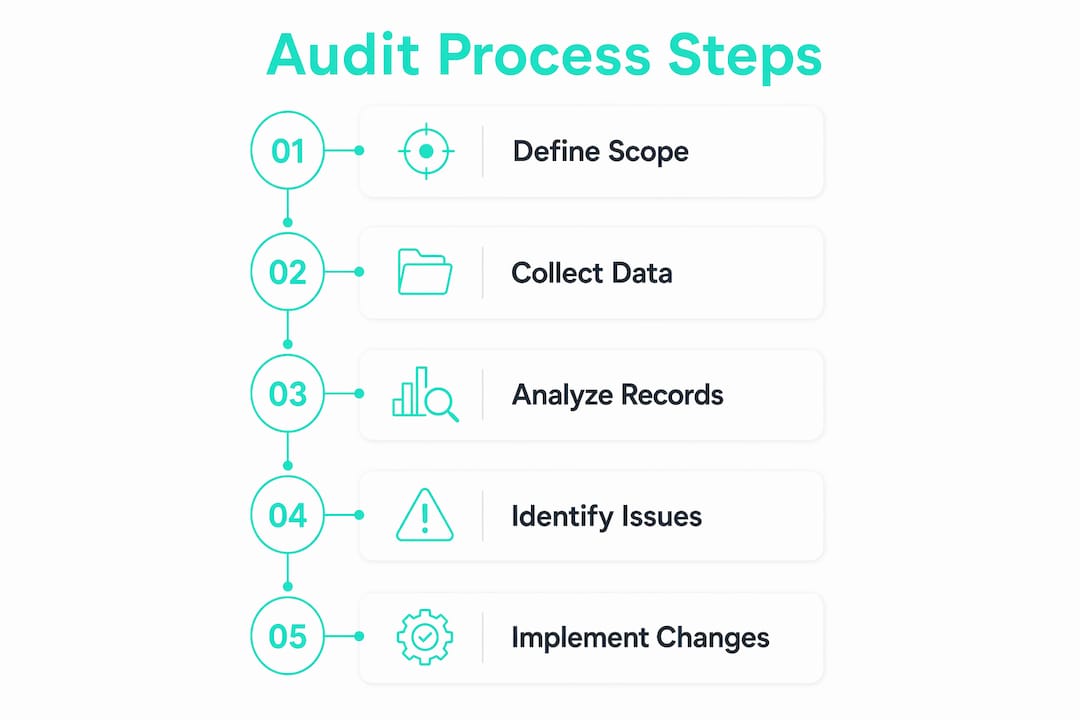
How to conduct time audits without turning them into a project: follow four phases, planning, data gathering, analysis, and reporting. Skipping any phase produces incomplete findings that HR teams and business owners cannot act on.
- Plan the audit scope. Decide whether you are auditing payroll accuracy, operational efficiency, or both. Identify which departments, job roles, or locations are in scope. Set a review period, typically two to four weeks of time records.
- Gather data systematically. Pull time records from your tracking system, whether that is UKG, a manual log, or a free tool like Kloqk. Track activities in 30-minute increments over a standard five-day workweek to surface where hours actually go.
- Analyze for exceptions. Look for missed punches, manager-authorized time edits, off-the-clock work patterns, and inconsistent break records. These gaps are where wage disputes originate.
- Document and report findings. Every finding needs a written note explaining what the data showed, what policy it may violate, and what corrective action is recommended.
Audit frequency matters as much as audit quality. Daily quick checks, weekly reviews before payroll runs, and quarterly deep dives form the most effective schedule. Yearly comprehensive audits, ideally aligned with your fiscal year-end, prevent payroll errors from accumulating into legal risks.
Pro Tip: Build a simple HR audit checklist that covers time tracking accuracy, break compliance, and classification status. Review it weekly before payroll closes, not after a complaint arrives.
HR time tracking best practices that make the audit shorter
Most audit pain is capture pain. If the underlying record is clean, the review is arithmetic. If it is not, the review turns into archaeology. Five HR time tracking best practices do most of the work.
- Capture at the moment, not at the end of the week. Punches taken live beat hours reconstructed on Friday every single time. That is the difference between a time and attendance record and a memory exercise.
- Record breaks as punches. An auto-deducted meal you cannot prove happened is the most common finding in any time and attendance review.
- Keep absence management in the same place as the punches. When approved leave, unpaid absence, and worked hours live in three systems, the audit burns its first hour just lining them up.
- Log every edit with a reason. "Forgot to clock out, confirmed with shift lead" costs eight seconds and answers a question two years early.
- Settle the definitions in writing. Workweek start day, rounding policy (off is safest), and how many hours is full time at your company. Audits find the gap between policy and practice, and the gap shrinks when the policy actually exists.
Attendance tracking is the piece small employers most often leave manual. Mechanical time clocks stamp a card and stop there, and a clipboard by the door records intent rather than fact. So how do small businesses track attendance in a way that survives a review? The same way they track hours: one timestamped record per event, out of one system. Our guide to time and attendance systems compares the options.
What are the benefits of HR audits focused on time?
The measurable impact of a well-run audit goes well beyond catching a few missed punches.
“Audits are often misperceived as reactive compliance tasks instead of proactive tools revealing inefficiencies and growth opportunities.” (Group Management Services)
Professionals spend up to 53% of their workday on low-value administrative tasks. That number means more than half of your labor budget may be funding work that does not move the business forward. An audit makes that waste visible so you can redirect it.
The strategic benefits of regular HR time management audits include:
- Reduced legal exposure: Audits catch wage and hour violations before they become Department of Labor complaints or class-action lawsuits.
- Workflow optimization: Hidden operational bottlenecks like redundant approval chains and outdated manual processes show up clearly in time data.
- Burnout prevention: When audits reveal that certain roles consistently log excessive hours, managers can redistribute workload before employees hit a wall.
- Payroll accuracy: Employees trust a paycheck more when they know the hours behind it were verified, not estimated.
- Strategic alignment: Audits show whether HR activities match company priorities, which is the foundation of any credible workforce performance review.
The compliance benefit alone justifies the effort. Even with digital time tracking in place, off-the-clock work and unauthorized time edits create wage disputes that cost far more to resolve than to prevent.
How to choose HR time management tools to support audits
The right HR time management tool does not just record hours. It creates an audit trail that holds up under scrutiny. There is no HR time management audit software category as such, which is worth knowing before you search for one. What you are buying is a time clock, a broader workforce management platform, or something between them, and the audit quality follows directly from that choice.

Look for these features when evaluating software:
| Feature | Why it matters for audits |
|---|---|
| Automated time capture | Removes manual entry errors that distort audit data |
| Exception alerts | Flags missed punches and overtime thresholds in real time |
| Audit trail logs | Records every edit with a timestamp and user ID |
| GPS geofencing | Confirms employees clock in from approved locations |
| Payroll export | Transfers verified hours directly to payroll without re-entry |
| AI policy tracking | Documents AI tool usage for 2026 compliance audits |
UKG offers deep enterprise-level audit reporting and integrates with most large HR systems. AttendanceBot works well for Slack-based teams that need lightweight time tracking without a dedicated app. Kloqk targets small businesses directly, offering photo verification at clock-in and payroll-ready time exports at no cost, with GPS geofencing on the Premium plan at $59 per location. For a restaurant with 20 employees or a construction crew spread across job sites, Kloqk eliminates the manual reconciliation that makes audits painful.
The three tiers matter more than the brand names. Basic time and attendance systems capture punches and export them. A cloud based time and attendance system adds approvals, exception reports, and multi-location views. Workforce management software layers on forecasting and labor budgets that a 20-person business will open once and never again. The sweet spot for most small employers is an HR time management audit system you can actually run every week: a clean punch record plus an exception report, nothing heavier.
For small businesses with limited HR staff, the priority is simplicity and data integrity. A tool that auto-generates exception reports saves hours of manual review every week. Integration with your payroll provider, whether that is Gusto, ADP, or QuickBooks, removes the re-entry step that introduces errors.
Pro Tip: Before selecting any time tracking tool, run a two-week pilot with one department. Audit that department’s data manually and compare it to the software output. Gaps in that comparison tell you exactly what the tool misses.
Tracking work goals alongside time data also strengthens audit outcomes. When you can connect hours logged to specific deliverables, you get a clearer picture of productivity, not just presence. Tools like AccomplishMint support year-end accomplishment tracking that pairs well with time audit findings.
Common challenges in HR time management audits and how to avoid them
Most audits fail not because of bad data, but because of avoidable process mistakes.
- Incomplete records: If employees forget to clock out or managers edit time without documentation, the audit data is unreliable before analysis even begins. Build a policy requiring written justification for any time record change.
- Scope confusion: Mixing payroll accuracy goals with operational efficiency goals in a single audit produces findings that satisfy neither objective. Define the audit type before you start collecting data.
- Employee resistance: Workers often interpret an audit as surveillance rather than support. Communicate the purpose clearly: the audit protects their pay accuracy and workload fairness, not just the company’s compliance record.
- Ignoring AI policy gaps: In 2026, any team using AI tools for scheduling, reporting, or communication needs a documented policy on how those tools are used. An audit that skips this area misses a growing source of legal and operational risk.
- Inconsistent cadence: A single annual audit catches problems too late. Consistent daily, weekly, and quarterly reviews reduce compliance risk and improve the quality of data you have to work with.
The gap between written policy and actual practice is where most wage disputes originate. Your audit checklist should always include a side-by-side comparison of what your employee handbook says and what your time records actually show.
How long does an HR time management audit for small business teams take?
For a business with 10 to 30 employees, plan on four to six working hours for your first audit, spread across a week. That estimate assumes your time records are digital. If you're pulling hours from paper sheets or text messages, double it, and treat that pain as finding number one.
Here's a realistic first-audit schedule:
- Hour 1: Export the last two full pay periods from your time tracking system, the payroll reports for the same dates, and your written break and overtime policies.
- Hours 2 and 3: Line up recorded hours against paid hours, employee by employee. Flag every edit, every missed punch, and every shift where a required meal break doesn't appear. Anything that pushes a week past 40 hours is a time and a half question, not just an hours question.
- Hour 4: Check classifications. Confirm each salaried employee actually meets an FLSA exemption test instead of assuming the job title settles it.
- Hours 5 and 6: Write up findings, assign one owner and one deadline to each corrective action, and put the next review date on the calendar.
The second audit runs faster, usually in half the time, because the data problems you fixed after round one stay fixed. Once exception alerts and a weekly pre-payroll review are in place, the quarterly deep dive becomes a two-hour job instead of a project.
A free HR time management audit is the normal case, not a promotion: run it internally and the only cost is the hours above. The findings tend to pay for those hours quickly. The best HR time management audit is simply the one you repeat, so pick a cadence you can keep rather than the one that sounds most thorough. One uncaught misclassification, or a pattern of skipped meal breaks in a state like California, can cost more in back wages and penalties than a year of weekly reviews.
One warning on scope: resist the urge to audit everything at once. Two pay periods of complete, carefully reviewed data will tell you more than six months of records skimmed in a hurry.
Key takeaways
An HR time management audit is the most direct way to align labor costs with business outcomes while staying compliant with wage and hour law.
| Point | Details |
|---|---|
| Define audit type first | Separate payroll accuracy audits from operational efficiency audits to avoid scope confusion. |
| Use a tiered review schedule | Daily checks, weekly payroll reviews, and quarterly deep dives reduce compliance risk consistently. |
| Audits reveal hidden waste | Up to 53% of workday hours may go to low-value tasks that audits make visible and correctable. |
| Tool selection drives data quality | Choose software with exception alerts, audit trails, and GPS verification to produce reliable records. |
| AI policies are now required | Any 2026 audit must assess how AI tools are used and whether usage aligns with documented policy. |
Why I think most businesses are auditing the wrong thing
Most HR teams I have seen treat time audits as a payroll cleanup exercise. They run the numbers before a quarterly close, fix the obvious errors, and call it done. That approach solves the compliance minimum but misses the strategic value entirely.
The real power of a time management audit is what it tells you about organizational design. When you see that a department manager spends 40% of her week in status meetings, that is not a scheduling problem. That is a structural problem, and no payroll system will surface it unless someone is looking for it.
The shift to remote and hybrid work made this worse. Without physical presence as a proxy for productivity, managers defaulted to meeting volume as a signal of engagement. Audits that track time by activity category, not just total hours, expose that pattern quickly. Data-driven auditing replaces that guesswork with evidence.
AI usage is the next blind spot. Teams are using AI tools to draft reports, summarize meetings, and generate schedules, but almost no one is auditing whether that usage aligns with company policy or produces the time savings it promises. That gap will become a liability faster than most HR teams expect.
My honest recommendation: treat your next time audit as a diagnostic tool, not a compliance checkbox. Ask what the data reveals about how work actually gets done, and you will find more value in one audit cycle than in years of anecdotal management.
Saad
How Kloqk makes HR time audits easier for small businesses
Running a clean time audit requires clean data, and that starts with a time tracking system built for accuracy from the first clock-in.
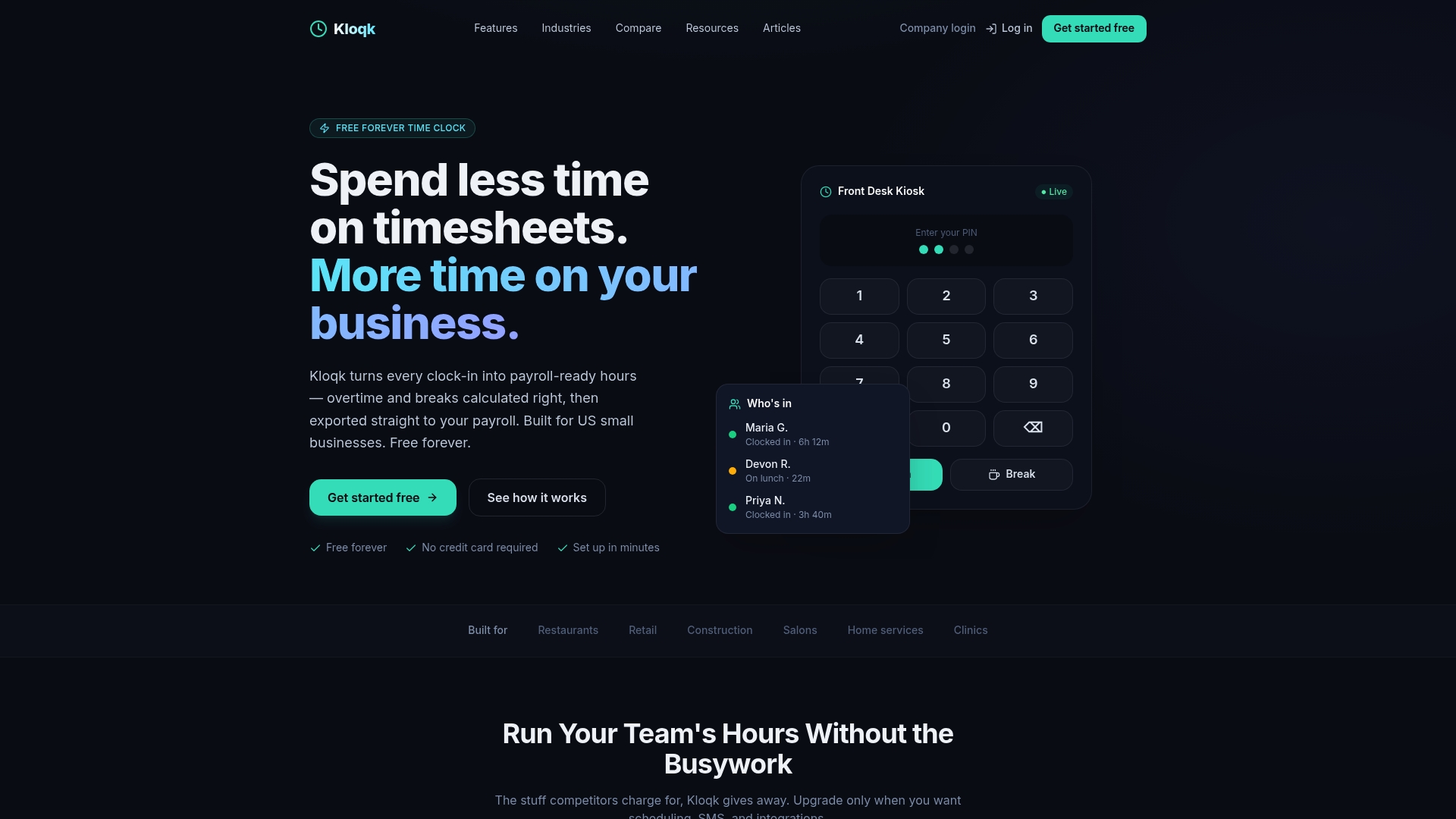
Kloqk gives small business owners and HR teams the tools to capture verified time records, flag exceptions automatically, and export payroll-ready data without manual reconciliation. GPS geofencing confirms employees are on-site when they clock in. Photo verification at clock-in prevents buddy punching. Every edit to a time record is logged with a timestamp, creating the audit trail your records need. Kloqk’s free time clock software is built specifically for small businesses in restaurants, construction, and field services where audit-ready records matter most and budget is tight.
Recommended
Frequently Asked Questions
What is the difference between a time audit and a time management audit?
A time audit checks whether hours recorded match hours paid, focusing on payroll accuracy. A time management audit examines whether those hours are spent on productive, goal-aligned work.
How often should an HR time management audit be conducted?
The most effective schedule combines daily quick checks, weekly reviews before payroll closes, and quarterly or annual deep-dive audits for full compliance review.
What should an HR audit checklist include for time management?
A solid checklist covers time tracking accuracy, break policy compliance, employee classification status, manager edit logs, off-the-clock work patterns, and AI tool usage policies.
Can small businesses conduct HR time management audits without dedicated HR staff?
Yes. Free tools like Kloqk automate exception flagging and generate audit-ready reports, reducing the manual work required to run a reliable time audit without a full HR team.
Why do HR time management audits matter for compliance in 2026?
Audits now must include AI policy adherence reviews alongside traditional wage and hour checks, since unmonitored AI tool usage creates both operational and legal exposure for employers.
Sources
Every figure on this page traces to one of these. Primary law and government sources are listed first.
Written by
Priya NairPeople Operations Writer
Priya focuses on HR and hiring for small teams, onboarding, scheduling people fairly, and the day-to-day of managing hourly staff without an HR department.
Keep Reading
Track Hours the Easy Way
Kloqk is a free time clock that handles punches, breaks, overtime, and payroll-ready reports.
Start free