Benefits of Automated Clock-In Systems for Small Business

Automated clock-in systems are software tools that capture employee work hours instantly and accurately, eliminating manual entry errors and turning raw attendance data into payroll-ready records. The benefits of automated clock-in systems go well beyond convenience. For small business owners in restaurants, construction, retail, and similar sectors, these systems prevent costly payroll mistakes, stop time theft, and create the audit trails required by federal and state labor law. Payroll corrections drop by up to 43% when businesses switch from manual timesheets to electronic tracking. That single number represents real money and real hours saved every pay period.
1. How automated clock-in systems improve payroll accuracy
Manual timesheets invite errors. Employees round up hours, managers misread handwriting, and spreadsheet formulas break. Automated attendance solutions remove every one of those failure points by recording clock-ins and clock-outs to the second.
The direct payroll benefit is significant. Electronic time tracking reduces payroll corrections by up to 43% compared to manual methods. Fewer corrections mean fewer disputes, fewer overpayments, and less time your bookkeeper spends fixing last week’s run.
Automated systems also handle the math that trips up manual processes:
- Overtime calculations based on daily or weekly thresholds
- Shift premiums for nights, weekends, or holidays
- Break deductions applied consistently across all employees
- Pay period totals exported directly to payroll software
Systems calculate wages, overtime, and shift premiums automatically every payroll period without manual intervention. That consistency is what makes payroll predictable instead of stressful.
Pro Tip: Connect your clock-in system directly to your payroll software before your first live pay run. Testing the export with one week of data catches formatting mismatches before they affect employee paychecks.

If you want a deeper look at what manual timesheets actually cost, the breakdown of payroll errors from manual timesheets is worth reading before your next pay cycle.
2. Preventing time theft and enforcing accountability
Time theft costs small businesses more than most owners realize. The most common form is buddy punching, where one employee clocks in on behalf of a coworker who has not arrived yet. A construction crew of 15 people can lose thousands of dollars a month to this practice alone.
Biometric authentication and GPS geofencing prevent buddy punching by tying every clock-in to a specific person at a specific location. The system cannot be fooled by a borrowed phone or a friendly coworker. Photo verification adds another layer: the system captures an image at clock-in, so managers can spot anomalies at a glance.
Key accountability features in modern automated attendance solutions include:
- GPS geofencing that restricts clock-ins to authorized job sites
- Photo verification captured at the moment of clock-in
- Device linking that allows only registered phones or tablets
- Real-time alerts when an employee clocks in outside a designated zone
Mobile GPS and device linking restrict clock-ins to on-site and authorized devices, which closes the loopholes that manual systems leave wide open. One construction company reported saving over $700,000 in its first year after adopting automated tracking. That figure reflects both recovered labor costs and reduced administrative overhead.
Kloqk’s GPS time clock with geofencing and buddy punching prevention tools are built specifically for field teams and multi-site operations where manual oversight is not practical.
3. Legal compliance and audit readiness
Labor law compliance is not optional, and the penalties for poor recordkeeping are real. The Fair Labor Standards Act requires employers to maintain accurate records of hours worked and wages paid. State laws often add break requirements, overtime thresholds, and mandatory rest periods on top of federal rules.
Automated clock-in systems handle compliance in three concrete ways:
- They track breaks, overtime, and total hours worked against legal thresholds automatically.
- They generate timestamped, immutable records that cannot be altered after the fact.
- They send real-time alerts when an employee approaches an overtime limit or misses a required break.
Automated systems record time to the second and maintain records for statutory retention periods. That matters enormously if you face a wage claim or a Department of Labor audit. A paper timesheet signed in pencil does not hold up the same way a timestamped digital record does.
Audit trail features are as vital as the clock-in mechanism itself. Businesses must maintain timestamped, immutable records for statutory retention to manage tribunal risk effectively. Without that trail, a single disputed paycheck can become a costly legal process.
Pro Tip: Check your state’s specific recordkeeping requirements before choosing a system. Some states require three years of wage records; others require more. Your clock-in system should match or exceed that retention window.
4. Reducing admin work and empowering employees
Every hour your manager spends reconciling timesheets is an hour not spent on the floor, on the job site, or with customers. Automated attendance solutions cut that administrative load significantly.
Employee self-service portals reduce routine HR queries by up to 70%. When employees can check their own hours, request time off, and view their schedules without calling the office, your HR workload drops fast. That reduction frees your team to focus on work that actually moves the business forward.
The operational gains extend beyond HR queries. Real-time dashboards replace static spreadsheets and give managers live visibility into attendance, labor costs, and scheduling gaps.
| Operational benefit | What it replaces |
|---|---|
| Automated timesheet totals | Manual addition and spreadsheet formulas |
| Self-service hour lookup | Employee calls and manager searches |
| Real-time labor cost view | End-of-week payroll estimates |
| Overtime alerts | Reactive schedule adjustments |
Real-time dashboards replace static, outdated spreadsheets for workforce insights. A restaurant owner who can see labor costs by the hour can make staffing decisions before overtime accumulates, not after the payroll report arrives.
The role of employee self-clock-in systems also extends to morale. When workers can verify their own hours at any time, they trust the pay process more. That trust reduces the low-level friction that quietly damages team culture over time.
5. ROI timeline and the case for switching now
Automated time and attendance systems deliver measurable ROI within roughly 6 months by eliminating manual admin hours and preventing overpayments. For a small business owner, six months is a short payback window for a system that then runs indefinitely.
The ROI comes from multiple directions at once. Payroll errors drop. Time theft stops. HR queries fall. Scheduling improves. Each of those gains compounds over time, which is why the efficiency of clock-in systems tends to grow the longer a business uses them.
Cloud-based systems add another layer of value. The case for cloud-based time tracking is particularly strong for businesses with multiple locations or remote teams, where centralized data access removes the need for physical timesheet collection.
The advantages of time tracking also show up in unexpected places. Managers who can see attendance patterns over weeks and months can identify chronic lateness, predict busy periods, and schedule more accurately. That kind of data-driven scheduling was once available only to large enterprises with dedicated HR software.
6. Choosing the right system for your small business
Not every automated attendance solution fits every business. A restaurant with 20 employees has different needs than a construction company managing crews across three job sites. The right system matches your workflow, not the other way around.
Key features to evaluate before committing to a system:
- Mobile clock-in with GPS geofencing for field teams and multi-site operations
- Photo verification to confirm identity at clock-in without biometric hardware
- Payroll software integration that exports hours in a format your payroll provider accepts
- Break and overtime tracking built into the system, not added as a paid upgrade
- Audit trail and record retention that meets your state’s labor law requirements
- Employee self-service access so workers can view hours and request changes without manager involvement
Geofencing ensures employees can only clock in at authorized locations, which is non-negotiable for any business with off-site workers. A system without geofencing is essentially an honor system with a digital interface.
Implementation matters as much as feature selection. Roll out the system to one team or location first. Collect feedback, fix friction points, and then expand. Employees who understand why the system exists and how to use it adopt it faster and with less resistance.
Pro Tip: For job site deployments, the mobile clock-in setup guide walks through the practical steps of configuring geofencing and training field crews.
Key takeaways
Automated clock-in systems deliver their strongest value when they combine payroll accuracy, time theft prevention, compliance recordkeeping, and employee self-service into a single tool that runs without daily manual input.
| Point | Details |
|---|---|
| Payroll accuracy | Electronic tracking reduces payroll corrections by up to 43% compared to manual methods. |
| Time theft prevention | GPS geofencing and photo verification stop buddy punching and offsite clock-ins. |
| Compliance protection | Immutable, timestamped records satisfy federal and state labor law audit requirements. |
| Admin reduction | Self-service portals cut routine HR queries by up to 70%, freeing managers for real work. |
| ROI timeline | Most businesses see measurable returns within approximately 6 months of adoption. |
Why transparency is the benefit nobody talks about
The conversation around automated clock-in systems almost always centers on cost savings and error reduction. Those benefits are real, and they matter. But the benefit I find most underrated is what happens to team culture when attendance records become objective and visible to everyone.
I have seen small business owners deal with the same dispute repeatedly: an employee insists they worked a full shift, the manager’s memory says otherwise, and there is no clean record to settle it. That kind of friction does not show up on a payroll report. It shows up in turnover, in resentment, and in the quiet erosion of trust between workers and management.
Objective, transparent attendance records reduce disputes and increase morale. When every employee knows their hours are recorded to the second and accessible at any time, the argument disappears before it starts. The system becomes the neutral party, and that neutrality is worth more than most owners expect.
The ROI calculation for automated attendance solutions usually stops at payroll savings. The real number includes the disputes that never happen, the turnover that does not occur, and the management time that goes back into running the business instead of mediating timesheet arguments. Those are harder to quantify, but they are just as real.
Saad
Kloqk gives small businesses free automated time tracking
Small business owners should not have to pay for the features that make time tracking actually work. Kloqk provides GPS geofencing, photo verification, overtime calculations, break tracking, and payroll exports at no cost, with no per-seat fees.
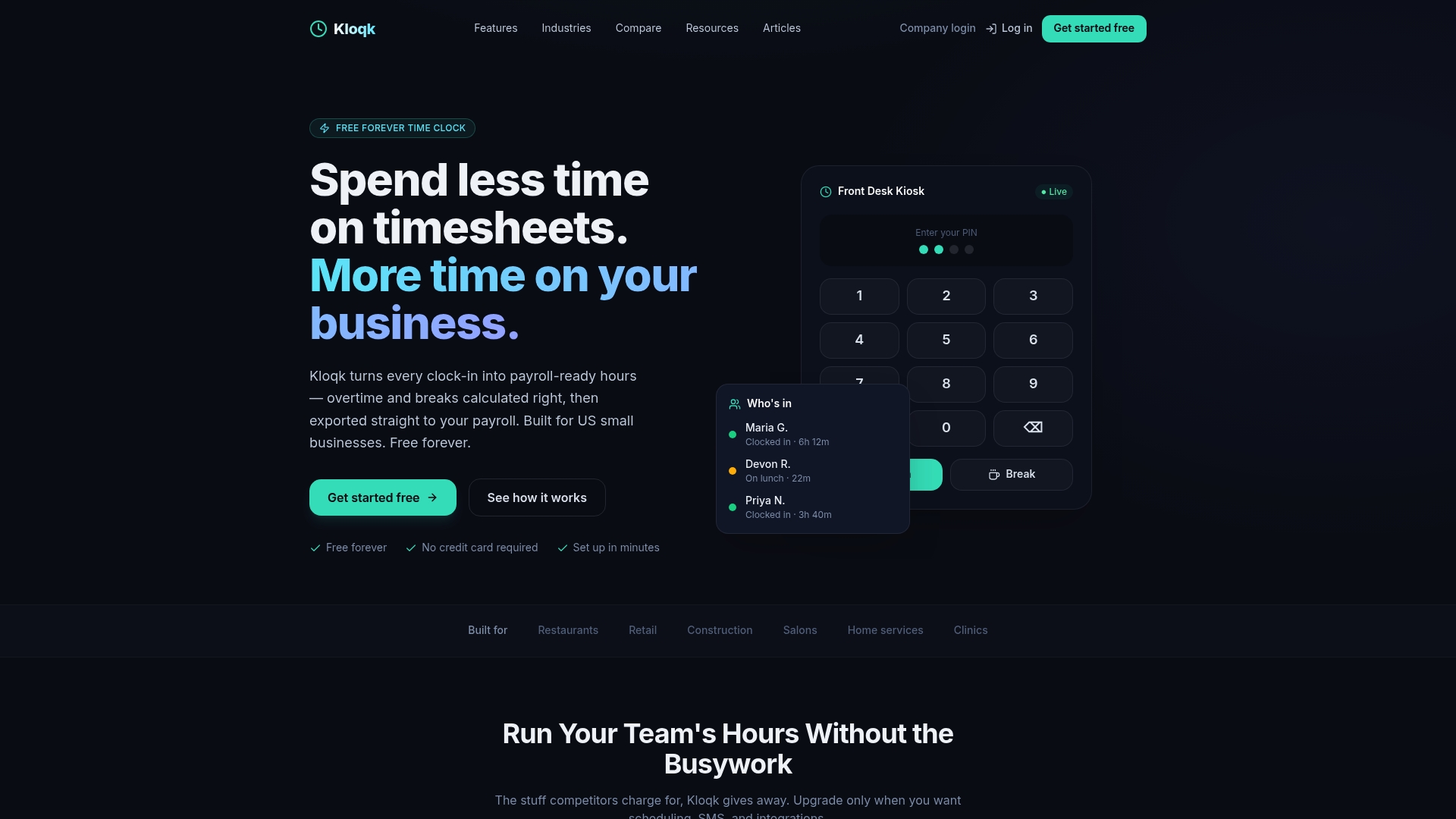
Kloqk’s free employee time tracking app turns clock-ins into payroll-ready hours without manual entry or expensive add-ons. The time and attendance tools include self-service access for employees and real-time dashboards for managers, built specifically for the way small businesses actually operate. Whether you run a restaurant, a construction crew, or a retail team, Kloqk handles the tracking so you can focus on the work.
FAQ
What are the main benefits of automated clock-in systems?
Automated clock-in systems improve payroll accuracy, prevent time theft, create compliance audit trails, and reduce administrative work. Electronic tracking reduces payroll corrections by up to 43% compared to manual methods.
How does GPS geofencing prevent time theft?
GPS geofencing restricts clock-ins to authorized locations, so employees cannot clock in from home, a vehicle, or any location outside the designated job site. This closes the loophole that buddy punching and offsite clock-ins exploit.
Are automated clock-in systems required for labor law compliance?
Federal law under the Fair Labor Standards Act requires accurate records of hours worked and wages paid. Automated systems generate timestamped, immutable records that satisfy those requirements and protect businesses during audits or wage claims.
How quickly do small businesses see a return on investment?
Most businesses see measurable ROI within approximately 6 months of adopting an automated time and attendance system, primarily through reduced payroll errors and eliminated manual admin hours.
Can employees access their own time records?
Yes. Self-service portals let employees view their hours, check schedules, and request changes without contacting a manager. This feature alone reduces routine HR queries by up to 70%.
Recommended
Sources
Every figure on this page traces to one of these. Primary law and government sources are listed first.
Written by
Marcus ReyesPayroll & Timekeeping Specialist
Marcus covers payroll accuracy, timesheets, and time tracking, the unglamorous mechanics that keep paychecks correct and audits painless.
Keep Reading
Track Hours the Easy Way
Kloqk is a free time clock that handles punches, breaks, overtime, and payroll-ready reports.
Start free