How Employee Hours Get Miscalculated: A Manager's Guide

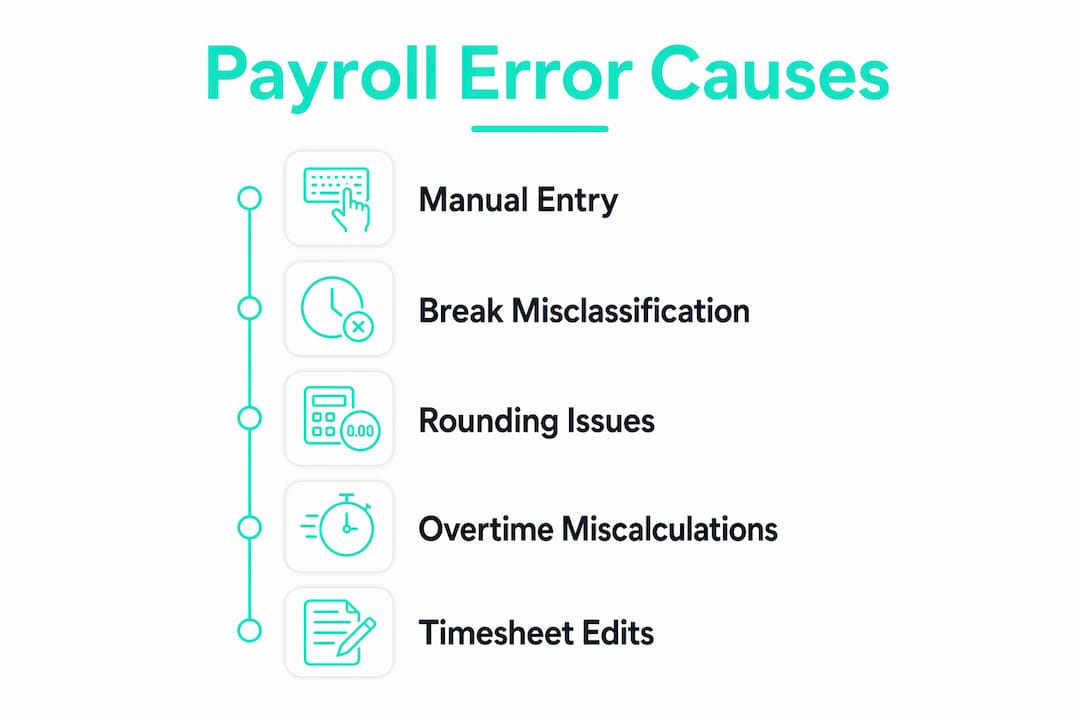
Miscalculated employee hours occur when inaccurate data, flawed tracking methods, or misunderstood payroll rules produce wrong wage totals. This is formally called a payroll calculation error, and it affects businesses of every size. How employee hours get miscalculated often comes down to three root causes: manual entry mistakes, break time misclassification, and overtime rule misunderstandings. Each one creates real financial and legal exposure. Restaurants, construction firms, and retail operations are especially vulnerable because their workforces clock in and out multiple times per shift, multiplying every opportunity for error.
What are the most common errors leading to miscalculated employee hours?
Manual data entry is the leading cause of payroll errors, including typos and transposed numbers. A single digit entered wrong on a timesheet can shift an employee’s hours by a full day. When you multiply that across a team of 20 people over 52 pay periods, the cumulative damage is significant.
Break time misclassification is the second most common source of common employee hour errors. Federal law under the Fair Labor Standards Act (FLSA) requires employers to pay for short rest breaks of 20 minutes or less, while bona fide meal periods of 30 minutes or more are unpaid. Mixing paid short breaks and unpaid meal periods consistently leads to errors. A manager who codes a 20-minute break as unpaid just shaved compensable time off an employee’s paycheck.
Rounding is a subtler problem. Many businesses round clock-in and clock-out times to the nearest 15 minutes. That practice sounds neutral, but systematic rounding can cause employees to lose over 20 hours of paid time annually. Twenty hours of lost pay per employee is not a rounding error. It is a wage theft liability.
- Typos and transposed numbers on paper or spreadsheet timesheets create immediate calculation errors.
- Break misclassification confuses compensable rest breaks with non-compensable meal periods.
- Aggressive rounding systematically shaves minutes that add up to hours over a year.
- Overtime misclassification fails to flag hours that cross the 40-hour weekly threshold.
- Spreadsheet formula errors produce wrong totals that look correct at a glance.
Pro Tip: Audit one pay period per quarter by manually recalculating five random employee timesheets. If you find discrepancies in more than one, your process has a systemic problem, not a one-off mistake.
How do payroll rules affect employee hour calculations?
The distinction between a workweek and a pay period trips up more managers than almost any other payroll rule. Overtime under the FLSA is calculated on a workweek basis, defined as any fixed, recurring period of 168 hours. A biweekly pay period covers two workweeks. You cannot average hours across both weeks to avoid overtime. If an employee works 50 hours in week one and 30 hours in week two, you owe 10 hours of overtime for week one, regardless of the two-week total.

The “regular rate of pay” is where overtime calculations get expensive. Overtime must include nondiscretionary bonuses, commissions, and shift differentials in the base rate before you apply the 1.5x multiplier. Many managers calculate overtime on the base hourly wage alone. That approach underpays overtime and creates legal risk.
| Calculation Factor | Common Mistake | Correct Approach |
|---|---|---|
| Overtime threshold | Averaging hours across a pay period | Calculate per workweek, not pay period |
| Regular rate of pay | Using base wage only | Include bonuses, differentials, and commissions |
| Break time | Treating all breaks as unpaid | Pay for breaks 20 minutes or shorter |
| Rounding | Always rounding down | Round neutrally or use exact times |
| Overtime rate | Applying 1.5x to base wage | Apply 1.5x to the full regular rate |
Scheduling decisions also drive hour miscalculations. A manager who approves a last-minute shift swap without checking weekly totals may not realize an employee just crossed 40 hours until payroll runs. By then, the overtime is already owed. Payroll software effectiveness depends on accurate scheduling and validated clock-in data. The software calculates correctly only when the inputs are correct.
Why do manual and software-based tracking methods still cause errors?
Paper timesheets and spreadsheets share the same fatal flaw: they rely entirely on human accuracy at every step. An employee writes down 8:00 AM when they actually clocked in at 8:14 AM. A manager approves it without checking. Payroll processes it. Nobody catches it until the employee disputes a paycheck three months later. Manual and paper-based tracking systems cause significant financial losses annually because errors compound quietly before anyone notices.
Payroll software does not solve this problem on its own. The software calculates correctly based on what it receives. If the input data is wrong, the output is wrong. Payroll software cannot fix inaccurate upstream data such as poor scheduling or unvalidated clock-ins. Garbage in, garbage out is not a cliché here. It is the exact mechanism behind most payroll disputes.
Proxy punching, where one employee clocks in for another, is a specific employee clock-in issue that inflates hours without any calculation error at all. The math is correct. The data is fraudulent. Without photo verification or GPS geofencing, there is no way to catch it from a spreadsheet.
- No audit trail means timesheet edits cannot be traced, verified, or defended during a labor audit.
- Unvalidated clock-ins allow employees to record times they were not physically present.
- Manual rounding introduces systematic bias that favors the employer and creates wage liability.
- Retroactive edits made by managers without employee confirmation are a leading source of overtime disputes.
Timesheet edits without documented reason codes and employee confirmation compromise audit trails. A well-intentioned correction made by a manager with no record of why it was made looks identical to a fraudulent edit during a Department of Labor audit.
Pro Tip: Any time a manager edits a timesheet, require a written reason and a digital confirmation from the employee. This single practice eliminates the majority of payroll disputes before they escalate.
What are practical strategies to prevent miscalculated employee hours?
Preventing hour miscalculations requires fixing the process at the point where data enters the system. Downstream corrections are expensive and slow. Upstream accuracy is fast and cheap.
-
Switch to automated clock-in validation. Use a system that captures the exact time of each clock-in and clock-out with no manual rounding. Real-time validation catches missed punches immediately rather than at payroll run.
-
Enforce GPS geofencing for field workers. Construction crews, landscapers, and delivery drivers cannot clock in from a location they are not at. GPS geofencing blocks remote or fraudulent clock-ins at the source.
-
Train managers on FLSA break rules. Compensable vs. non-compensable break classification is not intuitive. A one-hour training session per year eliminates a recurring source of errors.
-
Set overtime alerts before the threshold. Configure your time tracking system to flag employees approaching 38 or 39 hours mid-week. A schedule adjustment at that point costs nothing. Paying unplanned overtime costs more.
-
Require documented edits with employee sign-off. Every timesheet change needs a reason code and employee acknowledgment. This protects both the business and the employee.
-
Run a weekly payroll pre-audit. Compare scheduled hours against clocked hours before payroll processes. Discrepancies caught on Thursday cost nothing to fix. Discrepancies caught after payroll runs cost time, money, and trust.
-
Standardize your workweek definition. Pick a fixed start day and time for your FLSA workweek and never change it without a formal policy update. Inconsistent workweek definitions are a common source of overtime miscalculations.
Pro Tip: Export your payroll data to a spreadsheet once per quarter and sort by total hours per employee. Any outlier, high or low, deserves a second look. Patterns of consistent overtime from one employee or one location often signal a scheduling problem, not a workload problem.
Key Takeaways
Payroll hour miscalculations are almost always preventable. They stem from manual entry errors, break misclassification, rounding practices, and overtime rule misunderstandings, and each one has a direct fix.
| Point | Details |
|---|---|
| Manual entry is the top cause | Typos and transposed numbers in timesheets drive the majority of payroll errors. |
| Break rules are frequently misapplied | Breaks under 20 minutes are compensable under FLSA; treating them as unpaid creates wage liability. |
| Rounding creates real losses | Systematic rounding can cost employees over 20 hours of pay per year and expose employers to wage theft claims. |
| Overtime math is more complex than it looks | The regular rate of pay must include bonuses and shift differentials before applying the 1.5x multiplier. |
| Audit trails are non-negotiable | Timesheet edits without documented reasons and employee confirmation are indefensible during labor audits. |
The real reason payroll errors keep happening
I have watched businesses invest in payroll software and still run into the same disputes every quarter. The technology was not the problem. The process feeding the technology was.
The most persistent payroll errors I see are not calculation errors. They are trust errors. A manager edits a timesheet without telling the employee. The employee notices a discrepancy on their paycheck. They do not know if it was a mistake or intentional. That uncertainty is where disputes are born. Payroll disputes typically revolve around trust issues with manual time edits and lack of transparency, not just math.
The businesses that handle payroll well share one habit: they treat the time record as a document that belongs to both the employer and the employee. Any change to it requires both parties to acknowledge it. That sounds slow. In practice, it takes 30 seconds and prevents hours of dispute resolution.
Technology helps, but it does not replace managerial accountability. A GPS-verified clock-in system still needs a manager who checks the reports. An automated overtime alert still needs someone to act on it. The tools reduce the margin for error. The manager eliminates it.
Small errors do not stay small. A 15-minute rounding discrepancy per shift, across 10 employees, over a year, becomes a five-figure wage liability. The math is not dramatic. The outcome is.
Saad
How Kloqk helps you stop hour miscalculations at the source

Kloqk is a free employee time tracking solution built specifically for small U.S. businesses in sectors like restaurants, construction, and retail. Every clock-in is validated in real time with photo verification and GPS geofencing, which eliminates proxy punching and unvalidated entries before they reach payroll. Break tracking and overtime calculations are built in at no cost, and the system exports clean, payroll-ready data that removes the manual entry step entirely. For businesses managing field teams, Kloqk’s GPS time clock locks clock-ins to verified job site locations. The result is accurate hours, cleaner exports, and fewer disputes.
FAQ
What causes employee hours to be miscalculated most often?
Manual data entry errors are the leading cause, including typos and transposed numbers on timesheets. Break misclassification and aggressive rounding are the next most common sources.
Can payroll software prevent all hour miscalculations?
No. Payroll software depends on accurate upstream data including validated clock-ins and correct scheduling. Software calculates correctly only when the inputs are correct.
How does rounding affect employee pay?
Systematic rounding to the nearest 15 minutes can cause employees to lose over 20 hours of paid time per year. That loss creates wage theft liability for the employer under the FLSA.
What is the regular rate of pay for overtime?
The regular rate of pay includes the base hourly wage plus nondiscretionary bonuses, commissions, and shift differentials. Overtime must be calculated at 1.5x this full rate, not just the base wage.
Why do timesheet edits cause payroll disputes?
Timesheet edits without documented reasons and employee confirmation look identical to fraudulent changes during a labor audit. Undocumented edits also erode employee trust, which is where most overtime disputes actually begin.
Recommended
Sources
Every figure on this page traces to one of these. Primary law and government sources are listed first.
Written by
Marcus ReyesPayroll & Timekeeping Specialist
Marcus covers payroll accuracy, timesheets, and time tracking, the unglamorous mechanics that keep paychecks correct and audits painless.
Keep Reading
Track Hours the Easy Way
Kloqk is a free time clock that handles punches, breaks, overtime, and payroll-ready reports.
Start free