How to Identify Overtime Manipulation in Staff

Overtime manipulation is the deliberate inflation or falsification of work hours to collect pay for time that was never worked. Catching it takes three things: audited time records, cross-referenced data sources, and an eye for behavioral red flags.
The formal term is payroll fraud, and overtime schemes sit squarely inside that category. Payroll fraud schemes account for 15% of total fraud cases in North America, which means a real share of payroll losses at small and medium businesses traces back to hours nobody worked.
What is overtime, and when does it legally start?
You cannot spot manipulation without the baseline being manipulated, so define overtime first. Under the FLSA, overtime is time a nonexempt employee works past 40 hours in a workweek, paid at not less than one and one-half times the regular rate (29 USC 207). That is the entire federal overtime definition. No daily trigger, no weekend rule, no special rate for nights.
What is overtime pay, and how is overtime calculated?
Multiply the regular rate by 1.5 and apply it to every hour past 40. Calculating overtime gets harder only when a bonus or a second pay rate lands in the same week, because the regular rate has to absorb both before the multiplier runs, and that is where honest payroll overtime errors cluster rather than fraudulent ones. Our overtime calculator will calculate overtime from a week of punches, and our guide to how much is overtime pay walks the arithmetic.
Where state rules change the threshold
The FLSA overtime rule is a weekly one. Several states add a daily one on top, and California is the strictest. CA overtime law starts daily overtime after 8 hours and double time after 12, so the legal overtime threshold there can trigger on a Tuesday inside a 34-hour week. Daily overtime California requires is also the rule employees most often misread in their own favor, and the CA overtime rules are what break a single national policy for anyone running crews in two states. Our state overtime law guide lists the thresholds state by state.
Is overtime taxable?
Yes. Overtime is wages and gets withheld like any other wages. Employees sometimes hear "no taxes on overtime" and assume it changes what belongs on the timesheet. It changes neither the hours math nor your obligation to pay the premium, because it is a tax filing question rather than a payroll one. Our guide to when no tax on overtime starts covers the timing.
How to identify overtime manipulation in staff: tools and data sources
The most reliable way to monitor employee hours and detect overtime fraud is to stop relying on a single data source. A timesheet alone tells you what an employee claims. It does not tell you what actually happened.
Manual vs. automated time tracking
Manual timesheets give employees full control over what they record. That control creates opportunity. Automated systems like GPS time clocks and photo verification tools remove that opportunity by tying clock-ins to a physical location and a verified identity. Kloqk, for example, uses GPS geofencing and photo capture at clock-in to confirm that the right person is on-site before a shift is recorded. That combination makes it significantly harder to log hours that were never worked.

Cross-referencing independent data sources
Cross-referencing timesheets with at least three independent data sources is the standard for confirming whether reported hours match actual presence. Those sources include keycard access logs, network login timestamps, and project management outputs. Each source answers a different question. Keycard logs confirm physical entry and exit. Network logins confirm computer activity. Project outputs confirm whether work was actually produced. When all three align with the timesheet, the record is credible. When they diverge, you have grounds for a closer look.
Audit trails and AI-powered detection
Every time record system should log who modified an entry and when. Unchecked supervisor authority to edit timesheets near payroll deadlines is one of the most direct paths to manipulation. Audit trails close that gap by making every edit visible and attributable. Beyond audit trails, AI-powered payroll fraud detection tools now analyze patterns across large datasets and flag anomalies like overtime spikes near payroll cutoffs or late-night entries from unusual IP addresses. These tools do not replace human judgment, but they surface patterns that a manual review would miss.
| Data source | Detection value | Key limitation |
|---|---|---|
| GPS time clock | Confirms physical location at clock-in | Does not verify continuous presence |
| Keycard access logs | Records entry and exit times | Can be shared or bypassed |
| Network login timestamps | Shows active computer use | Remote workers may log in from home |
| Project management outputs | Links hours to deliverables | Requires consistent task logging |
| Payroll audit trails | Tracks all edits to time records | Only as useful as the review process |
Pro Tip: Kloqk’s remote employee time tracking combines GPS location data with photo verification, giving you two independent data points at every clock-in without adding administrative work.
Overtime abuse signs: which patterns signal manipulation?
Patterns reveal manipulation. Isolated incidents are often explainable. Repeated, consistent anomalies are not.
Watch for these specific red flags in your time records:
- Overtime just below approval thresholds. Overtime claims clustered just under the limit that triggers manager review suggest deliberate calibration, not coincidence.
- Precise clock times. Legitimate shift endings vary. When an employee clocks out at exactly 5:00 PM or exactly 8:00 PM every single day, that precision points to manual entry rather than an actual clock-out.
- Overtime during slow periods. A spike in claimed hours during a week with low customer volume or minimal project activity deserves scrutiny. The hours and the workload should move together.
- No corresponding output. If an employee logs four hours of overtime but produces nothing traceable in your project management system, that gap is a red flag.
- Gaps between GPS data and reported hours. When a GPS record shows an employee left the job site at 3:30 PM but the timesheet records a 5:00 PM clock-out, the discrepancy is measurable evidence. One Massachusetts investigation found one employee claimed nearly 1,700 overtime hours in a single year, with investigators confirming workers clocked out hours after leaving their worksites.
- Perfect roster matching. When every member of a team records identical overtime hours week after week, that uniformity suggests coordination rather than organic workload variation.
Pro Tip: Pay attention to how an employee responds when you ask a neutral question about their timesheet. Defensiveness or evasion in response to a simple clarifying question is itself a behavioral signal worth noting.
How to audit and verify overtime claims step by step
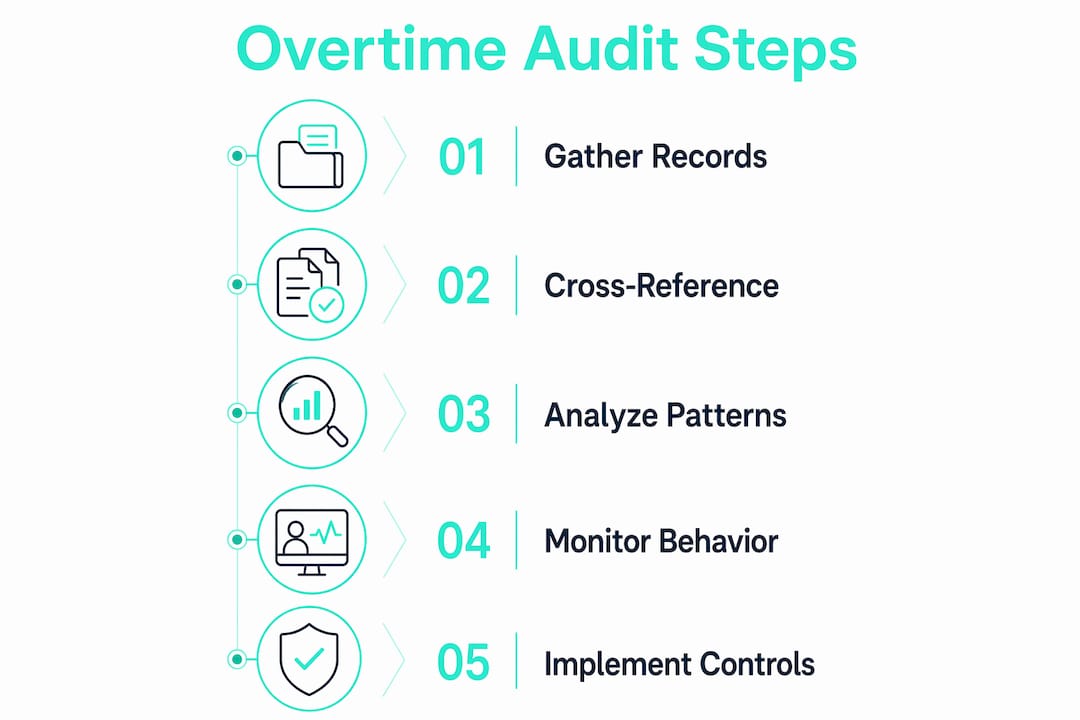
A structured audit process protects you legally and produces findings that hold up in a disciplinary conversation. How to spot overtime fraud reliably comes down to sequence: gather first, compare second, conclude last. Follow these steps in order to identify timecard manipulation without prejudging anyone.
-
Gather all relevant records. Pull time tracking data, payroll records, and any available access logs for the period in question. Organize them by employee and date before you analyze anything.
-
Cross-verify with three independent sources. Cross-system correlation between network logins, badge scans, and reported overtime gives HR objective evidence before any employee conversation takes place. Discrepancies between claimed hours and system activity justify a formal investigation.
-
Analyze for persistent patterns. One anomaly is a question. Three anomalies over six weeks are a pattern. Look across time, not just at individual incidents.
-
Conduct GPS or observational checks. For field-based employees, GPS data from a tool like Kloqk’s GPS time clock can confirm whether someone was on-site during claimed overtime hours. This step is most useful when you already have a pattern from step three.
-
Document everything with specificity. Record dates, times, data sources, and the exact nature of each discrepancy. Vague notes do not support disciplinary action. Specific, sourced records do.
-
Engage the employee with clarifying questions. Shifting from accusation to clarification minimizes trust damage while establishing accurate timekeeping. Open with a factual observation: “Our records show a difference between your clock-out time and the keycard log on these three dates. Can you help me understand that?” This approach gives the employee a fair chance to explain and gives you additional information.
-
Apply corrective measures and update policy. If manipulation is confirmed, document the outcome and update your overtime policy to close the gap that allowed it. Schedule regular audits going forward so the process becomes routine rather than reactive.
| Step | Action | Tools and tactics |
|---|---|---|
| 1. Gather records | Collect time, payroll, and access data | Time tracking software, payroll system |
| 2. Cross-verify | Compare three independent data sources | GPS logs, keycard records, network logins |
| 3. Analyze patterns | Look for recurring anomalies over time | Spreadsheet analysis, AI fraud detection |
| 4. GPS or observational check | Confirm physical presence during overtime | Kloqk GPS time clock, geofencing |
| 5. Document findings | Record specific discrepancies with evidence | Written records, screenshots, audit logs |
| 6. Employee conversation | Clarify discrepancies without accusation | HR meeting, written follow-up |
| 7. Corrective action | Update policy and schedule regular audits | Policy documentation, audit calendar |
How much does overtime padding actually cost?
Run the math on a single quiet case. An employee earning $18 an hour collects $27 an hour at time and a half. Pad each shift by 15 minutes and a five-shift week produces 1.25 phantom overtime hours, about $33.75. Over a 50-week year, that one habit costs you roughly $1,687. Five employees doing the same thing puts you near $8,400 a year, and none of it shows up as a line item anywhere.
That's the quiet version. The loud version is the coordinated scheme: a supervisor with unchecked edit rights, a crew that matches its numbers, and a payroll process nobody reviews. Those cases run into five and six figures before anyone asks a question, which is how the Massachusetts case above reached 1,700 claimed hours from one person in a single year.
Prevention costs less than either version. A tool that stamps every punch with a photo, like Kloqk's free time clock, closes most of the padding routes on day one, GPS geofencing on the Premium plan at $59 per location covers crews working off-site, and an overtime calculator makes it easy to verify what any given week should have cost you.
Overtime manipulation for small business owners with no HR department
Everything above assumes somebody has an afternoon to run an audit. Most small employers do not, so here is the compressed version. Overtime manipulation for small business owners is a tooling problem before it is a people problem: if the punch carries a photo and a location, and every edit is logged, the three easiest schemes stop working and the audit mostly stops being necessary.
There is no such thing as overtime manipulation software you can buy to solve this, whatever a vendor page implies. What you buy is a time clock with an audit trail, and then you spend ten minutes a month reading it. Set a recurring reminder and check three things: edits made within 48 hours of payroll close, any week where payroll overtime jumped more than 20% against the prior four weeks, and any overtime payment approved by the same person who submitted it.
How to find overtime you never approved
Sort last quarter's timesheets by overtime hours, descending, and read the top ten rows. Check each against the approval record. Overtime with no matching approval is either a broken process or a manipulated one, and you cannot tell which until you look. Run this once a quarter and you catch patterns while they are still small enough to fix with a conversation instead of a termination.
What mistakes undermine efforts to detect overtime fraud?
The most common errors in overtime fraud prevention are not technical. They are procedural and cultural.
- Dismissing small padding as harmless. Small, recurring overtime padding of 10 to 15 minutes per shift compounds into significant losses over a year. More importantly, ignoring it signals to the broader team that minor manipulation is acceptable. That signal invites larger schemes.
- Relying on one data source. A timesheet reviewed in isolation tells you nothing about whether the hours were real. Single-source reviews are the most common reason manipulation goes undetected for months.
- Giving supervisors unchecked edit rights. When the same person who approves timesheets can also edit them without a secondary review, the audit trail becomes meaningless. This is especially risky near payroll deadlines.
- Leading with accusation. A confrontational opening in an employee conversation damages trust and often produces defensiveness rather than information. The goal of the first conversation is to gather facts, not deliver a verdict.
- Skipping a written overtime policy. Employees cannot be held to a standard that was never communicated. A clear, written policy covering approval thresholds, documentation requirements, and consequences for falsification is the foundation of any fraud prevention program.
- Neglecting audit trail reviews. Audit trails only protect you if someone actually reviews them. Build a monthly review of timesheet edits into your HR calendar.
Pro Tip: Segregating timesheet submission and approval duties is one of the most effective structural controls available. The person who submits hours should never be the same person who approves them without a secondary review.
The other half of the problem: buddy punching and time theft
Overtime manipulation is the expensive version of a broader habit. Employee time theft covers padded punches, long breaks logged short, and one worker clocking in for another. The wider numbers, including how much does time theft cost employers across the US, sit in our buddy punching statistics roundup. Three questions come up every time.
Is buddy punching illegal?
No federal statute names it. It gets handled as theft or fraud under state law and it is grounds for termination under most handbooks. Your larger exposure is the inaccurate record it leaves behind, because the employer owns the obligation to keep accurate hours no matter who typed them.
How do you stop buddy punching?
Take the anonymity out of the punch. A shared PIN pad cannot tell who tapped it. A time clock with photo capture can, and a GPS punch adds where. Neither one requires a conversation with anybody, which is the point: the deterrent does the work quietly.
How does a photo time clock work?
The kiosk camera takes one still image at the moment of the punch and files it with the time entry. No video, no monitoring between punches. A manager scanning a day of thumbnails spots a mismatch in seconds, though most never have to, because the schemes stop the week the camera turns on.
Key Takeaways
Detecting overtime manipulation requires layered verification across multiple data sources, consistent behavioral monitoring, and a structured audit process that prioritizes evidence over assumption.
| Point | Details |
|---|---|
| Use multiple data sources | Cross-reference timesheets with GPS logs, keycard records, and network logins for reliable verification. |
| Watch for behavioral patterns | Overtime clustered below approval thresholds and precise clock times are the clearest red flags. |
| Follow a structured audit process | Document discrepancies with specificity before engaging employees in any clarifying conversation. |
| Fix procedural gaps | Separate timesheet submission from approval and require secondary reviews to close collusion risk. |
| Never ignore small discrepancies | Minor overtime padding sets a cultural precedent that leads to larger fraud over time. |
The oversight trap most managers fall into
I have seen managers at small businesses make the same mistake repeatedly. They build a solid time tracking system, catch a discrepancy, and then go straight into a confrontational conversation with the employee. The result is a defensive employee, a damaged relationship, and often no resolution because the manager had not yet gathered enough evidence to make a clear case.
The better approach is to treat the first sign of a discrepancy as the beginning of a data-gathering phase, not the end of it. Spend two to four weeks collecting cross-referenced evidence before you say anything. When you do sit down with the employee, you are not guessing. You are presenting a pattern with three independent data sources behind it. That changes the entire dynamic of the conversation.
The other thing I would push back on is the idea that rigorous oversight damages trust. In my experience, the opposite is true. Employees who work honestly resent working alongside people who pad their hours and get away with it. A transparent, consistent audit process protects the honest majority. The key is to apply it uniformly, not selectively, and to communicate clearly that the process exists to protect everyone, not to catch individuals.
Small businesses in particular tend to underinvest in this area because the administrative cost feels high. The actual cost of not investing is higher. One employee claiming 1,700 fraudulent overtime hours in a year is not a hypothetical. It has happened, and it happens in organizations that assumed trust was enough.
Saad
How Kloqk helps you stop overtime fraud before it compounds
Kloqk gives small and medium businesses most of the tools described in this article at no cost. Photo verification at clock-in helps prevent buddy punching, and full audit trails log every timesheet edit with a timestamp and user ID, both on the free plan. GPS geofencing, which confirms employees are on-site before a shift records, sits on the Premium plan at $59 per location.
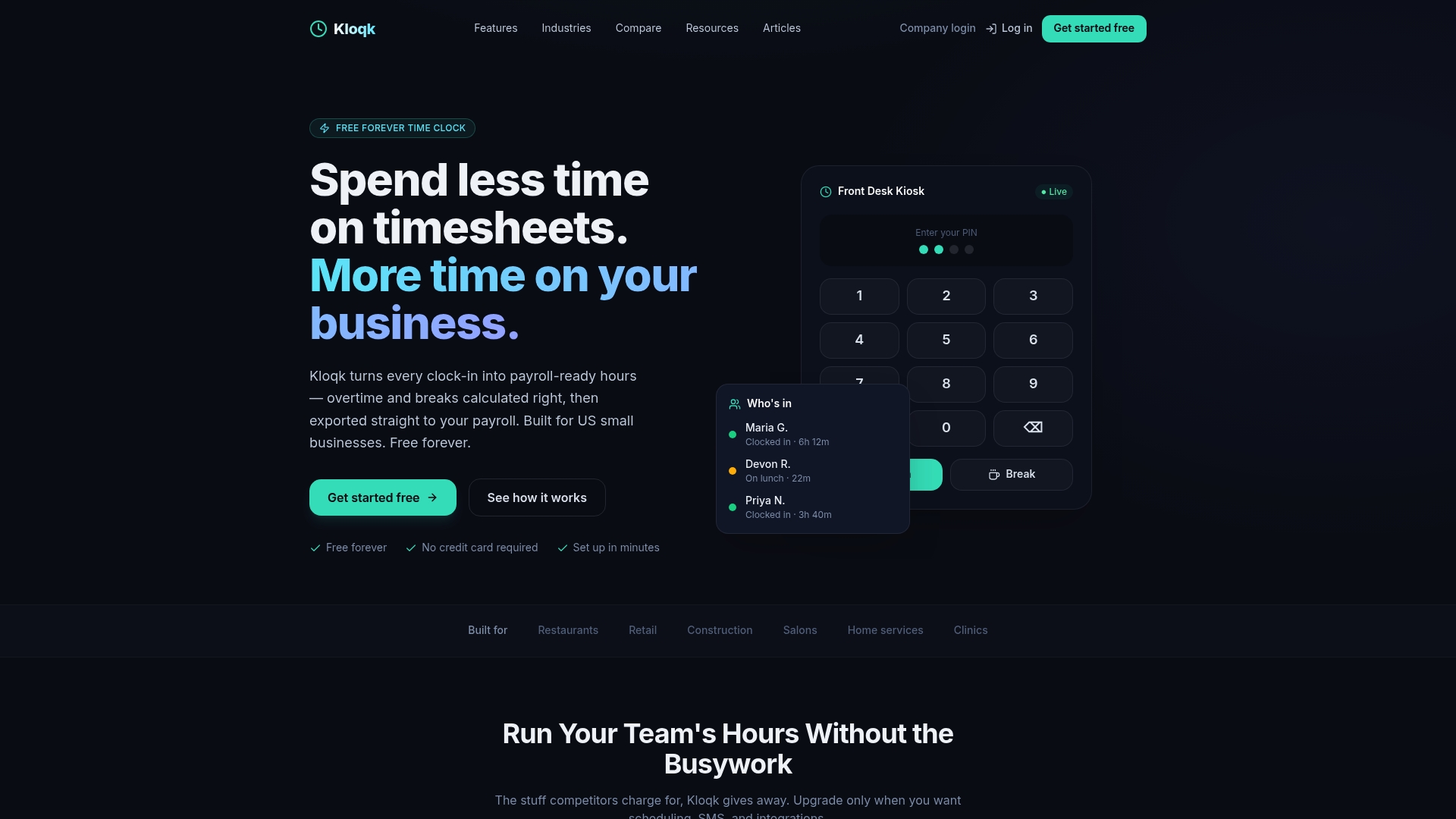
The employee time tracking features in Kloqk are built specifically for businesses that cannot afford a dedicated payroll fraud team but still need the same level of oversight. You get multi-source verification, payroll-ready exports, and overtime calculations without a monthly fee. If you manage hourly staff in construction, restaurants, or any field-based role, Kloqk’s time and attendance software is the most direct way to put the audit practices in this article into daily operation.
Recommended
Frequently Asked Questions
What is overtime manipulation in the workplace?
Overtime manipulation is the deliberate falsification of work hours to collect pay for time not actually worked. Common tactics include buddy punching, retroactive timesheet edits, and clocking out after leaving the worksite.
How do I detect overtime fraud without accusing employees?
Start by cross-referencing time records with at least three independent data sources such as GPS logs, keycard records, and network logins. Present discrepancies as clarifying questions rather than accusations to preserve trust while gathering facts.
What are the clearest overtime abuse signs in time records?
The clearest signs are overtime hours clustered just below approval thresholds, perfectly precise clock times, and spikes in claimed hours during periods of low workload. Patterns across multiple weeks are more reliable indicators than single incidents.
How does GPS tracking help verify overtime claims?
GPS time clock tools confirm whether an employee was physically present at the job site during claimed overtime hours. Kloqk's GPS geofencing creates a location-verified record at every clock-in, giving managers objective data before any employee conversation.
Why does ignoring small overtime padding matter?
Ignoring minor overtime increments sets a cultural precedent that subjective hour reporting is acceptable. That precedent makes larger, systemic fraud more likely over time and harder to address once it becomes normalized.
Sources
Every figure on this page traces to one of these. Primary law and government sources are listed first.
- 1. Cornell Legal Information Instituteprimary
- 2. acfe.com
- 3. eportid.com
- 4. everworker.ai
- 5. kickidler.com
- 6. boston25news.com
- 7. rosterelf.com
Written by
Dana WhitfieldHR Compliance Lead
Dana writes about wage-and-hour law, FLSA overtime, and leave compliance for U.S. small businesses, translating dense regulations into plain steps owners can act on.
Keep Reading
Track Hours the Easy Way
Kloqk is a free time clock that handles punches, breaks, overtime, and payroll-ready reports.
Start free