Why Job-Site Clock-Ins Prevent Disputes at Work

Job-site clock-ins are defined as verified, location-specific records of when and where an employee starts and ends work. They are the most direct tool for preventing workplace disputes because they replace memory and paper with objective, timestamped data. When attendance records are automated and GPS-verified, managers in construction, restaurants, and retail gain a defensible trail that removes the ambiguity behind most payroll and scheduling conflicts. Job site time tracking turns a common source of friction into a resolved fact before anyone files a complaint.
Why job-site clock-ins prevent disputes before they start
The core reason clock-ins prevent disputes is simple: they replace subjective claims with verifiable facts. An employee who believes they were shorted an hour cannot argue against a GPS-stamped record showing their exact arrival and departure. A manager who suspects a team member clocked in from home has the location data to confirm it. Verified records remove the “he said, she said” dynamic that turns minor payroll questions into formal grievances.

Dispute prevention in labor management has a recognized framework. Harvard’s Program on Negotiation describes dispute system design as shifting organizations away from positional bargaining toward interest-based resolution. Automated time tracking fits directly into that framework. It removes ambiguity around hours worked, so both sides start any conversation with the same facts rather than competing versions of events.
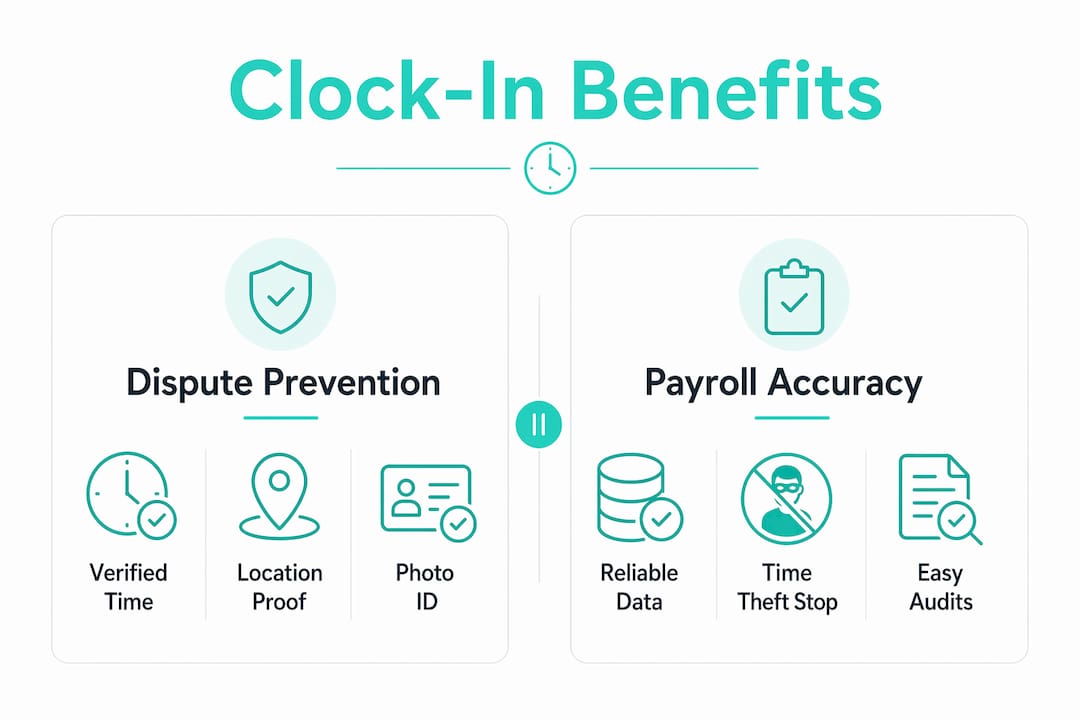
Kloqk builds this principle into its GPS geofencing and photo verification features. Every clock-in captures a location stamp and an optional photo, creating a record that is difficult to dispute and easy to share. For small business owners managing crews across multiple sites, that kind of transparency is not a luxury. It is the difference between a five-minute conversation and a two-week payroll dispute.
How does GPS verification stop buddy punching?
Buddy punching is the practice where one employee clocks in on behalf of an absent coworker. It is one of the most common forms of time theft in hourly workforces, and it directly inflates payroll costs while creating inaccurate attendance records. GPS clock-in systems combined with identity verification significantly reduce buddy punching by requiring the actual employee to be physically present at the job site to register a valid punch.
Here is how the technology works in practice:
- GPS geofencing sets a virtual boundary around the job site. Clock-ins attempted outside that boundary are rejected or flagged automatically.
- Photo verification captures an image at the moment of clock-in, confirming the person holding the phone matches the employee on record.
- Real-time alerts notify managers when a clock-in attempt falls outside the approved zone, so the issue surfaces immediately rather than at payroll time.
- Audit trails store every punch with a timestamp and coordinates, creating a record that holds up in any dispute review.
GPS-verified clock-ins confirm the team member is at the correct location, preventing time theft and increasing payroll accuracy. That accuracy matters because a single fraudulent punch per shift, multiplied across a crew of ten over a month, produces a meaningful payroll error.
Pro Tip: Set your geofence radius to match the actual footprint of the job site. A radius that is too wide defeats the purpose; one that is too tight will flag legitimate clock-ins near the site boundary.
How do automated systems catch attendance problems early?
Early detection is the most underrated benefit of automated clock-in systems. Managers can address issues like late arrivals or wrong-site clock-ins immediately, preventing entrenched disputes. A paper timesheet reviewed on Friday cannot catch a pattern that started on Monday. A real-time dashboard can.
Conflict management research from JAMS Pathways confirms that surfacing concerns early prevents weeks or months of friction later. A ten-minute conversation about a repeated late arrival costs far less than a formal grievance process. Automated attendance systems make that conversation possible by giving managers the data to open it.
Four management responses become available when you have real-time attendance visibility:
- Spot chronic lateness before it becomes a disciplinary issue, and address it with a coaching conversation backed by data.
- Identify site mismatches where an employee clocked in at the wrong location, catching scheduling errors before payroll runs.
- Detect unauthorized overtime as it accumulates, not after the pay period closes and the cost is already locked in.
- Confirm crew presence on safety-critical sites where headcount accuracy is a legal requirement, not just a payroll concern.
“Designing systems where tension is surfaced early and constructively prevents workplace conflicts from escalating.” JAMS Pathways
The shift from reactive dispute resolution to proactive conflict prevention is a structural one. It requires a system that delivers information in time to act on it. Automated time and attendance software is that system for most small businesses.
How do verified clock-ins reduce payroll disputes?
Manual timesheets and paper registers produce unreliable payroll input. Employees round up. Managers misread handwriting. Hours get lost between the job site and the accounting office. GPS-stamped entries give payroll teams a verified attendance trail that is easier to reconcile in any dispute.
The financial and morale benefits of accurate payroll are concrete. Employees feel safer knowing their pay is calculated from objective records rather than a manager’s memory. Harvard’s Program on Negotiation notes that transparent automated time-tracking builds trust by giving both managers and employees access to the same factual record. That shared access removes the power imbalance that makes payroll disputes feel personal.
| Common payroll dispute cause | How GPS clock-ins address it |
|---|---|
| Disputed start or end times | GPS timestamp records exact clock-in and clock-out moments |
| Overtime disagreements | Automated totals calculate hours worked without manual rounding |
| Missing break deductions | Break tracking logs are captured automatically within the system |
| Wrong-site pay rates | Location data confirms which site rate applies to each shift |
| Buddy punching inflation | Photo verification and geofencing block fraudulent punches |
Integrating geofenced clock-ins with payroll removes guesswork and reduces the time managers spend chasing explanations. For a restaurant owner reconciling tips and hours for fifteen employees, or a construction foreman managing three crews across two sites, that time savings is real money.
Pro Tip: Export your attendance data weekly, not just at payroll time. Weekly exports let you catch discrepancies while the details are still fresh and before they compound into a larger dispute.
Practical steps for setting up clock-ins that prevent disputes
Getting the technology right is only half the job. The other half is implementation. A GPS clock-in system that employees do not trust or understand will generate its own disputes.
- Choose software with GPS and geofencing built in. Entry-level field apps often lack location verification. Look for a system that captures coordinates at every punch and flags out-of-zone attempts automatically. Kloqk’s free employee time clock includes both features at no cost.
- Train employees before go-live. Show the team exactly what gets recorded, where it goes, and who can see it. Transparency about the system prevents the suspicion that it is being used against them rather than for accurate pay.
- Set a written clock-in policy. Define the approved clock-in window, the geofence boundaries, and the process for reporting technical issues. A written policy removes ambiguity and gives managers a reference point for any future dispute.
- Integrate clock-ins with your payroll system. Manual data transfer between a time clock and a payroll spreadsheet reintroduces the errors you are trying to eliminate. Direct export or integration closes that gap.
- Establish a clear dispute channel. Employees should know exactly how to flag a clock-in error before payroll runs. A defined process prevents small errors from becoming formal complaints.
Comprehensive attendance systems help supervisors managing multiple crews at various locations keep consolidated location and attendance data accurate. That consolidation is especially valuable in construction and landscaping, where a single payroll run may cover workers at five different addresses.
Key Takeaways
GPS-verified clock-ins prevent workplace disputes by replacing subjective attendance claims with objective, location-stamped records that both managers and employees can trust.
| Point | Details |
|---|---|
| GPS stops buddy punching | Geofencing and photo verification block fraudulent clock-ins before they reach payroll. |
| Early detection prevents escalation | Real-time attendance data lets managers address issues in minutes, not weeks. |
| Verified records reduce payroll errors | GPS timestamps eliminate rounding disputes and missing hours from manual timesheets. |
| Written policy supports the technology | Clear clock-in rules give managers a reference point and remove ambiguity for employees. |
| Integration closes the data gap | Connecting clock-ins directly to payroll eliminates manual transfer errors. |
The real cost of waiting until a dispute happens
Most managers I talk to treat time tracking as a back-office function. They set up a system, hand out a policy, and assume it runs itself. That assumption is expensive.
The disputes I see most often in hourly workforces are not about bad intent. They are about bad information. An employee who genuinely believes they worked 42 hours and got paid for 40 is not being difficult. They are reacting to a gap between their experience and their paycheck. Without a verified record, that gap has no clean resolution. Both sides dig in, and what started as a $50 payroll question becomes a formal complaint or, worse, a Department of Labor inquiry.
The shift to GPS-verified clock-ins changes that dynamic entirely. When the record is objective and both parties can see it, most disputes resolve in one conversation. The employee either sees the data confirms their hours, or they see where the discrepancy came from. Either way, the conversation is grounded in facts rather than feelings.
What I find most managers underestimate is the cultural effect. When employees know their time is tracked accurately and transparently, they trust the system. That trust reduces the low-level friction that never shows up as a formal dispute but absolutely shows up in turnover, morale, and productivity. Accurate timekeeping is not just a compliance tool. It is a trust-building mechanism.
The technology to do this well is no longer expensive or complicated. The only real barrier is inertia.
Saad
Kloqk gives small businesses a free way to prevent clock-in disputes
Payroll disputes cost small businesses time, money, and team trust. Kloqk was built specifically to eliminate the conditions that create those disputes in the first place.
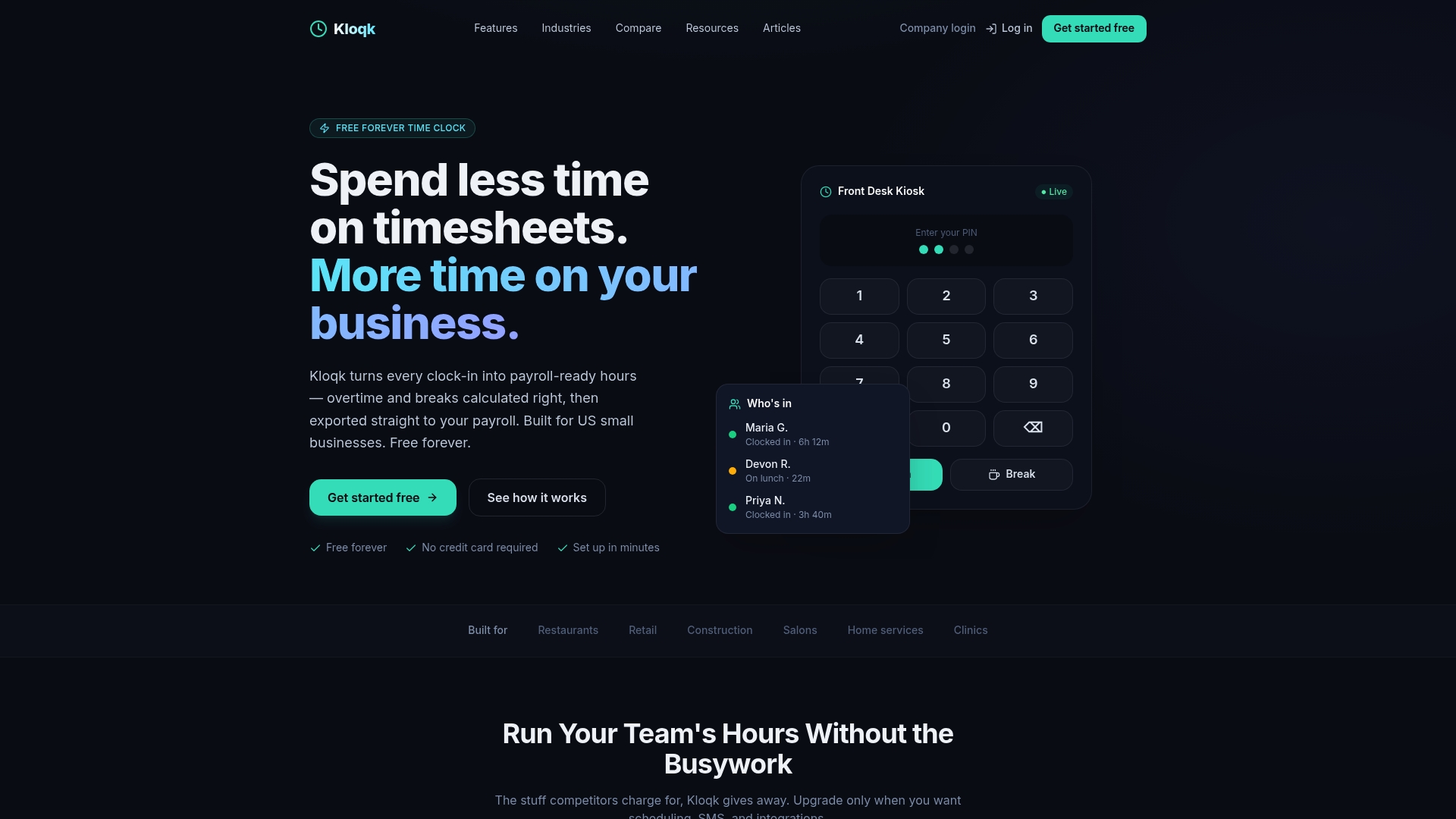
Kloqk’s GPS time clock with geofencing captures verified location data at every clock-in, blocks out-of-zone punches, and logs photo verification automatically. Overtime calculations, break tracking, and payroll exports are all included at no cost. There are no per-seat fees and no paywalled features. For construction crews, restaurant teams, and retail managers who need accurate records without a dedicated HR department, Kloqk delivers a complete employee time tracking solution that turns every clock-in into a defensible, payroll-ready record.
FAQ
What makes clock-ins more reliable than paper timesheets?
GPS-verified clock-ins capture an exact timestamp and location at the moment of punch, making them objective and tamper-resistant. Paper timesheets rely on memory and manual entry, both of which introduce errors that fuel payroll disputes.
How does geofencing prevent time theft?
Geofencing sets a virtual boundary around the job site and rejects or flags any clock-in attempt made outside that boundary. Combined with photo verification, it blocks buddy punching and off-site punches before they reach payroll.
Can small businesses afford GPS time clock software?
Kloqk offers GPS geofencing and photo verification at no cost, with no per-seat fees. Small businesses in construction, restaurants, and retail can access the full feature set without a subscription.
How quickly can GPS clock-ins resolve a payroll dispute?
A GPS-stamped attendance record gives both the manager and the employee the same objective data, so most disputes resolve in a single conversation. The record shows exact clock-in and clock-out times, location, and any flagged anomalies.
What should a clock-in policy include to prevent disputes?
A clear clock-in policy should define the approved time window for punching in, the geofence boundaries for each site, the process for reporting technical errors, and the consequences for policy violations. Written policies remove ambiguity and give managers a consistent reference point.
Recommended
Sources
Every figure on this page traces to one of these. Primary law and government sources are listed first.
Written by
Marcus ReyesPayroll & Timekeeping Specialist
Marcus covers payroll accuracy, timesheets, and time tracking, the unglamorous mechanics that keep paychecks correct and audits painless.
Keep Reading
Track Hours the Easy Way
Kloqk is a free time clock that handles punches, breaks, overtime, and payroll-ready reports.
Start free