Why Accurate Timesheets Reduce Disputes at Work

Accurate timesheets are defined as verified, timestamped records of employee hours that both workers and managers formally agree upon before payroll runs. They are the single most reliable tool for reducing payroll disputes, because they replace memory and assumption with documented fact. Small business owners in restaurants, construction, and retail face this problem daily: a worker believes they worked 42 hours, payroll shows 39, and nobody has a record that settles the question. That gap is where disputes are born. Understanding why accurate timesheets reduce disputes starts with recognizing that most conflicts are not about bad intent. They are about missing or unverifiable records.
Why accurate timesheets reduce disputes: transparency and trust
Accurate timesheets create transparency by giving both employees and managers access to the same verified data. When a worker clocks in and out with a timestamped system, neither side has to rely on memory. The record exists, it is dated, and it is visible to both parties.
The most effective systems go further than simple clock-ins. They include an employee submission step and a manager approval step. This two-stage process creates what labor law practitioners call a “contemporaneous record,” meaning a record made at the time of the event rather than reconstructed later. Contemporaneous records encourage immediate clarification of discrepancies before payroll finalizes, which prevents costly disputes from forming in the first place.
Transparency also builds trust over time. When employees see that their hours are recorded correctly and paid accurately every cycle, they stop questioning the process. That trust is not soft or intangible. It shows up in lower turnover, fewer HR complaints, and faster payroll runs.
Key elements that make timesheets transparent:
- Timestamped clock-ins and clock-outs with date and location data
- Employee submission requiring workers to confirm their own hours
- Manager review and approval before hours feed into payroll
- Visible edit history so any change is logged and attributed
Pro Tip: Set a weekly deadline for employee timesheet submission. When workers confirm their hours while the workweek is still fresh, errors surface immediately rather than weeks later during payroll.
How does automation reduce timesheet errors and payroll conflicts?
Manual timesheets introduce errors at every step. A worker writes down the wrong start time. A manager misreads handwriting. An administrator types the wrong number into a spreadsheet. Each error is small, but the cumulative effect is significant.

Correcting a single payroll error costs a business an average of $291. That figure covers the administrative time, the payroll reprocessing, and sometimes the legal review required to fix the mistake. For a small business running payroll for 15 employees, even a handful of errors per month adds up fast.
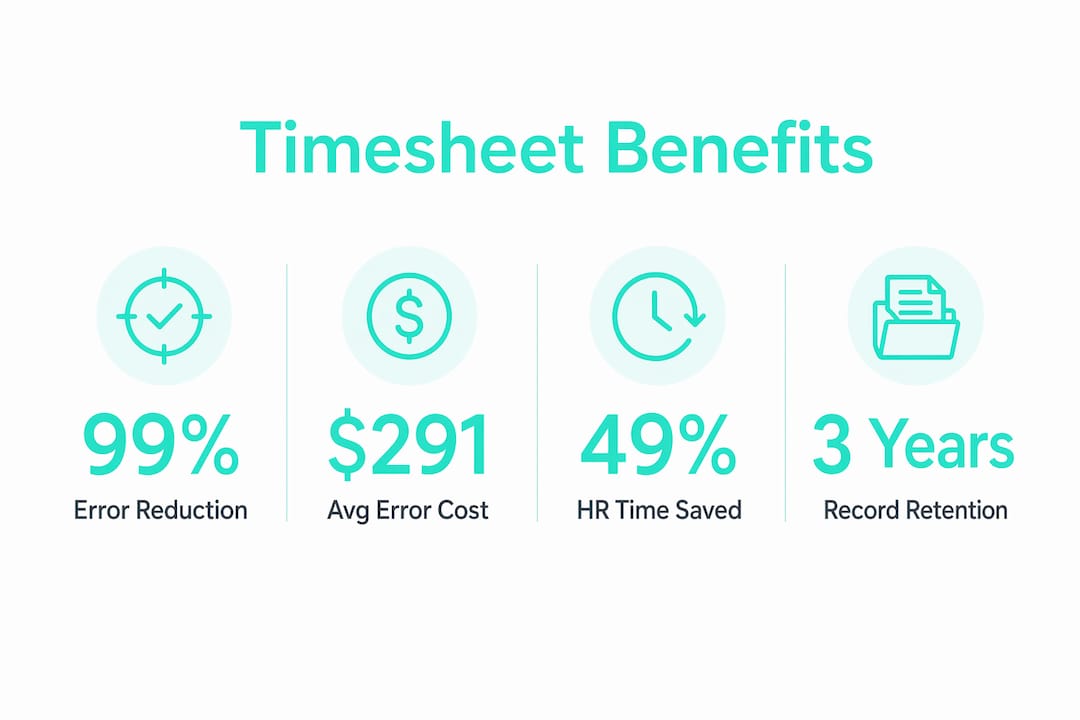
The administrative burden is equally damaging. 49% of HR teams spend five or more hours every month fixing payroll issues caused by manual timesheet errors. That is time not spent on hiring, training, or managing the business. Automated systems eliminate most of this burden by capturing hours directly from clock-in events rather than relying on manual transcription.
Businesses that switch from manual to automated time tracking report a 34% increase in workforce productivity. The gain comes primarily from less time spent reconciling spreadsheets and correcting data entry mistakes.
The practical advantages of automated systems over manual methods:
- Direct data capture: Hours flow from the clock-in event to the timesheet without human transcription.
- Automatic overtime calculation: The system applies FLSA overtime rules without a manager doing the math.
- Payroll integration: Hours export directly to payroll software, cutting the chance of re-entry errors.
- Break tracking: Meal and rest breaks are logged automatically, which matters for state labor law compliance.
- Real-time visibility: Managers see hours as they accumulate, catching problems before the pay period closes.
The payroll errors from manual timesheets are not just costly. They are preventable. Automation removes the human error points that create the discrepancies employees dispute.
Why is a formal approval workflow essential in preventing timesheet disputes?
An approval workflow is a structured process where employees submit their hours, managers review them, and both parties formally agree before payroll runs. Without this structure, hours enter payroll without anyone explicitly confirming they are correct.
The approval step does something specific: it creates a formal agreement on hours worked. When a manager approves a timesheet, they are signing off that the recorded hours are accurate. If a dispute arises later, that approval is documented evidence that both sides agreed at the time.
“The formal review and approval process encourages dialogue and clarification before payroll finalization, lowering conflict incidence. Clear, transparent, and trusted recording processes for hours worked result in most potential disputes never escalating to formal conflicts.”
Approval workflows also capture an audit trail automatically. Every submission, every edit, and every approval is logged with a timestamp and the name of the person who took the action. This log is what makes a timesheet defensible in a dispute. A timesheet without an audit trail is just a number on a page. A timesheet with a complete approval history is a legal document.
The workflow also speeds up payroll. When managers review hours weekly rather than scrambling at the end of the month, errors surface early. Payroll runs faster because the data is already verified. The business saves time, and employees get paid on schedule, which itself reduces friction.
Key steps in an effective approval workflow:
- Employee submits hours at the end of each shift or week
- Manager receives a notification and reviews the submission
- Manager approves or flags specific entries for clarification
- Employee confirms any corrections before final approval
- Approved timesheet locks and feeds directly into payroll
How does a compliance-ready audit trail protect your business?
The burden of proof in a wage dispute rests on the employer. When an employee claims they were underpaid, the employer must produce records showing otherwise. Without formal, agreed records, labor tribunals favor employee accounts. That is the legal reality small business owners face.
An audit trail is the employer’s primary defense. It logs every clock-in, every edit, every submission, and every approval, each with a timestamp and a user attribution. An immutable audit trail is often the only evidence that holds up in a labor tribunal. “Immutable” means the log cannot be altered after the fact without the alteration itself being recorded.
The Fair Labor Standards Act sets the baseline for recordkeeping. The FLSA requires employers to keep accurate records of hours worked and wages paid, with payroll records retained for three years and timecards retained for two years. Digital time records that meet these standards also satisfy FLSA recordkeeping requirements automatically, protecting the business from wage disputes before they start.
| Audit trail element | Why it matters in a dispute |
|---|---|
| Timestamped clock-ins | Proves exact start and end times without relying on memory |
| Edit history with user attribution | Shows who changed what and when, preventing tampering claims |
| Employee submission confirmation | Documents that the worker agreed to the recorded hours |
| Manager approval with timestamp | Creates formal employer sign-off as legal evidence |
| Payroll export record | Links approved hours directly to wages paid |
A system that allows manual edits without a transparent log of who made changes and when fails as a legal defense in a dispute. The audit trail is only as strong as its completeness.
Pro Tip: Store approved timesheets and their full audit logs in a cloud-based system. Local files get lost, corrupted, or deleted. Cloud storage keeps records accessible and timestamped for the full FLSA retention period.
Key Takeaways
Accurate timesheets reduce disputes because they replace unverifiable memory with documented, agreed-upon records that both employees and managers confirm before payroll runs.
| Point | Details |
|---|---|
| Contemporaneous records prevent disputes | Timestamped records made at the time of work are far harder to challenge than reconstructed accounts. |
| Automation cuts error costs | Correcting a single payroll error costs $291 on average; automated capture eliminates most error sources. |
| Approval workflows create legal agreements | Manager sign-off on hours turns a timesheet into a formal, documented agreement between employer and employee. |
| Audit trails are your legal defense | An immutable log of edits, submissions, and approvals is the evidence that holds up in wage disputes. |
| FLSA compliance requires retention | Federal law mandates keeping payroll records for three years and timecards for two years. |
The real cost of “good enough” timekeeping
I have seen small business owners treat timesheets as a formality. They figure their team is honest, payroll is close enough, and nobody is going to sue over a few minutes here and there. That thinking is expensive.
The disputes I have watched unfold rarely start with fraud. They start with a worker who genuinely believes they worked a full shift and a manager who genuinely believes they did not. Both people are right from their own perspective. The problem is that neither has a record that settles the question. Without one, the conversation turns adversarial fast.
The fix is not complicated. A digital system with employee submission and manager approval costs nothing to implement with tools like Kloqk. The workflow takes less than two minutes per employee per week. What it buys you is a paper trail that makes disputes either impossible to start or easy to resolve in under five minutes.
The managers I respect most treat their timesheet process the way they treat their financial records: not because they expect an audit, but because they know that good records are what separate a well-run business from a reactive one. Set the process up once, communicate it clearly to your team, and let the system do the work.
Saad
Kloqk makes accurate time tracking free for small businesses
Small business owners who want to reduce payroll disputes without adding administrative work have a direct option. Kloqk provides free employee time tracking built specifically for teams in restaurants, construction, and retail, where shift work and hourly pay make accurate records non-negotiable.
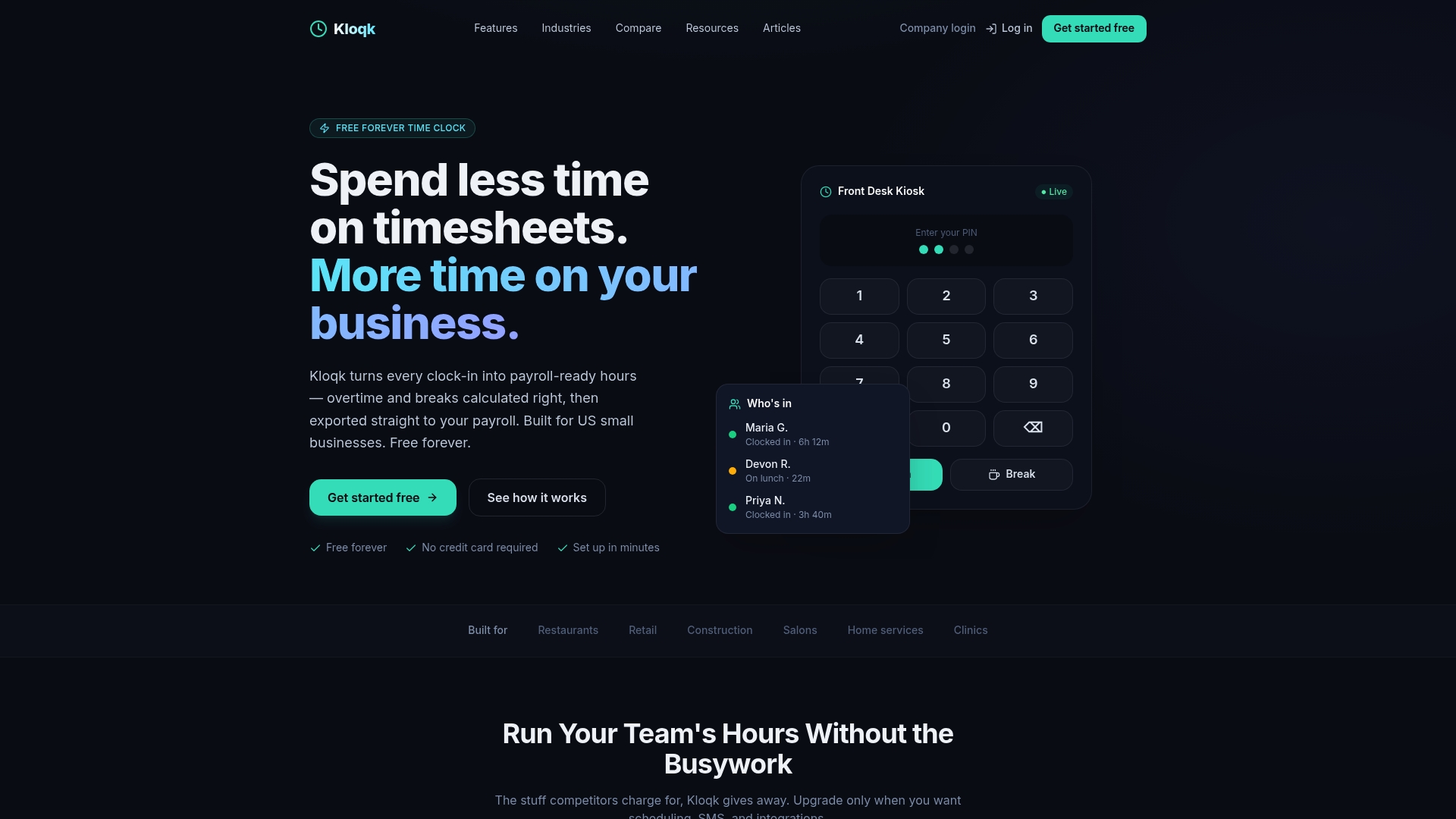
Kloqk captures clock-ins with photo verification and GPS geofencing, which prevents buddy punching and location fraud before they create disputes. The built-in approval workflow gives managers a structured review process, and the audit trail logs every edit and approval automatically. Overtime calculations, break tracking, and payroll exports are all included at no cost. For businesses that need coverage across multiple sites, Kloqk’s GPS time clock extends the same accuracy to every location. No per-seat fees, no paywalled features, and no manual spreadsheets.
FAQ
What makes a timesheet legally defensible in a wage dispute?
A timesheet is legally defensible when it includes timestamped clock-ins, an employee submission confirmation, manager approval, and a complete edit history. Without all four elements, an employer has limited evidence to counter an employee’s account.
How do approval workflows prevent payroll disputes?
Approval workflows require both the employee and manager to formally agree on hours before payroll runs. This formal agreement, logged with timestamps, resolves most discrepancies before they become disputes.
How long must employers keep timesheet records under the FLSA?
The FLSA requires employers to retain payroll records for three years and timecards or time records for two years. Digital systems that store these records automatically make compliance straightforward.
Why do manual timesheets create more disputes than digital ones?
Manual timesheets rely on handwriting, memory, and manual data entry, each of which introduces errors. The average payroll error costs $291 to correct, and 49% of HR teams spend five or more hours monthly fixing these mistakes.
What is a contemporaneous record and why does it matter?
A contemporaneous record is documentation created at the time of the event rather than reconstructed later. In timesheet terms, it means clock-ins and submissions recorded in real time, which carry far more legal weight than after-the-fact accounts.
Recommended
Sources
Every figure on this page traces to one of these. Primary law and government sources are listed first.
- 1. be-on-track.com
- 2. xero.com
Written by
Marcus ReyesPayroll & Timekeeping Specialist
Marcus covers payroll accuracy, timesheets, and time tracking, the unglamorous mechanics that keep paychecks correct and audits painless.
Keep Reading
Track Hours the Easy Way
Kloqk is a free time clock that handles punches, breaks, overtime, and payroll-ready reports.
Start free