Why Employee Time Theft Happens: A Manager's Guide

Employee time theft is defined as any instance where an employee receives pay for time they are not productively working. It ranges from arriving late and leaving early to falsifying timecards and clocking in for absent coworkers. Most managers treat it as an individual conduct problem, but the evidence points to a different conclusion: time theft is frequently a systems issue, where poor process design and weak workplace culture create the conditions for it to thrive. Understanding why employee time theft happens is the first step toward fixing the environment that enables it.
Why employee time theft happens: causes and behaviors
Time theft covers a wide range of behaviors, and most of them share a common thread. Employees rationalize non-productive paid time as compensation when they feel undervalued, underpaid, or ignored by management. The behavior is rarely random. It follows predictable patterns tied to morale, policy gaps, and the tools a business uses to track time.
The most common forms of time theft in food service, retail, and other hourly industries include:
- Buddy punching: One employee clocks in or out for a coworker who is absent or late. Buddy punching inflates payroll costs and is nearly impossible to catch without identity verification at the clock.
- Time padding: Employees add a few minutes to their start or end times on manual timesheets. Individually small, these additions compound across a full staff and a full year.
- Extended breaks: A 15-minute break becomes 25 minutes when no one is watching or tracking it.
- Personal device use: Employees using company time for personal activities like social media or running errands represent a quieter but equally costly form of time theft.
- Timecard falsification: Employees deliberately record incorrect clock-in or clock-out times on paper or digital logs.
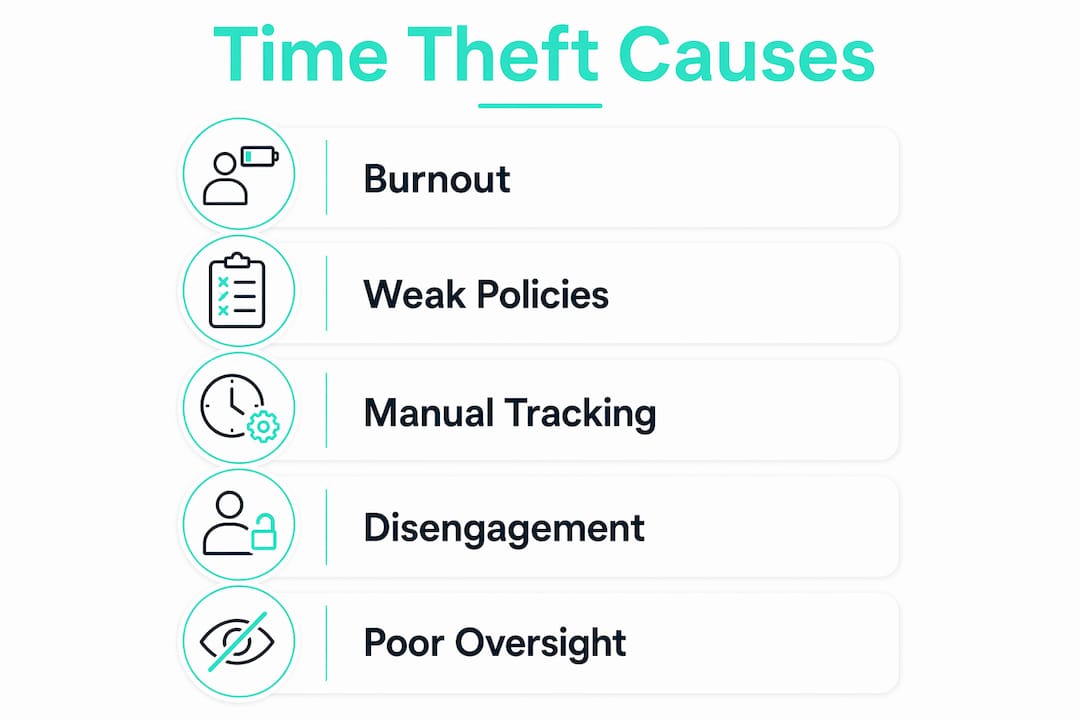
Two psychological drivers accelerate all of these behaviors. First, high stress and burnout push employees toward mental escapes during paid hours, making personal phone use or extended breaks feel justified. Second, perceived inequity, where one employee sees a coworker face no consequences for late arrivals, removes the social deterrent against doing the same.
Pro Tip: Track break durations, not just clock-in and clock-out times. A staff member who clocks in on time but takes three 30-minute breaks in a six-hour shift is still committing time theft, and most basic systems will miss it entirely.

How workplace culture shapes time theft patterns
Time theft often signals an underlying cultural problem rather than isolated dishonesty. Experts consistently find that workplaces with poor recognition, inconsistent leadership, and unequal enforcement produce higher rates of time theft than those with clear expectations and fair management.
“Time theft is frequently a symptom of deeper workplace culture problems. When employees feel disrespected or undervalued, they stop treating company time as something worth protecting.” Source: PeopleHR
The cultural factors that most reliably predict time theft include:
- Inconsistent enforcement: When managers ignore late arrivals for some employees but discipline others, the message is that rules are negotiable. That perception spreads fast in small teams.
- Lack of recognition: Employees who feel their effort goes unnoticed disengage. Disengaged workers are far more likely to rationalize time theft as a fair trade for their unacknowledged contribution.
- Poor leadership visibility: Managers who are rarely present on the floor or who fail to follow up on attendance issues create a low-accountability environment.
- Workload imbalance: When some employees carry significantly heavier workloads than others, resentment builds. That resentment often expresses itself through disengagement and time padding.
Employee engagement levels directly affect how much time theft a business experiences. Fixing the culture does not replace the need for accurate tracking, but it removes the motivation that drives most of the behavior in the first place.
Why manual time tracking systems enable time theft
Manual and inconsistent time tracking systems are one of the most direct operational causes of time theft. Manual timesheets can inflate wage costs by 2, 5% per year through errors and deliberate abuse. For a restaurant or retail store operating on thin margins, that figure can erase net profit entirely.
The table below shows how common tracking methods compare in their exposure to time theft risk:
| Tracking method | Primary risk | Typical error source |
|---|---|---|
| Handwritten timesheets | Falsification, rounding | Employee self-reporting |
| Basic digital punch clocks | Buddy punching | No identity verification |
| GPS-enabled apps with photo verification | Low risk | System configuration errors |
| Paper sign-in sheets | Shift overlap, omissions | No real-time enforcement |
The slow leak pattern is the most financially damaging aspect of manual systems. An employee who adds five minutes to their start time and five minutes to their end time every shift generates roughly 43 extra paid hours per year. Multiply that across 20 employees and the loss exceeds a full-time equivalent in payroll costs, often without a single deliberate act of fraud.
Retail and hospitality businesses face compounded risk because their time tracking is often fragmented across locations, shifts, and managers. When no single person has a real-time view of who is clocked in and where, discrepancies go undetected until payroll runs. By then, the loss is already locked in.
Time theft also creates operational gaps that reduce shift coverage. Reduced coverage enables other forms of shrink in retail, including external theft that occurs when floor staff are absent or distracted. The financial damage extends well beyond the payroll line.
Pro Tip: Run a monthly audit comparing scheduled hours to clocked hours for each employee. A consistent pattern of clocked hours exceeding scheduled hours by 5% or more is a red flag worth investigating before it becomes a payroll problem.
What managers can do to reduce time theft
Reducing time theft requires changes at three levels: policy, culture, and technology. No single fix works in isolation.
-
Write and communicate clear time policies. Employees cannot follow rules they do not know exist. Document clock-in and clock-out procedures, break lengths, and consequences for timecard falsification. Review these policies during onboarding and at least once per year.
-
Enforce policies consistently. Selective enforcement is more damaging than no enforcement. When managers apply rules unevenly, employees learn that the rules are social rather than operational. Consistent follow-through is the single most effective cultural deterrent.
-
Improve employee recognition. Disengaged employees are the most likely to commit time theft. Regular, specific recognition of good work raises morale and removes the rationalization that time theft is a fair exchange for unacknowledged effort.
-
Replace manual tracking with digital systems. Paper timesheets and basic punch clocks create the conditions for buddy punching and time padding. Digital time tracking systems with GPS geofencing and photo verification eliminate the most common manipulation methods at the source.
-
Use GPS and photo verification at clock-in. GPS geofencing confirms that an employee is physically at the work location when they clock in. Photo verification prevents buddy punching by requiring a face match. Together, these two features address the majority of deliberate time theft in hourly workplaces.
-
Train employees on the system. Technology only works when employees know how to use it correctly. Walk every new hire through the clock-in process, explain what the system tracks, and clarify that the data feeds directly into payroll.
-
Monitor for red flags consistently. Patterns like frequent early clock-outs, unusually long breaks, or clock-ins from outside the geofence are signals worth investigating. Identifying overtime manipulation early prevents small discrepancies from becoming large payroll errors.
Pro Tip: Set up automatic alerts for clock-ins that occur outside your geofence boundary. This single feature catches location fraud in real time rather than after payroll has already processed.
Key Takeaways
Employee time theft happens primarily because of weak systems, unclear policies, and disengaged employees, not because most workers are dishonest by nature.
| Point | Details |
|---|---|
| Systemic causes dominate | Time theft most often results from poor process design and inconsistent enforcement, not individual dishonesty. |
| Manual systems amplify losses | Handwritten timesheets and basic punch clocks can inflate payroll costs by 2, 5% annually through errors and abuse. |
| Culture drives behavior | Low morale, lack of recognition, and unequal enforcement create the conditions where time theft feels justified. |
| Technology closes the gap | GPS geofencing and photo verification eliminate buddy punching and location fraud at the point of clock-in. |
| Consistent enforcement matters | Applying rules unevenly teaches employees that policies are negotiable, which accelerates time theft across the team. |
The part most managers get wrong
Most managers I have worked with respond to time theft by adding rules. They post new break policies, send warning emails, and threaten disciplinary action. Some of that is necessary. But it rarely solves the problem because it treats the symptom rather than the cause.
The businesses I have seen reduce time theft most effectively did two things differently. First, they fixed the tracking system before they fixed the people. When employees know that every clock-in is verified by GPS and a photo, the opportunity for manipulation disappears. You cannot buddy punch a system that requires your face. Second, they invested in recognition before they invested in surveillance. A team that feels seen and fairly compensated has almost no motivation to steal time.
The uncomfortable truth is that if your business has a persistent time theft problem, the tracking system and the management culture are almost certainly contributing to it. Punishing employees without addressing those root causes produces short-term compliance and long-term resentment. The managers who get this right treat time theft as a process failure first and a conduct issue second. That shift in framing changes everything about how they respond.
Saad
How Kloqk helps small businesses address time theft

Kloqk’s free employee time tracking software gives small business owners the tools to close the gaps that make time theft possible. The platform includes GPS geofencing to confirm employees are on-site when they clock in, photo verification to prevent buddy punching, and automatic break tracking so extended breaks show up in the data rather than disappearing into payroll. Multi-location support means managers can monitor clock-ins across every site from a single dashboard. Overtime calculations and payroll exports are included at no cost. For restaurants, retailers, and other hourly businesses where margin pressure is constant, Kloqk turns accurate time capture into a standard operating practice rather than an ongoing management challenge.
FAQ
What is employee time theft?
Employee time theft is defined as receiving pay for time not spent productively working. Common examples include buddy punching, extended breaks, timecard falsification, and using company time for personal activities.
Why do restaurant staff falsify timecards?
Restaurant staff most often falsify timecards due to low morale, perceived unfair treatment, or weak oversight systems that make manipulation easy and low-risk. Manual timesheets with no verification create the most exposure.
How does time theft affect restaurant profit?
Time theft erodes restaurant profit through inflated payroll costs. Manual timesheets can inflate wage costs by 2, 5% annually, which is significant for businesses operating on thin margins where labor is the largest controllable expense.
What is buddy punching and why does it happen?
Buddy punching occurs when one employee clocks in or out for an absent coworker. It happens most often in workplaces that use basic punch clocks with no identity verification, making it easy to perform without detection.
What are the red flags of time theft for managers?
Key red flags include clocked hours that consistently exceed scheduled hours, clock-ins from outside the work location, unusually long break durations, and patterns of early clock-outs on specific days or shifts.
Recommended
Sources
Every figure on this page traces to one of these. Primary law and government sources are listed first.
Written by
Marcus ReyesPayroll & Timekeeping Specialist
Marcus covers payroll accuracy, timesheets, and time tracking, the unglamorous mechanics that keep paychecks correct and audits painless.
Keep Reading
Track Hours the Easy Way
Kloqk is a free time clock that handles punches, breaks, overtime, and payroll-ready reports.
Start free