40 Hour Baseline: Overtime Scheduling Rules HR Must Enforce

Federal law requires overtime pay at time and one-half for any hour worked past a threshold of 40 hours in a workweek, and several states add daily thresholds that trigger sooner. If an employee works overtime without a manager’s sign-off, you still owe the premium; policy violations do not cancel pay obligations. Your first move: verify each employee’s fixed workweek and confirm your time system captures every minute worked, approved or not.
TL;DR:
- Employers must verify each employee’s fixed workweek and ensure time systems capture every minute worked, approved or not, to avoid wage claims.
- Overtime is owed for hours exceeding 40 in a fixed seven-day workweek, regardless of work done before or after scheduled shifts, including off-the-clock work.
- State-specific rules, such as California’s daily overtime after 8 hours and double time after 12 hours, can impose stricter thresholds than federal law.
- Requiring prior written approval for overtime does not exempt employers from paying hours actually worked, especially if work is performed without approval.
- Automated timekeeping tools that record precise clock-in and clock-out data help prevent disputes and ensure compliance with overtime regulation.
Table of Contents
- Quick Compliance Checklist: Scheduling Overtime Rules HR Should Apply Now
- What Does the Federal Overtime Baseline Actually Require?
- How Do State Overtime Rules Differ From the Federal Baseline?
- Can You Control Scheduling Without Violating Overtime Law?
- How Do You Calculate Overtime Pay Correctly?
- Timekeeping Practices That Actually Prevent Overtime Disputes
- What HR Teams Consistently Get Wrong About Overtime Compliance
- How Kloqk Helps You Enforce Scheduling Rules Automatically
- Sources
Quick Compliance Checklist: Scheduling Overtime Rules HR Should Apply Now
Before you touch a schedule or run payroll, run through this list. It catches the errors that trigger audits and back-pay claims.
- Lock a fixed workweek for every employee in both payroll and scheduling software; don’t let it drift week to week.
- Record actual clock times to the minute, including any work done before or after a shift’s official start and end.
- Require written overtime approval, but plan to pay every hour actually worked, approved or not.
- Check your state’s thresholds for daily overtime, double time, and alternative workweek schedules.
- Roll nondiscretionary pay (bonuses, commissions, shift differentials) into the regular rate before calculating overtime.
Miss any one of these and you’re exposed to a wage claim, even if your intentions were fine.
What Does the Federal Overtime Baseline Actually Require?
The Fair Labor Standards Act sets the floor every U.S. employer has to clear, regardless of state. It defines a workweek as a fixed, recurring period of 168 hours, seven consecutive 24 hour days, that you set once and don’t shift around to dodge overtime math.
That workweek stands completely alone. You cannot average 30 hours one week and 50 the next to land on a tidy 40 hour mean and avoid paying overtime. The Wage and Hour Division’s regulations are explicit on this point: each seven day period gets its own overtime calculation, full stop.
The core number to remember: 40. Nonexempt employees who work more than 40 hours in that single workweek are owed time and one-half their regular rate for every hour past it. There’s no daily federal overtime trigger, just the weekly threshold.
“Hours worked” covers more than scheduled shift time. If you “suffer or permit” an employee to work, meaning you knew or should have known the work was happening, you owe for it. That includes prep time, cleanup, and answering a work text after clock out. The regular rate itself isn’t always just the hourly wage; it typically folds in nondiscretionary bonuses and other compensation, which sets up the calculation details in a later section. Overtime earned in a workweek is due on the regular payday for the pay period in which it was earned.
How Do State Overtime Rules Differ From the Federal Baseline?
Federal law is the floor, not the ceiling. Several states layer stricter rules on top, and if you run multi-state operations, the state rule usually wins whenever it’s more generous to the employee.
- California requires daily overtime after 8 hours in a workday, plus double time in specified circumstances, such as after 12 hours in a day. Employers there can also adopt alternative workweek schedules through an employee election process, which changes when the daily threshold kicks in but doesn’t eliminate weekly overtime obligations.
- Texas generally defaults to the federal 40 hour threshold with no daily overtime requirement, though state agencies publish their own payroll guidance for public employers that’s worth checking separately.
- Wisconsin echoes the federal 40 hour weekly baseline in its own overtime guidance, but the state’s wording around exemptions and specific industries differs enough from federal text that it’s worth reading directly rather than assuming parity.
The real danger zones are phased-in wage thresholds, industry-specific wage orders (common in California for healthcare and agriculture), and state-level comp time options that don’t exist federally. If you operate in more than one state, build your scheduling policy around the strictest applicable rule, not the average.
Can You Control Scheduling Without Violating Overtime Law?
You can absolutely require prior approval for overtime. What you can’t do is use that policy as a legal shield against paying for hours actually worked. Write your policy to say something like: “Overtime must be approved in advance by a supervisor; unauthorized overtime may result in disciplinary action, but all hours worked will be paid as required by law.” That single sentence protects you on both fronts, operational discipline and legal exposure.

Compensatory time works differently depending on who employs you. Private-sector employers generally cannot substitute comp time for overtime pay; cash is the expected remedy in almost every case. Public-sector employers have more flexibility to offer comp time under specific accrual caps and payout rules, a distinction that trips up HR teams who assume the rules are universal.
Here’s a simple operational sequence that keeps you covered:
- Require a written overtime request before the shift, routed through a supervisor.
- Log the approval (or denial) in your scheduling system, timestamped.
- Reconcile actual clock hours against approved hours every pay period, and pay any gap.
Pro Tip: Don’t discipline first and pay later. Pay the overtime on schedule, then address the policy violation separately through your normal disciplinary process. Combining the two invites a wage claim on top of a personnel issue.
How Do You Calculate Overtime Pay Correctly?
Getting the math right starts with the regular rate, and this is where most underpayment claims originate. Nondiscretionary bonuses, shift differentials, and commissions all need to be folded into that rate before you apply the time and one-half multiplier, a requirement Fact Sheet #23 spells out directly. Leave out a shift differential and you’ve underpaid overtime, even if the base hourly math looked correct.
When an employee works multiple rates in one workweek, say, $18 an hour on the line and $22 an hour training new staff, you calculate a weighted average across all hours worked, then apply the overtime premium to that blended rate. Our detailed step-by-step overtime calculation guide walks through the math in more depth.
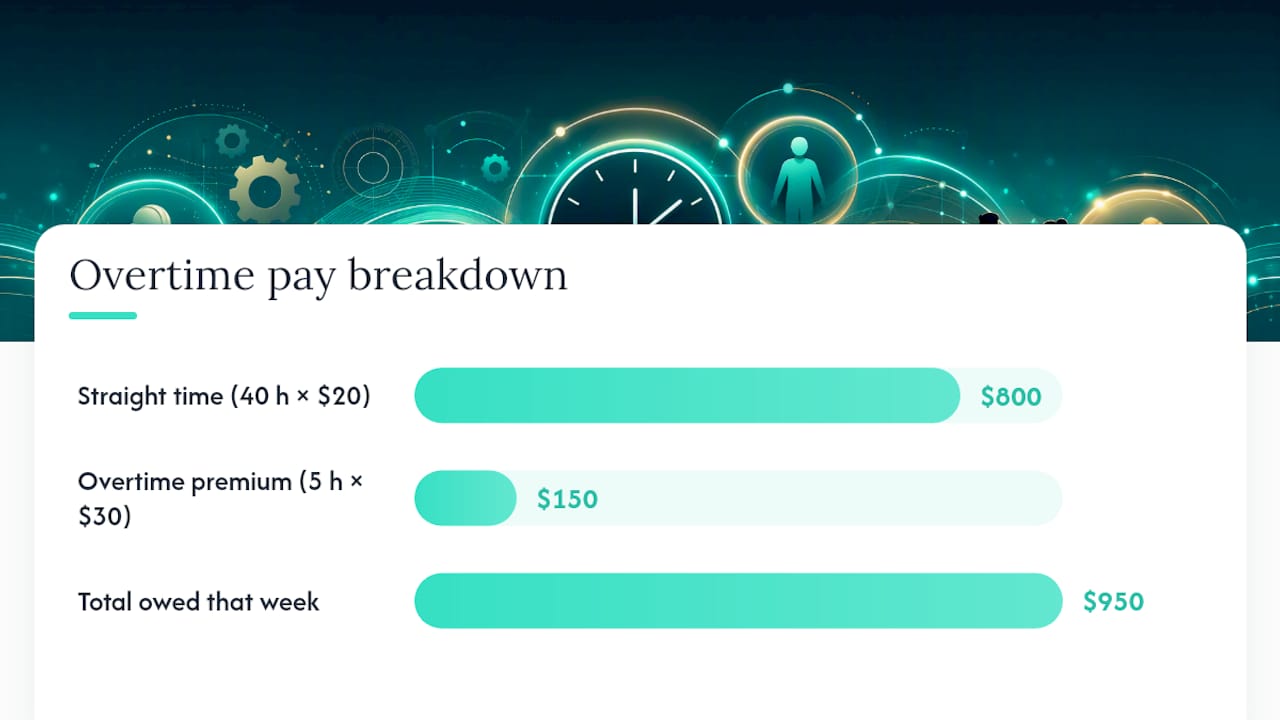
Here’s a quick example. An employee earns $20 an hour and works 45 hours in a workweek:
- Straight time: 40 hours × $20 = $800.
- Overtime premium: 5 hours × $30 (time and one-half) = $150.
- Total owed: $950.
That overtime pay is due on the regular payday for the period it was earned, not deferred to a later cycle.
Timekeeping Practices That Actually Prevent Overtime Disputes
Most overtime violations aren’t intentional. They come from sloppy time capture, an employee who clocks in on their phone from the parking lot, a manager who eyeballs hours instead of pulling a report, a workweek that quietly shifted during a schedule change. Automated, objective time capture closes most of that gap by recording exact clock times instead of relying on memory or rounded estimates.
- Use automated clock-in/clock-out systems that capture pre and post shift minutes, not just scheduled shift blocks.
- Have employees verify their own time records each pay period, and have supervisors reconcile against approved schedules.
- Keep one fixed workweek per employee in your payroll system, and document the business reason any time you change it permanently.
- Log every overtime approval; if an employee works without one, capture the evidence and pay the hours anyway.
Pro Tip: If your current system relies on paper timesheets or manual entry, you’re carrying more audit risk than you probably realize. A tool like Kloqk’s GPS time clock captures location and timestamp data automatically, which removes the guesswork from disputed hours.
What HR Teams Consistently Get Wrong About Overtime Compliance
The employers who get burned aren’t usually the ones ignoring overtime law. They’re the ones who assume a written approval policy does the legal work that only accurate time records can do. Prioritize an auditable, minute-by-minute record of hours worked over an elaborate approval hierarchy. Approval workflows matter for cost control, not legal defense.
Small employers, in particular, should resist the urge to build complicated sign-off chains and instead adopt one simple, consistently enforced time system paired with a short written overtime procedure. Worry less about catching every unauthorized minute before it happens and more about making sure nothing worked ever goes unrecorded. Off-the-clock work, not overtime itself, is what actually sinks employers in wage claims.
Saad
How Kloqk Helps You Enforce Scheduling Rules Automatically
Once you know the rules, the harder part is enforcing them shift after shift without adding a full-time payroll administrator to your headcount. Kloqk is built specifically for that gap: a free time tracking platform that turns raw clock-ins into payroll-ready hours, overtime premiums already calculated.
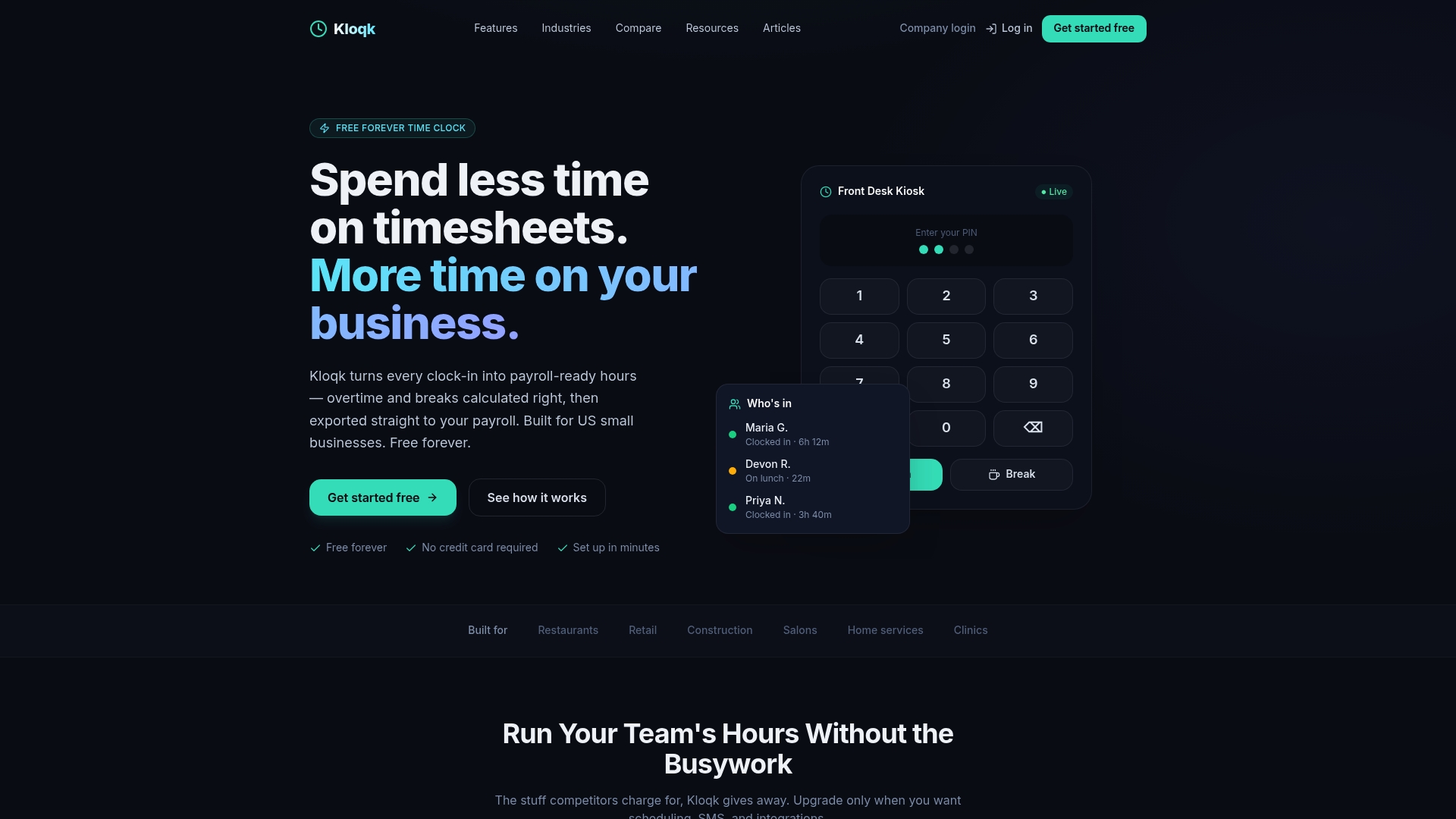
The system automates the calculations described, including weighted regular rates and overtime premiums, to ensure correct pay for differential shifts and hours worked beyond weekly thresholds. Photo verification confirms who actually clocked in, GPS geofencing stops off-site punching for distributed crews, and break tracking flags meal periods that could otherwise skew overtime totals. For teams with staff working from job sites or multiple locations, the remote and GPS-enabled time clock applies the same rules without extra setup.
If your current process depends on paper timesheets or a manager’s memory, consider trying free tier time tracking solutions to export compliant, payroll-ready timesheets.
This article is general information, not a substitute for advice from a qualified lawyer. Consult a qualified legal professional about your own circumstances before acting on anything here.
Sources
- Fact Sheet #23: Overtime Pay Requirements of the FLSA | U.S. Department of Labor
- Wage and Hour Division, 29 C.F.R. § 778 (Workweek and overtime computation)
- Overtime, California Department of Industrial Relations
Recommended
Sources
Every figure on this page traces to one of these. Primary law and government sources are listed first.
- 1. U.S. Department of Laborprimary
- 2. California Department of Industrial Relationsprimary
- 3. govinfo.gov
- 4. hr.osu.edu
Written by
Dana WhitfieldHR Compliance Lead
Dana writes about wage-and-hour law, FLSA overtime, and leave compliance for U.S. small businesses, translating dense regulations into plain steps owners can act on.
Keep Reading
Track Hours the Easy Way
Kloqk is a free time clock that handles punches, breaks, overtime, and payroll-ready reports.
Start free