Weekly Construction Crew Scheduling That Stops Double Bookings

The fastest way to eliminate crew confusion is a single, living weekly schedule tied to automatic crew notifications and GPS-backed time tracking. Build it around positions, not names, run a conflict check before you publish, and connect every shift to a clock-in. Taking these steps promptly can eliminate most avoidable delays. The sections below walk through the setup, the software features that make it stick, and a checklist you can copy this week.
TL;DR:
- Using multi-site, role-based scheduling software with conflict checks reduces costly double-bookings and last-minute hires, especially for crews over five members or multiple sites.
- Implementing GPS and photo verification at clock-in ensures workers are on-site and assigned correctly, minimizing buddy punching and payroll disputes.
- Running conflict checks before publishing schedules and confirming shifts through automatic notifications helps prevent coverage gaps and last-minute reshuffles.
- Connecting scheduling software to time tracking enables early detection of no-shows and enforces adherence, which is critical amid a tight labor market with high worker shortages.
- Maintaining a strict, weekly schedule update routine and a flexible bench of workers improves responsiveness and minimizes delays caused by absences or accidental overlaps.
Table of Contents
- Which Construction Crew Scheduling Approach Fits Your Crew Size?
- Key Features to Require in Crew-Scheduling Software
- How Do You Build a Weekly Schedule That Prevents Coverage Gaps?
- How Scheduling and Time Tracking Work Together to Cut No-Shows
- What Causes Most Scheduling Failures, and How Do You Fix Them?
- A Real-World Scenario: What Changes When Scheduling and Time Tracking Connect
- What a Field-First Project Manager Should Actually Prioritize
- How Kloqk Puts This Guide Into Practice
- Sources
Which Construction Crew Scheduling Approach Fits Your Crew Size?
Most scheduling breakdowns trace back to using a tool built for a simpler job than the one in front of you. A whiteboard works fine for a single foreman running six guys on one site. It falls apart the moment you’re juggling three sites, two apprentices who need journeyman supervision, and a rented excavator that has to move between jobs on a fixed date.
The real distinction is between two-dimensional and three-dimensional scheduling. A spreadsheet or wall calendar handles two dimensions well: people and dates. It has no built-in way to check the third dimension, which project each person belongs to on a given day, so nothing stops you from putting the same electrician on two jobs at 7 a.m. CrewSnap frames this as a fundamentally 3D problem, projects times people times dates, and that framing explains why spreadsheets keep producing the same failure mode no matter how careful the person filling them out is
Here’s a quick way to figure out where you sit:
- One site, under 15 crew members, no certification constraints: a shared calendar or basic app is enough.
- Two to five sites, mixed trades, apprentice ratios to track: you need a dedicated scheduling tool with role gating.
- Five-plus sites or frequent equipment sharing: you need a platform that checks people, projects, dates, and equipment together before anything goes live.
- Thin bench, high turnover: whatever tool you pick needs fast substitution, because you’ll be using it constantly.
The cost of staying on a spreadsheet past that first threshold isn’t abstract. Idle crews standing around because the second half of a two-person job never got assigned, last-minute hires brought in at a premium because nobody flagged a gap three days out, and double-bookings that only surface when two supervisors call the same worker at 6:45 a.m. Those costs compound faster in a market where labor is already tight. The construction industry faced an estimated shortfall of 650,000 workers in 2022, and that kind of gap means every no-show or misallocated hour costs more to fix than it did a decade ago, because there’s often no spare worker sitting at the shop waiting for a call.
The trade-off is simple: manual tools cost nothing upfront and cost you constantly in labor waste. Software costs a subscription and buys back the hours your PM or superintendent currently spends untangling Wednesday’s conflicts on Tuesday night.
Key Features to Require in Crew-Scheduling Software
Not every scheduling tool on the market solves the same problem, and a lot of procurement conversations get derailed by feature lists that look impressive but don’t map to actual failure points. Here’s what actually matters, grouped by what it prevents.
Core scheduling mechanics:
- A drag-and-drop weekly board so reassigning a crew takes seconds, not a rebuilt spreadsheet.
- Multi-site visibility on one screen, so you can see every job’s coverage at once instead of flipping between tabs.
- Role and certification gating that blocks you from assigning an unlicensed worker to a task that legally requires a license.
Operational controls:
- Overtime caps that flag a shift before it pushes someone past 40 hours, not after payroll runs.
- Labor-budget warnings tied to the project’s cost code, so a scheduling decision doesn’t quietly blow a budget line.
- Time-off blocking that removes an approved absence from the assignable pool automatically, rather than relying on someone remembering.
Integration essentials:
- GPS clock-in tied to the specific job a worker was scheduled for, not just a generic punch.
- Automatic notifications the moment a shift changes, so a reassigned crew member finds out from their phone instead of from an empty job trailer.
- Payroll exports that turn approved hours into a file your payroll process can use without re-entry.
- Equipment scheduling layered on top of crew assignments, so a rented skid steer and the operator who needs it show up on the same day. CrewSnap’s approach to linking equipment timelines with crew assignments is a solid reference point for what this should look like in practice.
Security and compliance:
- Geofencing that confirms a clock-in happened at the actual job site.
- Photo verification at punch-in to stop buddy punching before it costs you a payroll dispute.
- An audit trail that shows who changed what shift and when, which matters both for internal disputes and for certified payroll documentation.
Pro Tip: Before you sign up for anything, ask the vendor to show you the apprentice-ratio check live. A surprising number of platforms treat this as an edge case rather than a core feature, and it’s exactly the kind of gap that turns into a compliance headache during a labor audit.
How Do You Build a Weekly Schedule That Prevents Coverage Gaps?
This is the process. Run it the same way every week and most of the chaos that eats your Monday mornings never happens.
-
Start from the critical path, not the roster. Pull the tasks that have to happen this week to keep the project’s timeline intact, along with any fixed resources tied to them, a crane rental with a set delivery window, an inspector booked for Thursday. Schedule around those anchors first.
-
Map positions and minimum coverage, not names. Define what each job window actually needs: two framers, one licensed electrician, one apprentice under supervision. This is the “position over person” principle, and it matters more than most PMs give it credit for. When you schedule a role instead of a specific worker, a sick call or a resignation becomes a substitution problem instead of a schedule rebuild.
-
Block approved time off and absences before you assign anyone. If you assign shifts first and check time-off requests second, you’ll spend Thursday afternoon reshuffling. Pull every approved absence into the schedule as a hard block at the start of the process.
-
Run the assignment pass. With anchors, roles, and blocks in place, fill in your actual crew members against each position. This is where a thin bench shows up fast, if you don’t have enough qualified people for the coverage you defined in step two, you’ll see it here instead of Monday morning.
-
Run automatic conflict checks before you publish anything. A good platform checks for double-bookings across sites, verifies certification requirements against the assigned worker, confirms apprentice-to-journeyman ratios, and flags anyone approaching an overtime threshold. PMI’s PMBOK guidance frames schedule management as a continuous cycle of defining, sequencing, and controlling, not a one-time build, and this conflict check is where that control step actually lives week to week. More advanced platforms take this further; some AI-driven tools check dozens of constraints simultaneously, including rest windows and labor-budget caps, at the moment you build the schedule rather than after something has already gone wrong.
-
Resolve every flagged conflict before publishing. Don’t publish a schedule with a known gap and plan to “fix it later.” Later is Tuesday at 5:45 a.m. when a foreman is short a body.
-
Publish with automatic notifications, and require a confirmation. Every crew member should get notified the moment the schedule goes live or changes, and a simple morning confirmation, even a one-tap acknowledgment, tells you by 6 a.m. who’s actually planning to show up rather than leaving you to find out at 7:15.
-
Tie every clock-in to the scheduled job. When a worker punches in, the system should check that against what they were actually assigned to that day. This single link is what turns your schedule from a plan into an enforced reality.
A few habits make this whole cycle more durable:
- Publish on the same day and time every week, so crews build the habit of checking it.
- Keep a standing list of two or three flexible workers who can plug a last-minute gap without a full reassignment.
- Treat any manual override of the schedule as something that gets logged, not just typed over.
How Scheduling and Time Tracking Work Together to Cut No-Shows
A schedule that doesn’t talk to your time clock is just a document. The real value shows up when scheduled assignments feed directly into clock-in verification, because that’s what lets you compare planned coverage against actual coverage before the workday is half gone.
Here’s the mechanism: when a worker is scheduled for Job Site A on Tuesday and the clock-in system requires that punch to match the assignment, you get an automatic signal the moment someone doesn’t show up where they’re supposed to. Reconciling GPS clock-ins against scheduled assignments narrows the detection window for a missing crew member to before the workday even starts, instead of you finding out at lunch that half a framing crew never arrived.
Three things make this work in practice:
- Automatic notifications on any schedule change. If a shift moves, the affected worker gets pinged immediately, not verbally told by a foreman who might forget.
- GPS and photo verification at punch-in. This confirms a worker is actually on-site, not just claiming to be, and it stops the wrong-site pay disputes that come from someone clocking in from a job they weren’t assigned to.
- A morning no-show detection routine. By the time your first coffee is done, you should have a clear list of who was scheduled, who’s clocked in, and who’s neither.
Build a short verification routine around this and you’ll catch most problems before they cost you money:
- Morning check report: scheduled vs. actual, pulled automatically, reviewed by a supervisor before 8 a.m.
- Exception log: anything that didn’t match, late clock-in, wrong site, missing punch, tracked in one place instead of scattered across texts.
- Weekly reconciliation to payroll: confirm the hours that hit payroll actually match what was scheduled and worked, catching drift before it becomes a pattern.
Labor is tight enough right now that a single unplanned no-show can stall an entire crew. With an estimated 650,000-worker shortfall still shaping hiring conditions across the trades, you often don’t have a spare body to throw at the problem, which makes early detection worth more than it used to.
What Causes Most Scheduling Failures, and How Do You Fix Them?
Almost every recurring scheduling problem traces back to one of four habits, and none of them require new software to fix. They require a rule and someone willing to enforce it.
Static schedules. A schedule built once and left untouched all week can’t absorb a sick call, a weather delay, or a supplier no-show. Treat it as a living document instead. PMI’s PMBOK framework describes schedule management as continuous, covering activity definition, sequencing, and ongoing control, not a document you finalize and file away.
Person-based assignments instead of position-based ones. If your schedule says “Mike” instead of “licensed electrician, Zone B,” Mike’s sick day becomes a crisis instead of a swap. Fix this by defining every slot as a role with minimum qualifications, then filling roles with names last.
No single schedule owner. When two supervisors both believe they have authority to move a crew member, you get double-bookings that nobody catches until both jobs are short-handed. A clear project org chart that names who owns schedule changes is often a contractual requirement in tenders for exactly this reason, and it works just as well on a smaller job where nobody bothered writing it down.
Failing to block overtime before it happens. Catching an OT violation on Friday’s payroll run is too late to do anything but pay for it. Catching it Tuesday when you’re still building next week’s schedule gives you a chance to redistribute the work.
The fixes, in order of how much they cost to implement:
- Adopt a position-over-person policy for every recurring role.
- Keep a maintained bench list of two or three cross-trained workers who can cover a gap without a full schedule rebuild.
- Run a pre-publish conflict checklist every single week, no exceptions, even on quiet weeks.
- Set a fixed publish cadence (same day, same time) and a defined change-control process for anything after that.
- Name one person as the schedule’s verification owner, the one who signs off that the morning report has been checked.
Pro Tip: Assign your bench list a standing weekly review, even five minutes on Friday. A bench that isn’t checked regularly tends to be full of people who’ve already picked up other work, which defeats the purpose the first time you actually need it.
A Real-World Scenario: What Changes When Scheduling and Time Tracking Connect
Picture a 20-person framing and finish crew running three residential sites at once, coordinated off a shared spreadsheet and a group text. The pattern is familiar: a Thursday double-booking sends two guys to the same address while a third site sits short-handed, and payroll spends two extra hours every week untangling who actually worked where.
Moving that operation onto a connected schedule and time-tracking setup, Kloqk’s free time tracking platform pairs with a scheduling add-on, changes the mechanics in a few specific ways:
- GPS geofencing and photo verification confirm each clock-in happened at the assigned site, catching wrong-site punches before they turn into a payroll dispute.
- Automatic crew notifications replace the group text, so a Wednesday-night schedule change reaches every affected worker directly instead of getting lost in a chat thread.
- Payroll-ready hours come out the other end without a manual reconciliation step, because the clock-in is already tied to the scheduled job and cost code.
- Overtime and break tracking run automatically, flagging a shift before it crosses 40 hours instead of after the payroll batch runs.
The before-and-after here isn’t hypothetical guesswork. It’s the direct result of closing the gap between “who’s supposed to be where” and “who’s actually clocked in where,” which is the single mechanism behind most of the fixes covered above. A quick implementation checklist for making this switch:
- Move your master schedule to a shared, live format everyone checks the same way.
- Turn on GPS and photo verification for every crew member before the first live week.
- Set notification rules so any schedule change pushes automatically.
- Run the morning scheduled-vs-actual report for at least two weeks before trusting it fully.
What a Field-First Project Manager Should Actually Prioritize
Most scheduling advice focuses on the software. The bigger lever is habit, and three habits do most of the work.
Run a conflict check before every publish, no exceptions, even on a slow week when nothing looks likely to go wrong. That’s precisely when a quiet double-booking slips through, because nobody’s paying close attention. Second, require a short daily site confirmation, not a status meeting, just a quick tap or text that says the crew is where they’re supposed to be. It takes thirty seconds and it’s the cheapest early-warning system you’ll ever build. Third, maintain a flexible bench of two or three workers who can plug a gap, and actually check on them weekly, because an unmaintained bench is worse than no bench at all, it gives you false confidence.
On automation: small crews on one or two sites can run this manually with discipline and a shared calendar. Once you cross three sites or start dealing with certification gating and apprentice ratios, manual tracking stops scaling, and that’s the threshold where dedicated software earns its cost.
The cultural shift that matters most is making schedule adherence something you can actually measure, not just something you assume is happening. A morning report that shows scheduled versus actual, reviewed by a named person every single day, does more to fix chronic no-shows than any policy memo ever will.
Saad
How Kloqk Puts This Guide Into Practice
Kloqk gives you a genuinely free way to close the gap between your schedule and your payroll, no trial period, no feature paywall on the essentials that actually stop time theft and payroll errors. Where a lot of scheduling tools charge extra just to unlock GPS tracking or photo verification, Kloqk builds those into the free tier alongside overtime calculations and payroll-ready exports.
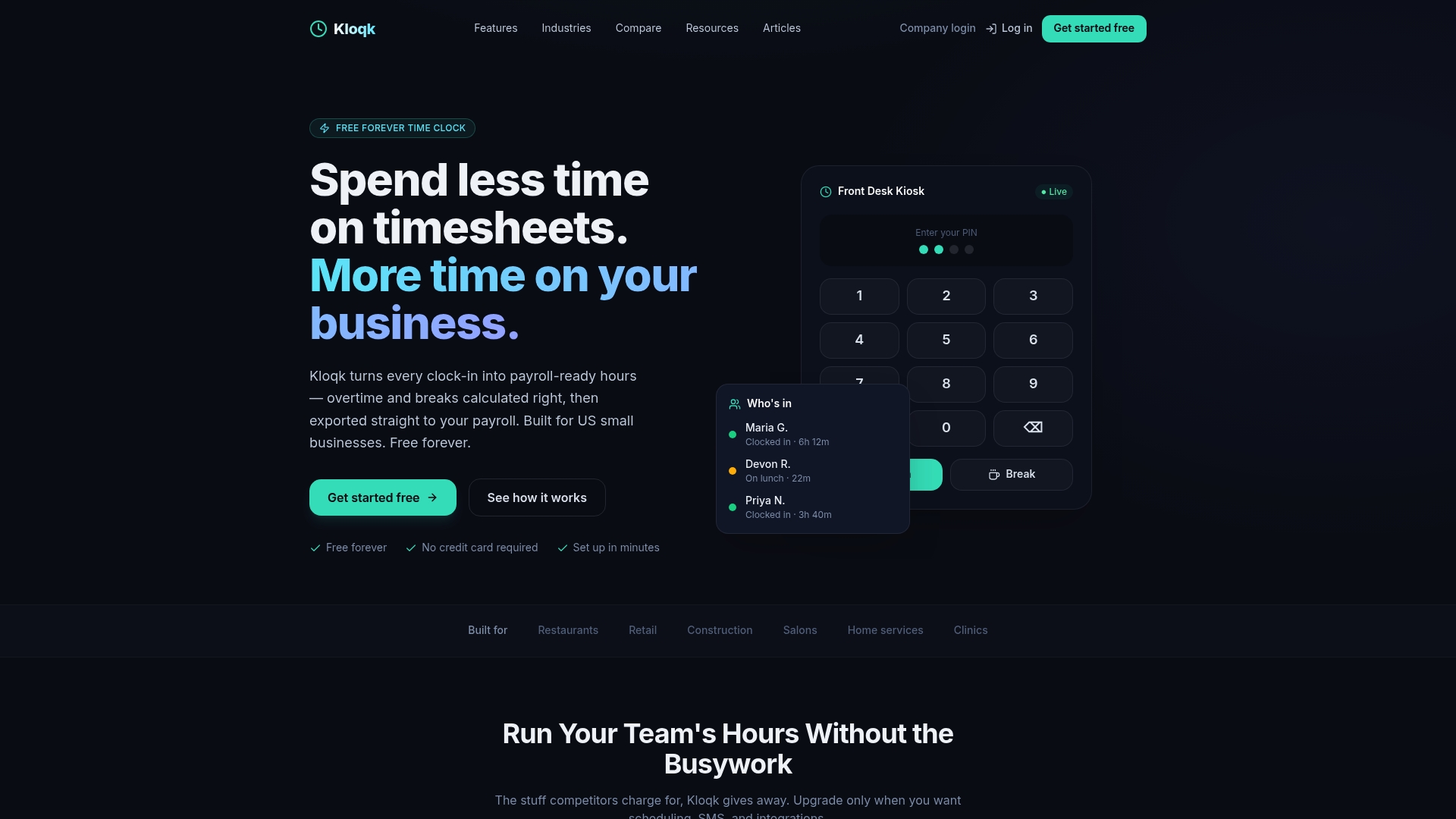
That matters because the fixes in this guide only work if the tools behind them are actually in use, not sitting unused because a manager balked at another line-item subscription. GPS geofencing confirms a worker clocked in at the right site. Photo verification stops buddy punching before it costs you a payroll dispute. And if your team is spread across multiple job sites, remote GPS time tracking keeps every clock-in tied to its actual location, not just a claim. Once you’re ready to layer scheduling on top, Kloqk’s construction resources walk through setting up scheduling software built for crew coordination and connecting it to time tracking on the construction industry page.
Set up your free account this week, connect it to your next weekly schedule, and check the morning scheduled-versus-actual report by Friday. That single habit will tell you more about where your crew scheduling is leaking time than a month of spreadsheet troubleshooting ever could.
Sources
The scheduling framework in this guide draws on PMI’s PMBOK Guide for its treatment of schedule management as a continuous, controlled process rather than a one-time task. Labor market context comes from the Associated Builders and Contractors’ 2022 workforce shortage release, which puts hard numbers behind why bench management matters more now than it used to.
For feature-level examples, CrewSnap’s approach to 3D scheduling and equipment coordination and SubTrade’s weekly grid and clock-in reconciliation model are both worth a look. For teams managing shared tools and materials across sites, Findle’s field guide to construction inventory management covers the equipment side of this problem in more depth. And Kloqk’s own work breakdown schedule guide and construction time tracking resource offer templates you can adapt directly.
- PMI PMBOK Guide
- ABC news release: construction industry faces workforce shortage of 650,000 in 2022
- CrewSnap Construction Crew Scheduling Software
Recommended
Sources
Every figure on this page traces to one of these. Primary law and government sources are listed first.
Written by
Sam TolbertWorkforce Operations Editor
Sam writes about scheduling, shift work, and the software that runs an hourly workforce, what actually saves time on the floor versus what just adds clicks.
Keep Reading
Track Hours the Easy Way
Kloqk is a free time clock that handles punches, breaks, overtime, and payroll-ready reports.
Start free