How Break Violations Affect Compliance in California

Missed meal and rest breaks in California don’t just create a scheduling headache. They trigger a layered set of statutory penalties that can compound quickly across a workforce, turning a single missed break into a multi-year litigation exposure. The core rule under Labor Code §226.7 is blunt: one additional hour of pay at the employee’s regular rate for each workday a required break wasn’t provided. That’s the floor, not the ceiling.
Here’s what that exposure actually looks like for an employer:
- Missed-break premium: One hour of pay per missed break per workday, per employee (Labor Code §226.7)
- Wage statement penalties: Up to $4,000 per employee under Labor Code §226 when premium pay isn’t correctly itemized on paystubs
- Waiting-time penalties: Up to 30 days of daily wages under Labor Code §203 when final pay at separation is short
- Attorneys’ fees and PAGA risk: Prevailing employees recover fees; Private Attorneys General Act claims multiply exposure across the entire workforce
- Labor Commissioner investigations: Systemic violations attract audits and civil enforcement
Pro Tip: Save the DLSE Meal Periods FAQ to your compliance folder now. It’s the agency’s own plain-language explanation of what “providing” a break actually requires, and it’s what investigators reference first.
Key Takeaways
California break violations create layered statutory exposure that compounds across employees and pay periods, the one-hour premium is the floor, not the total cost.
| Point | Details |
|---|---|
| Missed-break premium | One hour at the regular rate per missed break per workday, including nondiscretionary bonuses in the rate calculation. |
| Wage statement exposure | Failing to list the premium correctly on paystubs triggers penalties under Labor Code §226 that apply when premium pay isn’t correctly itemized on paystubs. |
| Waiting-time penalties | Unpaid premiums at separation can add additional potential wages owed under Labor Code §203 when final pay at separation is delayed or incomplete. |
| Rebuttable presumption defense | Contemporaneous schedules, break logs, and manager notes are the evidence that actually shifts the burden back to the employee. |
| Kloqk for break compliance | Kloqk’s free time tracking flags missed break punches and auto-queues exception reports, giving HR the audit trail California law expects. |
Table of Contents
- How break violations affect compliance: the full penalty picture
- What actually counts as a meal or rest break violation?
- What defenses actually hold up under the rebuttable presumption?
- What employers are actually required to do, and how to do it
- How to calculate and report the missed-break premium correctly
- What to do when you discover a violation
- Research-backed controls that actually reduce missed breaks
- An honest look at where HR teams actually fail
- Kloqk helps you catch break gaps before they become claims
- Sources
How break violations affect compliance: the full penalty picture
Each layer of exposure stacks independently. An employer who misses 50 meal breaks across a team over six months doesn’t face one penalty, they face up to 50 premium payments, potential wage statement violations on each of those pay periods, and waiting-time exposure for any employee who later separates.
The Ogletree analysis of California’s break penalty framework lays this out clearly: the statutory premium is just the entry point. Wage statement penalties under §226 apply when an employer fails to correctly list the premium on the paystub, even if the premium itself was paid. Waiting-time penalties under §203 apply at separation when wages owed (including unpaid premiums) aren’t paid in full and on time.
| Exposure type | Trigger | Typical amount |
|---|---|---|
| Missed-break premium | Each missed meal or rest break | 1 hour at regular rate per workday |
| §226 wage statement penalty | Incorrect or missing premium on paystub | $50 first violation, $100 each subsequent, up to $4,000 per employee |
| §203 waiting-time penalty | Unpaid wages at separation | Up to 30 days of daily wages |
| PAGA civil penalty | Any Labor Code violation | $4,000 per employee under Labor Code §226 |
| Attorneys’ fees | Employee prevails | Mandatory fee-shifting under California law |
Repeated or systemic violations shift the enforcement calculus sharply. A single complaint can trigger a Labor Commissioner investigation that covers the entire workforce and a three-year lookback period. Noncompliance costs routinely include reputational and operational damage well beyond the statutory fines, indirect costs that often exceed direct penalties by a significant multiple.
Aggregated enforcement analyses show that noncompliance costs fines, legal fees, remediation, and lost revenue, commonly exceed the cost of preventive compliance programs.
What actually counts as a meal or rest break violation?
California’s rules are more specific than most employers realize, and the gap between “we offer breaks” and “we provide compliant breaks” is where most violations originate.
Meal breaks must be at least 30 minutes, unpaid, and must begin no later than the end of the fifth hour of work. A second meal period is required before the end of the tenth hour. Rest breaks are paid, 10 minutes minimum, for every four hours worked (or major fraction thereof), roughly one in the middle of each four-hour block.

The DLSE is explicit: an employer must do more than make a break available. The employer must relieve the employee of all duty, relinquish control over their activities, and not impede or discourage them from taking the break. The Brinker Restaurant Corp. v. Superior Court (2012) standard confirmed this framework, employers must provide the opportunity, but don’t have to police whether employees actually take it, as long as no policy or practice discourages breaks.
Common violation triggers HR should map against current operations:
- Scheduling shifts that don’t build in break windows (a six-hour shift with no 30-minute meal period slot)
- On-call expectations during breaks (requiring employees to monitor phones or respond to messages)
- Production quotas or customer-service metrics that implicitly penalize employees for stepping away
- Manager language that discourages breaks (“we’re too busy right now,” “just finish this first”)
- Device monitoring or location tracking that signals employees aren’t truly off duty
On-duty meal exceptions exist but are narrow. Certain IWC Wage Orders (notably those covering healthcare and some single-employee operations) permit on-duty meal periods when the nature of the work prevents relief and the employee agrees in writing. That written agreement must be revocable at will. Don’t assume this exception applies without checking the specific Wage Order governing your industry.
Pro Tip: Pull your applicable IWC Wage Order from the DLSE website and compare your current break schedule against its timing rules line by line. Most HR teams discover at least one scheduling gap within the first 20 minutes.
What defenses actually hold up under the rebuttable presumption?
When an employee claims a break was missed, California courts and the Labor Commissioner apply a rebuttable presumption framework: if records show a break wasn’t taken, the employer bears the burden of showing it was provided and the employee chose not to take it.
The standard defenses, in plain terms:
- Bona fide relief from duty: The employer can show the employee was fully relieved, the break window was scheduled, and no policy or manager action impeded it.
- Lack of employer knowledge: The employer had a compliant policy, the break was scheduled, and the employee voluntarily skipped it without notifying management.
- Good-faith compliance belief: The employer followed DLSE guidance and applicable Wage Orders, maintained written policies, and trained managers consistently.
What actually moves the needle in a dispute is contemporaneous documentation. DLSE guidance and case law both place significant weight on records created at the time, not reconstructed after a complaint arrives.
Evidence that helps:
- Contemporaneous schedules showing break windows built into each shift
- Payroll records and timesheets with break start/end times logged
- Manager notes or exception logs when a break was missed and why
- Employee acknowledgment forms confirming receipt of the break policy
- Device or system logs showing employees were not active during break periods
The limits of each: schedules prove opportunity, not delivery. Timesheets can be altered. Employee acknowledgments prove the policy was communicated, not that it was followed. The strongest defense combines all of these, a written policy, a schedule that makes breaks feasible, and a contemporaneous record of what actually happened on each shift.
Pro Tip: Accurate timesheets are your first line of defense in any break dispute. A gap in the record is almost always read against the employer.
What employers are actually required to do, and how to do it
The legal obligation has three operational components: a written policy, a schedule that makes compliance physically possible, and manager behavior that doesn’t undercut either.
Written policy essentials:
- State the exact timing rules for meal and rest breaks by shift length (e.g., “Employees working more than five hours receive a 30-minute unpaid meal period before the end of hour five”)
- Reference the applicable IWC Wage Order by number
- Specify that breaks are duty-free and employees are relieved of all work obligations
- Include the process for reporting a missed break and how the premium will be paid
- Require employee signature acknowledging receipt
Scheduling requirements:
Your California lunch break policy must translate into actual shift templates. A six-hour shift needs a meal break window before hour five. An eight-hour shift needs two rest breaks and one meal period. Build these windows into your scheduling software as non-negotiable blocks, not suggestions.
Manager training, what to stop doing:
- Stop saying “finish this task first” when a break window opens
- Stop scheduling coverage so thin that taking a break creates a visible problem
- Stop treating break compliance as the employee’s responsibility alone
Recordkeeping minimums:
- Capture break start and end times on every shift, not just clock-in/out
- Log exceptions (missed breaks) with a reason code and the premium paid
- Retain records for at least three years (the California statute of limitations for wage claims)
- Run a weekly exception report to catch patterns before they become systemic
How to calculate and report the missed-break premium correctly
The one-hour premium is paid at the employee’s regular rate of pay, not just their base hourly wage. That distinction matters because the regular rate includes nondiscretionary bonuses, commissions, and shift differentials, anything the employee earned as a condition of employment.
Basic formula:
Regular rate = (Total straight-time earnings + nondiscretionary bonus) ÷ total hours worked in the workweek
Premium owed = Regular rate × number of missed breaks
Worked example:
An employee earns $20/hour and works 40 hours in a week, plus receives a $100 nondiscretionary attendance bonus. Two meal breaks were missed that week.
- Total earnings: ($20 × 40) + $100 = $900
- Regular rate: $900 ÷ 40 hours = $22.50/hour
- Premium owed: $22.50 × 2 missed breaks = $45.00
That $45 must appear as a separate line item on the wage statement. Burying it in regular wages or labeling it incorrectly triggers §226 exposure on top of the premium itself.
| Payroll element | Include in regular rate? |
|---|---|
| Base hourly wage | Yes |
| Nondiscretionary bonus | Yes |
| Shift differential | Yes |
| No | |
| Discretionary bonus | No |
| Expense reimbursements | No |
Recommended payroll procedures:
- Configure your payroll system to flag any shift where a break wasn’t recorded
- Calculate the regular rate each workweek before processing premiums (not at a flat base rate)
- List the premium as “Meal Period Premium” or “Rest Break Premium” on the paystub with hours and rate
- Run a quarterly true-up to catch any periods where nondiscretionary bonuses weren’t factored in
- Document the calculation method in your payroll procedures manual
California’s FLSA time rounding rules interact with break calculations, federal rounding practices don’t override California’s requirement to pay the full premium for each missed break.
What to do when you discover a violation
Speed matters. The longer a violation pattern runs uncorrected, the larger the lookback exposure and the harder it becomes to argue good faith.
Immediate response steps:
- Stop the bleeding: identify the affected employees, shifts, and time period within 48 hours of discovery
- Calculate and pay the premium owed before the next regular payday, don’t wait for a formal demand
- Issue corrected wage statements if the original paystubs didn’t list the premium correctly
- Preserve all records: schedules, timesheets, manager notes, and system logs from the affected period
- Notify employment counsel if the pattern spans more than one location or more than 30 days
Internal audit checklist:
- Pull a shift-level sample (at least 10% of shifts per location per quarter) and check for break gaps
- Cross-reference manager schedules against break records to identify concentrated patterns
- Review payroll records for any period where nondiscretionary bonuses weren’t included in the regular rate
- Interview a sample of managers about their break communication practices
- Check whether exception workflows are actually triggering premium payments when breaks are missed
Red flags that suggest systemic risk: violations concentrated in one store or under one manager, a consistent gap between scheduled break windows and actual break records, or a pattern of employees clocking back in within 20 minutes of a meal break start.
Prompt remedial action can materially reduce enforcement exposure. Regulators and courts view voluntary remediation favorably, a self-correcting employer is treated differently than one that waits for a lawsuit.
Pro Tip: Run your first internal audit before you receive a complaint. A self-initiated audit that finds and corrects violations is a far stronger good-faith argument than one triggered by a PAGA notice.
Research-backed controls that actually reduce missed breaks
Punishing employees for missing breaks doesn’t fix the problem. Organizational research consistently shows that compliance improves more when employees understand the reason behind a rule and feel the enforcement is fair than when they’re simply threatened with consequences. That finding applies directly to break compliance: managers who explain why breaks matter and who model taking them produce better outcomes than managers who post a policy and move on.
Studies on motivation and compliance find that intrinsic motivation and transparent enforcement produce more sustained rule-following than deterrence alone, frequent small nudges outperform rare, severe punishments.
Consistent, transparent enforcement matters too. When employees perceive that break rules are enforced selectively, some managers care, others don’t, long-term compliance commitment drops.
Specific technical controls worth implementing:
- Automated break reminders: Push notifications at the scheduled break window, sent to both the employee and their manager
- Mandatory break clocks: Require employees to clock out for meal periods in your time-tracking system; flag any shift where no break punch appears
- Exception-triggered premium payments: Configure payroll to auto-calculate and queue the one-hour premium whenever a break punch is missing
- Geofencing and photo verification: Confirm employees are actually off-site or away from workstations during breaks where location matters
- Weekly exception reports: Surface missed-break patterns by location, shift, and manager before they compound
Implementation tip: pilot new controls in one location with pre-defined metrics (missed-break rate, exception percentage, payroll true-up accuracy) before rolling out company-wide. A ComplianceStack analysis of enforcement data supports the business case, preventive controls consistently cost less than the remediation that follows a pattern violation.
An honest look at where HR teams actually fail
The most common compliance gap isn’t ignorance of the law. Most HR professionals in California know the one-hour premium exists. The failure usually happens at the operational layer: a scheduling template that was built for efficiency, not compliance; a manager who genuinely believes “we’re too busy” is a valid reason to delay a break; or a payroll system that flags overtime but has no break exception workflow at all.
The fix is almost always simpler than the litigation that follows. Pay the premium the moment you discover a missed break. Fix the schedule so the break window is physically possible. Retrain the manager with specific language, not a policy memo. These three steps, done promptly, reduce litigation risk more than any legal defense strategy.
The employers who end up in class actions aren’t usually the ones who had bad intentions. They’re the ones who had a gap between their written policy and their operational reality, and didn’t catch it until an employee’s attorney did.
Kloqk helps you catch break gaps before they become claims
Tracking breaks manually across a team of hourly workers is where compliance gaps hide. Kloqk’s free employee time tracking platform flags missed break punches automatically, so your payroll team sees exceptions before the pay period closes, not after a complaint arrives.
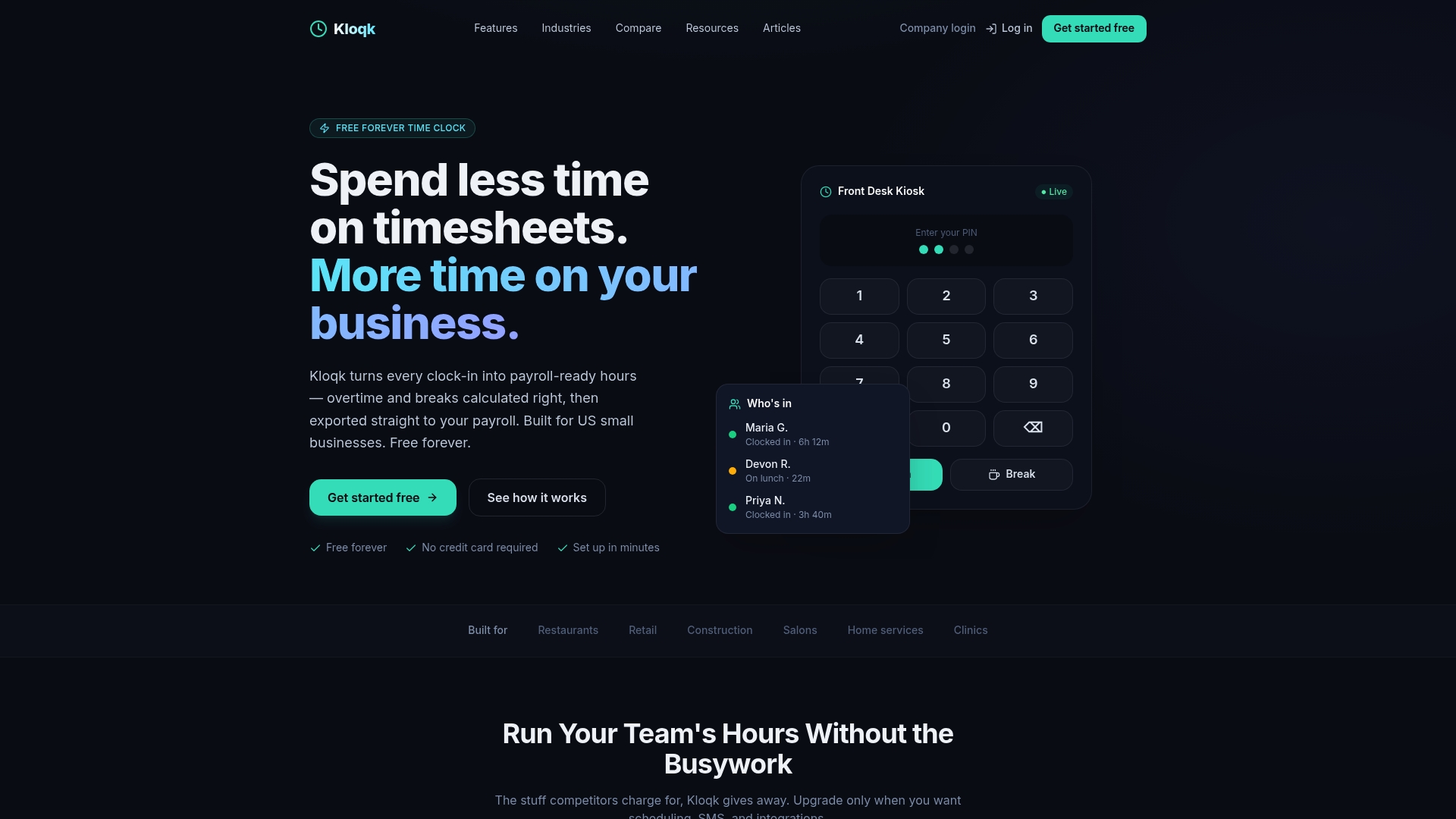
Break tracking, overtime calculations, and payroll-ready exports are included at no cost. The GPS time clock and photo verification features add a layer of contemporaneous documentation that holds up in disputes. For HR teams managing multiple locations, centralized exception reports surface patterns by site and shift, exactly the audit visibility that regulators expect to see. Start with Kloqk’s free plan and run your first break exception report this week at Kloqk.
Sources
- Division of Labor Standards Enforcement (DLSE) Meal Periods FAQ
- Why Does California Impose Such High Penalties for Rest Break Violations? - Ogletree
- Real Cost of Non-Compliance 2026: 500+ Enforcement Actions, ComplianceStack
- Organizational research on motivation and compliance (OSF preprint)
This article is general information, not a substitute for advice from a qualified lawyer. Consult a qualified legal professional about your own circumstances before acting on anything here.
Recommended
Sources
Every figure on this page traces to one of these. Primary law and government sources are listed first.
Written by
Dana WhitfieldHR Compliance Lead
Dana writes about wage-and-hour law, FLSA overtime, and leave compliance for U.S. small businesses, translating dense regulations into plain steps owners can act on.
Keep Reading
Track Hours the Easy Way
Kloqk is a free time clock that handles punches, breaks, overtime, and payroll-ready reports.
Start free