Do Exempt Employees Need to Track Their Hours Under FLSA?

Federal law does not require it. The FLSA lets employers skip daily or weekly hour records for properly classified exempt employees, and DOL Fact Sheet #17G confirms it directly. Employers can still require exempt staff to log time, but such requirements should be applied carefully to avoid legal risks if records are used improperly.
- You may require time tracking for exempt employees, but never as a basis to cut pay outside the salary-basis rules.
- Two narrow exceptions force hourly verification: Section 7(i) commission arrangements and FMLA eligibility disputes.
- Retention and format requirements live in 29 CFR Part 516, the federal recordkeeping regulation.
Table of Contents
- FLSA Exempt Time Tracking: What Federal Law Actually Requires
- When Is Hourly Tracking Actually Required for Exempt Staff?
- How Do You Build a Compliant Exempt Time-Tracking Policy?
- What’s the Best Way to Track Exempt Employee Hours Day to Day?
- Why Consistency Beats Cleverness in Exempt Time Policies
- How Kloqk Builds Compliant Time Tracking for Exempt Teams
- Where to Verify These Rules Yourself
- Sources
FLSA Exempt Time Tracking: What Federal Law Actually Requires
The Fair Labor Standards Act sets different rules for exempt and non-exempt employee time tracking, and the gap between them trips up more HR teams than any other wage-and-hour issue. For non-exempt workers, 29 CFR Part 516 demands daily and weekly hour logs. For exempt employees, that same regulation only requires basic identity and pay data: name, job title, pay rate, and total wages paid each period.
Payroll records need to stay on file according to federal retention requirements, including keeping payroll records and supporting documents for specified minimum periods as per 29 CFR Part 516.
The harder question is exemption status itself, especially when considering how to automate overtime calculation for your workforce to reduce errors and improve compliance. Part 541’s duties tests, paired with the salary-basis rule, determine whether an employee qualifies as exempt in the first place, and job titles carry zero legal weight on their own.
- The salary-basis rule requires a predetermined, fixed salary that does not fluctuate based on hours worked or quality of output.
- Deductions are only permissible in specific circumstances, such as full-day absences for personal reasons or disciplinary suspensions for workplace conduct violations.
- A pattern of improper deductions, what the DOL calls an “actual practice,” can void the exemption for an entire job category, not just the one employee affected.
That last point deserves attention. One improper deduction is a mistake you can fix. A repeated pattern is a legal problem that can retroactively convert an entire department to non-exempt status, triggering back overtime pay across the board.
When Is Hourly Tracking Actually Required for Exempt Staff?
Most exempt roles never need hour-by-hour records. A handful of situations change that.
- Section 7(i) commission exception. Retail and service employees paid on commission need their regular hourly rate verified to confirm they meet the exception’s conditions, which makes some hours documentation unavoidable (Fact Sheet #20).
- FMLA eligibility disputes. Workers need 1,250 hours in the prior 12 months to qualify for FMLA leave. Without records, the burden of proof lands on you as the employer, not the employee claiming eligibility.
- State and local law. Several states layer additional recordkeeping obligations on top of federal rules, sometimes covering exempt employees the FLSA leaves alone. Check your state labor department before assuming federal minimums are enough.
- Alternative pay structures. Piece-rate arrangements, certain computer-employee exemptions, and hybrid comp plans often need hours data just to calculate pay correctly, separate from any FLSA mandate.
Pro Tip: Keep a simple weekly total for any exempt employee whose FMLA eligibility is even remotely in question. It costs you almost nothing now and can save a costly dispute later, since FLSA recordkeeping guidance puts the evidentiary burden on employers who can’t produce hours data.
How Do You Build a Compliant Exempt Time-Tracking Policy?
A written policy protects you far more than an informal habit of asking managers to “keep an eye on it.” Build yours around four elements: purpose, scope, format, and enforcement.
State the purpose plainly, whether that’s attendance verification, client billing, or leave tracking, and stick to it. Define who the policy covers by job classification, not department, since exemption status varies within teams. Choose a record format, exceptions reporting, weekly totals, or full clock-ins, and apply it the same way across every employee in that classification.
- Train every manager on the same standard so enforcement doesn’t vary team to team, which invites disparate-treatment claims.
- Document every exception, absence, or deviation the moment it happens, not weeks later during a payroll reconciliation.
- Keep salary deductions limited to legally permissible categories: full-day personal absences, disciplinary suspensions for safety or conduct violations, and a few narrower carve-outs under Part 541.
- Store records the same way you’d store any sensitive HR file, with clear retention dates and restricted access.
The single biggest red flag auditors look for is a deduction that tracks suspiciously close to actual hours worked, since that pattern suggests the salary is functioning as disguised hourly pay. Reviewing what qualifies as overtime manipulation helps managers spot both employee-side gaming and employer-side deduction risk in the same review.
Pro Tip: Run a quarterly audit of every salary deduction made for exempt employees. If a deduction shows up for anything other than a full-day absence or a documented disciplinary suspension, flag it for legal review before the next pay cycle.
| Point | Details |
|---|---|
| Written policy scope | Define exactly which job classifications the policy covers and why. |
| Manager consistency | Train all managers to the same standard to avoid disparate treatment claims. |
| Deduction limits | Restrict pay deductions to legally permissible categories under Part 541. |
| Retention discipline | Keep payroll records three years, supporting records two years. |
What’s the Best Way to Track Exempt Employee Hours Day to Day?
Three approaches cover almost every exempt role without creating pay-linkage risk.
- Exceptions reporting. Employees confirm their standard schedule and flag only deviations, like a half-day absence or an early departure, rather than logging every hour.
- Weekly total submissions. A single end-of-week entry captures general capacity or project allocation without hour-by-hour granularity.
- Occasional punch-in for billing. Client-facing or project-based roles sometimes need clock-ins purely to support accurate invoicing, kept entirely separate from payroll calculations.
Whichever method you pick, apply DOL-consistent rounding practices if any rounding happens at all, and use a distinct flag for PTO or absence entries so they never get confused with hours-based pay adjustments.
- Route every exception through a manager sign-off before it hits payroll, closing the gap between what happened and what got recorded.
- Reconcile exception reports against payroll monthly, not just at year-end, so errors get caught while they’re still fixable.
- Name and file records consistently (by employee, month, and record type) so you can produce a specific request within hours if the DOL ever asks.
Off-the-clock work deserves its own line of attention here. Exempt employees answering emails at 9 PM or finishing a report over the weekend isn’t an FLSA problem the way it would be for non-exempt staff, since salary covers the job, not the clock. The real risk shows up when informal after-hours work patterns get treated as grounds to adjust pay downward in a slow week. That link between hours and pay is exactly what salary-basis rules prohibit.
Why Consistency Beats Cleverness in Exempt Time Policies
Most compliance failures I’ve seen analyzed in DOL guidance don’t come from a bad policy on paper. They come from a good policy applied unevenly, one manager granting flexibility another manager doesn’t, one department documenting exceptions while another lets things slide informally.

Consistent enforcement and manager training reduce litigation exposure more than any clever tracking method ever will. A tool that logs exceptions perfectly is worthless if half your managers ignore it and the other half use it to justify pay cuts. Keep the use of time data strictly neutral, attendance and billing, never a backdoor calculator for shaving salary.
When a classification decision sits anywhere near the line, document your reasoning and loop in employment counsel before rolling out a new tracking requirement. The cost of that conversation is nothing next to the cost of an “actual practice” finding that converts an entire job category to non-exempt retroactively.
Saad
How Kloqk Builds Compliant Time Tracking for Exempt Teams
Kloqk gives small employers a free way to run this playbook without building it from scratch. The platform separates attendance tracking from payroll triggers by design, so an exempt employee’s exception report or weekly total never automatically converts into a pay calculation. That distinction is exactly what keeps a documentation habit from turning into a salary-basis violation.
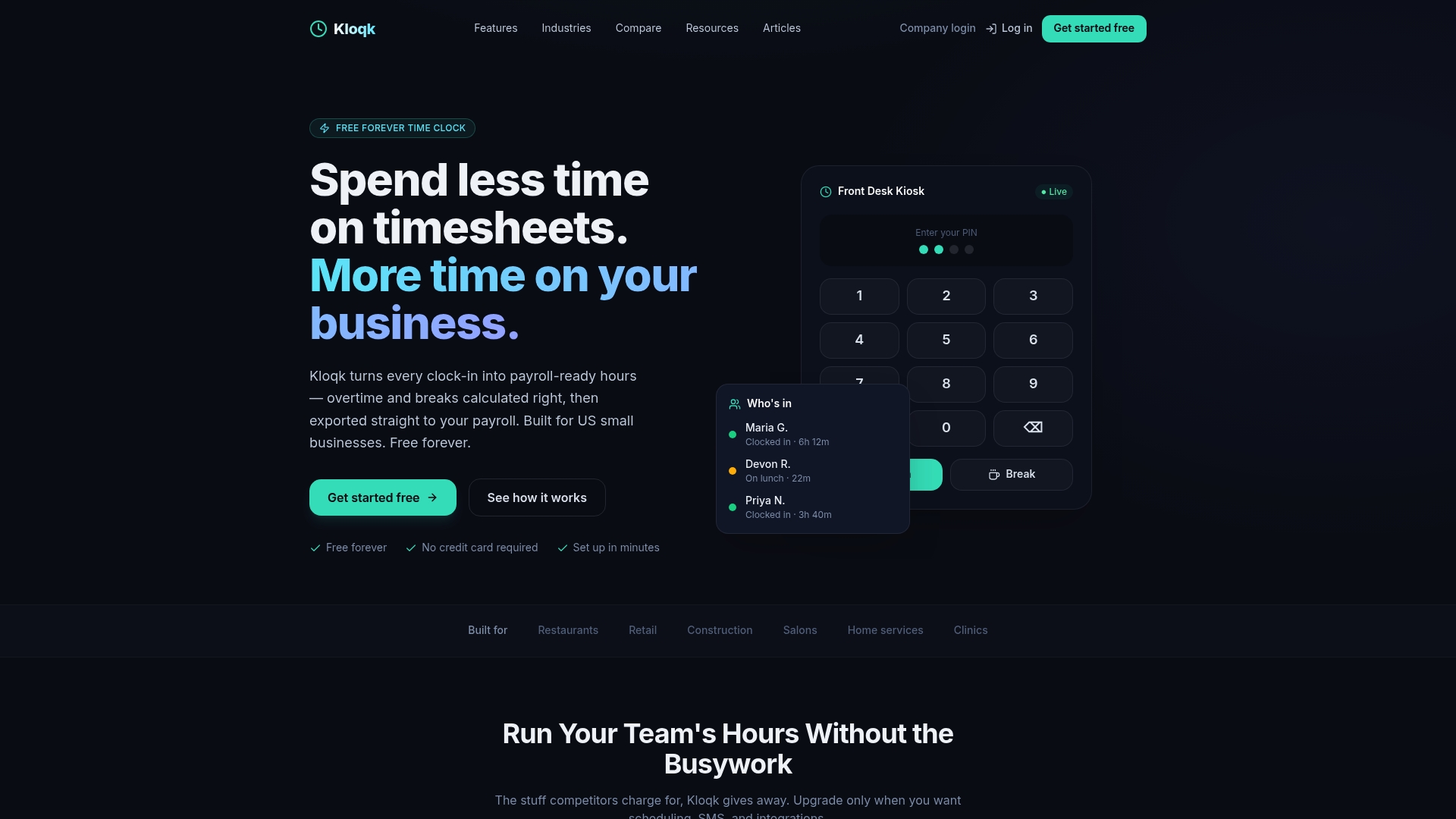
The free employee time tracking features include overtime calculations for your non-exempt staff, photo verification at clock-in, and payroll-ready exports, all configurable so exempt roles can use a lighter attendance flag while hourly teams use full time capture. GPS geofencing adds location verification for field or multi-site teams without forcing every employee into the same tracking method. Set up an exceptions-only workflow for your exempt staff in minutes, and keep your hourly crews on full clock-in tracking, all inside one free account built for restaurants, construction crews, clinics, and retail teams juggling mixed classifications.
Under federal law, exempt employees don’t have to track hours, but a documented, consistently enforced policy is what actually protects your business when a classification gets questioned.
| Point | Details |
|---|---|
| Federal minimum | FLSA does not require daily or weekly hour logs for properly classified exempt employees. |
| Risk lives in usage | Improper pay deductions tied to time records can void the exemption entirely. |
| Exceptions matter | Section 7(i) commissions and FMLA eligibility disputes are the clearest cases requiring hours data. |
| Retention rule | Keep payroll records three years and supporting records two years per 29 CFR Part 516. |
| Practical tool | Kloqk separates attendance flags from payroll triggers so exempt tracking stays low-risk. |
Where to Verify These Rules Yourself
- DOL Fact Sheet #17G on salary-basis rules and Part 541 exemptions
- 29 CFR Part 516 on recordkeeping requirements
- DOL Small Entity Compliance Guide for practical recordkeeping methods
- Exempt vs. non-exempt classification test for a quick internal check
This article is general information, not a substitute for advice from a qualified lawyer. Consult a qualified legal professional about your own circumstances before acting on anything here.
Sources
- Fact Sheet #17G: Salary Basis Requirement and the Part 541 Exemptions Under the Fair Labor Standards Act (FLSA) | U.S. Department of Labor
- 29 CFR Part 516 General Recordkeeping Requirements
- Small entity compliance guide | U.S. Department of Labor
Recommended
Sources
Every figure on this page traces to one of these. Primary law and government sources are listed first.
- 1. U.S. Department of Laborprimary
- 2. Electronic Code of Federal Regulationsprimary
- 3. timeprof.co.uk
Written by
Dana WhitfieldHR Compliance Lead
Dana writes about wage-and-hour law, FLSA overtime, and leave compliance for U.S. small businesses, translating dense regulations into plain steps owners can act on.
Keep Reading
Track Hours the Easy Way
Kloqk is a free time clock that handles punches, breaks, overtime, and payroll-ready reports.
Start free