A Restaurant Onboarding Checklist That Actually Sticks

Use a phase-based restaurant onboarding checklist covering pre-boarding, Day 1, Week 1, and 30/60/90-day milestones, paired with role-specific tasks for FOH, BOH, and managers. The three things to nail first: paperwork before the first shift, an assigned buddy or trainer, and a written first-week training map. Track hours and task completion from day one to catch payroll and compliance errors before they compound.
TL;DR:
- Completing all compliance tasks, including I-9, W-4, and certification forms, on time is essential to avoid legal risks and costly audits.
- Role-specific onboarding should be thorough, ensuring FOH staff master POS and payment systems, BOH staff verify recipe standards, and managers can run shifts independently within two weeks.
- Tracking onboarding metrics like 30-day retention, checklist completion, and first-paycheck accuracy helps identify system gaps and improve future training effectiveness.
- Simplifying processes with pre-created accounts, clear checklists, and automated payroll verification reduces the risk of onboarding abandonment and training inconsistency.
- Using free tools like Kloqk for time tracking and payroll ensures accurate first payments, GPS verification, and minimizes manager oversight during initial shifts.
Table of Contents
- Restaurant Onboarding Checklist: The Pre-Boarding Phase
- What to Cover on Day 1
- Week 1 Training Checklist and Milestones
- Compliance and Certification Checklist
- Role-Specific Onboarding Checklists for FOH, BOH, and Managers
- The 30/60/90-Day Onboarding Review
- Systems and Tools That Make Onboarding Repeatable
- Measuring Onboarding Success and Improving Retention
- Why Most Onboarding Checklists Fail in Practice
- Simplify Onboarding With Free, Accurate Time Tracking
- Sources
Restaurant Onboarding Checklist: The Pre-Boarding Phase
The days between a signed offer and a first shift decide whether Day 1 feels organized or chaotic. Get the admin done here so training time isn’t eaten by paperwork.
Send a short welcome message covering arrival time, dress code, who to ask for at the door, parking, and anything they should bring (ID, banking info for direct deposit). This one detail alone tends to cut down on no-show first shifts, since new hires who know exactly what to expect are less likely to get cold feet.
Pre-boarding checklist:
- Send offer acknowledgment and confirm start date, shift, and reporting manager
- Collect or schedule collection of W-4, direct deposit form, and emergency contact info
- Explain what identification to bring for I-9 verification
- Create POS login, time-clock profile, and scheduling account
- Add the new hire to the team chat or email group
- Assign a buddy or trainer and send them a one-page training map
- Prep uniform, locker or storage space, and a name tag
- Draft the Day 1 agenda so the shift lead knows what to cover
Copy this list into whatever scheduling or HR tool you already run, and check items off as they’re completed rather than the morning of.
What to Cover on Day 1
A good first shift follows a script, not a manager’s mood. Here’s the order that works:
- Quick welcome and introduction. Two minutes with the manager, not a formal sit-down. Set the tone: friendly, direct, here’s what today looks like.
- Finish mandatory paperwork. Complete I-9 Section 1 and any remaining W-4 or payroll forms. Federal rules require Section 1 by the first day of work and Section 2 within three business days after that, so don’t let this slide to Week 1.
- Walk the facility in workflow order. Start where a shift actually starts (POS station, walk-in, prep line) rather than a random tour. Introduce the new hire to teammates by name and role as you go, not as a lineup.
- Show the core systems. Clock in and out, basic POS order flow, how to check the schedule, and where SOPs or recipe cards live.
- Run the end-of-day check-in. Ask what confused them, confirm tomorrow’s shift time, and hand off any notes to the closing manager.
Keep the agenda visible. A written checklist prevents the common failure mode where a busy shift swallows the new hire’s entire orientation and nobody notices until Week 3.
Week 1 Training Checklist and Milestones
The first week should move from watching to doing to mostly-solo, in that order. Rushing this sequence is the single most common reason new hires freeze up during a rush.
- Day 1 to 2: Shadow a trained employee for a full shift; introduce food safety and allergen basics early, since these are non-negotiable regardless of role
- Day 2 to 3: Supervised hands-on tasks; enroll in ServSafe or a state-approved food handler course if not already certified
- Day 3 to 4: FOH staff should hit basic POS and payment-handling competency; BOH staff should have station setup and recipe specs down
- Day 4 to 5: Partial solo shifts with the buddy nearby, not hovering
- End of week: Buddy sign-off on core tasks, plus a short manager check-in
A one-page station checklist or a quick recorded demo of a common task (how we ring in a modifier, how we plate the special) does more for consistency than another verbal walkthrough. Buddies who work from a written training map produce far more consistent results than buddies left to freestyle, which is where most “he never showed me that” complaints come from.
Pro Tip: Give every buddy a five-minute checklist review before their first training shift. Ad-hoc buddy training is the number one reason two new hires from the same cohort end up with wildly different skill levels by Week 2.

Compliance and Certification Checklist
Compliance tasks are easy to forget in the rush of Day 1, but they carry real legal exposure if skipped.
- I-9 Section 1 by the first day; Section 2 within three business days, per Department of Labor guidance
- W-4 and any required state withholding forms
- Direct deposit enrollment
- Food handler or ServSafe certification, on the timeline your state or city requires
- Alcohol-service certification if the role touches bar or table service
- OSHA-aligned safety briefing covering hazard communication and emergency procedures
- Written disclosure of tip policy and any tip-credit notice your state mandates
- A single tracking sheet (digital or paper) where every proof of completion lives
Employee turnover carries real, measurable cost, and a big share of that cost traces back to gaps in structured onboarding, according to Cornell’s analysis of turnover economics. Skipping compliance steps to save five minutes on Day 1 is a poor trade against that cost.
Keep one tracking sheet per employee rather than scattering proofs across email threads and paper folders. When a labor audit happens, you want everything in one place.
Role-Specific Onboarding Checklists for FOH, BOH, and Managers
A universal checklist gets a new hire through the door. A role-specific one gets them to “ready to solo.”
Front of house:
- Memorize the menu, including allergens and daily specials
- Practice upsell language until it sounds natural, not scripted
- Master the full payment workflow, including splits and voids
- Understand tip reporting and pooling rules
- Pass POS certification (a manager sign-off, not just a login)
Back of house:
- Demonstrate equipment safety on every station they’ll work
- Show mise en place setup from memory, not a cheat sheet
- Match recipe specs and portion sizes on a plating check
- Sign off on sanitation basics for their station
Managers:
- Run a full open and close unsupervised
- Reconcile a register or drawer without error
- Complete a basic inventory count
- Handle a staffing gap or guest complaint with a supervisor observing
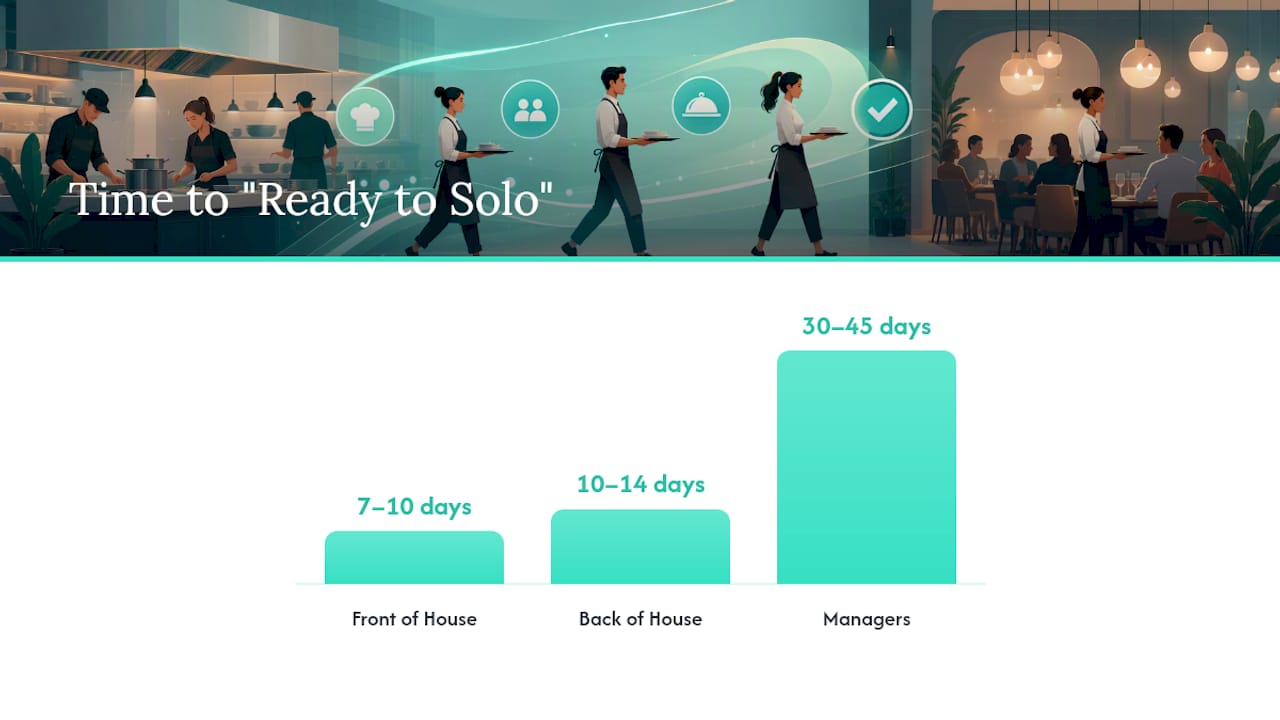
“Ready to solo” typically means a FOH server passes independently within 7 to 10 days, a line cook within 10 to 14, and a shift manager within 30 to 45. Faster isn’t always better here. A rushed sign-off just moves the training gap to a busier night.
The 30/60/90-Day Onboarding Review
Staged check-ins catch problems while they’re still cheap to fix.
- 30 days: Review menu quiz scores, supervised shift counts, and attendance. Ask directly: what’s still confusing? What would make your shifts easier?
- 60 days: Confirm independent competency on core tasks. Look at speed and error rate, not just whether the task got done.
- 90 days: Decide fit. This is when SHRM’s research on structured onboarding shows retention gains really show up, since employees who make it here with regular manager check-ins tend to stay longer.
Update the training checklist itself at each milestone. If three hires in a row stumble on the same POS step, that’s a checklist problem, not a hiring problem.
Systems and Tools That Make Onboarding Repeatable
Before Day 1, have accounts ready in every system a new hire will touch: POS, time clock, scheduling, e-sign for paperwork, and wherever your SOPs live. Pre-creating these saves 20 to 30 minutes of Day 1 setup time that should go toward actual training instead.
- POS login and role permissions set in advance
- Time-clock profile created and tested before the first punch
- Scheduling app access confirmed
- E-sign links sent for any remaining forms
- SOP or knowledge-base access shared on Day 1, not Week 2
This is where Kloqk’s free time tracking fits naturally into onboarding: payroll-ready timesheets, automatic overtime and break calculations, and photo or GPS verification at clock-in mean a new hire’s first paycheck comes out accurate without a manager reconciling punches by hand.
Pro Tip: Test every new hire’s clock-in on a slow morning before their first real shift. Fixing a login issue during a Tuesday lunch prep beats discovering it during Friday dinner rush.
Measuring Onboarding Success and Improving Retention
Track a small set of numbers rather than a gut feeling: 30-day retention rate, time-to-independence (days to first solo shift), checklist completion rate, and first-paycheck accuracy.
- Try a better welcome message and measure no-show rate on Day 1
- Assign buddy ownership explicitly and track sign-off consistency
- Record one short demo video per station instead of relying on live walkthroughs every time
- Run a brief 30/60/90 survey and actually revise the checklist based on answers
Turnover is expensive enough that even a modest bump in 30-day retention pays for itself many times over in reduced rehiring and retraining costs.
Why Most Onboarding Checklists Fail in Practice
The checklists restaurants build usually aren’t wrong. They’re just abandoned by Week 3, once the manager who wrote them gets pulled into a hundred other fires. I’ve seen this pattern play out the same way across small operators: a beautiful onboarding document gets built once, used for two hires, then quietly ignored while training reverts to “shadow Steve for a shift and figure it out.”
The fix isn’t a better document. It’s fewer moving parts. A pre-boarding message, a buddy with a one-page map, and a time clock that doesn’t require a manager to babysit the payroll math afterward will outperform an elaborate 15-page manual that nobody opens twice. Compliance and culture matter, but they survive contact with a busy Friday only when the system underneath them is simple enough to run without a manager standing over it.
If there’s one contrarian point worth taking from all this: the goal isn’t a perfect checklist. It’s a checklist boring enough that your busiest shift lead still follows it on a bad night.
Saad
Simplify Onboarding With Free, Accurate Time Tracking
Kloqk handles the part of onboarding managers dread most: making sure the first paycheck is right. The free plan includes payroll-ready timesheets, automatic overtime and break calculations, and photo or GPS verification at clock-in, so a new hire’s punches turn into accurate hours without a manager cross-checking a spreadsheet.
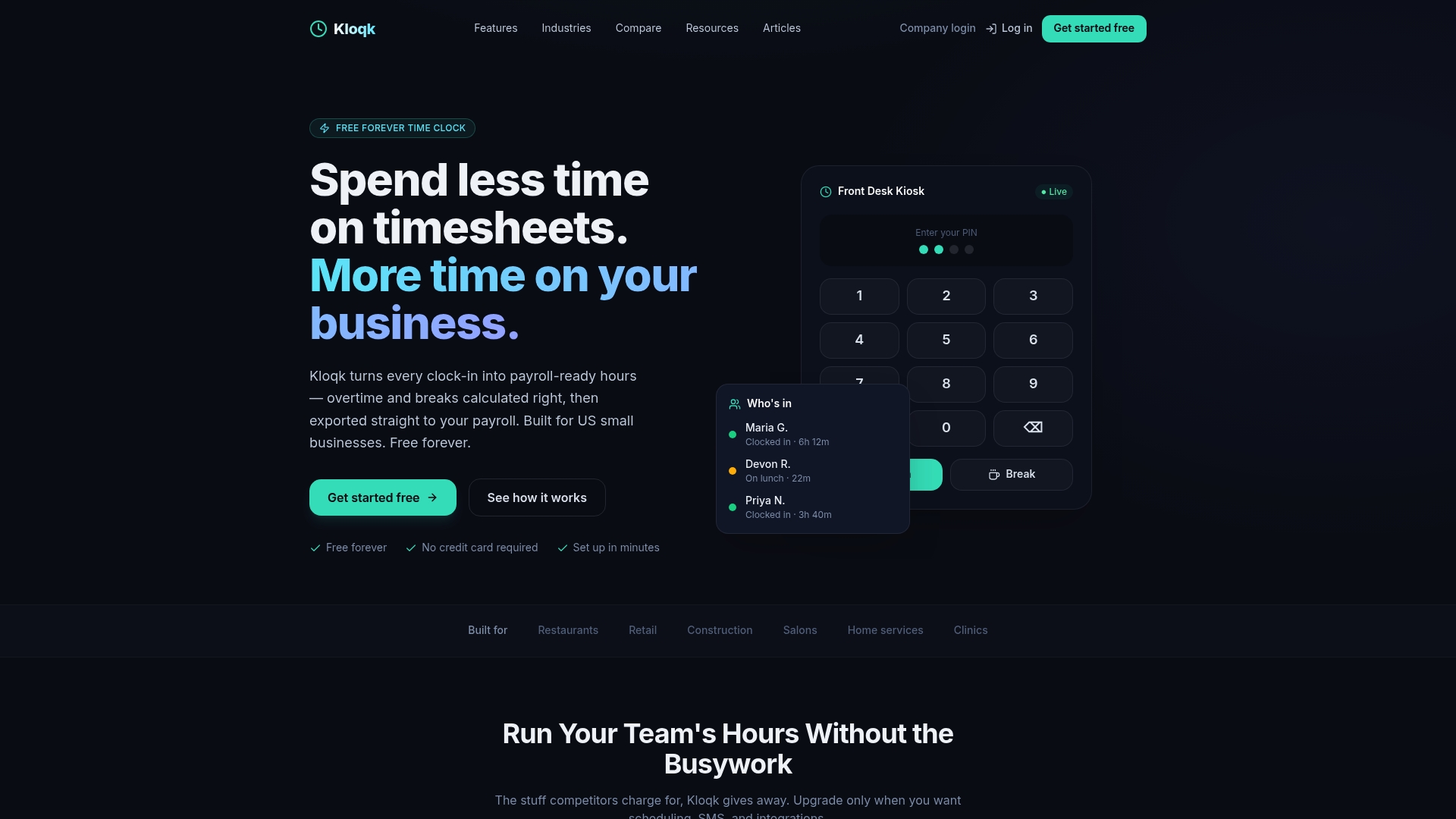
Set it up during pre-boarding: create the new hire’s profile, test a clock-in on their first shift, and export payroll once the pay period closes. For multi-location operations, Kloqk’s GPS geofencing confirms staff are actually clocking in on-site, and the free clock-in/clock-out app works the same way whether the hire punches in from a kiosk or their phone. Start a free account and add your next new hire before their first shift.
Sources
- Restaurant onboarding and training playbook (NYC Business)
- U.S. Department of Labor Fair Labor Standards Act (FLSA) and related guidance
- Cornell eCommons The cost of employee turnover (study)
Recommended
Sources
Every figure on this page traces to one of these. Primary law and government sources are listed first.
- 1. U.S. Department of Laborprimary
- 2. nyc-business.nyc.gov
- 3. ecommons.cornell.edu
Written by
Priya NairPeople Operations Writer
Priya focuses on HR and hiring for small teams, onboarding, scheduling people fairly, and the day-to-day of managing hourly staff without an HR department.
Keep Reading
Track Hours the Easy Way
Kloqk is a free time clock that handles punches, breaks, overtime, and payroll-ready reports.
Start free