The 8 and 80 Rule: How Overtime Works in Healthcare

The 8 and 80 rule is an overtime option under the Fair Labor Standards Act (FLSA) for hospitals and residential care establishments. Instead of paying overtime after 40 hours in a seven-day workweek, the employer uses a fixed 14-day period. Time-and-a-half is owed for every hour over 8 in a workday and every hour over 80 in the 14 days. The employer needs a prior agreement or understanding with the employees first. Most other employers cannot use it.
This guide covers who qualifies, what the agreement must say, how to calculate pay with worked examples, how state law changes the result, and how to track the hours.
TL;DR
- Under FLSA section 7(j), hospitals and residential care establishments may use a 14-day period with overtime after 8 hours a day and after 80 hours per period, according to the Department of Labor.
- The employer must reach an agreement or understanding with affected employees before the work is performed, and the 14-day period must be fixed and recurring.
- Daily overtime applies even if the employee never reaches 80 hours in the period.
- An employer can use 8 and 80 for some employees and the standard 40-hour system for others, but never both for the same person.
- If state law gives a higher overtime standard, the employee gets the higher one.
Table of Contents
- What the 8 and 80 rule is
- Who can use it
- What an employer must do before using it
- How to calculate 8 and 80 overtime
- Common mistakes
- How state law changes the result
- Tracking 8 and 80 hours without spreadsheets
- Perspective
- Start with clean time records
- How 8 and 80 compares with other schedules
- A short checklist for employers
- FAQ
- Sources
What the 8 and 80 rule is
The standard FLSA rule says covered, nonexempt employees get at least one and one-half times their regular rate for hours over 40 in a workweek. The Department of Labor’s FLSA questions and answers note special circumstances and exceptions to that rule, including hospitals and nursing homes under the 8 and 80 system.
The exception exists because healthcare schedules rarely fit a clean Monday-to-Sunday week. Shifts run 12 hours, nurses swap days, and staffing follows patient census. Section 7(j) of the FLSA lets a qualifying employer measure overtime across 14 consecutive days instead. The regulation at 29 CFR 778.601 sets out the conditions.
The name is the formula:
- 8: overtime for any hours over 8 in a workday within the 14-day period.
- 80: overtime for any hours over 80 in the 14-day period.
Both tests run at the same time, and both pay at one and one-half times the regular rate.
Who can use it
The exception is narrow. It applies to employment in hospitals and residential care establishments. The Department of Labor’s Fact Sheet #54 describes it for those facilities. Fact Sheet #31 says a nursing care facility may pay overtime after more than 8 hours in a day and more than 80 hours in a 14-day period, with a prior agreement. The Health Care Workers page makes the same point for nursing homes and residential living facilities.
That means a few things for owners and managers:
- A hospital or a nursing home can consider it.
- A retail store, restaurant, construction crew or general office cannot adopt it just because the math looks convenient.
- A clinic should confirm with its attorney or payroll advisor whether it fits the hospital or residential care category before relying on it.
If you are a restaurant manager or construction supervisor who landed here from a search, the standard 40-hour week applies to you. Our guides on how many hours a week before overtime kicks in and FLSA overtime rules cover your situation.
What an employer must do before using it
Two conditions come from 29 CFR 778.601:
- A prior agreement or understanding. The employer and the affected employees must agree, before the work is performed, to use a 14-consecutive-day period instead of the seven-day workweek for overtime.
- The right overtime pay. Hours over 8 in any workday and over 80 in the 14-day period must be paid at no less than one and one-half times the regular rate.
The agreement does not have to be in writing. But if it is not written, the regulation says a special record must be kept under the recordkeeping rules. In practice, a short signed acknowledgment in each employee’s file is the cleaner path, and it makes an audit far easier.
The 14-day period itself must be fixed and regularly recurring. Fact Sheet #54 says a change must be permanent and cannot be a way to avoid overtime. You cannot slide the period around from one cycle to the next to dodge a bad week.
One system per employee
Fact Sheet #54 allows an employer to use the standard 40-hour system for some employees and 8 and 80 for others in the same workplace. It does not allow both for a single employee. Pick one for each person and document it.
How to calculate 8 and 80 overtime
The key point that trips people up: the daily test is independent of the 80-hour test. Fact Sheet #54 says the employee must receive time-and-a-half for all hours over 8 in any workday in the period, even if the employee does not exceed 80 hours. Time-and-a-half also applies to hours over 80, whether or not daily overtime was worked in the first 80 hours.
The regulation adds that the first workday for the computation begins at the same time as the 14-day period and ends 24 hours later. Your workday boundaries are therefore tied to the period start, not to midnight by default.
All examples below use a regular rate of $20 an hour, so the overtime premium is $10 on top of the straight-time pay. They are our own illustrations of the rule, not figures from the Department of Labor.
Example 1: exactly 80 hours, no overtime
A nurse works ten 8-hour shifts across the 14 days. That is 80 hours, no day over 8, so no overtime is due. Pay is 80 × $20 = $1,600.
Example 2: daily overtime without reaching 80
In the 14 days, an employee works four 9-hour days and five 8-hour days. Total hours: 36 + 40 = 76. The total is under 80, but four days exceeded 8 hours, so 4 hours are overtime.
Pay is 76 × $20 = $1,520, plus the extra half-time premium of 4 × $10 = $40. Total: $1,560.
This is the case Fact Sheet #31 flags as a common violation: failing to pay daily overtime after 8 hours under the 8 and 80 system.
Example 3: over 80 hours with no long days
An employee works eleven 8-hour shifts, 88 hours in total. No single day passes 8 hours, so there is no daily overtime. But 8 hours are over 80.
Pay is 88 × $20 = $1,760, plus the premium of 8 × $10 = $80. Total: $1,840.

Example 4: the same hours under 40-hour and 8 and 80 systems
Take 80 total hours: 44 hours in week one (four 11-hour days) and 36 hours in week two (four 9-hour days).
| Standard 40-hour week | 8 and 80 | |
|---|---|---|
| Overtime hours | 4 (week one over 40) | 16 (12 in week one, 4 in week two, over 8 per day) |
| Premium owed at $10 | $40 | $160 |
| Total pay | $1,640 | $1,760 |
The 8 and 80 system is not a way to pay less overtime. With long shifts and uneven weeks, it can cost more, because the daily test catches hours the weekly test misses. Employers use it for scheduling flexibility, and employees benefit whenever daily hours run long.
A reminder on regular rate: overtime is based on the regular rate, which can include more than base pay. The Department of Labor’s guide on computing FLSA overtime pay is the place to confirm how to handle shift differentials and similar pay.
Common mistakes
- Skipping the daily test. Paying overtime only after 80 hours misses overtime on every 9-, 10- or 12-hour day.
- Applying 8 and 80 to the wrong employees. Fact Sheet #31 also lists paying overtime after 80 biweekly, instead of after 40 weekly, to employees who are not under 8 and 80.
- No agreement on file. Without a prior agreement or understanding, the 14-day method is not available, and a written acknowledgment is the easiest proof.
- Moving the period. The 14-day period must be fixed and recurring.
- Ignoring state law. See the next section.
How state law changes the result
The 8 and 80 rule is federal. If an employee is covered by both state and federal overtime laws, the Department of Labor’s FLSA FAQ says the employee is entitled to overtime under the standard that gives the higher rate of pay. So a state with its own daily overtime or other rules can raise what you owe even when you use 8 and 80.
Before you set up payroll, check your state labor department’s overtime rules for healthcare employees. A payroll advisor or employment attorney familiar with your state can confirm what applies to your facility.
Tracking 8 and 80 hours without spreadsheets
This rule is easy to describe and annoying to run by hand. You need accurate punch times, a fixed 14-day period, daily totals, a running period total and a clean export to payroll. Errors compound: one missed punch changes the daily total, which changes the period total.
Good time tracking for any overtime system comes down to a few habits:
- Record punch-in and punch-out for every shift, including breaks, so daily hours are not estimated.
- Keep the pay period fixed, with the same start day and time every cycle.
- Review daily totals before payroll closes, not after.
- Export hours to payroll with the daily detail intact so overtime can be checked against the rule.
- Keep timesheets for the retention period. Our guide on timesheet retention requirements explains it.
Rounding matters too. If your system rounds punches, review our explanation of FLSA time rounding rules, because rounding that consistently shaves minutes can create back-pay exposure.
Perspective
We built Kloqk around a simple belief: small businesses should not pay extra just to get hours right. The hard part of any overtime rule, 8 and 80 included, is not the arithmetic. It is the data underneath it. If punches are late, guessed or entered by a buddy, no formula rescues the paycheck.
That is why the core of Kloqk is free: unlimited employees, overtime and break calculations, payroll-ready timesheets and payroll exports. Photo verification at clock-in helps make sure the person on the schedule is the person on the clock. Mobile and kiosk punching mean a team on a busy floor can punch quickly instead of writing times on paper.
Specialized rules like 8 and 80 apply to a small group of facilities, and each facility should confirm how it applies with its own advisor. What we can promise is the foundation: clean, timestamped records of every shift, calculated and exported so you spend minutes on payroll instead of hours. Paid upgrades such as scheduling and PTO are there if you want them, never as a toll on the basics.
Saad
Start with clean time records
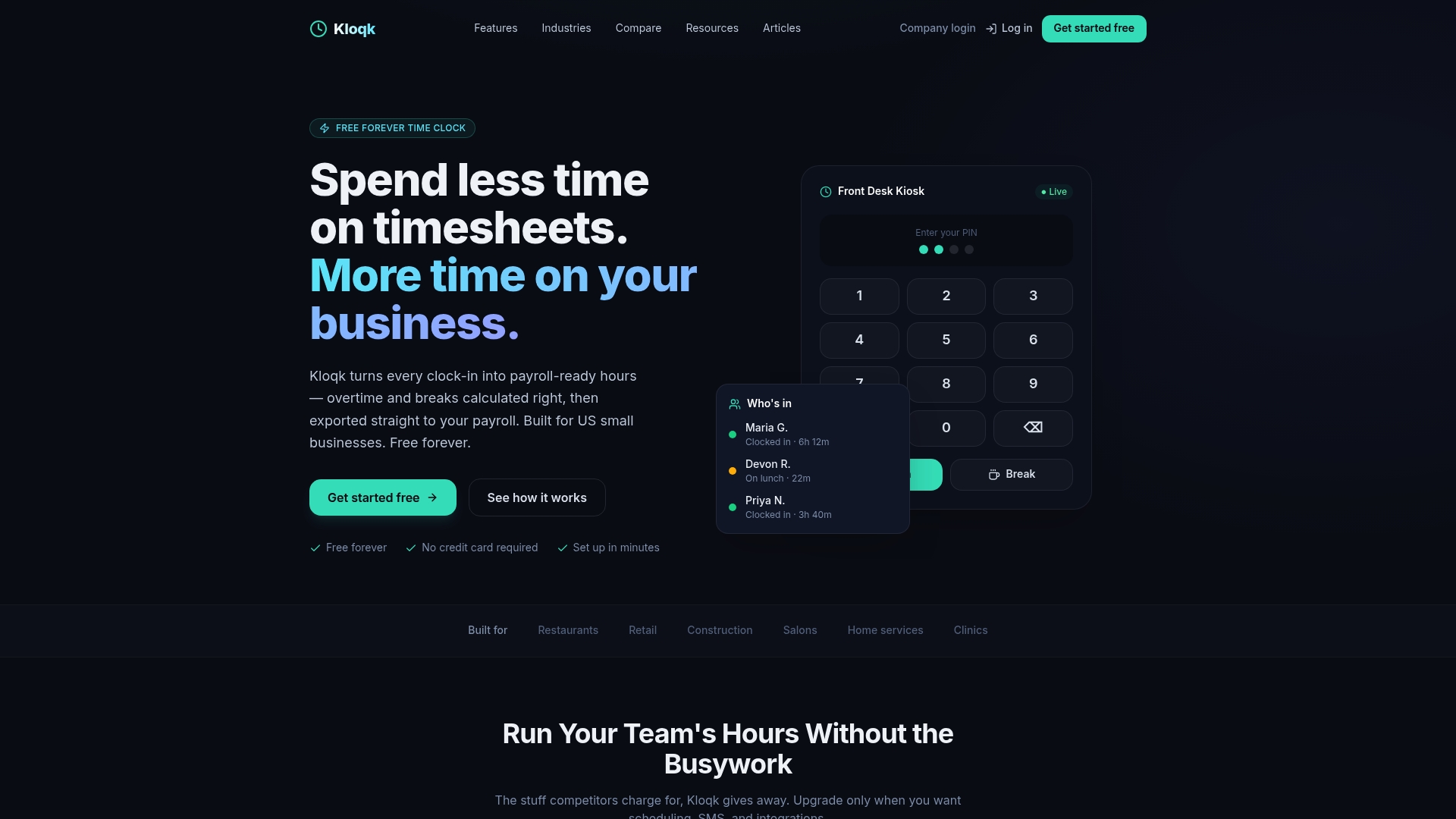
Whether your facility uses 8 and 80, the 40-hour week or a state rule, payroll starts with accurate punches. Kloqk’s free time clock covers unlimited employees with photo verification at clock-in, and our overtime tracking software turns punches into overtime and break calculations with payroll exports.
The Free plan has no published price. Pro is $29 per month per location and Premium is $59 per month per location, both optional. Compare them on the pricing page. If buddy punching is a concern on your floor, see how photo and GPS clock-ins help.
How 8 and 80 compares with other schedules
People often confuse 8 and 80 with compressed schedules such as the 9/80, since both involve 80 hours over two weeks. They are different things. A 9/80 is a work schedule: nine-hour days with one day off every other week. 8 and 80 is an overtime computation method. You can read how the schedule works in our guide to the 9/80 work schedule.
Salaried staff are another frequent question. Whether overtime applies depends on exemption status rather than on being paid a salary. See do salaried employees get overtime pay for the details.
For the baseline math that 8 and 80 departs from, our overtime calculation rules walk through the standard 1.5× calculation after 40 hours.
A short checklist for employers
- Confirm your establishment is a hospital or residential care establishment.
- Decide which employees will use 8 and 80 and which will stay on the 40-hour system. Never both for one person.
- Reach the agreement or understanding before the work is performed, and keep a written acknowledgment.
- Fix the 14-day period start date and time and do not move it.
- Set workday boundaries to begin with the period start.
- Check your state’s overtime rules and apply the higher standard.
- Track punches precisely and review daily totals before each payroll run.
- Retain the records for the required period.
FAQ
What does the 8 and 80 rule mean?
It is an overtime method for hospitals and residential care establishments under FLSA section 7(j). Employees get time-and-a-half for hours over 8 in a workday and for hours over 80 in a fixed 14-day period. It replaces the 40-hour workweek test for the employees who agree to it.
Does the employee have to agree to 8 and 80?
The employer needs an agreement or understanding with affected employees before the work is performed, according to 29 CFR 778.601. It does not have to be written, but if it is not, a special record must be kept. A signed acknowledgment is the safer practice.
Do I get overtime for a 10-hour day if I work fewer than 80 hours?
Yes, if your employer uses 8 and 80. Hours over 8 in a workday are overtime even when the 14-day total stays under 80. If you work on the standard 40-hour system instead, daily overtime is not required by federal law, though your state may require it.
Can a restaurant, retail store or construction company use 8 and 80?
No. The exception covers hospitals and residential care establishments. Other employers use the standard 40-hour workweek under the FLSA, plus any stricter state rules.
Do state laws override 8 and 80?
Where state and federal overtime laws both apply, the employee is entitled to whichever standard pays more, per the Department of Labor. Check your state labor department for healthcare-specific overtime rules.
Sources
- Fact Sheet #54: The Health Care Industry and Calculating Overtime
- Fact Sheet #31: Nursing Care Facilities Under the FLSA
- Health Care Workers, U.S. Department of Labor
- 29 CFR 778.601, Special overtime provisions for hospitals and residential care
- Questions and Answers About the Fair Labor Standards Act
- Fact Sheet #23: Overtime Pay Requirements of the FLSA
Recommended
Sources
Every figure on this page traces to one of these. Primary law and government sources are listed first.
- 1. U.S. Department of Laborprimary
- 2. Cornell Legal Information Instituteprimary
Written by
Dana WhitfieldHR Compliance Lead
Dana writes about wage-and-hour law, FLSA overtime, and leave compliance for U.S. small businesses, translating dense regulations into plain steps owners can act on.
Keep Reading
Track Hours the Easy Way
Kloqk is a free time clock that handles punches, breaks, overtime, and payroll-ready reports.
Start free