6 Legal Steps Small Employers Must Take for Geofencing

Geofencing is legal for employee time tracking in nearly every state when you limit it to work hours and job sites, tell employees in writing, and check your state’s notice rules first. The two things that get small employers in trouble aren’t the technology itself. They’re skipping written notice where state law demands it, and ignoring bargaining obligations if any part of the workforce is unionized. Tools like Kloqk address both by defaulting to hours-only geofences and photo verification instead of round-the-clock location pulls.
TL;DR:
- Geofencing is legally permissible for employee tracking if it is limited to work hours and locations, with proper written notice and compliance with state-specific rules.
- Most federal GPS laws, like the ECPA, do not apply to location logging, but privacy claims can arise under common law or biometric statutes if biometric data is involved.
- States such as Connecticut, Delaware, and New York require advance notice before monitoring, and noncompliance can lead to penalties or lawsuits, especially under Illinois’ BIPA.
- In unionized workplaces, geofencing may trigger bargaining obligations or violate labor laws if used to discipline or intimidate employees involved in organizing activities.
- Using tools like Kloqk that focus on hours-only geofencing and photo verification helps meet legal standards and reduces risks compared to continuous tracking.
Table of Contents
- Geofencing Legal Issues: The Federal Baseline
- Which State Rules Actually Change the Outcome?
- When Does Geofencing Become a Bargaining Issue?
- A Policy Checklist That Actually Holds Up Legally
- Who’s Liable When a Vendor Gets Breached?
- When Geofencing Helps and When It Backfires
- Kloqk: Built for Hours-Only Geofencing, Not Round-the-Clock Surveillance
- Where to Read the Primary Law and Guidance
- Sources
- FAQ
Geofencing Legal Issues: The Federal Baseline
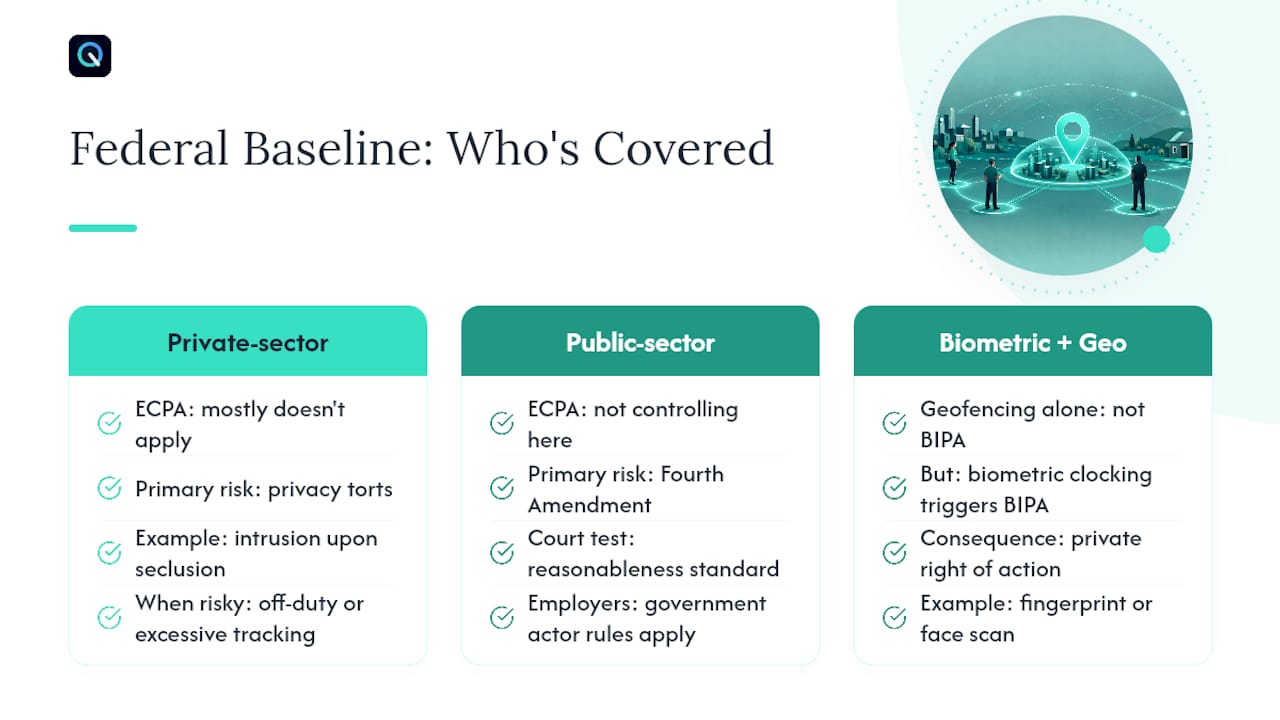
The federal law most people assume governs GPS tracking is the Electronic Communications Privacy Act (ECPA), and it mostly doesn’t apply the way employers expect. ECPA targets intercepted communications: phone calls, emails, messages in transit. A geofence ping that logs “employee entered the job site at 7:58 a.m.” isn’t a communication interception at all. It’s a location event, and ECPA has no real teeth here.
That gap doesn’t mean employers have a free pass. It just moves the risk to a different legal shelf. Private-sector employees generally can’t sue under the Fourth Amendment, since that protection restrains government action, not private business. But they can bring common-law privacy tort claims, things like intrusion upon seclusion, if tracking sweeps in off-duty movement or feels excessive relative to the business need. Public-sector employers face a different calculus entirely, since courts do apply Fourth Amendment reasonableness standards to how government employers monitor public workers.
There’s a third wrinkle worth flagging early: biometric statutes. If your time clock uses a fingerprint or face scan alongside geofencing, you’ve stepped into Illinois’ Biometric Information Privacy Act (BIPA) territory, and BIPA carries a private right of action, meaning employees can sue directly, not just wait for a regulator to act. Geofencing alone doesn’t trigger BIPA. Pairing it with biometric clock-in does.
Which State Rules Actually Change the Outcome?
State law is where most of the real legal exposure lives, and it’s a patchwork rather than a single standard. A state-by-state tracker of employee monitoring laws shows a handful of states requiring advance notice before an employer can rely on the standard consent exception for electronic monitoring.
Here’s what tends to trip up small business owners who assume one national rule applies everywhere:
- Connecticut, Delaware, and New York require employers to give notice before monitoring electronic communications or activity, and courts have extended similar reasoning to location tracking in some contexts.
- New Jersey specifically requires written notice before placing a tracking device in a vehicle an employee uses, even an employer-owned one.
- Illinois layers BIPA on top of general monitoring rules the moment biometric data enters the picture.
- Maine is adding a new notice statute taking effect in 2026, joining the list of states tightening these requirements.
- California doesn’t have a single geofencing statute, but its broader privacy and consent framework makes undisclosed tracking a much easier claim to bring.
Noncompliance consequences vary by state too. Some violations trigger civil penalties or attorney general enforcement. Illinois’ BIPA is the outlier because it lets an employee sue directly, and those cases have produced real settlements. If you operate in more than one state, don’t assume your home state’s rules travel with you. Check the law where each employee actually clocks in, and when in doubt, get written acknowledgment even in states that don’t strictly require it. It costs you nothing and it’s your best evidence if a claim ever surfaces.
When Does Geofencing Become a Bargaining Issue?
If any part of your workforce is unionized, geofencing isn’t just an HR decision. It’s potentially a labor relations one. The NLRB General Counsel has warned that electronic surveillance, including GPS tracking, can violate the National Labor Relations Act if it chills employees’ ability to organize or discuss working conditions. Monitoring can also count as a mandatory subject of bargaining, meaning you may need to negotiate the policy with the union before rolling it out, not after.
The warning signs are fairly specific. If geofencing data gets used to discipline someone shortly after they engaged in organizing activity, that timing alone can support an unfair labor practice charge. If your policy has no narrow scope, tracks broadly instead of hours-only, or exists without any documented business justification, you’re building the exact profile the NLRB has flagged. Document the operational reason (verifying job-site arrival, preventing buddy punching) before you deploy, not after someone complains.
A Policy Checklist That Actually Holds Up Legally
A written policy is your single strongest defense if a monitoring claim ever lands on your desk, according to legal analysis of employer GPS tracking rules. Here’s the sequence that keeps you defensible:
- Define a narrow business purpose. State exactly why geofencing exists (verifying clock-ins at job sites, stopping buddy punching) and confine it to work hours and locations tied to that purpose.
- Give written notice and get acknowledgment. Even where state law doesn’t mandate it, a signed acknowledgment closes the gap between “employees should have known” and “employees were told.”
- Configure hours-only logging. Set the system so tracking activates at shift start and deactivates at shift end, not a second before or after.
- Address take-home vehicles by name. If crews drive employer vehicles home, say so explicitly in the policy and disable tracking outside working hours. New Jersey requires written notice for this scenario specifically.
- Limit retention and restrict access. Keep location data only as long as payroll and dispute resolution require, and use it strictly to corroborate other evidence in an investigation, not as a stand-alone accusation.
- Lock down vendor terms. Require your time-tracking vendor to specify encryption, breach notification timelines, and data deletion on offboarding.
Pro Tip: Set automated privacy-mode schedules so geofencing simply switches off outside shift windows, and keep an audit log of who accessed location data and why. If a claim ever comes in, that log is often the difference between a quick dismissal and a drawn-out dispute.
Who’s Liable When a Vendor Gets Breached?
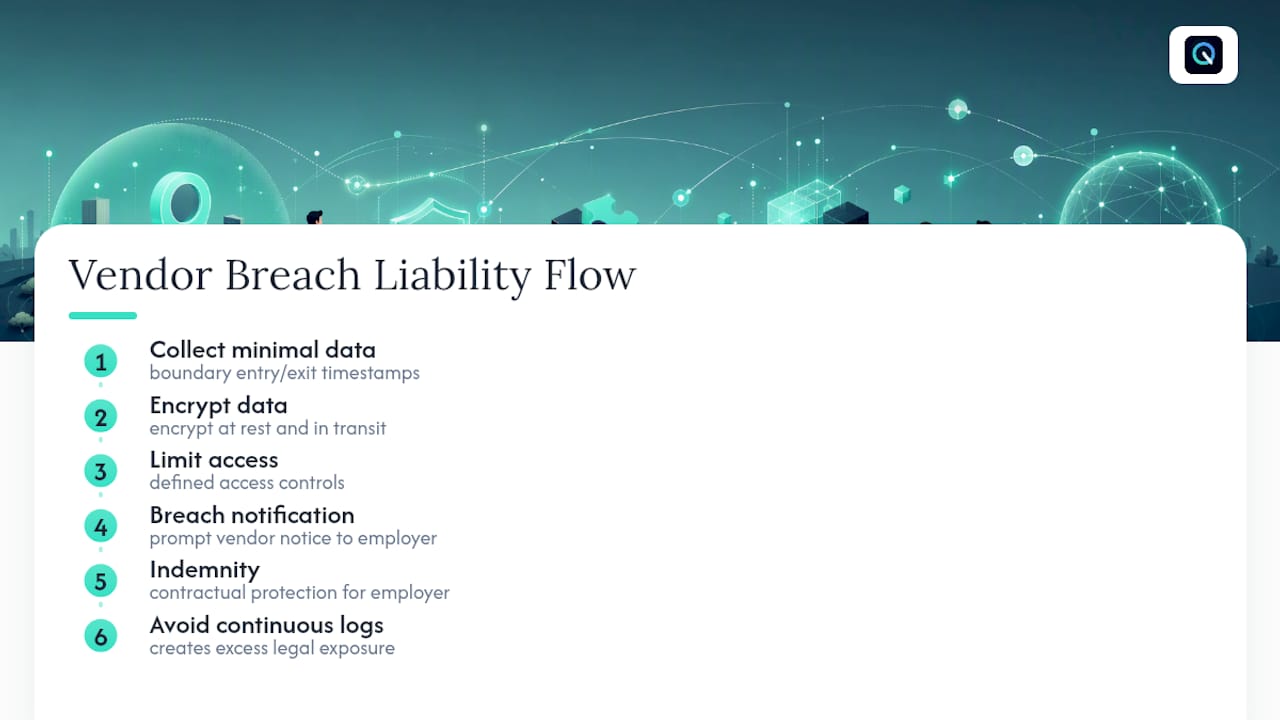
Your legal exposure doesn’t disappear just because a third-party vendor stores the location data. Under most state breach-notification laws, the employer, not the vendor, typically carries the responsibility to notify affected employees if that data gets exposed, according to practitioner analysis of geofencing and geotracking risk.
Build this into your vendor contract before you sign, not after an incident. Require encryption at rest and in transit, defined access controls, prompt breach notification commitments, and indemnity language that doesn’t leave you holding the bag alone. On the data side, minimize what you collect. Boundary events, entry and exit timestamps, are usually all payroll needs. Full continuous movement logs create more legal exposure than they solve, since geofencing itself is designed to record boundary crossings rather than a constant trail.
When Geofencing Helps and When It Backfires
Geofencing earns its place when you have a specific operational problem: crews spread across multiple job sites, remote field teams, or a buddy-punching pattern you can’t solve any other way. Narrow scope is what keeps it legally sound and keeps morale intact.
Where I’d pump the brakes is continuous tracking “just in case.” If photo verification at clock-in solves your actual problem, that’s the lower-risk move, since it avoids collecting movement data you don’t need. Courts and the NLRB have both signaled the same underlying principle: tailor the tool to the job, not the other way around. If you run a unionized shop or operate across several states, get counsel involved before rollout. It’s cheaper than fixing a bargaining violation after the fact.
Saad
Kloqk: Built for Hours-Only Geofencing, Not Round-the-Clock Surveillance
Kloqk is built around the exact policy checklist above rather than around collecting more data than you need. Its GPS geofencing activates only around job sites during working hours, its photo verification confirms who’s actually clocking in without tracking anyone’s movements the rest of the day, and its payroll-ready timesheets turn those clock-ins straight into overtime and break calculations for export.
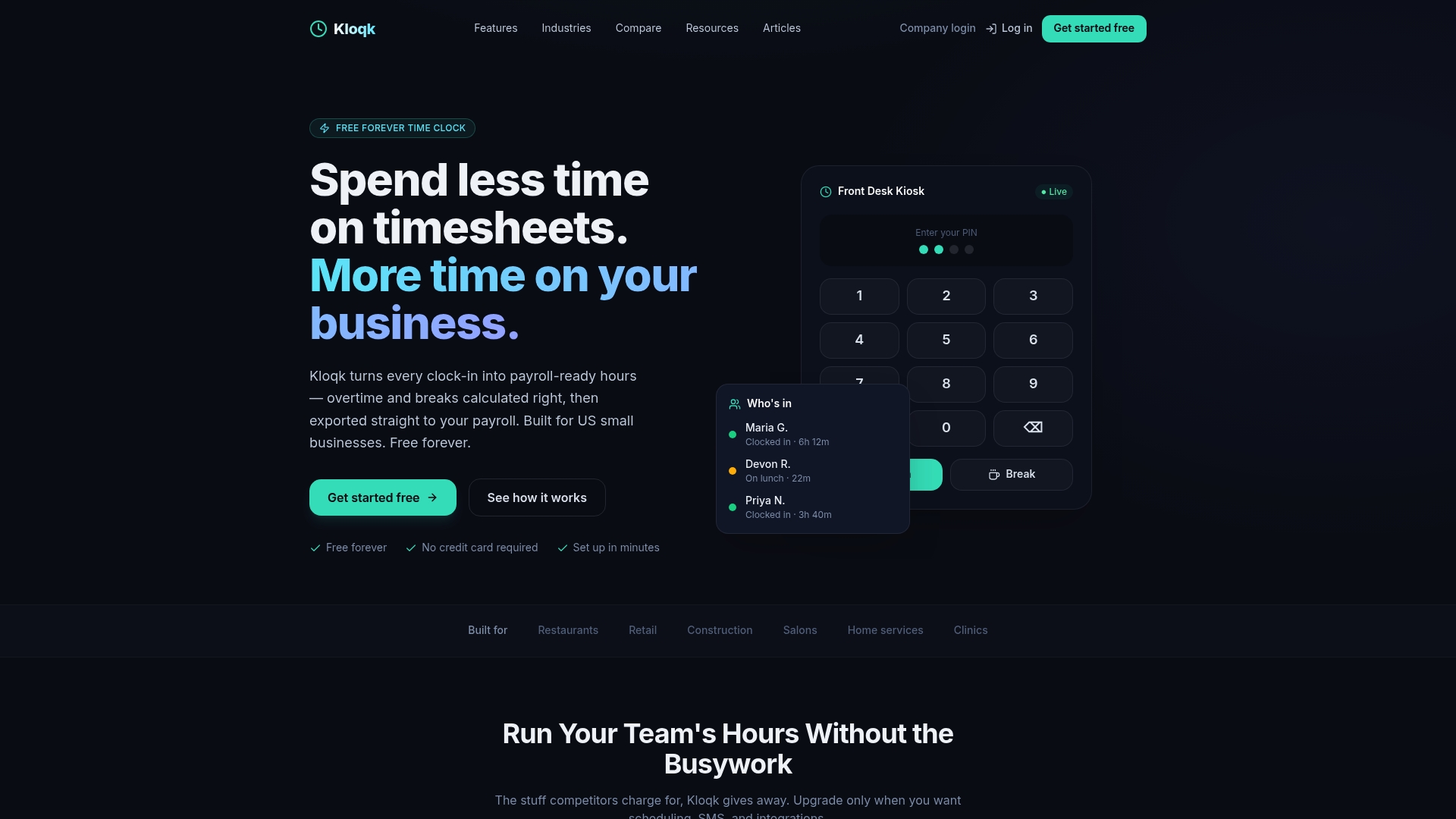
That combination matters because many competitors charge extra for compliance-grade features, overtime calculations, break tracking, and geofencing that support legal defensibility. Kloqk includes them in its Free plan with no published price, covering unlimited employees. If your team needs scheduling, PTO tracking, or SMS alerts on top of that, the Pro plan runs $29 per month per location and Premium runs $59 per month per location, both listed on the pricing page. Set up a free time clock account and configure your first hours-only geofence today.
Where to Read the Primary Law and Guidance
- The NLRB’s own memo on electronic surveillance is the clearest federal statement on when monitoring crosses into unlawful territory.
- The University of Florida Law Review’s analysis of GPS and cell phone tracking is the most detailed academic treatment of scope limits and investigatory use.
- Recording Law’s state-by-state monitoring tracker is the fastest way to check your specific state’s notice rules.
- For technical consent-flow design, Ecomtrada’s tracking and consent mode resource offers a useful technical perspective, though it’s written for a different audience than employment law.
Nothing here substitutes for advice from an employment attorney familiar with your state and industry, especially if you’re unionized or operate across state lines.
This article is general information, not a substitute for advice from a qualified lawyer. Consult a qualified legal professional about your own circumstances before acting on anything here.
Sources
- NLRB general counsel memo on unlawful electronic surveillance and monitoring
- Law review article on GPS and cell phone tracking of employees (University of Florida Law Review)
- Employee monitoring laws by state (Recording Law)
FAQ
Is Geofencing Legal for Tracking Employees at Work?
Yes, geofencing is legal in nearly every state when confined to work hours and job sites, paired with written notice, and configured to avoid off-duty tracking. Some states, including New Jersey and soon Maine, add specific notice requirements you need to check before rollout, per Recording Law’s state tracker.
Do I Have to Tell Employees I’m Using Geofencing?
Several states legally require advance notice, and it’s good practice everywhere else even where it isn’t mandatory. A signed written acknowledgment is your strongest evidence if an employee later claims they didn’t know.
Can Geofencing Violate Union Employees’ Rights?
It can, if the monitoring isn’t narrowly tailored or gets used in a way tied to organizing activity. The NLRB has stated that surveillance can be a mandatory bargaining subject in unionized workplaces, so employers should negotiate the policy rather than impose it unilaterally.
What Happens if My Time-Tracking Vendor Gets Breached?
Employers typically bear the notification responsibility under state breach laws even when a vendor holds the data, according to practitioner guidance on geofencing risk. That’s why vendor contracts should specify encryption, breach notice timelines, and deletion terms before you sign.
Does Kloqk’s Geofencing Track Employees Outside Work Hours?
No. Kloqk’s GPS geofencing is designed to activate around job sites during working hours only, which keeps it aligned with the hours-only approach most employment attorneys recommend. The feature is included on Kloqk’s free plan alongside photo verification and payroll-ready timesheets.
Recommended
Sources
Every figure on this page traces to one of these. Primary law and government sources are listed first.
Written by
Marcus ReyesPayroll & Timekeeping Specialist
Marcus covers payroll accuracy, timesheets, and time tracking, the unglamorous mechanics that keep paychecks correct and audits painless.
Keep Reading
Track Hours the Easy Way
Kloqk is a free time clock that handles punches, breaks, overtime, and payroll-ready reports.
Start free