U.S. Employers: Prevent Back Pay From 30 Minute Meal Break Deductions

Automatic 30-minute meal deductions are lawful only when the employee actually receives an uninterrupted bona fide meal period. Otherwise, the deducted minutes are compensable and the employer may owe back pay plus penalties. If the employee kept working, stayed on call, or couldn’t leave their post, that time belongs on the paycheck. State law can require more than federal law does, and the stricter rule wins.
TL;DR:
- Auto-deductions for meal breaks are lawful only when employees are truly relieved of duties for an uninterrupted 30-minute period; interruptions make the time compensable.
- Employers must actively verify that employees actually receive the break, with clear policies, oversight, and recordkeeping; automatic deductions without confirmation create liability.
- State laws like California and New York impose stricter meal and rest break requirements, with penalties for violations, making compliance more complex than federal minimums.
- Systematic issues like frequent interruptions, on-call duties, or inability to leave the work area turn automatic deductions into wage theft if not properly managed.
- Using time-tracking tools with break prompts, correction workflows, and verification features significantly reduces the risk of unpaid wages and compliance violations.
Table of Contents
- The Federal Baseline: FLSA Rules on Meal Breaks and Auto Deductions
- State Rules and the “Most Protective” Law: What to Check Beyond Federal
- Automatic Meal Deductions: Setups, Pitfalls, and Fixes
- How to Calculate Unpaid Wages and Overtime Exposure
- Employer Compliance Checklist: Policy, Payroll Fixes, and Tax Rules
- What to Do if Your Pay Was Docked Incorrectly
- How Time-Tracking Tools Reduce Auto-Deduction Risk
- Practical Compliance Beats Blame
- Kloqk: A Practical Tool to Prevent Meal-Deduction Errors
- FAQ
- Sources
The Federal Baseline: FLSA Rules on Meal Breaks and Auto Deductions
Federal law doesn’t require any employer to offer a meal or rest break. What it does require is that once a break is offered and taken, it meets a specific legal standard before the employer can treat it as unpaid. The Department of Labor’s guidance on breaks and meal periods spells out the core rule: a “bona fide meal period” is time during which an employee is completely relieved of duties for the purpose of eating a meal. Under 29 C.F.R. §785.19, that period is typically 30 minutes or longer and is not counted as hours worked, as long as the employee is truly free during it.
Short breaks work differently. Rest periods of about 5 to 20 minutes are treated as paid work time under the Fair Labor Standards Act, regardless of what the employee does during them. Meal periods of 30 minutes or more, by contrast, can be unpaid, but only if they’re genuinely uninterrupted. An employee who eats lunch at their desk while answering phones or monitoring equipment hasn’t received a bona fide meal period, even if the timeclock shows a 30-minute deduction.
This distinction matters enormously for payroll systems that auto-deduct a fixed block of time every shift. The Wage and Hour Division’s Fact Sheet #53, written for the health care industry but applied more broadly in wage-hour enforcement, lays out when automatic deductions hold up and when they don’t. The fact sheet’s examples show that an automatic 30-minute deduction policy can be lawful, but only when the employer takes active steps to confirm employees are actually getting the break. When interruptions are frequent, the deducted time becomes compensable work, and the employer is on the hook for it.
That responsibility doesn’t end with writing a policy. The same guidance makes clear that employers using automatic deductions remain accountable for making sure breaks happen in practice, not just on paper. A policy that says “all employees get an unpaid 30-minute lunch” means nothing if the floor is understaffed and nobody can actually step away.
A few patterns separate defensible systems from exposed ones:
- Confirmed relief from duty: the employee has no expectation of monitoring calls, equipment, or customers during the break.
- Freedom to leave: the employee can leave the work area, even if they choose not to.
- A real correction path: when a break gets cut short or skipped, the employee can flag it and get paid without a fight.
- Active oversight: managers check that breaks are happening, rather than assuming the schedule guarantees it.
The WHD opinion letter FLSA2026-7 adds a useful wrinkle here. It confirms that staying on the premises during a meal period doesn’t automatically make the time compensable. The test is whether the employee was relieved of duties and whether the time is predominantly for the employee’s benefit or the employer’s. An employee who sits in the break room scrolling their phone, with no work responsibilities, can still have a bona fide meal period even without leaving the building. The analysis is fact-specific, which is exactly why generic auto-deduction policies without oversight tend to create problems: they assume a uniform answer to a question that depends on what actually happened that day.
Recordkeeping ties all of this together. Employers that rely on auto-deductions without logging actual break starts and stops, or without a simple way for employees to report a missed or shortened break, are building a system that’s hard to defend if questioned later.

State Rules and the “Most Protective” Law: What to Check Beyond Federal
Federal law sets the floor, not the ceiling. A state-by-state summary from the Department of Labor shows that many states impose their own meal and rest break requirements, several of them considerably stricter than the FLSA. When state law gives employees more protection than federal law, the state rule controls. This is the single most common gap that trips up multi-state employers and small businesses that copy a generic break policy template without checking local rules.
California is the clearest example. State law requires a 30-minute unpaid meal period for any shift over 5 hours, and a second 30-minute meal period for shifts over 10 hours (with narrow waiver options). If an employer fails to provide a compliant meal break, California law requires a premium payment, one additional hour of pay at the employee’s regular rate, for each workday the meal period was missed, late, or interrupted. That premium is separate from any wages owed for time actually worked during the break. Our guide to California lunch break laws walks through the timing rules and waiver conditions in more detail, and our piece on how break violations affect compliance in California covers what remediation looks like once a violation is identified.
New York takes a different approach. State law requires factory employees to get a 60-minute noon-day meal period, while most other industries require a 30-minute midday break for shifts spanning the noon hour. The specifics vary by industry classification, which means a restaurant, a warehouse, and an office in the same city can be operating under different rules. New York doesn’t impose the same one-hour premium penalty structure as California, but failing to provide the required break still exposes an employer to wage claims for the unpaid time if duties weren’t actually suspended.
Washington and Oregon also set their own meal and rest break requirements, generally mandating a 30-minute meal period for shifts of a certain length plus paid rest breaks on a set schedule, again more detailed than the federal baseline. The pattern across these states is consistent: federal law tells you the minimum, state law often tells you the real rule.
A practical state-by-state checklist should cover:
- Minimum shift length that triggers a required meal period (varies from no requirement to 5 hours).
- Whether a penalty or premium payment applies for a missed or late break.
- Whether rest breaks are separately required and paid in addition to meal periods.
- Industry-specific carve-outs, since health care, transportation, and manufacturing often have different rules than retail or office work.
Because these rules shift and vary by jurisdiction, the safest move for any employer operating in more than one state is to check the official state labor department page for each location rather than relying on a single national policy template.
Automatic Meal Deductions: Setups, Pitfalls, and Fixes
Most payroll systems that auto-deduct meal time use one of a few standard setups, so understanding the correct steps for payroll and working hours is crucial, as explained in the BCEA Working Hours resource for South African employers. The most common is a flat deduction, usually 30 minutes, subtracted from every shift over a certain length regardless of whether a break actually happened. A slightly more careful version requires a manager to confirm the break occurred before the deduction applies. The weakest version relies on an “implied” policy: the handbook says breaks are unpaid, so the system deducts time automatically and assumes compliance.
That third setup is where most legal exposure concentrates. A flat deduction with no verification doesn’t know the difference between an employee who sat down for lunch uninterrupted and one who covered the register for a coworker the whole time. When employees routinely get interrupted, remain on call, or can’t physically leave their post, due to short staffing, a single-person shift, or an “on-duty meal” expectation, the deducted time is compensable work, and the auto-deduction is quietly generating unpaid wages every single shift.
Four things typically turn an automatic deduction into a liability:
- Interrupted breaks: an employee gets called back to the floor, the phone, or a customer before the 30 minutes is up.
- On-call or monitoring duties: the employee is expected to respond to messages, alarms, or requests during the “break.”
- No ability to leave: understaffing means someone has to stay near the work area, which undercuts the claim that the employee was relieved of duty.
- No correction workflow: when a break is missed or cut short, there’s no simple way for the employee to flag it, so the deduction stands uncorrected.
The fix isn’t a better-written policy. It’s operational controls that make the policy true in practice. Real-time break prompts that ask an employee to confirm they’re starting and ending a break create a timestamped record instead of an assumption. An easy correction workflow, where an employee can note “break interrupted” or “break not taken” with one tap, gives the business a chance to pay correctly before the problem compounds across dozens of shifts. Manager verification adds a second layer of accountability, and an audit log gives payroll and, if necessary, a Wage and Hour Division investigator, a clear record of what actually happened.
Staffing plays a bigger role than most employers want to admit. A written policy promising a 30-minute uninterrupted lunch is meaningless on a floor where there’s never enough coverage to make that physically possible. Fixing the schedule, even modestly, often solves more compliance risk than any amount of policy language.
Pro Tip: Run a two-week spot audit comparing scheduled auto-deductions against manager-confirmed break logs before you assume your current system is compliant.
A written policy is a starting point, not a safeguard. Employers that treat the policy as the whole compliance effort, without the verification and correction steps behind it, are the ones most likely to find a gap between what the handbook says and what the timecards actually show.
How to Calculate Unpaid Wages and Overtime Exposure
When a meal deduction turns out to be unlawful, the math isn’t complicated, but it compounds fast. Start with the deducted minutes, convert them to hours, and multiply by the employee’s regular rate of pay. That gives the base amount owed for the missed or interrupted break. The complication comes when those minutes push total weekly hours past 40, because now the employer owes not just straight-time pay for the deducted minutes, but overtime on top of it.
Here’s a simple worked example. Say an employee earns $15 per hour and works five 8-hour shifts in a week, 40 hours total, with a 30-minute “unpaid” lunch auto-deducted each day. If those breaks were routinely interrupted and should have been paid, that’s 2.5 hours of unpaid time across the week. Added back to the 40 hours already worked, the employee actually worked 42.5 hours. The first 40 hours are owed at $15 per hour, or $600. The remaining 2.5 hours cross into overtime territory and are owed at time-and-a-half, or $22.50 per hour, for a total of $56.25. The employer now owes $56.25 in overtime pay that wouldn’t exist if the breaks had been genuinely uninterrupted and properly unpaid.

That’s just the wages. Under the FLSA, an employer that violates minimum wage or overtime rules can also be liable for liquidated damages equal to the amount of unpaid wages, effectively doubling the exposure, unless the employer can show the violation was made in good faith and with reasonable grounds to believe it complied with the law. On top of that, a successful wage claim typically shifts the employee’s attorney’s fees onto the employer, which is part of why even a small per-shift discrepancy becomes expensive once it’s multiplied across a pay period, a team, and the statute of limitations.
The documentation that supports (or undermines) these calculations includes:
- Time clock exports showing actual clock-in and clock-out times, including any manual edits.
- Manager approval records for shift changes, break interruptions, or corrections.
- Correction logs showing how often employees flagged missed or shortened breaks.
- Payroll registers showing how deductions were applied week to week.
Rounding rules add another layer of precision that’s easy to get wrong. The FLSA permits rounding time to the nearest 5, 10, or 15 minutes, but only if the rounding practice is neutral over time, meaning it doesn’t systematically favor the employer. Our breakdown of FLSA time rounding rules covers how to check whether a rounding policy is actually neutral in practice, which matters directly here since rounding interacts with meal deductions in ways that can quietly shave real minutes off every paycheck.
Employer Compliance Checklist: Policy, Payroll Fixes, and Tax Rules
A defensible meal-break program rests on a handful of concrete practices, not a single policy document. The checklist that holds up under scrutiny includes a clear written policy stating when breaks are required and how they’re recorded, employee training so staff know how to report a missed or interrupted break, a correction workflow that’s actually used rather than theoretical, manager sign-off on break logs, and a recurring payroll audit, not a one-time setup-and-forget system.
When a review turns up past errors, the fix is a retroactive payroll correction: recalculate affected pay periods using the method above, issue back pay including any overtime owed, and document exactly how the correction was calculated. That documentation matters twice over. It protects the employer if a Wage and Hour Division audit asks for evidence of good-faith compliance, and it gives the business a clean record if the same question comes up again later. Our break policy examples offer starting templates for the written policy piece, and our four-step guide to break tracking compliance walks through building the audit habit into a regular routine.
IRS guidance in Publication 15-B sets out when meals provided to employees can be excluded from taxable income, either under the “convenience of the employer” test in section 119 or as a de minimis fringe benefit under section 132.
Tax treatment of employer-provided meals has also shifted. Recent federal tax changes narrowed the deduction employers could previously claim for providing meals to staff, a benefit that was partially deductible through 2025 but became more limited afterward in many situations. That shift makes it more important for payroll and finance teams to track precisely whether a given meal benefit is taxable compensation, a non-taxable de minimis fringe, or something that no longer qualifies for the deduction it once did. Treating this as a payroll classification question rather than an afterthought avoids both wage-hour and tax reporting mistakes at once.
Record retention ties the whole checklist together. Keeping timecards, correction logs, and payroll registers for at least the period covered by the applicable statute of limitations means that if a question ever comes in from an employee, a state agency, or the Department of Labor, the business has a documented, defensible answer instead of a scramble.
What to Do if Your Pay Was Docked Incorrectly
If a meal break deduction looks wrong, the strongest position starts with documentation, not confrontation. Build a record before raising the issue so the conversation is about facts, not memory.
- Collect your own records: keep personal notes of when breaks actually started and ended, screenshots of pay stubs, and any timecard exports you can access.
- Save communications: hold onto emails, texts, or scheduling messages that show you were called back during a break or couldn’t leave your post.
- Raise it internally first: contact your manager or payroll department directly, point to the specific shifts affected, and ask for a correction; most employers would rather fix a documented error than face a complaint.
- Request a payroll review: ask whether the issue affected other pay periods or other employees on the same schedule, since isolated errors are often part of a pattern.
- File a complaint if it isn’t resolved: the Wage and Hour Division accepts complaints confidentially, and most states maintain a parallel labor agency that handles state-specific violations like missed meal premiums.
- Know your timeline: FLSA claims generally must be filed within two years, or three years if the violation was willful, so don’t let documentation sit indefinitely.
For a single missed break, an internal fix is usually fastest. For a pattern that looks systemic, affecting an entire shift, location, or job title, consulting an employment attorney before filing is worth considering, since willful or widespread violations carry larger damages and may justify a collective action rather than an individual claim.
How Time-Tracking Tools Reduce Auto-Deduction Risk
The operational controls described earlier, break prompts, correction workflows, manager verification, and audit logs, aren’t abstract advice. They’re specific features a time-tracking system either has or doesn’t, and the gap between those two states is where most meal-deduction liability lives.
A system built to reduce this risk typically needs to provide:
- Break start and stop prompts so the timeclock captures an actual event instead of assuming a fixed block occurred.
- A one-tap correction path for employees to flag an interrupted or skipped break at the moment it happens, not two weeks later.
- Manager approval flows that create a second set of eyes on break records before payroll runs.
- Audit logs that preserve a time-stamped history if a dispute or agency inquiry comes up later.
- Photo verification and GPS geofencing to confirm who clocked in, from where, reducing disputes over whether someone was actually on-site or off-duty.
We built our free time tracking platform around exactly this gap. Break tracking, overtime calculations, and payroll-ready exports are included at no cost, alongside photo verification for clock-ins and GPS geofencing to confirm location at punch time, the same categories of control that separate a defensible meal-deduction system from an exposed one. For a small business trying to tighten this up without overhauling an entire payroll process, piloting these controls on a single crew or store for one pay period is usually enough to see where the current system is quietly generating risk.
Practical Compliance Beats Blame
Most meal-break violations we come across aren’t the result of employers trying to shortchange their teams. They’re the result of a payroll default nobody revisited after the business got busier, the schedule got tighter, or a new location opened without the same oversight as the original one. Treating that gap as a people problem, blaming managers or employees for not flagging it, misses the actual fix, which is almost always operational.
The businesses that stay out of trouble here aren’t the ones with the most detailed handbook. They’re the ones that run a quick audit every so often, give employees an easy way to say “that break didn’t happen,” and treat a payroll correction as routine maintenance rather than an emergency. That shift in mindset, from policy as a shield to policy as a practice, protects workers’ paychecks and keeps small employers out of a Wage and Hour Division letter they didn’t see coming.
Saad
Kloqk: A Practical Tool to Prevent Meal-Deduction Errors
Getting meal deductions right shouldn’t require a payroll specialist or a line item in the budget. We built our free time clock platform so small businesses can track breaks accurately without paying for the basics other providers put behind a paywall.
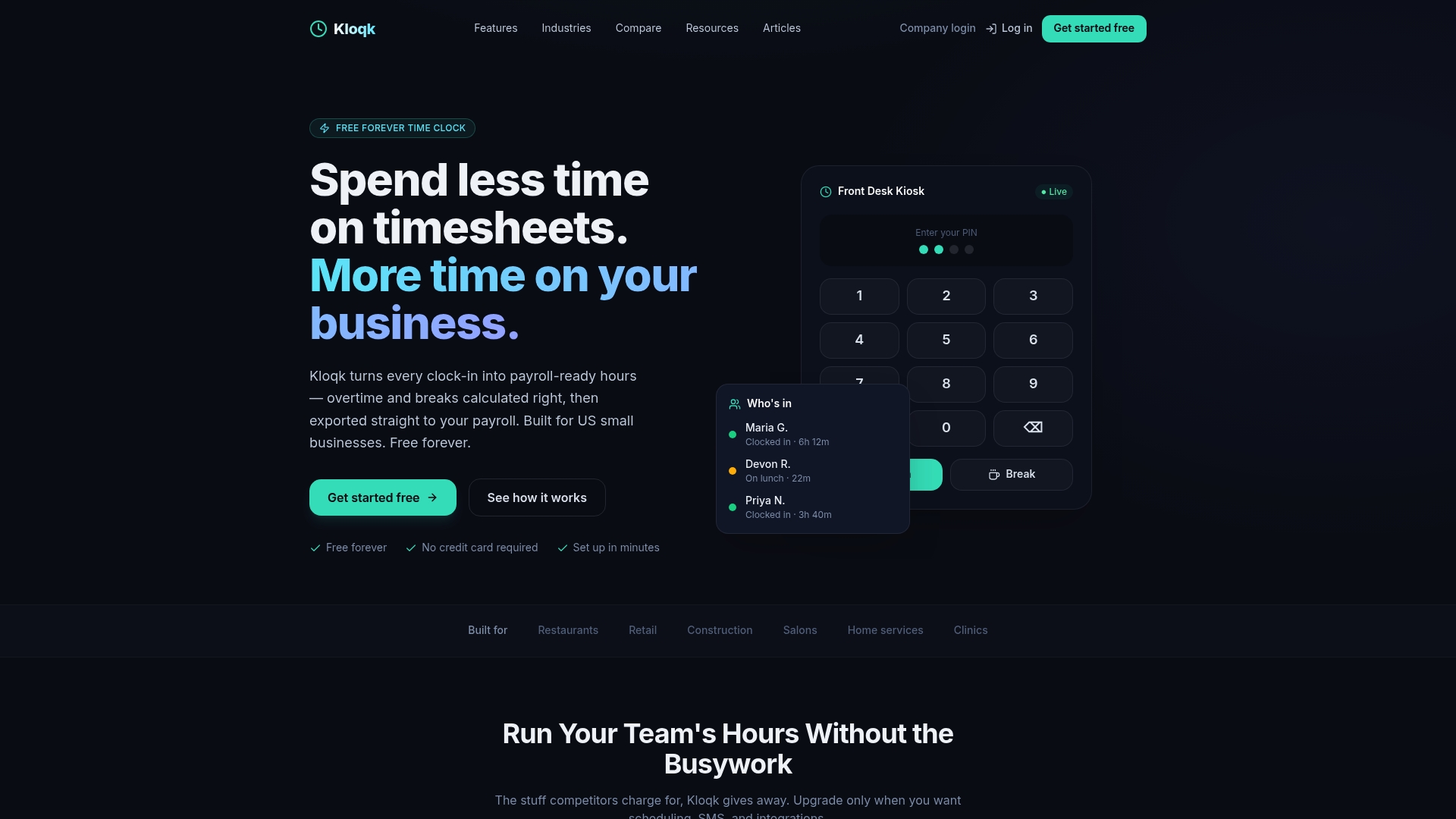
Our free plan includes break tracking, overtime calculations, and payroll-ready exports, plus photo verification at clock-in and GPS geofencing to confirm where punches happen. None of that requires an upgrade or a contract to use.
A good place to start:
- Run a one-pay-period audit comparing your current auto-deductions against what actually happened on the floor.
- Turn on break prompts so employees confirm when a break starts and ends instead of a flat deduction applying automatically.
- Give your team a correction path so a missed or interrupted break gets flagged and paid before it becomes a pattern.
Everything above is available on our Free plan, with Pro at $29 per month per location and Premium at $59 per month per location for businesses that want scheduling, PTO, or additional integrations layered on top. Explore our employee time tracking features to see break tracking and payroll exports in action before deciding whether an upgrade makes sense for your team.
FAQ
What is the federal law on meal breaks?
Federal law, under the Fair Labor Standards Act, does not require employers to provide meal or rest breaks at all. When an employer does offer a meal break and it lasts roughly 30 minutes or more with the employee completely relieved of duties, that time can legally be unpaid under 29 C.F.R. §785.19.
Can a company deduct 30 minutes from your day if you don’t take a lunch?
No. If you didn’t actually get an uninterrupted break, free from work duties, the deducted time must be paid, and auto-deducting it anyway creates unpaid wages the Wage and Hour Division can pursue. This is one of the most common sources of wage claims tied to automatic payroll systems.
Which states require rest breaks?
Multiple states, including California, Washington, and Oregon, require paid rest breaks on top of unpaid meal periods, with specifics varying by shift length and industry. The Department of Labor’s state summary page is the most reliable place to check current requirements for a specific state.
Can I work 5 hours without a lunch break in New York?
New York’s meal break rules depend on industry and shift timing rather than a flat 5-hour trigger, with factory workers generally entitled to a 60-minute midday break and most other industries entitled to 30 minutes if the shift spans the noon period. A shift that doesn’t cross a required meal window may not trigger a mandatory break under state law, so checking the specific industry rule matters more than counting hours alone.
How much can missing a meal break cost an employer?
The cost depends on the state and whether the missed break caused unpaid overtime, but it can include straight-time back pay, overtime premiums, and in states like California, an additional hour of pay as a penalty for each violation day. Under the FLSA, employers can also face liquidated damages equal to the unpaid wages, which effectively doubles the amount owed.
Sources
- Breaks and Meal Periods | U.S. Department of Labor
- Publication 15-B (Employer’s Tax Guide to Fringe Benefits) | IRS
Recommended
Sources
Every figure on this page traces to one of these. Primary law and government sources are listed first.
- 1. U.S. Department of Laborprimary
- 2. Internal Revenue Serviceprimary
Written by
Sam TolbertWorkforce Operations Editor
Sam writes about scheduling, shift work, and the software that runs an hourly workforce, what actually saves time on the floor versus what just adds clicks.
Keep Reading
Track Hours the Easy Way
Kloqk is a free time clock that handles punches, breaks, overtime, and payroll-ready reports.
Start free