Small Business: 4 Steps to Break Tracking Compliance and Audit Proof

Break tracking compliance comes down to two things: timestamped records of every break and a written policy that gets enforced the same way every shift. Federal and state wage laws both hinge on proof, not intention, so the fix is a timekeeping system that captures start and end times automatically and flags a missed or short break the moment it happens. There are free time clocks available that include both pieces, which can help small businesses close this gap without hiring outside help.
TL;DR:
- Timestamped records of every break, including start and end times, are essential to provide legal proof in wage disputes and audits.
- State laws like California require detailed recordkeeping and impose penalties if meal or rest breaks are missed or inadequately documented.
- Automated tracking methods, such as prompted punch-ins and GPS verification, significantly reduce non-compliance risks compared to paper or manual logs.
- Building a clear, accessible policy and performing regular audits help ensure ongoing compliance and catch issues before they escalate.
- Using platforms like Kloqk can streamline break tracking with features that include attestation, automatic calculations, and payroll exports, supporting defensible records.
Table of Contents
- What Is Break Tracking and Why Does It Matter?
- Does Federal Law Require Employee Breaks?
- What’s the Best Way to Track Employee Breaks?
- How Do You Build a Defensible Break-Tracking Program?
- How Does Kloqk Support Break Compliance?
- An Editorial Take on Getting This Right
- Get Compliant Break Tracking Running Today
- Where to Verify These Rules
- Sources
- FAQ
What Is Break Tracking and Why Does It Matter?
Break tracking means recording exactly when an employee clocks out for a meal or rest period and when they clock back in, then storing that data somewhere you can retrieve it later. A solid system captures the start and end timestamps, an employee attestation confirming the break was taken as recorded, and, for mobile or multi-location teams, a photo or location stamp tied to the punch.
Not every break gets treated the same under wage law. Short rest breaks are generally paid time, while genuine meal periods must be sufficiently long and unpaid only when the employee is fully released from duty. Mix those up in your records and you’ve created a wage calculation error, not just a paperwork problem.
The real value shows up when a state auditor or a former employee’s lawyer asks for proof. A timestamped log with attestation is evidence. A blank field or a manager’s memory is not. Missing records don’t just look bad. In several states, they shift the burden onto the employer to prove the break happened, which is a losing position if you have nothing to show.
A few things any small business should nail down early:
- Capture start and end times for every break, not just scheduled ones.
- Require the employee to confirm the break was taken as logged.
- Store photo or location data when staff work off-site or across shifts.
- Keep records for at least three years, which lines up with typical audit windows.
- Assign a manager to review exceptions weekly, not just when a complaint arrives.
Does Federal Law Require Employee Breaks?
No. The Fair Labor Standards Act sets no federal requirement that employers offer meal or rest breaks at all. What it does regulate is how you pay for the breaks you choose to give. Short rest breaks between 5 and 20 minutes count as compensable work time, while a bona fide meal period is unpaid only if the employee is completely relieved of duty, no answering calls, no monitoring equipment, nothing.
That federal baseline is thin on purpose. It leaves room for states to layer on stricter rules, and many do exactly that, adding mandatory break timing, paid rest periods, and specific recordkeeping duties that go well beyond what the FLSA demands.
California is the sharpest example of how much stronger state law can get. Under DLSE guidance, employers must provide a 30-minute unpaid meal period for any shift over five hours, with a second meal period required past ten hours. Rest breaks must be paid and offered at a rate of roughly 10 minutes per four hours worked.
When meal or rest break records are missing or incomplete, California law creates a rebuttable presumption that the violation occurred. The employer has to prove otherwise, not the employee.
Violations carry a real cost: an additional hour of pay at the employee’s regular rate for each day a meal or rest break was missed. Miss both in one shift, and that’s two premium hours owed, on top of the wages already due. CalChamber notes that employers also carry the burden of ensuring meal periods provide genuine relief from duty, not just a scheduled gap on paper.
If you operate in California, or plan to, this is a state where a detailed rundown of lunch break law is worth reading before you finalize a break policy. The broader lesson applies everywhere: figure out which state rules govern your workforce first, then build your tracking system to match the strictest one you’re subject to. Building for the federal floor when your state sets a higher bar is how businesses end up with penalties they never saw coming.
What’s the Best Way to Track Employee Breaks?
Not all tracking methods carry the same risk, and the cheapest option usually costs the most in disputes down the road.
- Paper timesheets. Zero software cost, maximum exposure. Handwritten times are easy to alter after the fact, and when a dispute lands in front of a labor board, a paper log with no timestamp carries little weight.
- Spreadsheets. A step up in organization, but the data still gets entered manually, often after the shift ends. It looks more official than paper but proves just as little.
- Auto-deduction. The system automatically subtracts a set break period, say 30 minutes, from every shift regardless of whether the break actually happened. This is where a lot of small businesses get burned: if an employee works through lunch and the system still deducts the time, that’s an unpaid wage violation baked directly into payroll. Auto-deduction can work, but only when paired with a fast, visible correction workflow employees actually use.
- Prompted recording. The employee taps a button to start and end each break, the system timestamps it, and managers see exceptions in real time. This is the recommended default for most hourly teams because it’s accurate without adding friction to the workday.
- Kiosk, photo, and GPS verification. Adds a layer of identity and location proof, which matters most for construction crews, delivery staff, or any team that isn’t clocking in from a single fixed location.
Pro Tip: Don’t roll out a new tracking method to your entire team at once. Pilot it with one location or one shift for two weeks, fix what breaks, then expand. You’ll catch policy gaps while the stakes are still low.
How Do You Build a Defensible Break-Tracking Program?
A defensible program starts with a policy employees can actually read and follow, not a paragraph buried in an employee handbook nobody opens. Spell out break entitlements by shift length, when breaks should be taken, which are paid and which aren’t, and exactly what happens when a break gets missed.
Timestamped systems only work if employees confirm the data is accurate. Build in a quick attestation step at clock-in or clock-out, and route any manager override through a logged exception rather than a silent edit.
Real-time alerts matter more than most owners assume. A missed break caught the same day is a training conversation. A missed break discovered six months later during a state audit is a liability.
- Write a policy covering timing, pay status, and missed-break procedures.
- Require attestation on every break punch, not just flagged ones.
- Set alerts for breaks that run short or don’t happen at all.
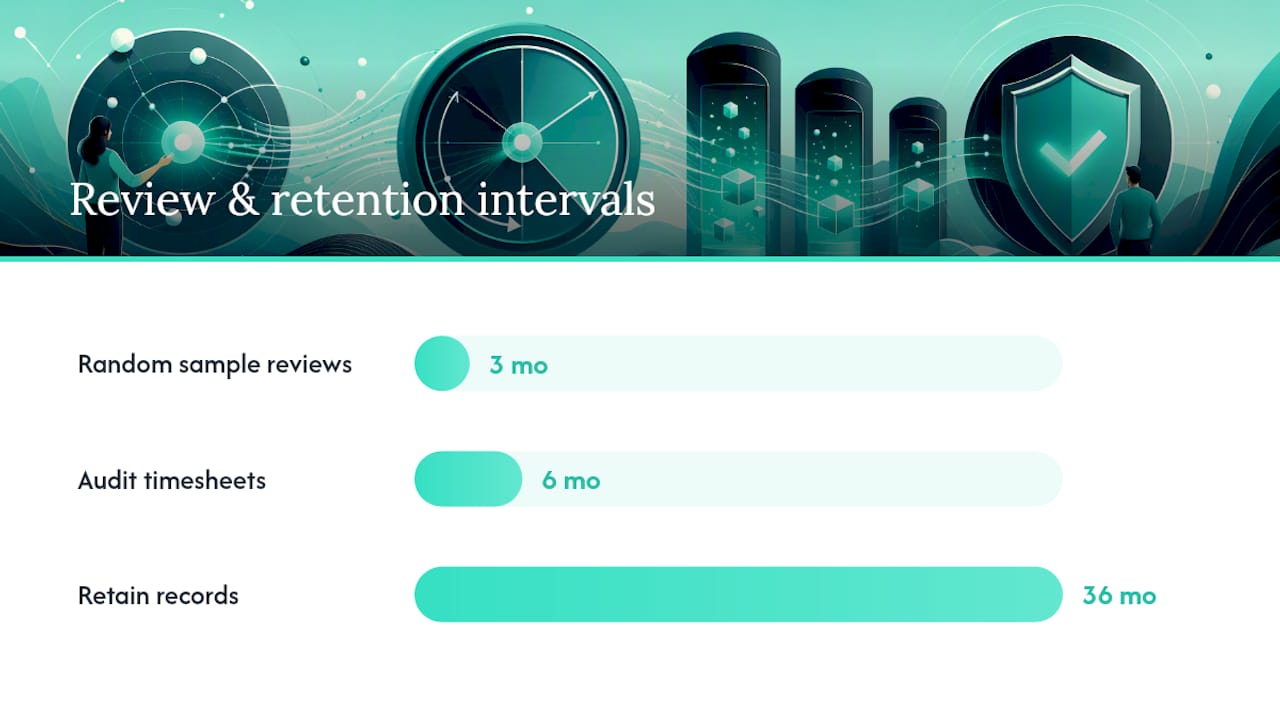
- Audit timesheets at least twice a year, mapping entitlements by role since break rules often differ by job type or minor status.
- Retain timestamped records for the standard three-year window and log every correction with a reason.
- Train managers to treat honest self-reported corrections as normal, not a performance issue.
A random sample of timesheets reviewed each quarter tends to surface problems long before they turn into a claim. It’s a small habit that catches a scheduling conflict or a chronically skipped break while it’s still cheap to fix.
How Does Kloqk Support Break Compliance?
Kloqk’s free time tracking platform was built around the exact gaps that create break violations: unreliable timestamps, missing attestation, and no visibility until it’s too late.
- Timestamped break punches with employee attestation, so every record stands on its own as evidence.
- Automatic break and overtime calculations, removing the manual math that introduces payroll errors.
- Payroll-ready exports that carry break data straight into your pay run.
- Photo verification at clock-in to confirm who’s actually punching the clock.
- GPS geofencing for teams working across job sites or delivery routes.
Getting this running takes four steps: turn on break prompts so employees log start and end times directly, configure alerts for missed or short breaks, walk your managers and staff through the new workflow in one short session, and set a recurring quarterly audit on the calendar. None of this replaces legal counsel for a state-specific gray area, particularly in states with rules as detailed as California’s. What it does is give you clean, timestamped operational data the moment you need to prove compliance instead of scrambling to reconstruct it.
An Editorial Take on Getting This Right
Most small businesses don’t get burned by malice. They get burned by a system that never wrote anything down. Break compliance is really a payroll accuracy problem wearing a legal hat, and fixing it protects margin as much as it protects you from a claim. If you do nothing else this quarter: write the policy, turn on timestamped prompts, and schedule your first audit. Everything else follows from those three moves.
Saad
Get Compliant Break Tracking Running Today
Some platforms provide timestamped break punches, automatic break and overtime calculations, and payroll-ready exports in a core platform without per-seat fees, helping to maintain a clean audit trail. That combination is what turns the policy you just wrote into records you can actually defend.
If your team works off-site or across shifts, pair that with GPS geofencing so location data backs up every punch. Head to the free time clock and break tracking features page, set up break prompts for your team, and run your first export on the next pay cycle. It’s the most direct route from “we hope our records hold up” to knowing they will.
Where to Verify These Rules
- U.S. Department of Labor: Breaks and Meal Periods
- California DLSE Meal Periods FAQ
- CalChamber: California Meal and Rest Break Laws
- Huprich Law: Rest and Meal Break Rights
This article is general information, not a substitute for advice from a qualified lawyer. Consult a qualified legal professional about your own circumstances before acting on anything here.
Sources
- Breaks and Meal Periods | U.S. Department of Labor
- Division of Labor Standards Enforcement (DLSE) Meal Periods FAQ
- California meal and rest break laws | CalChamber
- The Complete Guide to Break Tracking and Working Time Regulations | Relentify
FAQ
What Is the OSHA Rule on Breaks?
OSHA doesn’t set break requirements. Break rules fall under wage and hour law, governed federally by the FLSA and, in many cases, by stricter state statutes like California’s.
Are Employers Legally Required to Give Employees a Break?
Federal law sets no such requirement, but a growing number of states do. California, for example, mandates a 30-minute meal period after five hours worked and paid rest breaks throughout the shift.
Who Is Responsible for Tracking Employee Hours?
The employer holds that responsibility, including breaks, under federal and state wage law. Delegating the clock punches to staff doesn’t shift the legal duty to keep accurate records off the owner’s plate.
What Does Compliance Tracking Actually Mean?
It means keeping timestamped, attestable records of hours worked and breaks taken so you can prove, not just claim, that pay matched actual time on the clock. Tools like Kloqk build that timestamp and attestation directly into the clock-in process.
How Long Should Break Records Be Kept?
Most employers keep timestamped break and time records for at least three years, matching typical audit and recordkeeping expectations under federal wage law.
Recommended
Sources
Every figure on this page traces to one of these. Primary law and government sources are listed first.
- 1. U.S. Department of Laborprimary
- 2. California Department of Industrial Relationsprimary
- 3. calchamber.com
- 4. relentify.com
- 5. huprichlaw.com
Written by
Dana WhitfieldHR Compliance Lead
Dana writes about wage-and-hour law, FLSA overtime, and leave compliance for U.S. small businesses, translating dense regulations into plain steps owners can act on.
Keep Reading
Track Hours the Easy Way
Kloqk is a free time clock that handles punches, breaks, overtime, and payroll-ready reports.
Start free