State Labor Law Requirements for Construction Sites
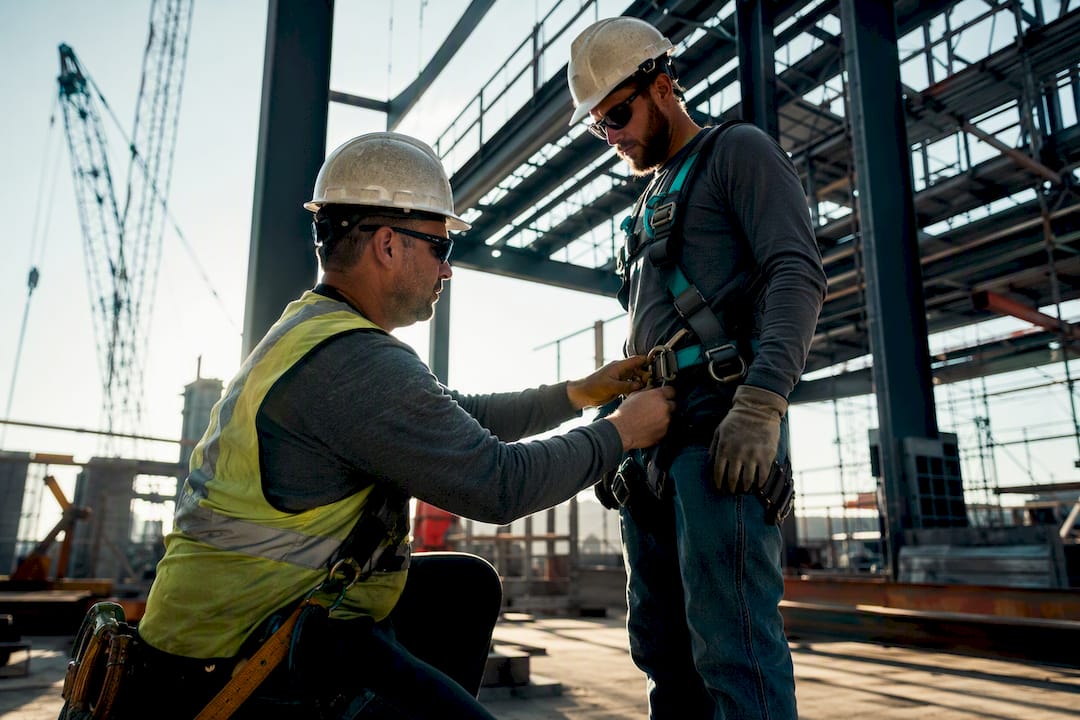
If your jobsite runs afoul of labor law, three federal regimes are almost always the reason: the Fair Labor Standards Act (FLSA) for wages and overtime, OSHA for safety, and Davis‑Bacon/CWHSSA for public-funded contracts. Layer state-specific rules on top, and compliance stops being a checkbox and becomes an ongoing operational habit.
Before a crew touches a jobsite, confirm these five things:
- Required federal and state notices are posted where workers actually see them
- Every worker’s classification (employee vs. independent contractor) is documented, not assumed
- Site-specific safety training happened and you have proof, not just a memory of it
- Your timekeeping system tracks a real 7-day workweek, not a fudged biweekly average
- Someone owns the compliance file, so it isn’t scattered across three people’s inboxes
Pro Tip: The single fastest fix for most of these gaps is a digital time-tracking and onboarding process that timestamps every clock-in and training sign-off automatically, so you’re not reconstructing records after an investigator asks for them.
Key Takeaways
Construction wage-and-hour compliance depends on defining a true 7-day workweek, documenting classification and training decisions, and checking state-specific rules before every public bid.
| Point | Details |
|---|---|
| Confirm FLSA coverage | Check the $500,000 revenue and two-employee threshold, but remember individual coverage applies regardless of size. |
| Fix the workweek definition | Overtime must be calculated after 40 hours in a fixed 7-day period, never averaged across pay periods. |
| Document training, not just PPE | Keep site-specific training records for every worker, including staffing-agency hires. |
| Check state rules every bid cycle | Prevailing wage, certified payroll, and posting rules vary by state and change annually. |
| Use auditable time tracking | Kloqk’s photo verification and GPS geofencing create the workweek-accurate, exportable records auditors ask for first. |
This article is general information, not a substitute for advice from a qualified lawyer. Consult a qualified legal professional about your own circumstances before acting on anything here.
Table of Contents
- What Federal Laws Apply to Construction Sites?
- Who Counts as a Covered Worker on Your Site?
- What Are the Wage and Recordkeeping Rules for Construction Payroll?
- What Safety Training Does OSHA Require on Jobsites?
- How Do State Rules Change Construction Labor Compliance?
- What Are the Most Common Construction Labor Violations?
- What Is a Practical Compliance Checklist for Construction Sites?
- How Does Accurate Time Tracking Reduce Wage-and-Hour Risk?
- Reduce Wage-Hour Risk With Auditable Time Tracking
- Sources
What Federal Laws Apply to Construction Sites?
The FLSA governs minimum wage, overtime, and recordkeeping for most construction businesses. A company falls under enterprise coverage if it has two or more employees and $500,000 or more in annual gross sales, and workers engaged in interstate commerce get individual FLSA protection no matter the employer’s size.
OSHA treats construction as a high-hazard industry, which means employers must provide a safe workplace, train workers on recognized hazards, and follow construction-specific standards. Twenty-nine states and territories run their own OSHA State Plans, and those can impose rules stricter than the federal baseline.
Then there’s the federal-contract layer. The Contract Work Hours and Safety Standards Act requires time-and-a-half overtime on covered federal and federally assisted contracts above set dollar thresholds, and it works alongside Davis‑Bacon prevailing wage rules on public projects.
- FLSA: overtime, minimum wage, recordkeeping
- OSHA: hazard prevention, training, PPE, inspections
- Davis‑Bacon/CWHSSA: prevailing wage and overtime on federally funded work
Who Counts as a Covered Worker on Your Site?
Coverage isn’t optional based on job title. Under the FLSA, enterprise coverage kicks in at that $500,000 revenue and two-employee threshold, but individual coverage for workers touching interstate commerce applies regardless of employer size.
Temporary and staffing-agency workers complicate this. OSHA guidance makes clear that a host employer generally retains responsibility for site-specific training even when the worker’s paycheck comes from a staffing firm. You can’t outsource the duty just because you outsourced the hire.
Watch for these misclassification red flags:
- Paying a “1099 contractor” who works set hours under your direct supervision
- No written agreement defining scope, tools, or schedule independence
- Using the same worker as a contractor on one job and an employee on the next
Pro Tip: Keep a signed classification worksheet for every worker, referencing the economic realities test, and file it before the first day of work, not after a complaint arrives.
What Are the Wage and Recordkeeping Rules for Construction Payroll?
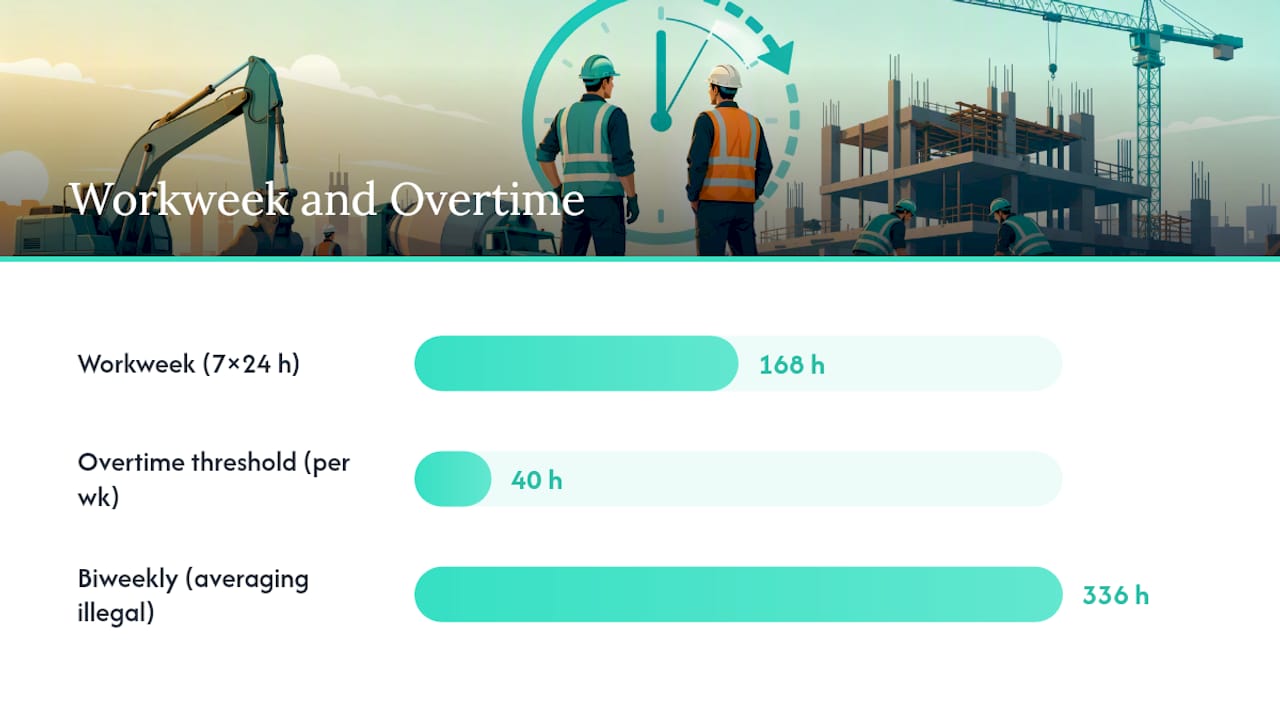
The FLSA defines the workweek as a fixed, recurring period of seven consecutive 24-hour periods, and overtime kicks in after 40 hours within that single window. Paying overtime based on hours worked across a biweekly pay period rather than each week is illegal. Each workweek stands alone, and averaging hours to dodge overtime is one of the most persistent misconceptions in construction payroll.
Recordkeeping obligations under 29 CFR Part 516 require accurate logs of hours worked, wages paid, and deductions taken. Missing timesheets or reconstructed records after the fact are exactly what triggers a Department of Labor investigation.
On federally funded projects, 29 CFR Part 5 layers on prevailing wage determinations, fringe benefit rules, and certified payroll submissions.
- Define your workweek in writing and apply it consistently
- Never average hours across pay periods to reduce overtime
- File certified payroll on any Davis‑Bacon covered project
Misclassification and improper overtime math are the two most frequent sources of construction wage-and-hour violations.
Pro Tip: Automated time capture tied to your actual workweek eliminates the manual math errors that cause most overtime disputes.
What Safety Training Does OSHA Require on Jobsites?
Employers must assess site hazards before work starts and provide training and PPE matched to those hazards. This isn’t a one-time orientation video. OSHA expects documented, site-specific training, particularly for high-risk activities like fall protection, scaffold work, and silica exposure.

When workers arrive through a staffing agency, the host employer still carries most of the training verification burden. OSHA guidance recommends documented walk-throughs and job hazard analyses for every temporary worker, not a verbal assurance from the staffing firm.
Standards inspectors check most often on construction sites:
- Fall protection (the leading cause of construction fatalities)
- Scaffold stability and access
- PPE fit and usage, including respiratory protection
- Language-appropriate training for non-English-speaking crews
Pro Tip: Auditors look for proof training was verified, not just offered. A dated sign-off sheet or digital training log tied to each worker’s file closes that gap fast.
How Do State Rules Change Construction Labor Compliance?
Federal law sets the floor, not the ceiling. States running their own OSHA State Plan can add inspection priorities and standards beyond what federal OSHA requires, and prevailing wage programs vary sharply from state to state.
New York’s Article 8 requires prevailing wages on virtually all public works regardless of contract size, mandates certified payroll filings, requires OSHA-10 training on many public projects, and publishes county-level wage schedules that reset every year. Rhode Island goes further on frequency: it requires certified weekly payroll forms and weekly pay for prevailing-wage employees, with penalties for missing paperwork.
- Check your state labor department’s construction-specific wage pages before bidding public work
- Confirm whether your state OSHA plan differs from federal defaults
- Verify posting and record-retention periods, which vary by state
Pro Tip: If you operate across state lines, centralize your legal tracking in one calendar so wage-schedule updates and posting deadlines don’t slip between jobs.
What Are the Most Common Construction Labor Violations?
Misclassification tops the list, followed closely by overtime miscalculation, missing certified payroll on public projects, absent site-specific training records, and skipped or outdated postings.
Enforcement comes through several channels: WHD wage investigations, OSHA inspections (often triggered by a complaint or a referral), state labor department audits, and on public contracts, withheld payment or debarment from future bids. The Associated General Contractors of America notes that construction law shifts by state and by year, which is exactly why a rule that was compliant last bid cycle can lapse without anyone noticing.
- Misclassification of employees as independent contractors
- Overtime calculated on a biweekly average instead of the legal workweek
- Certified payroll missing or filed late on Davis‑Bacon covered work
- No documented proof of site-specific safety training
Wage-and-hour complaints remain a persistent source of construction industry enforcement action, and remedies often include back pay, liquidated damages, and civil penalties.
What Is a Practical Compliance Checklist for Construction Sites?
- Verify FLSA coverage and worker classification before the first paycheck, and file the documentation.
- Define a fixed 7-day workweek and build your pay system around it, not a biweekly shortcut.
- Post required federal and state notices at every jobsite entrance or break area.
- Document site-specific safety training for every worker, including temporary hires from staffing agencies.
- Confirm prevailing-wage and certified payroll obligations on any public or federally assisted project.
- Retain payroll and training records for the periods required under 29 CFR Part 516 and applicable state rules.
- Run a quarterly internal audit comparing timesheets, training logs, and postings against current requirements.
Pro Tip: If resources are tight, get steps 2, 4, and 6 right first. Accurate timekeeping, documented training, and clean records catch most violations before an inspector ever shows up.
How Does Accurate Time Tracking Reduce Wage-and-Hour Risk?
A system built around your actual workweek makes it structurally hard to bank overtime illegally or misplace hours across job codes. When clock-ins timestamp automatically against a defined 7-day cycle, the averaging error that causes most FLSA violations simply can’t happen.
Photo verification at clock-in and GPS geofencing add a second layer: proof that the right worker clocked in at the right site, which matters when a wage dispute or an audit asks who worked where and when.
- Export certified, audit-ready timesheets by worker, job, and pay period
- Retain photo and location logs alongside hours for WHD or state review
- Flag overtime as it accrues, not after payroll runs
Pro Tip: Keep exported timesheets, training sign-offs, and classification worksheets in one retrievable file per worker. That’s the folder an auditor asks for first.
A Note on Priorities When Time Is Short
If you can only fix three things this quarter, fix these: your workweek definition, your training documentation, and your worker classification file. Everything else on the checklist matters, but these three generate the most citations and the most back-pay claims when they’re wrong. Perfect postings won’t save you from a misclassified crew.
Reduce Wage-Hour Risk With Auditable Time Tracking
Kloqk turns every clock-in into a payroll-ready, audit-ready record, so the workweek rule, overtime math, and training documentation this guide covers stop depending on memory or spreadsheets.
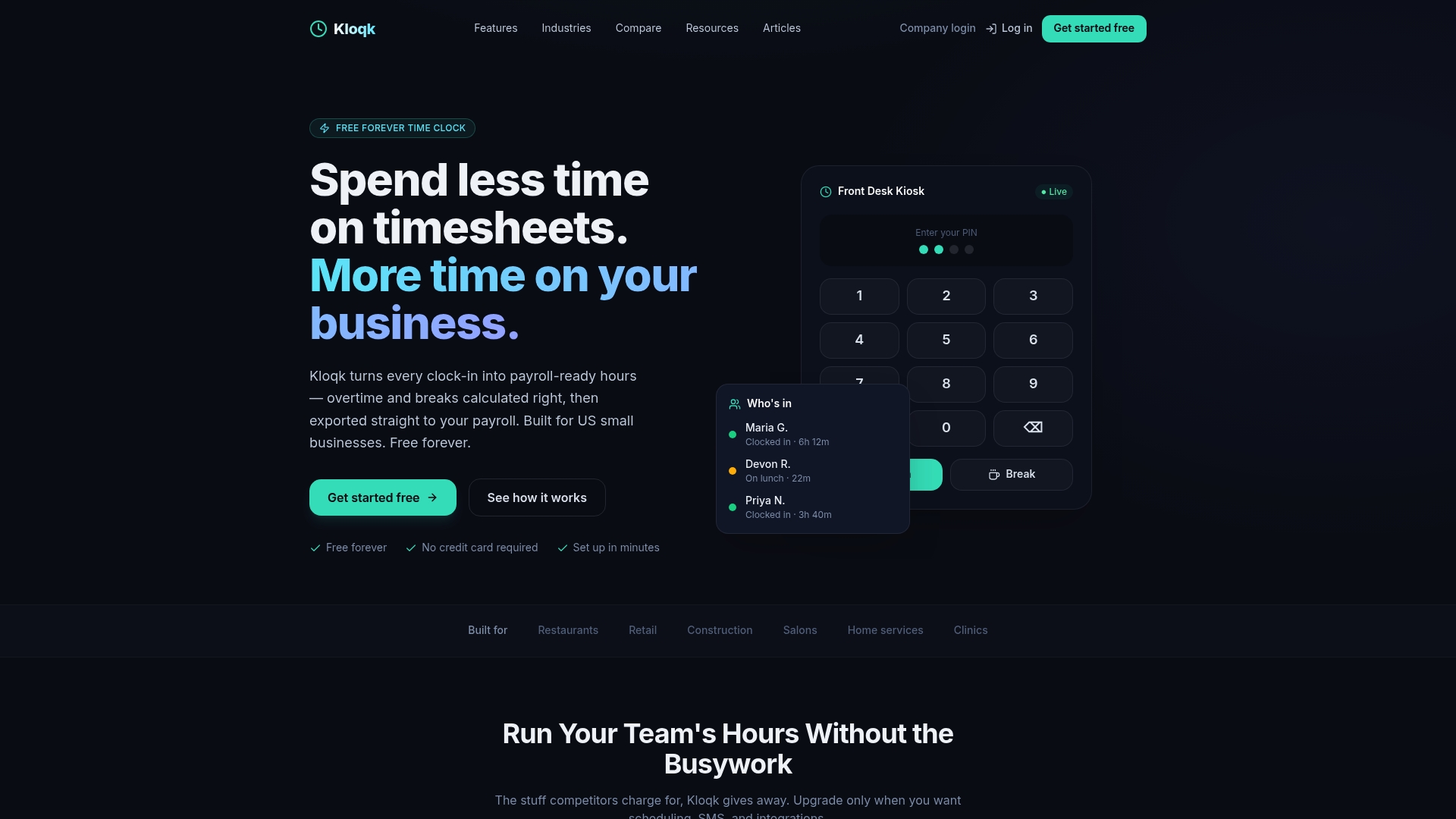
Photo verification confirms who actually clocked in, GPS geofencing ties that punch to the right jobsite, and overtime calculates automatically against a real 7-day workweek instead of a biweekly average. For crews spread across multiple sites, the GPS time clock with geofencing prevents the buddy-punching and location disputes that show up in wage complaints, and the free employee time tracking platform exports certified timesheets in the format a WHD investigator or state auditor actually wants to see. Set up a free account and run your next pay period through it before your current process runs another compliance gap.
Sources
- Fact Sheet #1: The Construction Industry Under the Fair Labor Standards Act (FLSA) | U.S. Department of Labor
- Employment Law Guide, Hours and Safety Standards in Construction Contracts
- Construction Industry | Occupational Safety and Health Administration
- eCFR :: 29 CFR Part 5 (Mar. 9, 2026) Labor Standards Provisions Applicable to Contracts Covering Federally Financed and Assisted Construction
- Bureau of Public Work, Guide for Employers (Article 8) | New York State Department of Labor
Recommended
Sources
Every figure on this page traces to one of these. Primary law and government sources are listed first.
- 1. U.S. Department of Laborprimary
- 2. U.S. Department of Laborprimary
- 3. Electronic Code of Federal Regulationsprimary
- 4. dol.ny.gov
- 5. dlt.ri.gov
- 6. agc.org
Written by
Dana WhitfieldHR Compliance Lead
Dana writes about wage-and-hour law, FLSA overtime, and leave compliance for U.S. small businesses, translating dense regulations into plain steps owners can act on.
Keep Reading
Track Hours the Easy Way
Kloqk is a free time clock that handles punches, breaks, overtime, and payroll-ready reports.
Start free