Construction Payroll Compliance in 2026: A Contractor's Guide

Construction payroll compliance means meeting every wage, classification, and reporting obligation that applies to your workers and your projects. Get it wrong, and you’re looking at back wage assessments, civil penalties, and possible debarment from federal contracts. The Wage and Hour Division (WHD) of the Department of Labor treats construction as one of the most audited sectors for wage and hour violations, and that scrutiny has only intensified under the Bipartisan Infrastructure Law. Understanding payroll compliance in construction means grasping how the Davis-Bacon Act, the Fair Labor Standards Act (FLSA), certified payroll reporting, and state prevailing wage laws all operate at the same time, on the same project, often with conflicting requirements.
The stakes are concrete. Contractors who misclassify workers, submit inaccurate certified payroll reports, or ignore state wage rules face back wages, interest, treble damages under the False Claims Act, and a three-year debarment window. This guide walks through every layer of how construction payroll compliance works, from the foundational laws to the internal audit practices that keep contractors out of trouble.
What federal and state laws govern construction payroll?
The Davis-Bacon Act is the starting point for any federally funded construction contract exceeding $2,000. It requires contractors and subcontractors to pay workers the locally prevailing wage and fringe benefit rates published by the Department of Labor for each trade and location. Those rates come from wage determinations posted on SAM.gov and must be incorporated into every covered contract before work begins.
The FLSA layers on top of Davis-Bacon by setting the federal overtime threshold at 1.5 times the regular rate for hours beyond 40 in a workweek. Some states go further. California, for example, requires daily overtime after eight hours, and double time after 12. When federal and state rules conflict, contractors must apply the stricter standard, which often means the state rule wins.

Over 30 states have their own prevailing wage laws, sometimes called “Little Davis-Bacon” statutes, and many impose rates and reporting requirements that exceed federal minimums. When both sets of rules apply simultaneously, contractors must pay the higher wage and follow the stricter reporting protocol.
A few other laws that directly affect construction payroll:
- False Claims Act: Intentional falsification of certified payroll records on federally funded projects can trigger treble damages plus civil penalties.
- Contract Work Hours and Safety Standards Act (CWHSSA): Requires overtime pay on federal contracts and allows the government to withhold funds for violations.
- Multi-state withholding rules: Workers who cross state lines require separate payroll tax registrations in each jurisdiction where they perform work.
- Record retention: Federal rules require payroll records on prevailing wage projects to be kept for at least three years after project completion, with many states requiring longer.
Prime contractors carry a dual burden: they must comply themselves and verify that every subcontractor on the job complies too. The DOL holds prime contractors responsible for subcontractor violations, which makes subcontractor oversight a legal obligation, not just a management preference.
In 2026, the Department of Labor proposed a new 5-factor classification test emphasizing economic reality, control, and business independence to determine worker status. That shift matters because written contracts alone no longer settle the question of whether someone is an employee or an independent contractor.
How certified payroll reporting works for federal projects
Certified payroll reporting is the documentation mechanism that proves compliance with Davis-Bacon prevailing wage requirements. Every contractor and subcontractor on a covered federal project must submit a weekly payroll report, signed under penalty of perjury, confirming that workers were paid the correct wages and fringe benefits for their trade and classification.
The standard form is Form WH-347, published by the WHD. Contractors may use a different format, but it must contain identical information and include a signed Statement of Compliance. The report must be submitted within seven days of the regular pay date for that weekly pay period, and submissions are required even for weeks when no work was performed on the project.
| Report element | What it must include |
|---|---|
| Worker identification | Full name and last four digits of Social Security number |
| Work classification | Trade or craft (e.g., carpenter, electrician, laborer) |
| Hours worked | Daily and weekly hours by classification |
| Wage rates | Straight-time and overtime rates paid |
| Fringe benefits | Amount paid per hour toward bona fide benefit plans |
| Statement of Compliance | Signed certification by a responsible party |
| Submission deadline | Within one week of the regular pay date |
Fringe benefits require particular care. Contractors can satisfy the fringe benefit portion of the prevailing wage either by making contributions to bona fide benefit plans (health insurance, pension, vacation funds) or by paying the fringe amount in cash on top of the base wage. Administrative costs do not qualify as bona fide benefits, so contractors cannot count overhead toward their fringe rate. Each benefit must provide verifiable value to the worker.
Electronic submission of certified payroll reports is increasingly standard, and many funding agencies now require it. If errors are discovered after submission, contractors should correct and resubmit proactively. Waiting for an auditor to find the mistake is far more costly than self-correcting.
Pro Tip: Keep a project-specific certified payroll file that includes the wage determination, all submitted WH-347 forms, fringe benefit documentation, and any approved conformances. Auditors request exactly this package, and having it organized cuts response time from weeks to hours.
Common payroll compliance mistakes construction contractors make
Misclassification of construction workers is a common issue, drawing consistent scrutiny from both the IRS and the DOL. Misclassification is the most expensive mistake a contractor can make, because it triggers back taxes, penalties, and interest across every affected pay period.
Here are the errors that show up most often in DOL investigations and IRS audits:
- Misclassifying employees as independent contractors based on written agreements rather than the economic reality test. If your company controls how, when, and where the work gets done, that worker is almost certainly an employee under federal standards.
- Applying the wrong prevailing wage rate because the contractor used a statewide rate instead of the county-specific determination, or assigned a worker to the wrong trade classification.
- Late or incomplete certified payroll submissions. Missing a weekly deadline, submitting unsigned forms, or leaving fringe benefit fields blank are among the most common audit triggers.
- Poor fringe benefit documentation. Fringe benefit errors cause more Davis-Bacon violations than any other single issue. Contractors often fail to reconcile what was promised in the wage determination with what was actually contributed to benefit funds.
- Ignoring multi-state tax registration. A crew that works in three states requires three separate withholding registrations. Many contractors skip this step and accumulate penalties quietly.
- Overtime miscalculations for workers with multiple classifications. A worker who spends part of the day as a laborer and part as an equipment operator must have overtime calculated correctly across both rates.
- Inadequate record retention. Because the three-year retention clock starts at project completion, not at payroll processing, contractors can face audits on jobs they finished years ago and no longer have records for.
The IRS classification framework looks at behavioral control, financial control, and the nature of the working relationship. A signed “independent contractor agreement” carries almost no weight if the contractor dictates work hours, provides tools, and directs the method of work.
What are the penalties for construction payroll non-compliance?
The financial exposure from payroll violations in construction is steep, and it compounds quickly. Back wages are the baseline: contractors owe the full difference between what workers were paid and what they should have been paid, plus interest. For projects with dozens of workers across multiple pay periods, that figure can reach six digits before penalties are even added.
Under the Davis-Bacon Act, contractors found in violation face contract termination, liability for costs incurred by the government, and debarment from federal contracting for up to three years. Debarment is particularly damaging for contractors who depend on public works projects, since it effectively shuts them out of a major revenue stream.
The False Claims Act adds another layer of risk. Intentional submission of inaccurate certified payroll reports can result in treble damages, meaning the government can recover three times the amount of the false claim, plus civil penalties per violation. The DOJ has doubled those per-violation penalties in recent years, making a pattern of inaccurate submissions extraordinarily expensive.
Misclassification carries its own penalty structure. Employers who misclassify workers owe both the employer and employee share of FICA taxes for the affected periods, plus failure-to-file penalties and interest. Willful misclassification can escalate to criminal charges.
The record retention window means audits can reach back years. A project completed in 2022 can still be audited in 2026 if the three-year clock started at completion. Contractors who purge records early lose their primary defense.
Audit triggers include misclassified workers, incorrect prevailing wage rates, and late or incomplete certified payroll submissions. Worker complaints filed with the WHD are the most common starting point for investigations, but funding agencies also conduct routine compliance reviews on Bipartisan Infrastructure Law projects.
Best practices for staying compliant with construction wage regulations
Contractors who perform quarterly self-audits reduce compliance violations by about 75% on average. That single habit, done consistently, catches errors before an agency does.
Beyond self-audits, here are the practices that separate compliant contractors from those who get caught:
- Train your payroll staff on Davis-Bacon and state prevailing wage rules before each new project starts, not after the first violation notice arrives.
- Maintain a wage determination library organized by project, updated whenever the DOL issues a revised determination mid-contract.
- Reconcile fringe benefit contributions monthly against what the wage determination requires. Gaps compound fast when you’re running multiple projects.
- Verify subcontractor compliance before the first paycheck is cut. Collect their certified payroll reports weekly, review them for accuracy, and flag discrepancies immediately.
- Register for payroll taxes in every state where your workers perform services, even for short-duration projects.
- Use construction-specific payroll software that applies the correct prevailing wage rate by trade, location, and project automatically. Manual rate lookups are where errors breed.
- Keep audit-ready files for every project: wage determinations, certified payrolls, fringe benefit documentation, worker classifications, and subcontractor compliance records.
Pro Tip: Integrate your payroll system with your project management software so that job codes, worker classifications, and hours flow directly into payroll without manual re-entry. Every manual transfer is a chance for a rate or classification error.
Knowing why construction pay compliance matters goes beyond avoiding fines. Contractors with clean compliance records win more bids, retain workers longer, and face fewer project delays from agency investigations.
How time tracking tools support construction payroll compliance
Accurate time data is the foundation of every compliant payroll run. If the hours are wrong, the wages are wrong, the certified payroll is wrong, and the audit exposure follows automatically.
Construction-specific time tracking tools address this at the source. Features that matter for compliance include:
- GPS geofencing that restricts clock-ins to the actual job site, preventing workers from logging hours before they arrive or after they leave.
- Photo verification at clock-in to confirm worker identity and eliminate buddy punching, which distorts both hours and classification records.
- Trade and classification tagging so that when a worker switches from laborer to operator mid-shift, the system records both classifications and the hours in each.
- Automated overtime alerts that flag when a worker approaches the weekly threshold or crosses a state-specific daily limit.
- Payroll export formatting that maps directly to certified payroll report fields, reducing the manual work of preparing WH-347 submissions.
- Multi-site support for contractors running crews across several job sites simultaneously, with location-specific wage rates applied automatically.
Mobile timekeeping in construction has become the practical standard for field crews who don’t sit at desks. A mobile app that works offline and syncs when connectivity returns keeps records intact even on remote sites.
Kloqk offers GPS geofencing, photo clock-in verification, overtime calculations, and payroll-ready time exports at no cost, which removes the budget barrier that keeps smaller contractors on manual timesheets. For a contractor managing workers across multiple classifications and locations, having that data organized and exportable before payroll runs is the difference between a clean submission and a corrected one.
Pro Tip: Set up classification-based pay rules in your time tracking system before the project starts. Changing them mid-project creates retroactive discrepancies that are painful to reconcile and easy for auditors to spot.
How to handle fringe benefits and union wages in payroll compliance
Fringe benefits are where Davis-Bacon compliance gets technically demanding. The prevailing wage determination specifies both a base rate and a fringe rate for each trade classification. Contractors must pay the full package, and the fringe portion must go toward bona fide benefits.
Bona fide benefits include health insurance, pension contributions, vacation funds, and apprenticeship programs. The key word is “bona fide”: the benefit must provide real, verifiable value to the worker. Administrative costs, overhead, and profit do not qualify. If a contractor cannot document that a benefit meets the bona fide standard, the DOL will treat that portion as unpaid wages.
Union collective bargaining agreements (CBAs) add another layer. When a CBA sets wages and fringe rates above the prevailing wage determination, the CBA rate governs. Contractors working in multiple states must also navigate union jurisdiction reciprocity, where a worker’s home local may have different benefit fund arrangements than the local covering the project site. Getting this wrong means double contributions or missed contributions, both of which create audit exposure.
For non-union contractors, the cash-in-lieu option is common: pay the fringe amount directly to the worker as additional cash wages. This is simpler to document but increases the worker’s taxable income and the contractor’s payroll tax burden. Some contractors mix approaches, covering health insurance through a plan and paying remaining fringe amounts in cash.
Reconcile fringe benefit contributions against the wage determination every pay period. Waiting until year-end to discover a shortfall means months of underpayment to correct, with interest.
How to conduct an internal payroll audit for construction
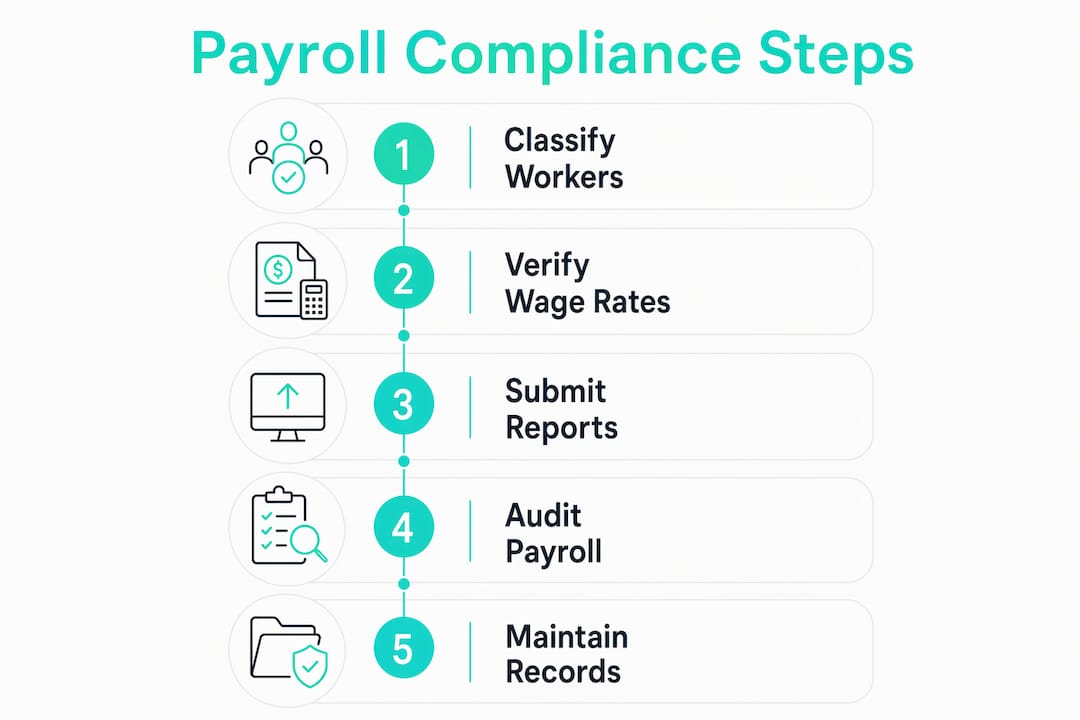
An internal payroll audit is a structured review of your own records before a government agency does it for you. The goal is to find classification errors, rate mismatches, and documentation gaps while you still control the outcome.
Start with worker classification. Pull the list of everyone paid as an independent contractor on each active and recently completed project. Apply the DOL’s economic reality test to each one: does your company control how the work is done? Does the worker operate an independent business with multiple clients? Written contracts are not the test. The actual working relationship is.
Next, verify prevailing wage rates. For each project, confirm that the wage determination in the contract file matches the rates being applied in payroll. Check that each worker’s classification matches the work they actually performed, not just the classification that was convenient at bid time.
Review certified payroll submissions for completeness. Every week covered by the project should have a submitted WH-347 or equivalent, signed by a responsible party, with fringe benefit fields completed. Missing weeks, unsigned forms, and blank fringe columns are the three most common findings in WHD investigations.
Check your record retention files. For any project completed in the last three years, you should be able to produce the wage determination, all certified payrolls, fringe benefit documentation, and worker classification records within a few business days. If you cannot, that gap needs to close before an auditor asks.
A time management audit of your payroll processes also reveals where manual steps create error risk. Every place a number is re-entered by hand is a place where the certified payroll can diverge from the actual payroll, which is exactly what auditors look for.
Run these reviews quarterly. The contractors who catch their own mistakes first are the ones who avoid the back wage assessments, penalty notices, and debarment proceedings that follow a full DOL investigation.
Key Takeaways
Construction payroll compliance requires simultaneously meeting federal Davis-Bacon wage rules, state prevailing wage laws, certified payroll reporting deadlines, and worker classification standards, with prime contractors legally responsible for subcontractor violations too.
| Point | Details |
|---|---|
| Certified payroll deadlines | Form WH-347 must be submitted within one week of the regular pay date for each weekly pay period. |
| Worker classification risk | About 20% of construction workers are misclassified, leading to IRS and DOL scrutiny and significant back tax liability. |
| Fringe benefit documentation | Fringe errors cause more Davis-Bacon violations than any other single issue; reconcile contributions every pay period. |
| Record retention window | Federal rules require payroll records for at least 3 years after project completion, not from the payroll date. |
| Self-audit impact | Contractors who perform quarterly self-audits reduce compliance violations by about 75% on average. |
Recommended
Sources
Every figure on this page traces to one of these. Primary law and government sources are listed first.
Written by
Marcus ReyesPayroll & Timekeeping Specialist
Marcus covers payroll accuracy, timesheets, and time tracking, the unglamorous mechanics that keep paychecks correct and audits painless.
Keep Reading
Track Hours the Easy Way
Kloqk is a free time clock that handles punches, breaks, overtime, and payroll-ready reports.
Start free