How Small Businesses Lose Money on Inaccurate Time Tracking

Manual or insecure time tracking causes overpayments, hidden overtime, and unbilled hours that quietly drain payroll budgets every single pay period. The immediate fix is payroll-ready, tamper-resistant time tracking. As payroll expert Raj Bhaskar notes at CPA Practice Advisor, owners routinely mistake “on-time” payroll for “accurate” payroll, and small overtime miscalculations compound quietly over months into significant margin erosion. The FLSA requires employers to maintain accurate records of hours worked, so inaccurate timekeeping is both a financial and a legal exposure.
Three things you can do right now:
- Enable photo verification or GPS clock-ins so every punch is authenticated before it hits your payroll.
- Require real-time clock-ins instead of end-of-shift estimates or paper sign-ins.
- Pull one recent pay period and compare raw clock-in data against approved timesheets. One audit often surfaces the problem immediately.
Key Takeaways
Inaccurate time tracking costs small U.S. businesses real payroll dollars every pay period, and the fix is a payroll-ready, tamper-resistant system paired with a clear clocking policy and a weekly audit habit.
| Point | Details |
|---|---|
| Small errors compound fast | Six padded minutes per day per employee costs roughly $4,500/year at $18/hr; multiply by headcount. |
| Policy and tech both required | A clocking policy stops behavioral drift; photo verification and GPS stop technical fraud. |
| FLSA compliance is non-negotiable | Accurate records must be retained for at least two years; a tamper-resistant audit trail satisfies this. |
| Measure three KPIs weekly | Track paid-but-not-worked minutes, missed-punch rate, and overtime variance to confirm the fix held. |
| Kloqk covers the core for free | Photo verification, GPS geofencing, overtime rules, and payroll exports are all included at no cost. |
Table of Contents
- How small businesses lose money on time: the failure-mode catalogue
- How small per-pay-period errors compound into large annual losses
- Operational changes that stop common time-tracking losses
- What technical features actually stop each failure mode
- Why Kloqk is the right fit for small hourly businesses
- Your 30/60/90-day rollout to stop the bleeding
- How to measure whether the problem is actually fixed
- What switching to payroll-ready tracking actually feels like
- Stop losing payroll dollars with Kloqk
- Sources
How small businesses lose money on time: the failure-mode catalogue
Every dollar of payroll leakage starts with one of a small set of recurring errors. Recognizing them in your own operation is the first step.
- Buddy punching. A coworker clocks in for someone who is late or absent. In a restaurant, this can mean paying for a no-show shift without realizing it until the next pay run.
- Padded breaks. A 15-minute break becomes 25. Across a five-person retail floor, that adds up to nearly an extra hour of paid time per day.
- Rounded or estimated clock-outs. Employees guess their end time, or a manager fills in a “close enough” figure. Construction crews are especially prone to this when paper logs sit in a truck.
- Missed clock-outs. An employee forgets to punch out, and the system defaults to a long shift or flags an error that a manager fixes manually, often generously.
- Missed or misapplied overtime. A salon employee works 41 hours but the manager only checks daily totals, missing the weekly overtime trigger under the FLSA’s 40-hour rule.
- Manual data-entry errors. A manager transcribes hours from a paper timesheet into payroll software and transposes digits. A $14.50/hr employee gets paid for 84 hours instead of 48.
- Incorrect job or project allocations. In construction, hours billed to the wrong job code inflate one project’s labor cost and understate another’s, wrecking job costing.
Time theft covers all of these, not just outright fraud. Padded breaks and buddy punching are the most common forms, and prevention depends on accurate, tamper-resistant tracking paired with a clear written policy.
How small per-pay-period errors compound into large annual losses
The math is straightforward and sobering. Take a modest scenario: one employee pads six minutes per day.
| Variable | Value |
|---|---|
| Padded minutes per day | 6 minutes |
| Working days per year | 250 |
| Annual padded hours (1 employee) | 25 hours |
| Hourly wage | $18/hr |
| Annual cost (1 employee) | $4,500 |
| Annual cost (10 employees) | $4,500 |
Six minutes feels trivial. Multiply it by ten employees and 250 working days, and you are paying for 250 hours of work that never happened. Add overtime multipliers (1.5x for hours over 40 per week) and employer-side payroll taxes, and the real cost per employee climbs higher than the base wage calculation suggests.
The compounding problem: Raj Bhaskar warns that overtime errors and irregular-hour miscalculations are the most insidious because they are small enough to escape notice each period but large enough to matter across a full year. Automation is the primary hedge.
Payroll inaccuracies also carry an indirect cost that rarely appears on a spreadsheet. Employees who receive incorrect pay, whether overpaid and then corrected or underpaid and left waiting, are more likely to leave. Replacing an hourly worker typically costs more than the payroll error itself, once you factor in recruiting, onboarding, and the productivity gap during training. The hidden costs of manual time tracking systems extend well beyond the payroll line.
Operational changes that stop common time-tracking losses
Technology fixes the mechanism, but policy fixes the behavior. Both are necessary.
- Write a clocking policy and make employees sign it. Define exactly when to clock in (before the first task, not after settling in), when to clock out, and what to do if a punch is missed. Ambiguity is where padding lives.
- Document missed punches formally. Require employees to submit a written correction request for any missed clock-in or clock-out, with a supervisor countersignature. This creates friction that discourages casual rounding.
- Run end-of-week supervisor approvals. Managers should review and approve timesheets before payroll closes, not after. Catching a 10-hour discrepancy on Friday costs five minutes. Catching it after payroll runs costs a correction cycle and, potentially, a compliance headache.
- Train new hires on clocking rules during onboarding. Most payroll mistakes trace back to bad data captured at hire or in the first weeks of employment. A 10-minute onboarding walkthrough on the time clock prevents months of errors.
- Apply discipline consistently. Selective enforcement signals that the policy is optional. One documented conversation per violation, applied uniformly, changes behavior faster than any software feature.
Pro Tip: Frame the clocking policy as protection for your honest employees, not surveillance of the dishonest ones. When workers understand that accurate records protect their own pay and prevent them from being blamed for someone else’s padding, compliance improves without resentment.
What technical features actually stop each failure mode
Policies set expectations; features enforce them. Here is the direct mapping:
| Failure mode | Technical safeguard |
|---|---|
| Buddy punching | Photo verification at clock-in |
| Off-site or fraudulent clock-ins | GPS geofencing |
| Disputed hours or audits | Tamper-resistant audit trail |
| Overtime miscalculation | Automatic overtime rules (FLSA 40-hr weekly) |
| Missed break compliance | Automated break enforcement and alerts |
| Manual entry errors in payroll | Direct payroll export (CSV, integration) |
Photo verification and GPS geofencing are the two features that address the highest-frequency fraud vectors for hourly teams. An immutable audit trail matters most when a dispute reaches a labor authority or a wage claim. Payroll-ready exports eliminate the transcription step where digit-transposition errors happen.
FLSA recordkeeping rules require employers to retain accurate time records for at least two years. A system with a tamper-resistant log satisfies that requirement and gives you a defensible record if a former employee files a wage claim. Audit trails and payroll exports shorten dispute response time from days to minutes.
Pro Tip: Before signing up for any time-tracking system, ask two questions: “Can an employee or manager edit a submitted punch without leaving a visible log entry?” and “Does your payroll export map directly to my payroll provider’s import format?” A “yes” to the first and a “no” to the second are both disqualifiers.
Why Kloqk is the right fit for small hourly businesses
Small businesses do not need enterprise complexity. They need a system that works on day one, costs nothing to start, and does not require a payroll administrator to configure.
Kloqk is built for exactly that. The core platform is free and covers every failure mode listed above:
- Photo verification at every clock-in stops buddy punching without biometric hardware.
- GPS geofencing prevents off-site punches for construction crews, delivery teams, and any mobile workforce.
- Automatic overtime calculations apply FLSA weekly rules without manual intervention.
- Break enforcement flags missed or short breaks so managers catch compliance gaps before payroll closes.
- Payroll-ready exports eliminate manual transcription and connect directly to payroll runs.
The cost-benefit case is direct. A 10-person team losing six minutes per employee per day loses roughly $4,500 annually at $18/hr before overtime multipliers. Kloqk’s free tier costs $0 to start. Even the paid tiers for scheduling, PTO, and integrations run a fraction of that annual leakage. Automated clock-in systems recover that margin within the first pay period.
Your 30/60/90-day rollout to stop the bleeding
Days 1-30: set the foundation
- Choose a payroll-ready time clock (Kloqk’s free tier works for this).
- Write and distribute your clocking policy; collect signed acknowledgments.
- Run a pilot with one team or one location.
- Enable photo verification and GPS geofencing from day one.
- Audit one pay period manually to establish your baseline.
Days 31-60: full rollout and configuration
- Expand to all teams and locations.
- Configure overtime rules (40-hour weekly FLSA minimum; add state rules where applicable).
- Set break enforcement alerts for your state’s required break schedule.
- Train all supervisors on the approval workflow.
- Run your first payroll export and reconcile it against your payroll ledger.
Days 61-90: measure, refine, and lock in
- Calculate your paid-but-not-worked minutes per employee versus the baseline.
- Adjust geofence radii or photo requirements based on what the first 60 days revealed.
- Document the process for onboarding new hires so the system scales without retraining.
- Set a recurring weekly audit cadence (see the next section).
How to measure whether the problem is actually fixed
Fixing the system is not the same as verifying the fix held. These KPIs tell you whether the leakage has stopped:
- Paid-but-not-worked minutes per employee per day (target: under 2 minutes after 90 days).
- Overtime hours as a percentage of scheduled hours (flag anything above your historical baseline).
- Missed-punch rate (number of manual corrections per pay period; should trend toward zero).
- Variance between scheduled and actual hours (large gaps signal either scheduling errors or time padding).
- Payroll error rate (number of corrections per payroll run; target is zero).
Weekly audit (15 minutes):
- Pull the week’s raw clock-in log.
- Compare it against approved timesheets for three randomly selected employees.
- Check that photo and GPS logs exist for each punch.
- Flag any manual edits and confirm they have a supervisor note.
Monthly audit (30 minutes):
- Reconcile the payroll export against your GL or payroll ledger.
- Review overtime totals against the schedule.
- Check your missed-punch rate trend. If it is rising, the policy enforcement has slipped.
Overtime alerts are the single fastest KPI to move. Most businesses see missed overtime drop within the first full pay period after enabling automatic rules.
What switching to payroll-ready tracking actually feels like
The shift is less dramatic than owners expect, and that is the point. Before accurate tracking, payroll feels like a guessing game: you run the numbers, something looks off, you spend an hour chasing down a manager who remembers “roughly” what happened on Tuesday. After the switch, payroll closes in minutes. The export matches the schedule. Disputes drop because the photo log and GPS record answer the question before it becomes an argument. The margin you recover is not a windfall; it is money that was always yours, just quietly leaking out through a process that rewarded imprecision.

Stop losing payroll dollars with Kloqk
Payroll leakage from inaccurate time tracking is one of the most fixable cost problems a small business faces, and Kloqk makes the fix free to start.
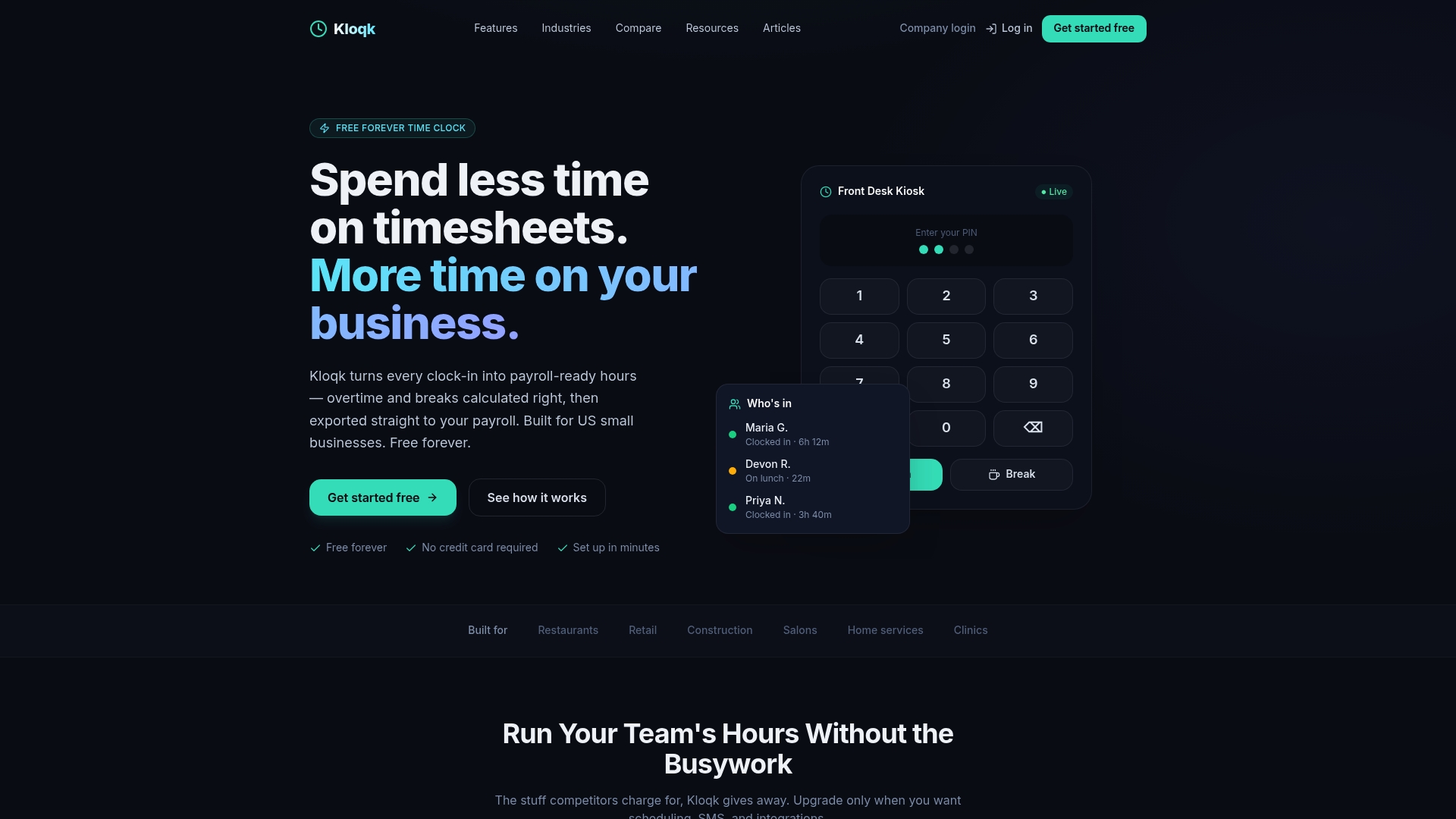
Sign up for Kloqk’s free plan, configure your geofence and photo verification in under 10 minutes, and run a single pay-period pilot. You will see the difference in the first export. The core employee time tracking features, including overtime calculations, break tracking, audit trails, and payroll exports, cost nothing. Optional paid upgrades for scheduling, PTO management, and integrations are available when you are ready to go further. Start the pilot this week, and compare your next payroll run against the baseline you pulled in day one.
Sources
Use these sources when building your clocking policy, preparing for a labor audit, or evaluating time-tracking vendors.
- 5 Payroll Mistakes That Are Costing Small Businesses Thousands, and How to Fix Them, CPA Practice Advisor
- Time Theft at Work: What It Is and How to Prevent It | FirstHR
Recommended
Sources
Every figure on this page traces to one of these. Primary law and government sources are listed first.
- 1. U.S. Department of Laborprimary
- 2. cpapracticeadvisor.com
- 3. firsthr.app
Written by
Priya NairPeople Operations Writer
Priya focuses on HR and hiring for small teams, onboarding, scheduling people fairly, and the day-to-day of managing hourly staff without an HR department.
Keep Reading
Track Hours the Easy Way
Kloqk is a free time clock that handles punches, breaks, overtime, and payroll-ready reports.
Start free