No Call No Show: A Policy & Manager Guide for Employers

A no call no show (NCNS) happens when an employee misses a scheduled shift and never contacts the employer before it starts. The moment you confirm one, do three things: attempt contact through every number on file, arrange coverage for the shift, and document each attempt with a timestamp. Check whether FMLA or ADA protections might apply before you consider discipline.
- Call, text, and try an emergency contact.
- Pull a backup or ask a manager to cover the shift immediately.
- Log every attempt, with times, before end of day.
Quick fact: Shift-heavy employers commonly over-hire by 10% to 20% specifically to absorb the disruption an unplanned absence like this causes.
Key Takeaways
A defensible NCNS response combines immediate contact attempts, careful documentation, a written policy with a clear job-abandonment threshold, and a check for FMLA or ADA protections before any discipline.
| Point | Details |
|---|---|
| Define NCNS precisely | Set an exact cutoff, such as 30 minutes past shift start with no contact. |
| Act within the first hour | Call, text, arrange coverage, and log every attempt with a timestamp. |
| Check federal protections first | Rule out FMLA, ADA, or USERRA coverage before disciplining or terminating. |
| Use progressive discipline | Move from written warning to suspension to termination over a rolling window. |
| Document everything | Store contact logs, return-to-work notes, and signed policy acknowledgments. |
| Use tools to prevent and prove | Kloqk logs missed punches, photo verification, and GPS location for free. |
Table of Contents
- How Does a No Call No Show Usually Happen?
- What Should a Manager Do in the First Hour?
- What Legal Risks Come With Disciplining an NCNS?
- How Do You Write an Enforceable NCNS Policy?
- How Should You Document and Discipline an NCNS?
- What Prevents No Call No Shows Before They Happen?
- How Can Time-Tracking Software Support Your Policy?
- Turn Your NCNS Policy Into an Enforceable System
- Frequently Asked Questions
- Sources
How Does a No Call No Show Usually Happen?
Most NCNS incidents trace back to something ordinary, not defiance. An employee oversleeps after a late night, a car breaks down with no way to send a text, or a phone dies with no charger in reach. Sudden illness, a medical emergency, or a caregiving crisis (a sick kid, an aging parent’s fall) also accounts for a large share of cases.
Retail, hospitality, healthcare, and manufacturing feel this hardest because a single missing worker on a tight shift schedule leaves a real gap. A cook who never shows means a slower kitchen and an angrier line of customers. That operational cost is exactly why most employers treat an unexplained no show far more seriously than a phoned-in call-out. One is a heads-up. The other is a scramble.
- Oversleeping or a broken alarm
- Transportation failure (car trouble, missed bus, dead battery)
- Sudden illness or a medical emergency
- Phone or communication failure
- Caregiving emergencies (child care, elder care)
- Forgetting the shift entirely (a common issue where scheduling is unclear)
What Should a Manager Do in the First Hour?
Speed matters here. The first sixty minutes determine whether you cover the shift smoothly or scramble at the last second, and whether your documentation will hold up later.
- Call the employee, then follow up with a text within 10 to 15 minutes.
- Try an emergency contact if one is on file.
- Notify your shift lead or payroll contact that a slot needs coverage.
- Pull from a backup list, cross-trained staff, or an on-call employee.
- Log the incident immediately, don’t wait until end of shift.
A simple outreach script works better than winging it: “Hi [name], this is [manager] at [business]. You were scheduled for [shift] and haven’t checked in. Please call or text me back as soon as you can.” When the employee resurfaces, keep the return conversation calm: “I’m glad you’re okay. Walk me through what happened so we can figure out next steps.”
- Record exact call and text timestamps
- Note who attempted contact and by what method
- Save texts or voicemails as evidence
- File everything in the employee’s record the same day
What Legal Risks Come With Disciplining an NCNS?
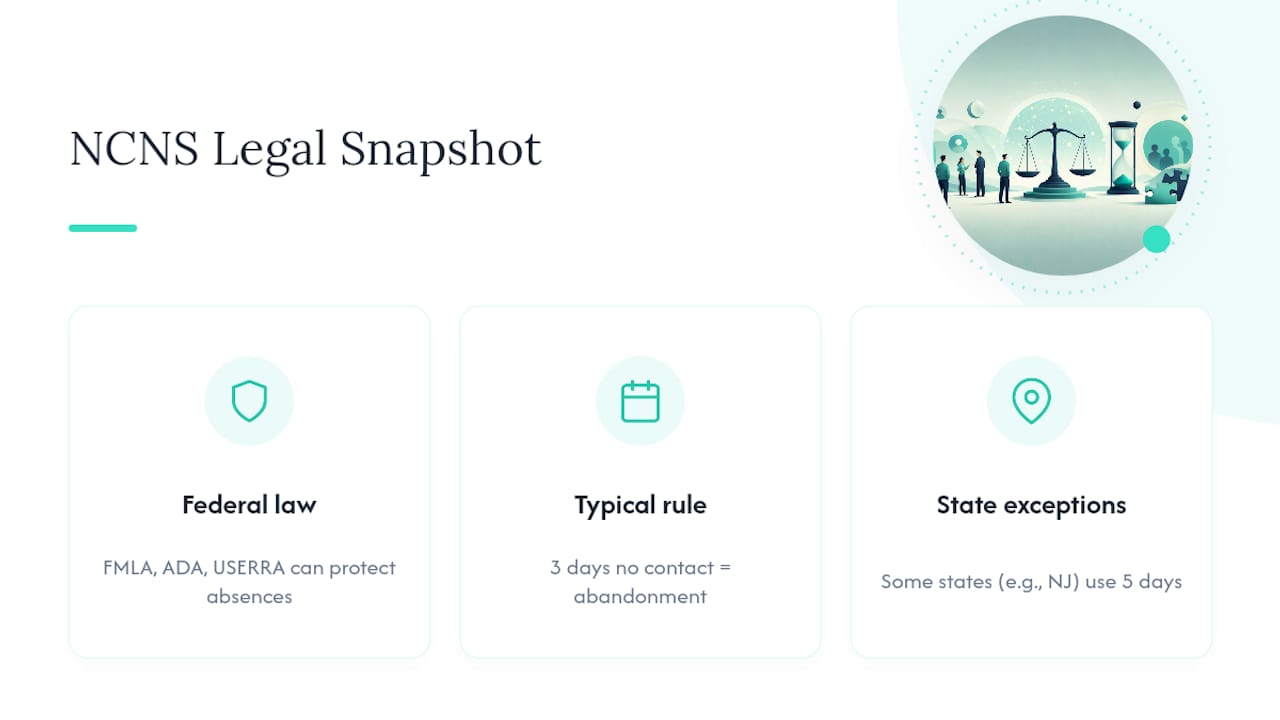
Before you write anyone up or move toward termination, check whether federal protections could reclassify the absence. The FMLA, the ADA, and USERRA (for military service members) can all turn what looks like an unexcused absence into protected leave. An employee hospitalized without a way to call in, or dealing with an undisclosed disability flare-up, may be covered even if they never used the words “FMLA” or “ADA” out loud.
Before disciplining, ask why the absence happened, request documentation if the situation warrants it, and loop in HR or legal counsel before finalizing anything. Skipping that step is how a routine termination turns into a wrongful-termination claim or an unemployment appeal you lose.
Pro Tip: Check your state’s paid-sick-leave law and its legal definition of job abandonment before you act. Three consecutive missed days without contact is a common threshold nationally, though New Jersey and a handful of other states sometimes use five.
This article offers general guidance, not legal advice. Consult an employment attorney before finalizing any termination decision related to an NCNS.
How Do You Write an Enforceable NCNS Policy?
A policy that only exists in your head isn’t a policy. It’s a habit you can’t defend in an unemployment hearing. Every workable NCNS policy needs a few non-negotiable pieces.
- A clear definition, including the exact cutoff (for example, no contact by shift start plus 30 minutes counts as an NCNS)
- Approved notification methods (a phone call to the manager, not a text to a coworker)
- A tiered list of consequences by incident number
- A job-abandonment threshold, commonly three consecutive no-shows
- A carve-out acknowledging FMLA, ADA, and other protected leave
- A signed acknowledgment on file for every employee
Sample definition: “An employee who fails to report for a scheduled shift and does not notify a manager by phone within 30 minutes of shift start will be considered a no call no show.”
Sample notification clause: “Employees must call their direct supervisor, not text a coworker or post on a group chat, to report an absence or late arrival.”
Sample progressive-discipline language: first incident, written warning; second incident within 90 days, unpaid suspension; third incident, termination review. Sample abandonment clause: “Multiple consecutive scheduled shifts missed without employer contact will be treated as voluntary resignation.”
Pro Tip: Store every signed acknowledgment digitally and re-distribute the policy whenever you update it. A policy nobody remembers signing is hard to enforce later.
How Should You Document and Discipline an NCNS?
A defensible NCNS policy pairs a clear timeline with consistent recordkeeping. Most employers use a rolling 90 to 180 day window: first offense gets a written warning, a second gets suspension, a third moves toward termination review.
- Log every contact attempt with exact timestamps.
- Record the coverage decision and who filled the shift.
- Document the return-to-work conversation in writing.
- Note whether protected leave was assessed and how.
- Finalize discipline only after HR or counsel signs off.
- Keep contact logs in the personnel file, not a manager’s personal notes
- Store texts, voicemails, and emergency-contact call records
- Treat a job-abandonment declaration as a last resort, not a default
What Prevents No Call No Shows Before They Happen?
Most NCNS incidents are preventable with better systems, not stricter punishment. Reminder systems and multiple-contact protocols, borrowed from healthcare’s approach to missed appointments, cut no-show rates in scheduling contexts just as effectively as they do in medical ones.
- Give employees one obvious way to report an absence, not three confusing options
- Send shift reminders the night before, especially for volatile weekend or holiday shifts
- Cross-train staff so a single absence doesn’t collapse a shift
- Keep a small backup or on-call pool for high-risk shifts
- Make PTO requests simple enough that people use them instead of skipping the shift
Good employee scheduling practices and tracking absenteeism trends both reduce the frequency of surprise gaps.
Pro Tip: Move your reminder window earlier for shifts with historically high no-show rates, like Sunday mornings or the day after a holiday. A text sent 18 hours ahead catches problems a same-day reminder misses.
How Can Time-Tracking Software Support Your Policy?
A written policy only works if you can prove what happened. Time-tracking software turns “he said, she said” into a timestamped record.
- Instant alerts the moment a scheduled shift passes with no clock-in
- Photo verification at punch-in, useful for disputes over who actually showed up
- GPS geofencing that confirms an employee clocked in from the job site, not from home
- Payroll-ready timesheets that reflect the exact hours worked, not estimates
When an NCNS happens, job-site clock-in records cut investigation time from a guessing game to a two-minute log review. Pair that with a missed punch policy so managers know exactly how to classify a gap versus a genuine no-show.
Pro Tip: Set your notification cadence to alert a manager within 15 minutes of a missed clock-in, and keep logs on file for at least a year in case of an unemployment claim.
A Practitioner’s Take on Accountability and Empathy
Enforcing an NCNS policy consistently and treating people like humans aren’t opposites. Most managers I’ve seen get this wrong lean too hard one way. The best return-to-work conversations sound like: “I need to understand what happened, and I need this documented, and I also want to know if you’re okay.”
Turn Your NCNS Policy Into an Enforceable System
A written policy only holds up if you can back it with real records, and that’s the gap Kloqk closes. Every clock-in gets a timestamp, a photo, and a GPS location, so when a shift goes unfilled, you have proof instead of a guess.
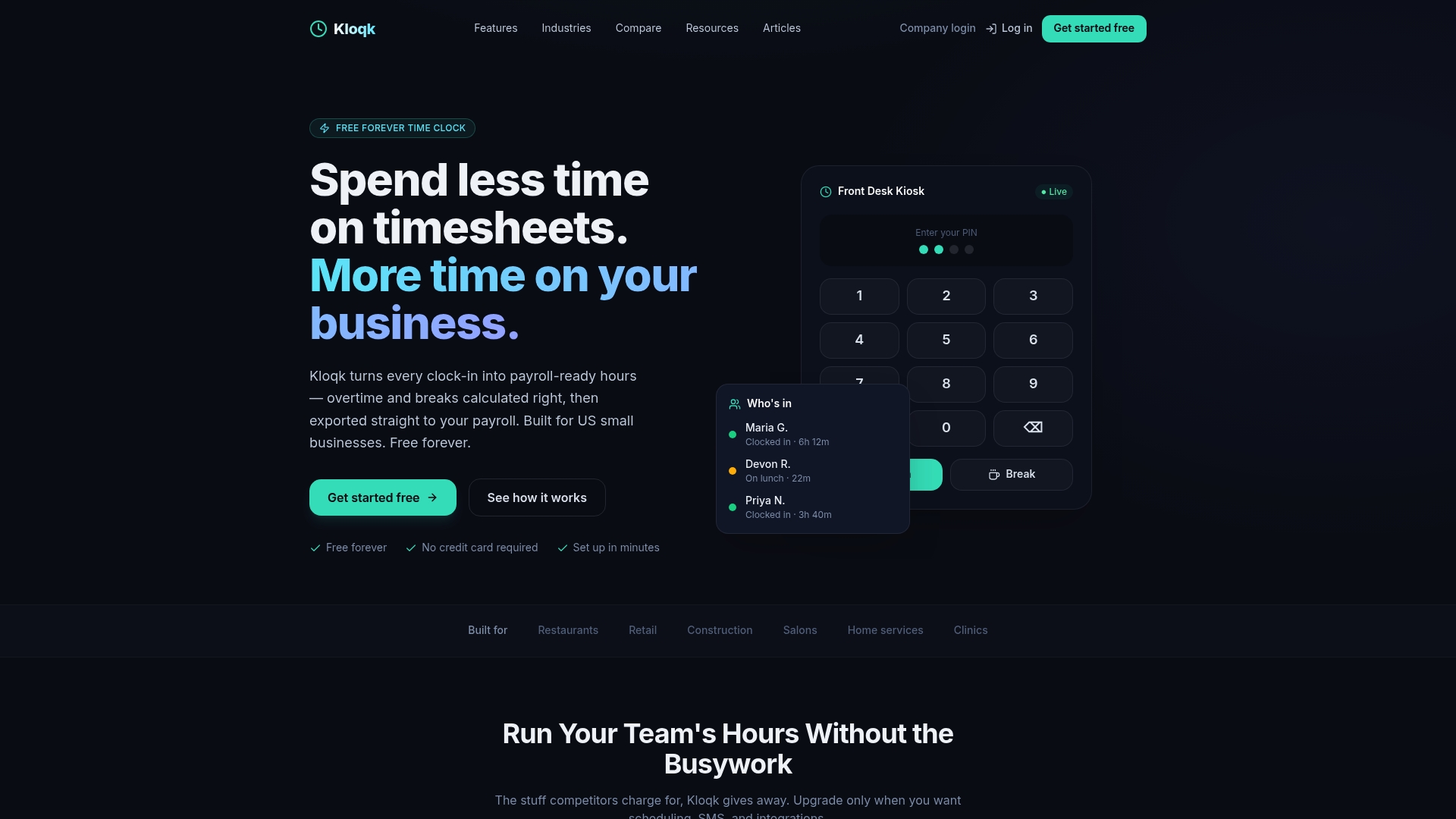
The core features cost nothing: payroll-ready timesheets, overtime and break tracking, and instant alerts when a scheduled punch never happens. That last one matters most for NCNS enforcement. Instead of piecing together who called whom at what time, you get a clean log the moment a shift starts without a clock-in. Add GPS geofencing if you manage off-site crews or multiple locations, and you’ll know immediately whether a missed shift is a no-show or a legitimate mix-up.
Set up your free employee time tracking account today and start building the documentation trail your NCNS policy actually needs.
Frequently Asked Questions
What counts as a no call no show versus a late call-out? A late call-out means the employee notified you, even if it was minutes before the shift. A no call no show means shift start passed with zero notification, which is why most policies set an exact cutoff window.
How many no call no shows before termination is appropriate? Most employers use three consecutive missed shifts without contact as the job-abandonment threshold, though this varies by state and by your own written policy. Always confirm no protected leave applies first.
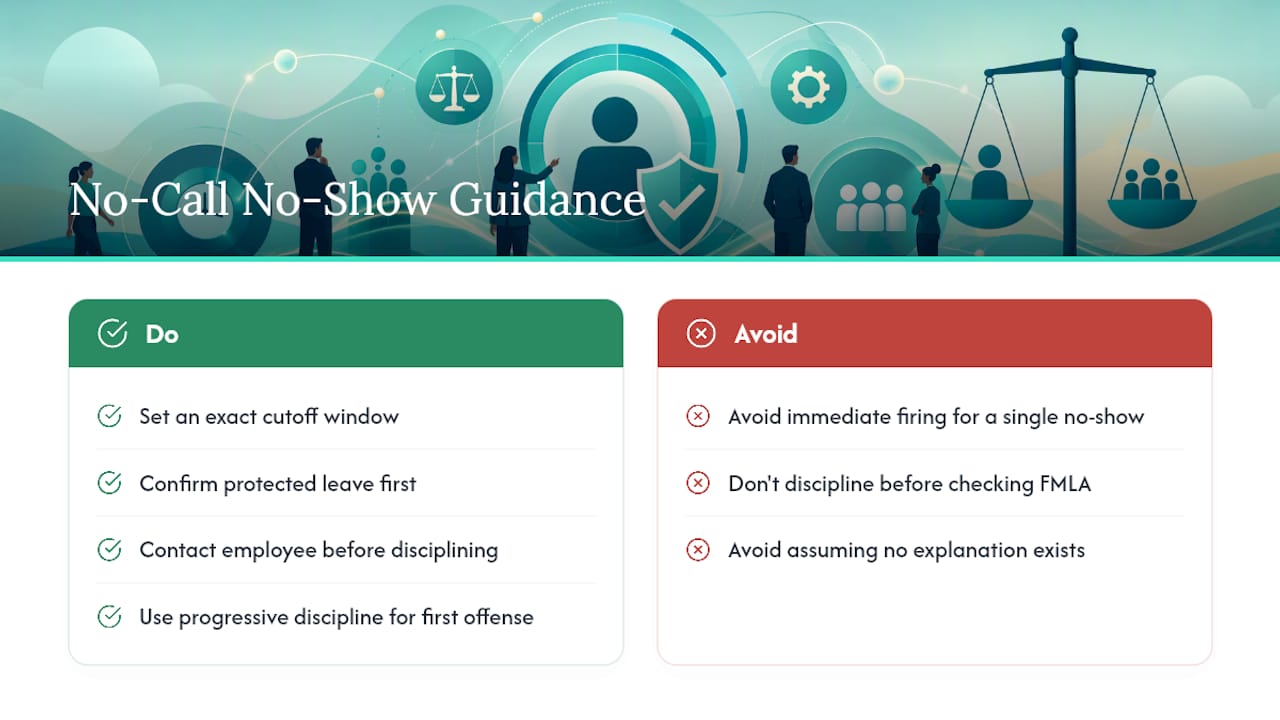
Can an employee be fired for one no call no show? Yes, if your policy states it and the facts don’t suggest a protected absence, but most employers use progressive discipline for a first offense unless the situation is severe.
Does FMLA protect a no call no show? It can, if the absence relates to a serious health condition the employee couldn’t report in time. That’s exactly why contacting the employee and asking what happened comes before any disciplinary action.
What should a no call no show apology include? A genuine explanation of what happened, acknowledgment of the disruption it caused, and a clear plan for how they’ll notify you going forward if something similar happens again.
Sources
Recommended
Sources
Every figure on this page traces to one of these. Primary law and government sources are listed first.
Written by
Priya NairPeople Operations Writer
Priya focuses on HR and hiring for small teams, onboarding, scheduling people fairly, and the day-to-day of managing hourly staff without an HR department.
Keep Reading
Track Hours the Easy Way
Kloqk is a free time clock that handles punches, breaks, overtime, and payroll-ready reports.
Start free