Absenteeism at Work: HR Guide to Measure and Reduce It

Absenteeism at work is repeated, unscheduled employee absence that disrupts operations and should be tracked and managed as a core workforce metric. If you’re an HR professional or manager reading this, here are four things to do before anything else: calculate your current absence rate (formula in Section 5), flag the three to five roles where a single absence creates the most coverage risk, ask frontline managers to schedule brief check-ins with any employee who has missed two or more unscheduled days in the past 30, and pull your written attendance policy to check when it was last updated.
Those four steps matter because the costs compound fast. U.S. employers lose an estimated $2,945 per salaried employee per year to absenteeism, and that figure covers only direct payroll costs. Add overtime, temporary coverage, and the productivity drag on the team left behind, and the real number climbs higher.
- Check your organization’s absence rate against the BLS industry average for your sector.
- Flag high-impact roles where one absence triggers overtime or customer-facing gaps.
- Start manager check-ins with employees showing early absence patterns.
- Review your leave policies for clarity, consistency, and legal compliance.
- Set a monthly cadence for reviewing absence data by team and reason code.
Pro Tip: Don’t wait for a pattern to become a problem. A single manager conversation after a second unscheduled absence costs almost nothing and often prevents a third.
Key Takeaways
Absenteeism at work costs U.S. employers an estimated $2,945 per salaried employee per year in direct costs alone, and the organizations that reduce it fastest combine consistent measurement, early manager intervention, and clear, legally vetted attendance policies.
| Point | Details |
|---|---|
| Calculate your absence rate now | Use the formula (days absent ÷ available workdays × 100); a rate at or above 4% warrants a policy and culture audit. |
| Classify before you act | Distinguish authorized vs. unauthorized and controllable vs. uncontrollable absences before applying any disciplinary step. |
| Manager conversations are the highest-leverage tool | A return-to-work interview after every unscheduled absence costs minutes and catches problems before they become patterns. |
| Check FMLA, ADA, and state sick-leave law first | Never apply progressive discipline without verifying whether the absences are legally protected under federal or state law. |
| Kloqk tracks attendance accurately from day one | Photo verification and GPS geofencing give small HR teams clean, defensible absence data without manual reconciliation. |
Table of Contents
- How HR classifies absenteeism at work
- What actually causes employee absenteeism
- The real cost of absenteeism to your organization
- How to calculate your absenteeism rate
- Evidence-based strategies for reducing absenteeism
- Manager playbook for handling repeated absences
- Legal risks HR must check before discipline or termination
- How to turn absence data into targeted interventions
- Practical tools for tracking and managing absence data
- What most absenteeism programs get wrong
- Kloqk gives small HR teams accurate absence data from day one
- Sources
How HR classifies absenteeism at work
Clear classification is what separates a defensible absence record from a vague log that falls apart under legal scrutiny. Before you can measure or manage employee absenteeism, you need a consistent taxonomy.
Authorized vs. unauthorized. Authorized absence is approved in advance or covered by a legal entitlement: FMLA leave, approved PTO, jury duty. Unauthorized absence is unscheduled and unexplained, or where the employee failed to follow the reporting procedure. The distinction matters for discipline: you generally cannot apply progressive discipline to authorized leave without triggering legal risk.
Controllable vs. uncontrollable. Research published on PubMed frames this as the most operationally useful split. Uncontrollable absence covers genuine illness, injury, or family emergency. Controllable absence reflects a choice the employee made, often shaped by workplace conditions, policy gaps, or low engagement. The same source notes that employees tend to “rise or sink to the level of expectations,” which is why vague or inconsistently enforced policies quietly raise your baseline.
Occasional vs. chronic. Occasional absence is isolated and infrequent. Chronic absence is a pattern often characterized by frequent unscheduled absences that significantly impact attendance rates. Chronic absence is the category that drives most of the cost and legal exposure.
Absenteeism is not a single phenomenon. Conflating a one-time illness with a pattern of Monday absences leads to interventions that miss the actual driver. Classification is the first act of management.
Common operational definitions HR should record:
- Time-lost rate: total days absent divided by total scheduled days, expressed as a percentage. Best for cost modeling.
- Frequency rate: number of absence episodes divided by headcount. Catches employees who take many short absences rather than a few long ones.
- Bradford Factor: a weighted frequency score that penalizes short, frequent absences more heavily than long ones. Useful for flagging patterns but requires consistent application to be defensible.
The BLS measures absence for full-time wage and salary workers who usually work 35 or more hours per week but worked fewer than 35 in the reference week. That definition is narrower than most employer-level tracking, so HR should document which definition their internal metrics use to keep reporting comparable over time.
What actually causes employee absenteeism
Most absence programs fail because they treat every absence as a compliance problem rather than a signal. A systematic literature review published in MDPI’s Social Sciences found that employee attitudes, specifically job satisfaction, organizational commitment, pay satisfaction, and job involvement, are the most consistently repeated predictors of absenteeism across empirical studies. Illness is the most visible cause. Disengagement is often the underlying one.
Major cause categories:
- Illness and injury: acute illness (flu, respiratory infections), chronic conditions, and workplace injuries. Flu season typically drives a measurable spike in January and February.
- Mental health and burnout: anxiety, depression, and stress-related exhaustion. NIOSH surveillance data supports tracking health-related absence against a historical baseline to detect unusual spikes, including those driven by psychological stressors.
- Caregiving and childcare: school closures, elder care emergencies, and lack of backup care options. This driver disproportionately affects employees in certain demographic groups and tends to be invisible in absence records coded simply as “personal.”
- Transportation and commute barriers: unreliable transit, vehicle breakdowns, and long commutes. More relevant in industries with fixed shift start times.
- Workplace stress and conflict: poor manager relationships, workload imbalance, and interpersonal conflict. These are controllable drivers that policy and manager training can address directly.
- Disengagement: employees who are present in body but absent in motivation often progress to physical absence. Absenteeism and turnover tend to move together as withdrawal behaviors.
The attitudinal drivers deserve specific attention because they respond to organizational intervention. Pay dissatisfaction, a sense that effort goes unrecognized, and low commitment to the organization are addressable through compensation reviews, recognition programs, and employee engagement strategies. Illness is harder to prevent; disengagement is not.
Statistic: A 2018 systematic review found that job satisfaction and organizational commitment were the most frequently replicated predictors of absence behavior across dozens of independent studies, appearing more consistently than demographic variables or job characteristics.
The real cost of absenteeism to your organization
The headline figure is $2,945 per salaried employee per year in direct costs, per Investopedia’s summary of employer-facing research. For a 50-person team, that’s roughly $147,250 annually before you account for indirect costs.
SHRM’s research on the total financial impact of employee absences documents both direct and indirect costs, and the indirect side is where most organizations underestimate the damage. When a skilled employee is absent, someone else covers. That coverage comes as overtime pay, a temporary hire, or degraded output. None of those options are free, and all of them affect the team left behind.
Absenteeism also correlates with turnover. The MDPI systematic review notes that absence and other withdrawal behaviors tend to cluster in the same employees, meaning a high-absence worker is often also a flight risk. Replacing an hourly employee typically costs a fraction of their annual salary; replacing a skilled or managerial employee can cost significantly more.
| Absence scenario | Direct payroll cost | Coverage cost | Productivity gap |
|---|---|---|---|
| 1 employee, 5 days absent | Paid leave or unpaid gap | Overtime or temp labor | Delayed deliverables, reduced output |
| 3 employees, 5 days each | Multiplied payroll cost | Possible shift restructuring | Team morale impact, manager time diverted |
| Chronic absentee, 20+ days/year | Sustained payroll drain | Ongoing coverage arrangements | Role effectively understaffed |
The productivity gap column is the one most organizations fail to quantify. Workflow automation tools that flag coverage gaps in real time can reduce the lag between an absence and a management response, which is where much of the indirect cost accumulates. Workflow automation reduces that operational friction by surfacing gaps before they become crises.
How to calculate your absenteeism rate
The standard formula is straightforward. Apply it consistently and you’ll have a number you can benchmark, trend, and defend.
Standard absence rate formula:
Absence Rate (%) = (Total Days Absent ÷ Total Available Workdays) × 100
Worked example:
- Team size: 20 employees
- Measurement period: one quarter (65 working days)
- Total available workdays: 20 × 65 = 1,300
- Total days absent (unscheduled): 52
- Absence Rate: (52 ÷ 1,300) × 100 = 4.0%
Absence rates at or above a commonly cited threshold warrant auditing both policy and workplace culture rather than focusing solely on individual absences.
Frequency rate formula:
Frequency Rate = Total Absence Episodes ÷ Average Headcount
A team of 20 with 30 absence episodes in a quarter has a frequency rate of 1.5. High frequency with short duration suggests a different problem than low frequency with long duration.
- Define your measurement period (monthly, quarterly, annual) and stick to it.
- Decide which absence types to include: unscheduled only, or all non-worked time.
- Pull total scheduled days from your time-tracking or HRIS system.
- Record absence episodes separately from absence days to calculate both metrics.
- Segment by department, shift, and manager before drawing conclusions.
| Absence rate | Interpretation | Suggested action |
|---|---|---|
| Below 2% | Low; monitor for data gaps | Confirm all absences are being recorded |
| 2%-3% | Typical range for many industries | Maintain current programs; review by role |
| 4% or above | Often cited as excessive | Audit policy, culture, and high-absence cohorts |
The BLS absence data by occupation and industry gives you sector-specific benchmarks. Healthcare, transportation, and production occupations consistently show higher rates than professional and managerial roles. Compare your rate to your sector, not the overall average.
Pro Tip: Track frequency and duration separately. An employee with 10 one-day absences is a different management challenge than one with a single 10-day medical leave, even though both show the same total days lost.
Evidence-based strategies for reducing absenteeism
Reducing absenteeism requires interventions at three levels: organizational design, manager behavior, and policy clarity. Programs that operate at only one level tend to plateau.
1. Flexible scheduling and remote options
Flexible start and end times reduce transportation-related absences and give employees a legitimate way to handle minor caregiving needs without taking a full day. Flexible work schedule policies that are clearly written and consistently applied reduce the incentive to call in sick for non-illness reasons. Remote and hybrid arrangements have a mixed effect on absenteeism: they reduce commute-driven absence but can mask disengagement if managers aren’t tracking output alongside attendance.
2. Paid sick leave design
Employees without paid sick leave are more likely to come in ill and infect colleagues, or to take unauthorized absences rather than report honestly. A well-designed paid sick leave bank, separate from PTO, removes the financial penalty for honest reporting. Several states now mandate paid sick leave; check your state’s current requirements before designing a policy.
3. Wellness programs with measurable targets
Generic wellness programs have mixed evidence. Programs tied to specific health risks in your workforce, flu vaccination clinics, EAP access for mental health, ergonomic assessments for physical roles, tend to show clearer impact on health-related absence. NIOSH recommends tracking health-related absence against a five-year historical baseline to detect unusual spikes, which gives you a way to measure whether a wellness intervention is actually moving the needle.
4. Return-to-work interviews
A brief, structured conversation on the day an employee returns from any unscheduled absence is one of the highest-leverage, low-cost interventions available. It signals that absences are noticed, creates an opportunity to identify underlying issues early, and generates a documentation record without being punitive. Manager training on how to run this conversation consistently is where most of the value comes from.
5. Workload and engagement audits
High absence rates in a specific team often reflect workload imbalance or a manager relationship problem rather than individual employee behavior. A quarterly engagement pulse and a workload review by role can surface these issues before they drive absence. The MDPI systematic review is clear that attitudinal drivers respond to organizational conditions, which means they are addressable.
KPIs to track for each strategy:
- Absence rate (monthly, by team)
- Frequency rate (episodes per employee per quarter)
- Return-to-work interview completion rate
- EAP utilization rate
- Overtime hours attributable to absence coverage
Statistic: SHRM’s research confirms that organizations investing in structured absence-reduction programs see measurable reductions in both direct payroll costs and indirect coverage expenses, with the return on investment strongest for programs combining manager training with clear policy enforcement.
Manager playbook for handling repeated absences
Managers are the first line of response, and inconsistency at this level is where most absenteeism programs break down. A manager who ignores a pattern in one employee while disciplining another for the same behavior creates legal exposure and erodes team trust.
Step-by-step manager response checklist:
- Verify and document the absence: date, duration, reason given, and whether the employee followed the reporting procedure.
- Check for protected status before any disciplinary action: Is this potentially FMLA-qualifying? Has the employee disclosed a medical condition or disability?
- Conduct a return-to-work conversation on the first day back. Keep it brief, supportive, and factual. Ask if there’s anything the organization can do to help.
- Set clear expectations in writing if a pattern exists. Reference the attendance policy specifically.
- Offer support resources: EAP referral, schedule adjustment, or a temporary accommodation if appropriate.
- Follow up at 30 days. If the pattern continues, escalate to the next step in the progressive discipline process.
Sample attendance policy elements HR should include:
- Reporting procedure: who to call, by what time, and what information to provide
- Definition of unscheduled absence and how it differs from approved leave
- Trigger points for progressive discipline (e.g., three unscheduled absences in 90 days)
- Documentation requirements at each stage
- Accommodation review process before any termination decision
- Consistent enforcement statement
Documentation checklist for each absence episode:
- Date and duration of absence
- Reason provided by employee
- Whether the reporting procedure was followed
- Notes from return-to-work conversation
- Any accommodation requests or medical documentation received
- Actions taken and dates
A missed punch policy is a useful companion document: it establishes what happens when an employee fails to clock in or out, which is often the first visible sign of an attendance problem in hourly roles.
Pro Tip: Document every return-to-work conversation in a consistent format, even when the absence seems minor. Inconsistent documentation is the most common reason progressive discipline fails under legal challenge.
| Manager action | When to apply | Documentation required |
|---|---|---|
| Informal check-in | First or second unscheduled absence | Brief note in employee file |
| Return-to-work conversation | Every unscheduled absence | Signed conversation summary |
| Written warning | Per policy trigger point | Formal written notice, employee signature |
| Performance improvement plan | Persistent pattern after warning | PIP document, HR sign-off |
| Termination review | After PIP failure | Full absence history, legal review |
Legal risks HR must check before discipline or termination
Acting on absenteeism without a legal review is one of the fastest ways to convert a legitimate performance issue into a wrongful termination claim. Four federal frameworks create the most exposure.
- FMLA (Family and Medical Leave Act): Employees at covered employers (50+ employees) who have worked 12 months and 1,250 hours are entitled to up to 12 weeks of unpaid, job-protected leave for qualifying medical and family reasons. Absences that qualify for FMLA cannot be counted against an employee in a disciplinary attendance program. Intermittent FMLA is the most common source of confusion: an employee can take FMLA in single days or partial days, and each qualifying absence must be tracked separately.
- ADA (Americans with Disabilities Act): If an employee’s absences are related to a disability, the employer may be required to provide a reasonable accommodation before discipline or termination. A leave of absence beyond FMLA entitlement can itself be a reasonable accommodation. Always conduct an interactive process before acting.
- State sick-leave laws: As of 2026, more than 20 states and many municipalities require employers to provide paid sick leave. Some of these laws restrict how employers can count sick leave use in attendance programs. California, New York, Illinois, and Washington have particularly detailed requirements.
- Leave-related discrimination: Absences tied to pregnancy, a protected medical condition, or a religious observance carry discrimination risk if handled differently from other absences. Consistent documentation and consistent enforcement are your primary defenses.
Before applying progressive discipline for attendance, HR should verify: (1) whether the absences are FMLA-qualifying, (2) whether the employee has disclosed a condition that may trigger ADA accommodation obligations, and (3) whether state sick-leave law restricts how the absences can be counted. Consult employment counsel before terminating an employee whose absences may be legally protected.
This article provides general information only and is not legal advice. Confirm current federal and state requirements with a qualified employment attorney before enforcing punitive attendance measures.
How to turn absence data into targeted interventions
Raw absence numbers don’t tell you much. Segmented absence data tells you almost everything. The goal is to move from a single organization-wide rate to a role-level, manager-level, and reason-code breakdown that points to specific interventions.
Dashboard items and KPIs to track:
- Overall absence rate (monthly and rolling 12-month)
- Frequency rate by department and manager
- Lost-time percentage by role category
- Reason code distribution (illness, personal, no-call/no-show, other)
- Seasonal trend line against a five-year historical baseline
- Return-to-work interview completion rate
NIOSH recommends using a historical baseline and an epidemic threshold to detect unusually high health-related absence, which is directly applicable to employer-level dashboards. If your January absence rate is consistently 1.5 percentage points above your annual average, that’s a signal to pre-position flu vaccination and EAP resources in December.
Analysis checklist:
- Segment absence data by role, shift, department, and manager.
- Identify the top three absence reason codes and whether they cluster in specific teams.
- Compare absence rates across managers with similar team sizes to isolate manager-driven patterns.
- Flag employees with three or more absence episodes in a rolling 90-day window.
- Review seasonal trends and compare to prior years.
- Set a monthly review cadence with a quarterly deep-dive.
Designing a pilot intervention:
Pick one high-absence team or reason code. Apply a single intervention (return-to-work interviews, flexible scheduling, or an EAP communication campaign). Measure absence rate and frequency rate for that cohort over 90 days against a control group or prior-period baseline. If the rate drops, scale. If it doesn’t, change the intervention before expanding.
| Dashboard metric | Review cadence | Action trigger |
|---|---|---|
| Absence rate by team | Monthly | Rate above 4% for two consecutive months |
| Frequency rate by employee | Monthly | Three or more episodes in 90 days |
| Reason code distribution | Quarterly | Single code exceeds 40% of all absences |
| Seasonal trend vs. baseline | Annually | Current year exceeds five-year average by 1.5+ points |
Remote clock-in monitoring adds a layer of data for distributed teams, where absence patterns can be harder to detect without systematic tracking.
Practical tools for tracking and managing absence data
The accuracy of your absence data is only as good as the system capturing it. Manual timesheets and verbal reports introduce errors that make your absence rate unreliable and your interventions misdirected.
Tool categories HR should evaluate:
- Mobile time clocks with photo verification and GPS geofencing: Confirm that the employee who clocked in is actually the employee assigned to the shift, and that they’re at the right location. This is particularly valuable in field-based roles (construction, home health, delivery) where buddy punching and unverifiable absences are common.
- HRIS with absence codes: A system that captures reason codes at the point of absence, not retrospectively, produces cleaner data for analysis. Look for FMLA and ADA tracking fields built into the absence module.
- Scheduling and PTO banks: Integrated scheduling lets managers see coverage gaps in real time when an absence is reported, rather than discovering them at shift start.
- Analytics and reporting dashboards: The ability to export absence data by employee, team, reason code, and date range is the minimum requirement for the kind of segmented analysis described in the previous section.
Tool selection checklist:
- Does it capture absence reason codes at the time of reporting?
- Does it flag FMLA-qualifying absences automatically or prompt for review?
- Can managers access absence history without going through HR?
- Does it export payroll-ready data to reduce reconciliation time?
- Does it support mobile clock-in with location verification for field teams?
- Is it compliant with federal and applicable state labor laws?
Cloud-based time and attendance systems give small HR teams the reporting depth of enterprise HRIS without the implementation cost. For teams tracking remote or hybrid employees, off-site attendance verification practices become part of the absence management workflow.
Pro Tip: The best time-tracking tool for absence management is the one your managers will actually use. A system that requires three screens to log an absence will be skipped. Prioritize mobile-first, one-tap reporting over feature depth.
Statistic: In hourly and field-based roles, photo verification and GPS geofencing at clock-in materially reduce unverifiable absences and simplify payroll reconciliation, removing a common source of disputed absence records.
What most absenteeism programs get wrong
The conventional wisdom on managing absenteeism focuses almost entirely on the back end: progressive discipline, documentation, termination. Those tools matter, but they’re the wrong place to start.
The more useful frame is this: absenteeism is a lagging indicator. By the time an employee has three unscheduled absences in a quarter, the underlying problem, disengagement, burnout, a bad manager relationship, a caregiving crisis, has usually been present for months. The absence is the symptom. The policy response addresses the symptom. The actual driver goes untouched.
What actually moves the needle, based on the evidence reviewed here, is a combination of consistent measurement, early manager conversations, and genuine attention to the attitudinal drivers. An employee who feels fairly paid, reasonably managed, and trusted to handle their schedule honestly is less likely to take an absence they don’t need. That’s not idealism. It’s what the systematic review of absence determinants shows across dozens of independent studies.
The other thing most programs underestimate is manager training. A manager who knows how to run a return-to-work conversation, who asks “is there anything we can do to help?” before reaching for the discipline form, catches problems early and builds the kind of trust that makes employees report honestly rather than call in sick to avoid a difficult conversation. That conversation costs 10 minutes. The alternative costs $2,945 per employee per year, and that’s before the overtime.
Kloqk gives small HR teams accurate absence data from day one
Tracking absenteeism accurately requires a time clock that captures real data, not self-reported spreadsheets. Kloqk’s free employee time tracking software gives small business HR teams photo-verified clock-ins, GPS geofencing, and payroll-ready exports at no cost, removing the most common source of disputed absence records in hourly and field-based teams.
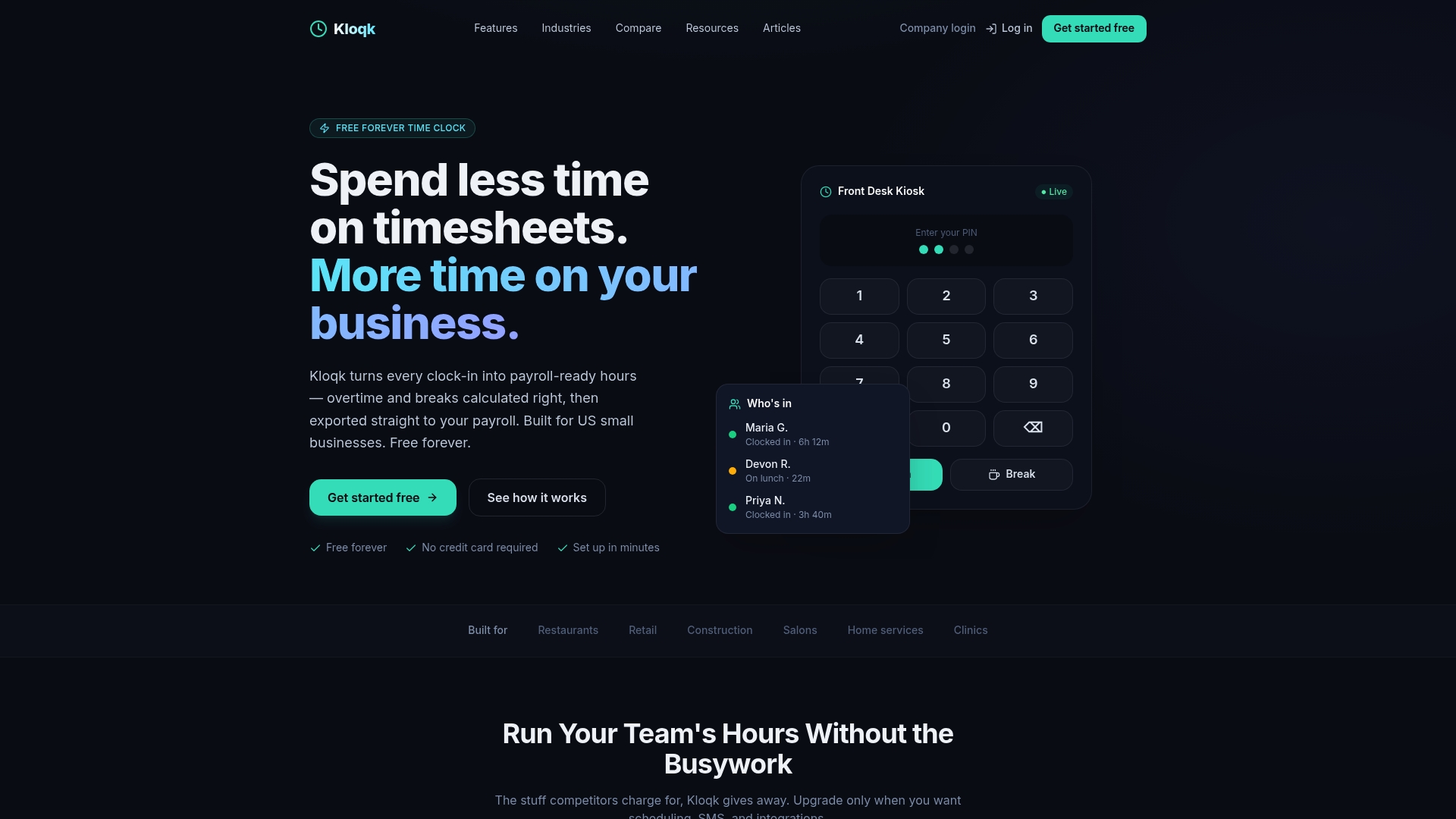
For remote and hybrid teams, Kloqk’s remote employee time tracking features let managers verify off-site attendance without manual check-ins or honor-system reporting. The dashboard surfaces absence patterns by employee and team, so you’re working from real data when you sit down for that return-to-work conversation.
Set up a pilot with two teams this week. The free plan requires no credit card, and the absence data you collect in the first 30 days will tell you more about your attendance patterns than a year of manual tracking.
Sources
The sources below are the primary references used throughout this guide. Each one is worth bookmarking for ongoing absence management work.
- Absences from work of employed full‐time wage and salary workers by occupation and industry
- Workplace absenteeism surveillance (NIOSH/CDC)
- Understanding Absenteeism: Causes, Impact, and Management Strategies
- The Determinants and Outcomes of Absence Behavior: A Systematic Literature Review
- Absenteeism: causes and cures, PubMed
- Total Financial Impact of Employee Absences (SHRM report)
This article is general information, not a substitute for advice from a qualified lawyer. Consult a qualified legal professional about your own circumstances before acting on anything here.
Recommended
Sources
Every figure on this page traces to one of these. Primary law and government sources are listed first.
- 1. U.S. Bureau of Labor Statisticsprimary
- 2. SHRMprimary
- 3. investopedia.com
- 4. pubmed.ncbi.nlm.nih.gov
- 5. mdpi.com
- 6. cdc.gov
- 7. gozera.ai
Written by
Priya NairPeople Operations Writer
Priya focuses on HR and hiring for small teams, onboarding, scheduling people fairly, and the day-to-day of managing hourly staff without an HR department.
Keep Reading
Track Hours the Easy Way
Kloqk is a free time clock that handles punches, breaks, overtime, and payroll-ready reports.
Start free