3 Copy Ready Break Policy Examples HR Teams Can Paste Into Handbooks

Three copy-ready break policy templates follow, built for shift-based, standard-office, and remote teams. The federal baseline under the Fair Labor Standards Act is simple: short breaks are paid, and genuine meal breaks are unpaid as long as the employee is off duty. Pick the example closest to how your team actually works, then check it against your state’s rules before you paste it into your handbook.
TL;DR:
- Paid rest breaks lasting 5 to 20 minutes are considered work time, while meal breaks of 30 minutes or more can be unpaid if employees are fully relieved of duties.
- State laws, such as California and Washington, often demand stricter break requirements and higher penalties for violations than federal rules.
- Accurate timekeeping, including clocking out for unpaid meal breaks and logging interruptions, is crucial to prevent wage claims and ensure compliance.
- Break policies must specify scope, definitions, payment status, and correction procedures to withstand legal scrutiny during audits or claims.
- Transitioning to digital time tracking with photo verification and GPS geofencing improves record accuracy, especially for remote or hybrid teams.
Table of Contents
- Break Policy Examples for Three Common Workplace Setups
- What Every Break Policy Should Include
- The Legal Baseline: Federal Rules and Why State Law Still Matters
- Recording Breaks Without Creating a Wage Claim
- Making Breaks Work on a Real Schedule
- Why a Clear Break Policy Pays for Itself
- Turning These Templates Into Actual Payroll Records
- Sources
Break Policy Examples for Three Common Workplace Setups
Every workplace runs breaks a little differently, but most fall into one of three patterns. Below are three sample clauses you can adapt directly, each built around what Workable’s and Lattice’s template libraries flag as the fields most employers get wrong.
Shift-based retail or restaurant example:
- Employees working a shift of five or more hours receive a paid short rest break and an unpaid meal break of typical durations.
- Breaks are staggered across the shift roster so at least one team member covers the floor or register at all times, ensuring smooth coverage as advised in the Frontline operations blog.
- Employees must clock out for unpaid meal breaks and clock back in immediately after; rest breaks require no clock action since they stay paid.
- If a break gets skipped because of a rush or callout, the shift lead logs it and reschedules coverage before the employee’s next shift.
Standard 8-hour office example:
- Employees receive two paid short breaks split across the shift and one unpaid lunch break, typically scheduled near the midpoint of the day.
- Breaks should not be skipped to leave early or combined into one long block without manager approval.
- Managers who notice a missed lunch two or more times in a pay period should flag it to HR, not just note it and move on.
Remote or hybrid example:
- Remote employees follow the same paid/unpaid structure as in-office staff; they clock out for meal breaks in the time tracking system exactly as they would on-site.
- Reasonable restroom and stretch breaks do not require clocking out, mirroring in-office practice.
- If a remote employee’s break gets interrupted by a client call or urgent message, they log the interruption and take the remaining break time later in the day.
What Every Break Policy Should Include
A break policy that only lists durations will leave gaps the moment a wage claim or state audit lands on your desk. Use this list as a working checklist:
- Scope specify whether the policy applies to nonexempt employees only, part-time staff, and minors (who may have separate state-mandated break rules).
- Break definitions spell out rest breaks, meal breaks, restroom breaks, and lactation breaks, with typical durations for each.
- Paid vs. unpaid treatment state plainly which breaks count toward hours worked and overtime calculations, and which do not.
- Timekeeping expectations explain exactly when employees clock in or out and what counts as a policy violation.
- Correction process describe how an employee fixes a missed punch and confirms it wasn’t retaliatory to report.
- State compliance clause note that state and local law may add requirements beyond this policy and that the stricter rule always applies.
Pro Tip: Build your lactation break language directly from DOL Fact Sheet 73 rather than writing it from scratch. Nursing-mother protections are federally mandated, and generic templates often skip this clause entirely.
The Legal Baseline: Federal Rules and Why State Law Still Matters
Federal law doesn’t require you to give breaks at all. But once you offer them, the FLSA draws a clear line: breaks lasting roughly 5 to 20 minutes count as paid work time, while a bona fide meal period of about 30 minutes or more can be unpaid, provided the employee is fully relieved of duties. An employee eating lunch at their desk while answering phones is still working, whatever the clock says.
State law frequently goes further than that floor:
- California requires a paid 10-minute rest break for every four hours worked and a 30-minute unpaid meal break for shifts over five hours, with premium pay owed if breaks are denied.
- Washington mandates a paid 10-minute rest break every four hours, with specific timing windows built into the state’s rest break and meal period rules.
- New York sets meal break minimums that vary by industry and shift length, with factory workers and hospitality staff often subject to different rules than office employees.
Because these rules shift by state and sometimes by county, every policy should include a line stating that local law overrides the company baseline when it’s stricter. The Department of Labor’s state guidance page is worth bookmarking and linking directly in your handbook.
Recording Breaks Without Creating a Wage Claim
Getting the clock action right matters as much as getting the duration right. Employees should clock out for unpaid meal breaks and stay clocked in for paid rest breaks. Mixing that up is one of the most common sources of underpayment complaints.
- Start with a simple manual log if you’re a small team, but move to digital time clocks once you have more than a handful of shift workers.
- Photo verification at clock in and GPS geofencing cut down on buddy punching and breaks logged from the wrong location.
- Build a correction workflow: an employee who forgets to clock back in reports it same-day, a manager approves the fix, and the record shows no pattern of retaliation for reporting errors.
According to Blissbook’s federal timekeeping template, pairing clear clocking rules with a documented correction process is what actually protects employers in a wage audit, not the policy language alone.
Sample wording: “Employees must clock out for unpaid meal periods and clock back in upon return. Missed punches must be reported to a manager the same day for correction.”
Making Breaks Work on a Real Schedule
A policy is only as good as the schedule built around it. Staggering breaks across a shift, rather than sending everyone out at the same time, keeps coverage intact on small teams.
- Assign a specific covering employee for each break slot rather than leaving it informal.
- Train managers to notice patterns, not single incidents; one missed lunch is an accident, three in a month is a scheduling problem.
- Send a short written notice whenever break timing changes, so nobody learns about a new rule mid-shift.
- Escalate to HR when a manager reports repeated missed breaks on the same team, since that usually points to understaffing rather than employee behavior.
Pro Tip: Ask managers to log missed breaks the same way they’d log a scheduling conflict. A pattern buried in memory never gets fixed; a pattern on paper does.
Why a Clear Break Policy Pays for Itself
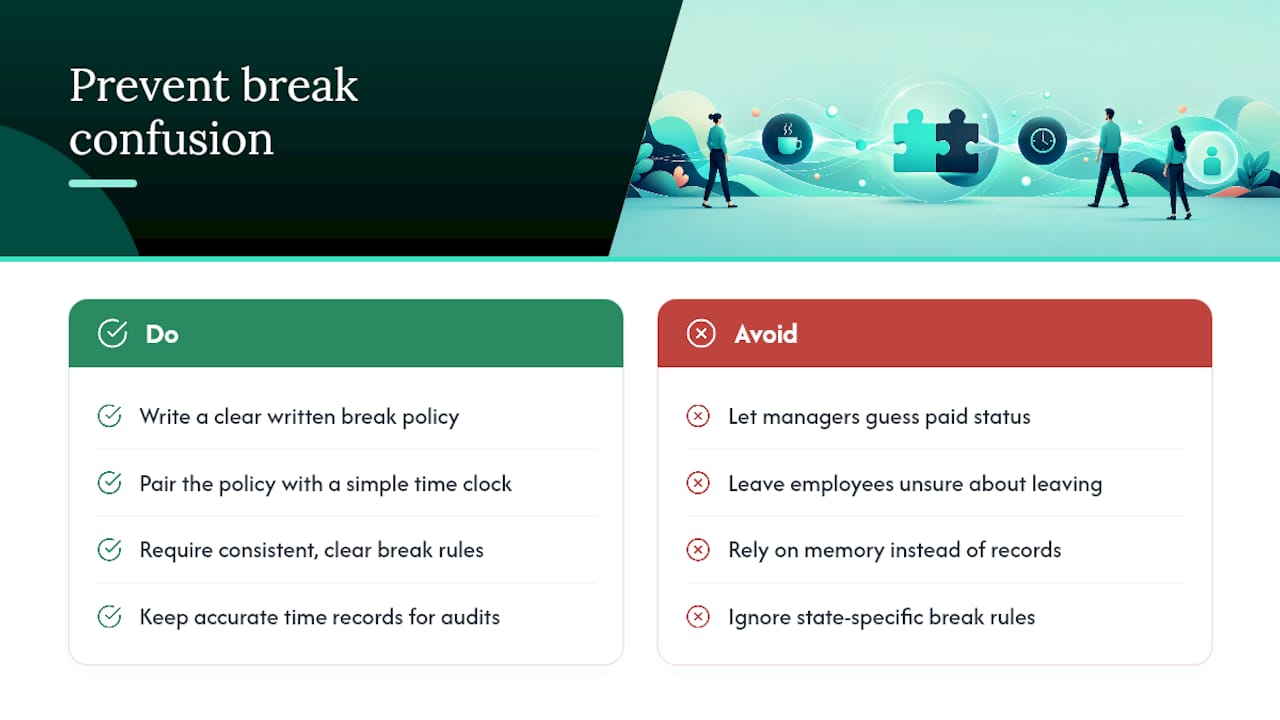
Small businesses lose more hours to break confusion than they realize. Not from long lunches, but from managers guessing whether a 12 minute break should have been paid, or an employee unsure if they can leave the building. A written policy removes that guessing, and pairing it with a simple time clock removes the second layer of risk: records that can’t back up what actually happened.
Clear rules plus accurate tracking is what keeps a wage complaint from turning into a wage audit. For deeper reading on state-specific rules, our guide on California lunch break law walks through one of the stricter frameworks in the country.
Saad
Turning These Templates Into Actual Payroll Records
Writing the policy is half the job. Proving you followed it is the other half, and that’s where most small businesses fall short with spreadsheets and paper logs. Kloqk’s free time tracking platform turns the exact clock actions described above, clocking out for meal breaks, staying clocked in for paid rest breaks, into payroll-ready records automatically, with overtime already calculated.
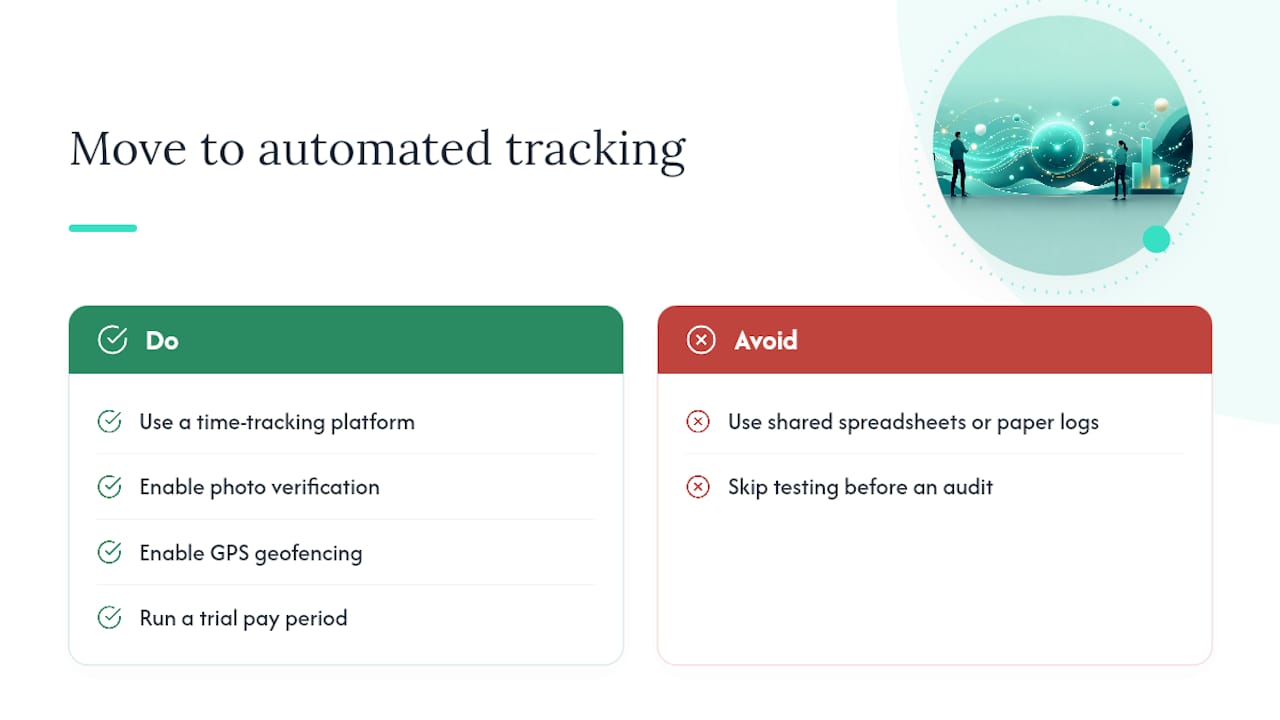
Photo verification confirms who actually clocked in, and GPS geofencing (useful for the GPS-enabled time clock) confirms where. For teams with remote or hybrid staff, the remote time tracking features apply the same rules to off-site clock actions. If your current process is a shared spreadsheet or a paper sign-in sheet, that’s usually the sign it’s time to switch. Set up a free account and run your next pay period through it before your next audit finds the gap first.
Sources
- Hours worked under the FLSA U.S. Department of Labor (elaws)
- Employee breaks company policy template Workable
- Employee Breaks Policy Template Lattice
- Rest breaks, meal periods & schedules Washington State Department of Labor & Industries
Recommended
Sources
Every figure on this page traces to one of these. Primary law and government sources are listed first.
- 1. U.S. Department of Laborprimary
- 2. U.S. Department of Laborprimary
- 3. Washington State Legislatureprimary
- 4. resources.workable.com
- 5. lattice.com
- 6. bossyhq.com
- 7. blissbook.com
Written by
Marcus ReyesPayroll & Timekeeping Specialist
Marcus covers payroll accuracy, timesheets, and time tracking, the unglamorous mechanics that keep paychecks correct and audits painless.
Keep Reading
Track Hours the Easy Way
Kloqk is a free time clock that handles punches, breaks, overtime, and payroll-ready reports.
Start free