New York Spread of Hours: Rules, Rates and Examples

In New York, spread of hours pay is one extra hour of pay at the basic minimum wage. It is owed for any day when the stretch between the start and the end of an employee’s workday is longer than 10 hours. The stretch counts unpaid meal breaks and gaps between shifts, not just hours worked. As of January 1, 2026, that extra hour is $17.00 in New York City, Nassau, Suffolk and Westchester, and $16.00 in the rest of the state. Below you will find who is covered, how the span is measured, worked examples, and the records to keep.
TL;DR
- The trigger: a workday whose spread of hours exceeds 10, or that includes a split shift, earns one extra hour of pay.
- The rate: one hour at the basic minimum wage for your region ($17.00 downstate, $16.00 upstate as of January 1, 2026), not the employee’s own hourly rate.
- The measure: the clock runs from the first punch in to the last punch out, including meal breaks and off-duty gaps.
- Restaurants and hotels: the extra hour applies to every employee, whatever their regular rate. Other industries follow a top-up rule aimed at workers at or near minimum wage.
- Records: keep arrival and departure times for these days for six years.
Table of Contents
- What spread of hours pay is
- How the workday span is measured
- 2026 rates: how much the extra hour is worth
- Who is covered
- Worked examples
- How it interacts with overtime
- What employers cannot do
- Records that keep you compliant
- Our perspective
- Tracking spread of hours with a time clock
- Common mistakes to avoid
- FAQ
- Sources
What spread of hours pay is
New York’s wage orders treat a very long workday as something that deserves a small premium. Under the state’s Miscellaneous Industries and Occupations wage order (12 NYCRR Part 142), an employee receives one hour’s pay at the basic minimum hourly wage rate, on top of the minimum wage the order requires. This applies for any day on which the spread of hours exceeds 10 hours, there is a split shift, or both.
The premium is not a wage for work performed. It is a payment tied to the shape of the day. One employment law firm notes that the rule was meant partly to put a brake on excessive hours and to give extra compensation to people who devote most of a day to work.
Two terms matter:
- Spread of hours: the interval between the beginning and end of an employee’s workday, including working time, time off for meals, and intervals off duty (12 NYCRR 142-2.18).
- Split shift: daily hours that are not consecutive. A meal period of one hour or less does not break them.
How the workday span is measured
This is where most mistakes happen. Managers count paid hours. The law counts elapsed time.
The Department of Labor’s Hospitality FAQ says the calculation includes any off-duty time, including meals, rest periods and time between shifts. Its Protect Your Paycheck page adds that an employee can be owed the payment even if they were not working for 10 hours.
The Hospitality Industry Wage Order gives two official examples:
| Schedule | Hours worked | Spread | Extra hour due? |
|---|---|---|---|
| 7 a.m. to 10 a.m. and 7 p.m. to 10 p.m. | 6 | 15 hours | Yes |
| 11:30 a.m. to 3 p.m. and 4 p.m. to 10 p.m. | 9½ | 10½ hours | Yes |
Both examples come from the Hospitality Industry Wage Order. A cook who works a lunch rush, goes home, and returns for dinner can easily trigger it while working a modest number of paid hours.
A simple way to check any shift
- Take the time of the first clock-in of the day.
- Take the time of the last clock-out of the day.
- Subtract. Do not remove meal breaks or gaps.
- If the answer is more than 10 hours, the extra hour is on the table.
2026 rates: how much the extra hour is worth
The extra hour is paid at the basic minimum hourly wage for the employee’s region. Under 12 NYCRR 142-2.1, as of January 1, 2026, the rates in the wage order are:
| Region | Minimum wage per hour (as of January 1, 2026) |
|---|---|
| New York City | $17.00 |
| Nassau, Suffolk and Westchester | $17.00 |
| Rest of New York State | $16.00 |
The hour is paid at the regional minimum, not at the worker’s own rate. A line cook earning $24 an hour in Manhattan who triggers the rule gets an extra $17.00 for that day, not $24. Minimum wage figures are adjusted over time, so confirm the current figure on the state’s page before you set up payroll for a new year. Our own pages track the New York minimum wage and the New York City minimum wage if you want the numbers in one place.
Who is covered
New York has several wage orders, and the version of the rule that applies to you depends on your industry.
Restaurants and hotels
Under the Hospitality Industry Wage Order (12 NYCRR 146-1.6), on each day the spread of hours exceeds 10, an employee in a restaurant or all-year hotel receives one additional hour of pay at the basic minimum hourly rate. The section applies to all employees in these businesses regardless of their regular rate of pay. A well-paid server and a minimum-wage dishwasher are treated the same way.
Miscellaneous industries and occupations
Part 142 covers all employees except those under another minimum wage order and employees of a nonprofit that has elected to be exempt. In practice this reaches many retail shops, offices, clinics, salons and similar employers. The Department of Labor reads the rule here as a top-up for workers at or near minimum wage. Per the JTNY Law summary of the order, no additional compensation is due if weekly wages actually paid equal or exceed the total of:
- 40 hours at the basic minimum wage,
- overtime at the employee’s overtime rate, and
- one basic-minimum-wage hour for each day the employee worked more than 10 hours.
Other industries
Construction and other sectors can fall under different rules or none at all for this purpose, and farm work has its own wage order with its own overtime threshold. If you are unsure which order governs your business, read the list on the state’s Wage Orders page or ask an employment attorney or your payroll provider.
Worked examples
These use the $17.00 New York City rate. They are illustrations of the rule, not payroll advice for your specific case.
Example 1: restaurant, split shift. A server in a Brooklyn restaurant works 11 a.m. to 3 p.m., goes off duty, then returns from 5 p.m. to 10 p.m. That is 9 hours worked but an 11-hour spread. The employer owes one extra hour at $17.00, whatever the server’s base wage.
Example 2: retail, long day, low wage. A stockroom employee paid exactly $17.00 an hour works 8 a.m. to 7 p.m. with a one-hour unpaid lunch. Hours worked: 10. Spread: 11 hours. Under the top-up approach, the employee is owed one more hour at $17.00 for the day unless weekly pay already covers the total described above.
Example 3: retail, long day, higher wage. A department lead earning $25.00 an hour works five 11-hour spreads in a week with unpaid lunches, so 50 hours worked. The weekly floor from the formula is 40 hours at $17.00 ($680), plus overtime for 10 hours at the employee’s overtime rate, plus five spread hours at $17.00 ($85). The overtime piece at 1.5 times $25.00 is $37.50 an hour, or $375 for 10 hours. That floor is $1,140. Actual pay is 40 hours at $25.00 ($1,000) plus $375 overtime, or $1,375, which is above the floor. Under the Part 142 reading, no extra spread payment is due. If this lead worked in a restaurant, the extra hour would still be owed each day.

How it interacts with overtime
Spread of hours pay and overtime are separate. Overtime in New York is generally 1½ times the regular rate for hours worked over 40 in a workweek. Part 142 sets the threshold at over 44 hours for residential employees.
The spread payment is not pay for work performed, so it does not feed into the overtime calculation. The Department of Labor says it does not impact overtime calculations, and the Hospitality order says it need not be included in the regular rate. That keeps the math clean: calculate overtime on hours worked, then add the spread hour as its own line.
For the overtime side, see our guides to New York overtime laws and the 1.5x overtime calculation rules.
What employers cannot do
Meal and lodging credits are common in hospitality. They cannot be used here: the additional hour shall not be offset by credits for meals or lodging provided to the employee. If you offer staff meals, the spread hour is still owed in full.
If you are reviewing what else you owe employees beyond wages, such as ADA-compliant wellness programs, keep the spread-of-hours line separate in payroll so each obligation stays visible.
Tipped workers are not an exception. The extra hour is at the basic minimum hourly rate, so review how your tip credit works alongside it in our New York tipped minimum wage guide.
Records that keep you compliant
The wage order puts the burden of proof on paperwork. Every employer under Part 142 must keep weekly payroll records for at least six years. They must show hours worked daily and weekly, including arrival and departure times for employees on a split shift or a spread over 10 hours. Each wage payment must come with a statement listing hours worked, rates paid, gross wages, allowances claimed, deductions and net wages.
A practical checklist:
- Record every clock-in and clock-out, not just daily totals.
- Keep meal break start and end times, since they sit inside the spread.
- Flag any day where first-in to last-out passes 10 hours.
- Show the spread payment as its own line on the pay statement.
- Store the records for six years.
Meal break rules matter here too, so check the New York meal and rest break laws and the wider New York labor law overview.
Our perspective
Most spread of hours mistakes we see are not about bad intent. They come from timesheets that show paid hours and hide the clock-in and clock-out times that decide the answer.
Our view is that a time clock should do the boring part for a small team. It should capture exact punches, handle breaks, calculate overtime, and hand your payroll provider hours that are ready to use. That is why the core of Kloqk is free, with unlimited employees, overtime and break calculations, photo verification for clock-ins, and payroll exports.
When the start and end of every day are recorded accurately, spotting a 10-hour-plus spread takes seconds instead of a payroll-day scramble. Our upgrades for scheduling, PTO and more are optional, so you can run a payroll-ready operation without paying for the basics.
Saad
Tracking spread of hours with a time clock
The law is simple. The hard part is catching long days across a week of split shifts and several employees. A time clock that stamps every punch gives you what the law asks you to keep: arrival and departure times for each day.
Kloqk’s free plan includes payroll-ready timesheets, overtime and break calculations, photo verification for clock-ins, mobile and kiosk punching, and payroll exports. Paid plans are optional: Pro is $29 per month per location and Premium is $59 per month per location, listed on our pricing page.
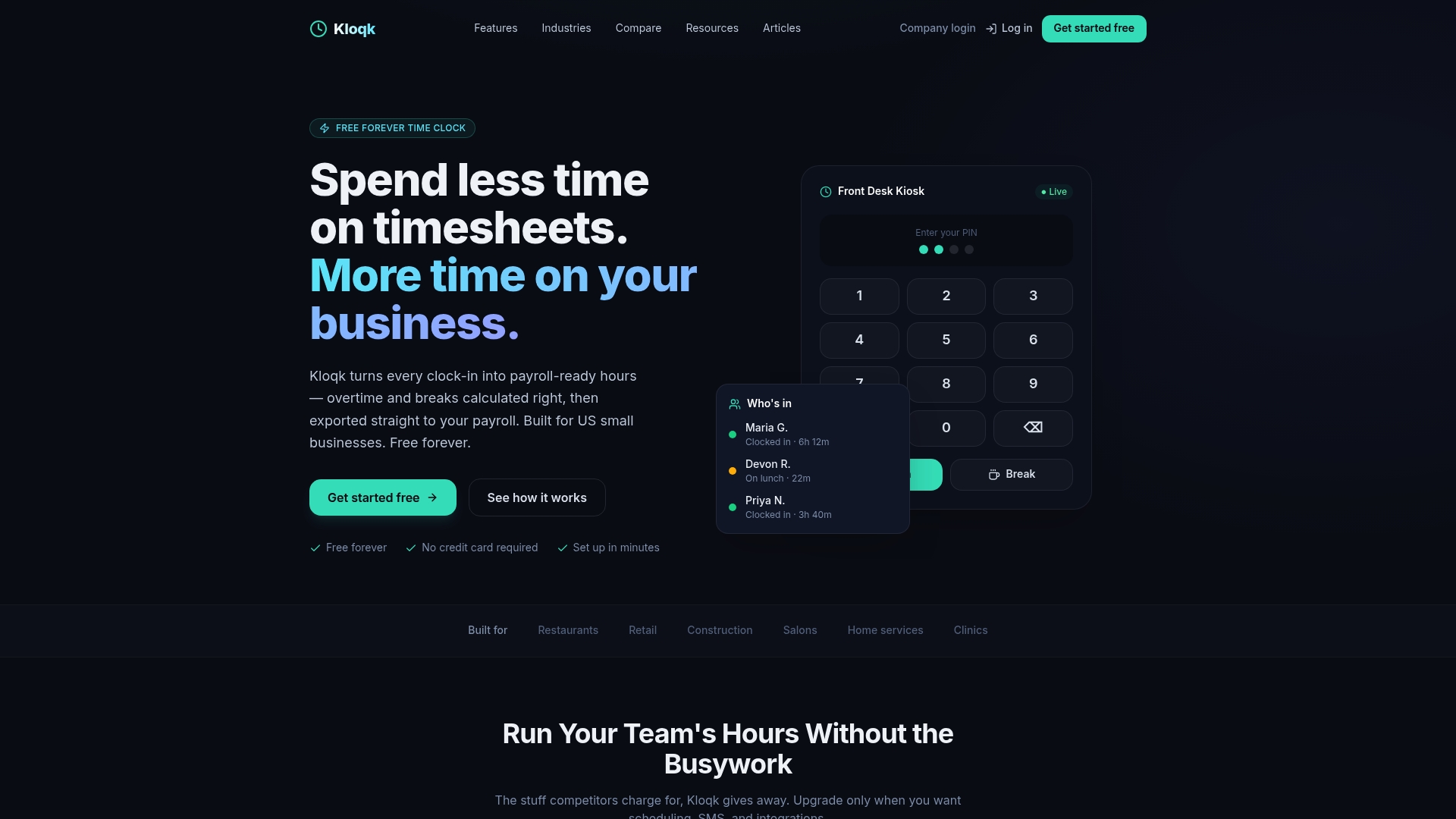
If you run a restaurant, shop or clinic in New York, start with our free time clock software for small business and review each day’s first and last punches before you run payroll. For overtime math, try the free overtime pay calculator.
Common mistakes to avoid
- Subtracting the lunch break from the spread. The span includes meals and off-duty gaps.
- Paying the extra hour at the employee’s own rate. It is paid at the regional minimum wage.
- Adding the spread hour to the regular rate for overtime. It is not pay for work performed.
- Using the wrong region. The New York City, Nassau, Suffolk and Westchester rate differs from the upstate rate.
- Assuming a higher wage removes the duty everywhere. In restaurants and all-year hotels, the extra hour applies regardless of the regular rate.
- Not keeping records. Six years of arrival and departure times is the standard for these days.
FAQ
Does spread of hours pay apply if I only worked 8 hours?
Yes, it can. The test is the span from start to end of the day, not the hours worked. A split shift with a long unpaid gap can pass 10 hours even when paid time is far lower, as in the Department of Labor’s 6-hour, 15-hour-spread example.
Is the extra hour paid at my regular hourly rate?
No. It is paid at the basic minimum hourly wage for your region: $17.00 in New York City, Nassau, Suffolk and Westchester, and $16.00 elsewhere in the state, as of January 1, 2026. Check the state’s wage order page for the current figure.
Do salaried or higher-paid employees get it?
In restaurants and all-year hotels, the extra hour applies regardless of the regular rate of pay. In other industries covered by Part 142, the Department of Labor treats it as a top-up for workers at or near minimum wage. Ask your payroll provider or an employment attorney how it applies to a specific role.
Does spread of hours pay count toward overtime?
No. It is not payment for work performed, so it is left out of the overtime calculation. Overtime is figured on hours actually worked over 40 in a workweek.
How long do I need to keep the records?
At least six years. The records should show daily and weekly hours, including arrival and departure times on days with a split shift or a spread over 10 hours.
Sources
- MISCELLANEOUS INDUSTRIES AND OCCUPATIONS (CR142), NYS Department of Labor
- Hospitality Industry Wage Order (CR146), NYS Department of Labor
- Hospitality Wage Order FAQ, NYS Department of Labor
- Protect Your Paycheck, NYS Department of Labor
- Wage Orders, NYS Department of Labor
- 12 NYCRR 142-2.18, Cornell Legal Information Institute
- New York’s Spread of Hours Rule, JTNY Law
- Does New York’s spread of hours rule affect you?, Kessler Matura
Recommended
Sources
Every figure on this page traces to one of these. Primary law and government sources are listed first.
- 1. Cornell Legal Information Instituteprimary
- 2. dol.ny.gov
- 3. kesslermatura.com
- 4. jtnylaw.com
- 5. blog.hadaco.com
Written by
Dana WhitfieldHR Compliance Lead
Dana writes about wage-and-hour law, FLSA overtime, and leave compliance for U.S. small businesses, translating dense regulations into plain steps owners can act on.
Keep Reading
Track Hours the Easy Way
Kloqk is a free time clock that handles punches, breaks, overtime, and payroll-ready reports.
Start free