Protect Exempt Status: 5 Salaried Time Tracking Clauses for US HR

Tracking a salaried employee’s hours is generally legal, and for non-exempt salaried workers it’s federally required. The real risk isn’t the clock itself. It’s what you do with the data afterward, especially if it leads to docking an exempt employee’s pay for hours worked short of a full day. Before rolling out any tracking system, confirm classification, put your policy in writing, and spell out exactly how time records will and won’t touch anyone’s paycheck.
TL;DR:
- Tracking salaried employee hours is legal for both exempt and non-exempt workers, but using the data to dock exempt pay can jeopardize exempt classification.
- Employers must keep detailed records for non-exempt employees for three years, including hours worked and overtime, to stay compliant during audits or claims.
- Exempt workers can clock in without losing their exemption, provided deductions are proper and they are reimbursed for improper pay cuts; precise recordkeeping is essential.
- State laws like those in California, New York, and Washington often impose higher thresholds and stricter rules, requiring multi-state policies to adhere to the most restrictive standards.
- A clear, enforceable time tracking policy should specify employee classifications, official system use, rounding rules, and procedures for correcting improper deductions to defend against legal challenges.
Table of Contents
- The Legal Baseline: FLSA Recordkeeping and Exempt Status
- Why Employers Track Salaried Hours Anyway
- Building a Defensible Salaried Time Tracking Policy
- Copy-Ready Policy Language You Can Adapt
- State Rules That Raise the Bar
- What HR Teams Get Wrong About Salaried Tracking
- What Actually Matters Once the Policy Is Live
- Put the Policy Into Practice With Kloqk
- Sources
- FAQ
The Legal Baseline: FLSA Recordkeeping and Exempt Status
Federal law splits salaried employees into two very different buckets, and mixing them up is where most compliance headaches start.
For non-exempt employees, whether they’re paid hourly or a fixed salary, the Fair Labor Standards Act requires you to keep records of hours worked each day, total hours per week, the regular hourly rate, and overtime earnings. The Department of Labor’s Fact Sheet #21 sets the retention period at three years for those records and two years for the underlying timecards. Skip this and you’re exposed the moment a wage claim or audit lands on your desk.
Exempt status is a different animal entirely. To classify someone as exempt from overtime, you generally need to satisfy three tests: the employee performs executive, administrative, or professional duties (the duties test); earns above the federal salary threshold; and receives that pay on a true salary basis, meaning a fixed, predetermined amount regardless of hours actually worked. The salary basis rule lives in 29 CFR 541.602, and it’s the section that trips up more employers than any other.
Here’s the part HR teams consistently get backwards: the FLSA does not prohibit exempt employees from clocking in. Nothing in federal law says an exempt worker can’t punch a time clock. What creates liability is using that data to make improper deductions, docking pay for a partial-day absence, for instance, in a way that undermines the salary-basis test.
If a company shows a pattern of improper pay deductions, the employer may lose the exemption for that entire job classification, not just for the employee whose pay was directly affected. The good news is that the safe-harbor provision under 29 CFR 541.602 lets you preserve the exemption if you reimburse the employee and demonstrate a good-faith effort to comply going forward.
A few things every HR file should confirm before tracking goes live:
- Which employees are exempt versus non-exempt, verified against current duties, not job titles
- Written acknowledgment that exempt status won’t change based on hours logged
- A clear internal process for correcting accidental deductions
- Documentation showing the salary basis has been maintained consistently
Misclassifying a salaried worker as exempt when their actual duties don’t qualify is one of the most common and expensive mistakes employers make, and it’s worth running that check before you touch your tracking policy at all. For a deeper look at when salaried status doesn’t equal exempt status, see this breakdown of exempt employee time tracking rules.
Why Employers Track Salaried Hours Anyway
If tracking isn’t always required for exempt staff, why do so many companies do it? Because the data serves purposes that have nothing to do with docking pay.
PTO and FMLA administration is the biggest driver. You can’t accurately deduct paid time off, or properly document intermittent leave, without knowing how many hours someone actually worked in a given week. FMLA regulations under 29 CFR 825.500 specifically require employers to record dates and hours when leave is taken in increments smaller than a full day, which makes hour-level tracking a practical necessity for any manager handling intermittent leave.
Beyond leave, businesses track salaried hours for:
- Client billing and project costing, especially in professional services and agencies
- Productivity benchmarking across teams or departments
- Staffing forecasts and workload balancing
- Audit-readiness in case classification ever gets challenged
The key is framing this correctly to your managers. Time data for exempt employees should be treated as administrative, informing scheduling, billing, and leave calculations, never as a lever for pay adjustments. Train supervisors explicitly on this distinction, because a well-meaning manager who docks an exempt employee’s pay for showing up two hours late is the exact scenario that destroys an exemption.
Pro Tip: Build a one-line rule into your manager training: “Time data for exempt staff informs decisions, it never determines pay.” Repeat it in every onboarding session for new supervisors, not just once at rollout.
Rounding practices matter here too. The DOL permits rounding to the nearest 5, 10, or 15 minutes, but only when applied neutrally and not in a way that systematically shaves hours off an employee’s total. There’s no federal “7 minute rule” despite how often that phrase gets tossed around in HR forums, just a consistency requirement.
Building a Defensible Salaried Time Tracking Policy
A policy that protects you in an audit or lawsuit needs specific components, not vague language about “tracking hours worked.” Here’s the checklist, in priority order.
-
Scope and classification language. Name every employee category the policy covers: exempt, non-exempt, remote, and contractors. Ambiguity here is what plaintiffs’ attorneys look for first.
-
A single system of record. Designate one platform as official and prohibit employees from using spreadsheets, paper logs, or side apps without sign-off. Multiple systems create multiple conflicting records, and conflicting records are a gift to opposing counsel.
-
Exact clock rules. Spell out start and stop procedures, how meal breaks get logged, and whether auto-deductions apply. Auto-deducted meal breaks are convenient but have triggered class actions in several states; requiring employees to actively clock breaks, or capturing exact minutes with regular audits, is the safer route.
-
Overtime authorization procedures. Require pre-approval for overtime, but state plainly that unauthorized overtime still gets paid, discipline for the policy violation is separate from the pay obligation.
-
Off-the-clock prohibition with a real reporting path. Ban unrecorded work, then give employees an easy, low-friction way to report time they weren’t able to log.
-
Rounding methodology, documented and audited. Write down the rounding algorithm, run quarterly neutrality checks, and exclude California operations from rounding if you’re already capturing exact minutes there.
-
Retention schedule. Match the longest applicable state requirement, and flag biometric time data for separate handling under state privacy statutes.
-
Safe-harbor and reimbursement language. State how the company corrects improper deductions and reimburses affected employees, this is what preserves your exemption if a mistake happens.
Pro Tip: Treat this checklist as a one-page appendix to your handbook, not eight scattered handbook sections. HR investigators and plaintiffs’ attorneys both look for internal consistency, and a single reference page makes that easy to demonstrate. You can find more detail on rounding mechanics in this FLSA rounding rules guide.
Copy-Ready Policy Language You Can Adapt
Drafting from scratch eats hours you probably don’t have. These starting clauses cover the highest-risk areas.
Scope clause: “Non-exempt employees, regardless of pay basis, must record all hours worked. Exempt employees may be required to record hours for administrative purposes; such records will not be used to reduce salary except as permitted by law.”
Rounding clause (multi-state fallback): “Time will be recorded to the exact minute. Employers operating in California or similar jurisdictions should default to exact-minute capture rather than rounding, since state case law has narrowed what counts as acceptable rounding when precise timestamps already exist.”
Overtime pre-approval clause: “Non-exempt employees must obtain supervisor approval before working overtime. All overtime hours, approved or not, will be paid in accordance with the FLSA. Working unapproved overtime may result in disciplinary action separate from compensation.”
FMLA/intermittent leave clause: “For employees on approved intermittent FMLA leave, hours taken in increments of less than a full day will be recorded and documented per federal recordkeeping requirements, without altering the employee’s exempt classification or salary basis.”
Reimbursement and safe-harbor clause: “Any employee who believes an improper deduction has been made from their salary should report it to HR within [X] business days. The company will investigate promptly and reimburse any confirmed improper deduction to preserve exempt status under applicable safe-harbor provisions.”
Adapt the bracketed details to your handbook’s existing tone, but keep the substance intact. These five clauses cover the scenarios that generate the most wage-and-hour claims nationally.
State Rules That Raise the Bar
Federal law sets the floor. Several states set a considerably higher one, and if you operate in more than one state, the strictest rule wins by default whether you plan for it or not.
California, Washington, and New York all maintain salary thresholds above the federal minimum for exemption eligibility. An employee who qualifies as exempt under federal rules can still be non-exempt under state law in these jurisdictions, which means you owe them full hour-level tracking and overtime pay regardless of what their offer letter calls them.
A few other state-level triggers to watch:
- Daily overtime rules (California requires overtime after 8 hours in a day, not just 40 in a week) force hour-level tracking even for otherwise borderline-exempt roles
- Mandatory meal and rest break documentation in states like California adds a layer of required recordkeeping beyond the federal minimum
- Biometric consent laws, including Illinois’s BIPA, require specific disclosures before you can use fingerprint or facial recognition for clock-ins
- Location tracking for GPS-based time clocks often needs explicit written consent under state privacy statutes
The practical fix: if you operate in multiple states, apply the strictest applicable rule company-wide rather than maintaining a patchwork of state-specific policies. It’s simpler to administer and it closes most of the gaps that trigger multi-state audits.
What HR Teams Get Wrong About Salaried Tracking

The most expensive mistakes I see aren’t legal misunderstandings. They’re operational sloppiness. A company classifies someone as exempt without ever running the duties test, lets three different departments use three different tracking tools, and writes a rounding policy so vague that nobody can explain it during a Department of Labor audit. None of that requires bad intent. It just requires nobody owning the process end to end.
A single system of record with an immutable audit trail solves more of this than any handbook language can. When every clock-in, break, and manager approval lives in one exportable, payroll-ready record, you’ve already satisfied most of the safe-harbor documentation burden before a dispute even starts.
Operational features like exportable payroll-ready timesheets, automated overtime flags, break tracking, and photo or GPS verification for location-based roles don’t just save administrative time. They generate the audit trail that makes safe-harbor claims credible when an improper deduction happens by accident.
Kloqk’s time tracking feature set was built around exactly this gap: turning the policy checklist HR writes on paper into a system that enforces it automatically.
What Actually Matters Once the Policy Is Live
Classify people correctly before you enforce anything. Pick one system and document every exception in writing. Run a quarterly check on rounding neutrality and deduction incidents, not an annual one; problems compound fast between reviews. And if you operate across state lines, default to whichever rule is strictest rather than juggling separate policies per office.
Saad
Put the Policy Into Practice With Kloqk
Writing the policy is half the work. Enforcing it consistently across every shift, every location, and every pay period is where most small businesses fall behind. The system provides a unified platform offering payroll-ready timesheet exports, automatic overtime calculations, break tracking, photo verification at clock-in, and GPS geofencing for location-based roles, all included at no cost.
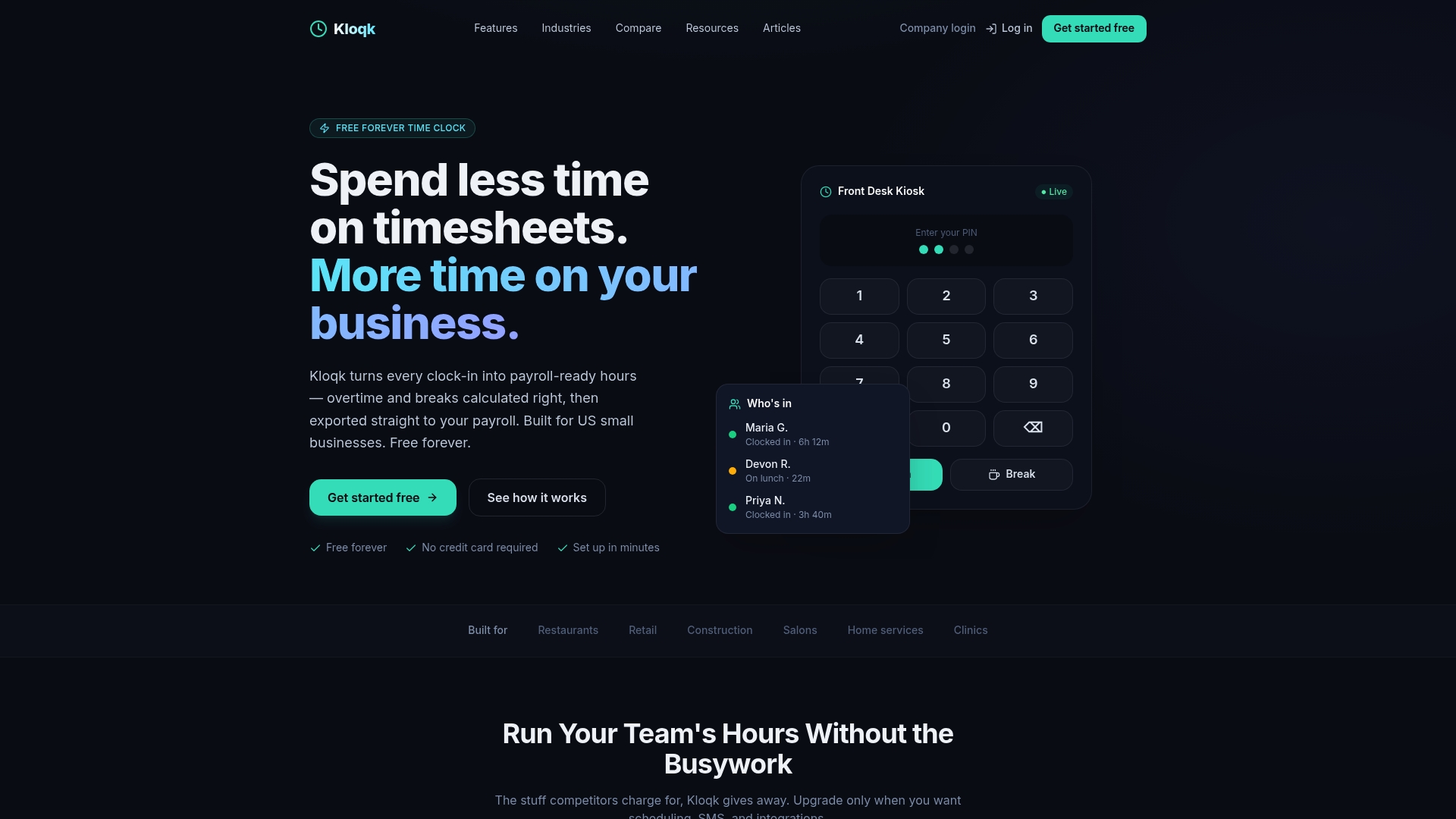
That combination matters because it directly maps to the audit-trail and safe-harbor documentation this article covers: every clock-in is timestamped and photo-verified, every overtime hour is flagged automatically, and every export is ready for payroll without manual reconciliation. If your current setup is a spreadsheet plus a paper log plus someone’s memory, that’s the multi-system risk auditors flag first.
Start with the free time clock app to convert your written policy into an enforced one, and export your first payroll-ready timesheet before your next pay cycle.
Sources
- U.S. Department of Labor Fact Sheet #21 (FLSA recordkeeping)
- DOL elaws, hours worked / rounding guidance
- eCFR, 29 CFR 541.602 (salary basis)
FAQ
Is it legal to track salaried employees’ hours?
Yes. Employers can track hours for both exempt and non-exempt salaried employees; the legal risk isn’t the tracking itself but using that data to make improper pay deductions from exempt staff.
Do salaried employees still have to clock in?
Non-exempt salaried employees must have their hours recorded under the FLSA. Exempt employees aren’t required to clock in by federal law, but employers may require it for administrative purposes without affecting exempt status.
What is the 7-minute rule for employees?
There’s no federal “7-minute rule.” The DOL permits rounding to the nearest 5, 10, or 15 minutes as long as it’s applied consistently and doesn’t systematically undercount hours worked.
What should a salaried time tracking policy include at minimum?
At minimum, it should name which employee classes it covers, designate one official system of record, set clear overtime authorization rules, prohibit off-the-clock work, and include safe-harbor language for correcting improper deductions.
Can tracking hours affect an exempt employee’s classification?
Yes, but only if the employer uses those hours to reduce salary improperly. Tracking hours for scheduling, billing, or leave administration does not, by itself, jeopardize exempt status.
Recommended
Sources
Every figure on this page traces to one of these. Primary law and government sources are listed first.
- 1. U.S. Department of Laborprimary
- 2. Electronic Code of Federal Regulationsprimary
- 3. SHRMprimary
- 4. U.S. Department of Laborprimary
- 5. easyb.org
- 6. legalclarity.org
Written by
Marcus ReyesPayroll & Timekeeping Specialist
Marcus covers payroll accuracy, timesheets, and time tracking, the unglamorous mechanics that keep paychecks correct and audits painless.
Keep Reading
Track Hours the Easy Way
Kloqk is a free time clock that handles punches, breaks, overtime, and payroll-ready reports.
Start free