US Employers: Travel Time Pay Policy Checklist to Avoid Wage Claims

Travel time is compensable when it’s part of an employee’s principal job duties or falls during regular work hours; ordinary home-to-work commuting is not. That’s the standard set by the Fair Labor Standards Act and enforced by the Department of Labor. The exceptions, though, are where most payroll mistakes happen, so the rest of this guide walks through the federal test, the scenarios that trip up employers most often, and the payroll math to get it right.
TL;DR:
- Most travel time is only compensable when it occurs during work hours or as part of principal job duties, excluding ordinary home-to-work commutes.
- Travel between job sites during the workday and overnight travel overlapping regular working hours are considered compensable, but passenger trips outside work hours are usually not.
- Proper recordkeeping, including separate tracking of travel hours and GPS or photo evidence, is essential to avoid costly wage claims and ensure compliance.
- State laws like California’s may impose stricter rules, requiring pay for employer-mandated transportation, even if federal law considers it a commute.
- Implementing clear policies and regular audits can prevent most travel pay disputes and ensure payroll accurately reflects compensable travel time.
Table of Contents
- What Do the FLSA and DOL Say About Paid Travel Time?
- What Are Common Travel Pay Scenarios and Their Outcomes?
- How Does Travel Time Affect Overtime Pay Calculations?
- Which States Have Stricter Travel Pay Rules Than Federal Law?
- What Should a Travel Pay Policy Include?
- What’s an Employer’s Checklist for Travel Pay Compliance?
- Why Guesswork on Travel Pay Costs More Than the Fix
- How Kloqk Helps Employers Track Travel Time Accurately
- Sources
What Do the FLSA and DOL Say About Paid Travel Time?
The federal baseline comes from the Portal-to-Portal Act, which carved ordinary commuting out of paid work time. Everything else depends on context. Travel between job sites during the workday counts as hours worked because it’s part of the job itself, not a trip to get to the job.
Special one-day assignments work differently. If you send an employee to another city for a single day, the travel counts as work time, though you can subtract what their normal commute would have been. The DOL’s travel time guidance adds a nuance many HR teams miss: overnight travel that overlaps regular working hours is compensable, but the department’s enforcement policy generally excludes passenger travel outside those hours when no work is performed.
A few reference points worth bookmarking:
- Fact Sheet #22 covers the principal-activity test and commuting exclusions.
- DOL’s Travel Time page addresses passenger versus driver distinctions and after-hours travel.
- elaws Advisors (the Hours Worked screening tools) walk through on-call and standby scenarios interactively.
None of this is optional guidance. It’s the enforcement framework the DOL applies during a wage-and-hour audit.
What Are Common Travel Pay Scenarios and Their Outcomes?
Most disputes fall into a handful of repeatable patterns. Here’s how they typically shake out:
- Site-to-site travel during the workday. An HVAC tech drives from Job A to Job B at 11 a.m. That drive is paid. It’s not a commute; it’s part of doing the job.
- Special one-day assignments. A payroll clerk normally commutes 20 minutes but gets sent to a conference three hours away for a single day. If travel starts at 6 a.m. and ends at 9 a.m., you can deduct the 20-minute baseline commute and pay the remaining 2 hours and 40 minutes as work time.
- Overnight travel overlapping work hours. An employee flies at 2 p.m. on a Tuesday, during their normal 9-to-5 shift. That portion is compensable. A flight at 9 p.m. on a Friday, outside their schedule, generally isn’t, unless they’re working.
- Driver versus passenger. The person driving a company vehicle is almost always working. A passenger who spends the ride answering emails or joining a call has converted otherwise noncompensable time into paid time.
- Personal detours and meal breaks. A stop for lunch or a personal errand during a work trip doesn’t count, even if the underlying travel would otherwise be paid.
The pattern across all five: control and purpose decide compensability, not the vehicle or the mileage.
How Does Travel Time Affect Overtime Pay Calculations?
For nonexempt employees, every hour of compensable travel counts toward the 40-hour workweek threshold the same as time spent on the clock at a desk or job site. That means travel hours can push someone into overtime even in a week where their “regular” hours never came close to 40.
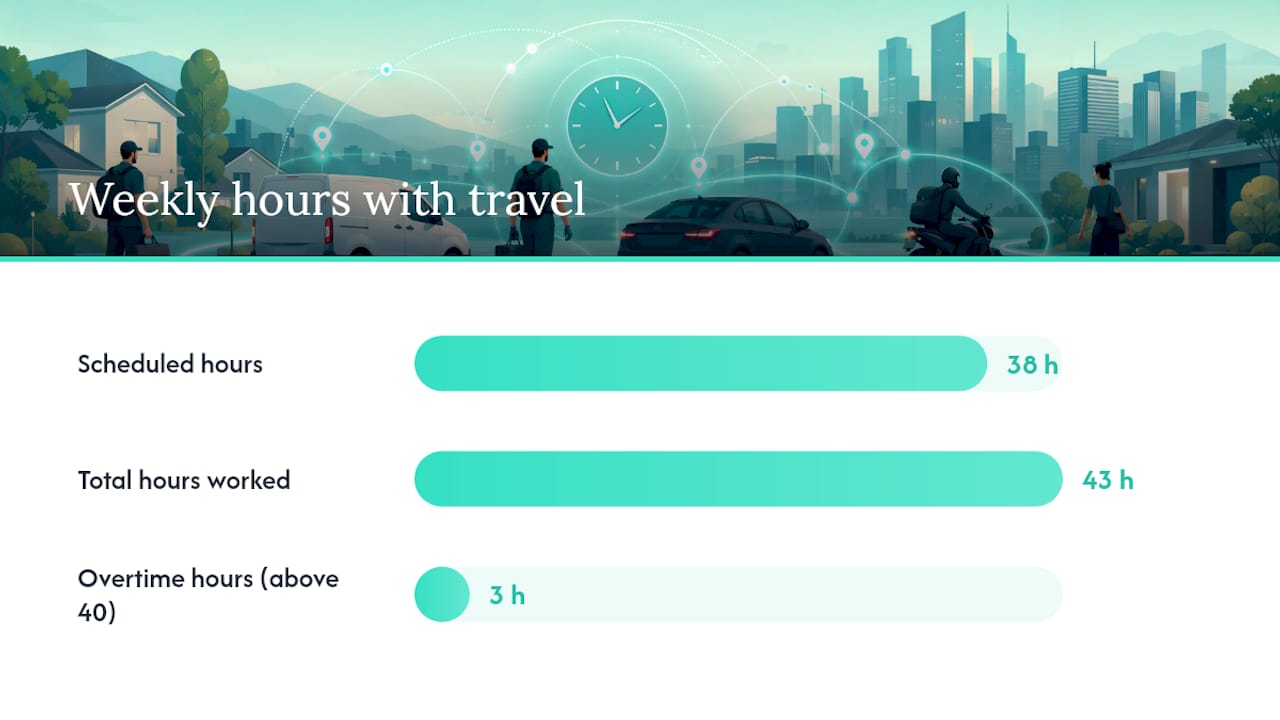
Here’s a worked example. A construction supervisor works a standard 38-hour week, then gets sent on a same-day out-of-town inspection that adds several hours of compensable travel, minus a typical commute deduction. That brings total hours worked to roughly 43. Under FLSA overtime rules, the 3 hours above 40 get paid at time-and-a-half, not straight time.
A few payroll mechanics matter here:
- Travel hours must be recorded separately enough to reconstruct them in an audit, not folded silently into a lump “hours worked” total.
- Time rounding practices that are fine for shift punches can distort travel segments if applied carelessly, especially on short trips.
- Payroll teams who mishandle travel hours in overtime math create a pattern the DOL specifically watches for during wage claims: hours worked that never make it into the 40-hour count.
Getting the overtime calculation right on a single travel-heavy week is straightforward. Getting it right consistently across dozens of employees without a system is where most underpayment claims start.
Which States Have Stricter Travel Pay Rules Than Federal Law?
Federal law is the floor, not the ceiling. Several states apply broader tests, and California is the one every multi-state employer needs to understand before assuming FLSA compliance is enough.
California uses a “subject to control” standard rather than the federal principal-activity test. Under this approach, tied to the Morillion v. Royal Packing Co. line of reasoning, if an employer requires employees to ride employer-provided transportation to a job site, that time is generally compensable, even when the same trip would be an unpaid commute under federal rules.
Other state-level differences to watch for:
- Some states require pay for employer-mandated transport regardless of who’s driving.
- Mileage reimbursement rates and rules vary by state and interact separately from hourly pay obligations. The mileage reimbursement guide from The Tax Refinery breaks down how reimbursement and wage obligations work as separate tracks.
- Several states impose stricter recordkeeping standards than the federal minimum, which matters most during an audit.
Pro Tip: If you operate in multiple states, apply the strictest applicable standard company-wide rather than maintaining separate rulebooks per location. It’s easier to overpay slightly in a lenient state than to underpay in a strict one and get caught.
What Should a Travel Pay Policy Include?
A written policy prevents the inconsistency that causes most disputes. At minimum, it should define when travel starts and ends, how driver versus passenger time is handled, whether meal breaks during travel are paid, and who approves travel assignments before they happen.
Tracking practice matters just as much as the policy language. Require employees to clock travel segments separately rather than lumping them into a single daily punch. GPS geofencing can log location-based start and end points automatically, which removes the guesswork of “when did the drive actually begin.” Photo verification at clock-in adds a timestamped record that holds up if a claim ever gets challenged.
Pro Tip: Keep assignment orders, travel directives, timesheets, and mileage logs in one retrievable place. If the DOL or a state agency ever asks for backup on a specific pay period, you want to produce it in minutes, not days.
Recordkeeping items worth retaining for at least the FLSA’s standard retention window:
- Signed travel assignment orders
- Timesheets showing travel segments separately from other work
- Mileage logs tied to specific trips
- Manager approvals for special one-day assignments
What’s an Employer’s Checklist for Travel Pay Compliance?
Run through this before your next audit finds the gaps for you:
- Write or update a travel-pay policy with clear definitions of compensable time.
- Configure payroll to capture travel hours separately and calculate overtime automatically.
- Adopt a time-tracking process that records travel start and end points, not just daily totals.
- Train managers on driver versus passenger rules so enforcement doesn’t vary by supervisor.
- Audit travel pay quarterly and correct underpayments before they become a pattern.
Why Guesswork on Travel Pay Costs More Than the Fix
Most travel pay violations aren’t malicious. They’re the result of a policy that lives in someone’s head instead of on paper, paired with timesheets that can’t reconstruct what actually happened on a given trip. Fix the policy and the record simultaneously. Guessing at travel hours after the fact is how a $200 underpayment becomes a wage claim.
Saad
How Kloqk Helps Employers Track Travel Time Accurately
Travel pay disputes almost always come down to one question: can you prove when the clock started? GPS geofencing answers that automatically, logging location-based start and end points so a job-site-to-job-site trip doesn’t rely on someone’s memory three weeks later. Photo verification at clock-in adds another layer of proof, cutting down on disputes about who was actually traveling and when.
Kloqk builds overtime calculations and break tracking into its free employee time tracking platform, so travel hours that push a week past 40 get flagged and paid correctly without a manual spreadsheet. Teams with staff moving between sites, especially in construction and field service, can also use the remote time tracking tools to capture travel segments as they happen rather than reconstructing them at week’s end. If crews travel between job sites regularly, consider starting an account and running a payroll cycle through the system before deciding whether it fits.
Recommended
Sources
Every figure on this page traces to one of these. Primary law and government sources are listed first.
- 1. U.S. Department of Laborprimary
- 2. blog.thetaxrefinery.com
Written by
Marcus ReyesPayroll & Timekeeping Specialist
Marcus covers payroll accuracy, timesheets, and time tracking, the unglamorous mechanics that keep paychecks correct and audits painless.
Keep Reading
Track Hours the Easy Way
Kloqk is a free time clock that handles punches, breaks, overtime, and payroll-ready reports.
Start free