Comp Time in the Private Sector: What the Law Allows

In most cases, a private-sector employer cannot give a nonexempt employee time off instead of overtime pay. Federal law reserves that trade for public agencies. If your hourly employee works more than 40 hours in a workweek, you owe overtime pay for those hours, in cash, on the regular payday. This guide explains the rule, the one big state exception, what you can do legally, and how to keep records that hold up.
TL;DR
- Under the FLSA, comp time instead of overtime pay is limited to public agencies, so private employers generally must pay cash overtime.
- Overtime is at least 1.5 times the regular rate for hours over 40 in a fixed seven-day workweek, and you cannot average hours across weeks.
- California is a notable exception: Labor Code section 204.3 allows comp time under strict written conditions.
- You can legally adjust schedules within the same workweek, offer paid time off as a benefit, or pay overtime on time.
- Accurate daily punches are your protection, and a time clock that calculates overtime automatically removes most errors.
Table of Contents
- What comp time means, and why people ask about it
- The federal rule for private employers
- How public-sector comp time works (and why it is not a template)
- The California exception
- What you can legally do instead
- Comp time vs. overtime: the quick comparison
- Recordkeeping that protects you
- Perspective: how we think about this
- Put accurate hours to work
- FAQ
- Sources
What comp time means, and why people ask about it
Comp time, short for compensatory time, is paid time off that an employee earns instead of getting cash for overtime. Work 45 hours, take some hours off later, skip the overtime check. It sounds like a fair deal for both sides. The employee gets flexibility, and the employer manages payroll.
That is exactly why the question comes up so often in small businesses. A restaurant has a slammed holiday week followed by a dead one. A construction crew works long days while a job is behind, then waits on permits. A clinic runs short-staffed during flu season. Owners and employees both think: why not bank the hours?
The answer depends on who the employer is. The U.S. Department of Labor’s eLaws guidance defines comp time as paid time off earned instead of immediate cash for overtime, and says section 7(o) of the Fair Labor Standards Act limits that substitution to public agencies. Private employers are not covered by that provision.
The federal rule for private employers

If your business is private and your employee is covered by the FLSA and not exempt, the overtime rule is simple to state. According to DOL Fact Sheet #23, a covered nonexempt employee must receive at least 1.5 times the regular rate for each hour over 40 in the employer’s fixed seven-day workweek.
Three details matter in practice:
- The workweek is fixed. You pick the seven-day period (for example, Monday through Sunday) and keep it consistent. Overtime is measured inside that period.
- Hours are not averaged. Fact Sheet #23 explains that hours cannot be averaged across workweeks. Working 50 hours one week and 30 the next does not net out to 40 and 40.
- The regular rate is more than the hourly wage. It generally equals includable weekly remuneration divided by hours actually worked, so certain bonuses can change it.
Why “one for one” time off does not fix it
Suppose an employee works 46 hours and you offer 6 hours off next week. That feels equal. It is not, for two reasons. The overtime is owed for the week the hours were worked, and time off at straight time is worth less than 1.5 times pay. Even in the public sector, where comp time is legal, the rate has to be at least 1.5 hours off for each overtime hour, as DOL Fact Sheet #7 states.
A worked example
The U.S. Small Business Administration gives a clean illustration: an employee paid $16 per hour who works 42 hours must be paid $24 per hour for the two overtime hours. The week then comes to 40 hours at $16 ($640) plus 2 hours at $24 ($48), or $688.

The DOL’s Handy Reference Guide shows the same logic with an employee paid $8 per hour who works 44 hours. That employee is owed $12 per overtime hour and $368 for the week.
For more step-by-step math, including bonuses and multiple pay rates, see our guide on how to calculate overtime pay.
How public-sector comp time works (and why it is not a template)
It helps to see what the exception looks like, because some private employers copy it informally and get into trouble. Section 7(o) applies only to employees of a public agency: a state, a political subdivision of a state, or an interstate governmental agency. The conditions are detailed.
| Feature | Public agency comp time | Private employer |
|---|---|---|
| Allowed instead of cash overtime | Yes, under conditions | Generally no |
| Rate | At least 1.5 hours per overtime hour | Cash at 1.5 times the regular rate |
| Agreement | Required before the work is performed | Not applicable |
| Accrual cap | 240 hours, or 480 for public safety and seasonal staff | Not applicable |
The eCFR regulation requires a collective-bargaining agreement or other representative agreement, or an employer-employee agreement made before the work. It also says that comp time above the 240- or 480-hour cap must be replaced by overtime compensation for additional overtime hours. The caps themselves appear in Fact Sheet #7: up to 480 hours for law-enforcement, fire-protection, emergency-response and seasonal employees, and up to 240 hours for other state and local government employees.
Cash-out rules are strict as well. Under 29 CFR § 553.21, payment for accrued comp time is made at the employee’s regular rate when payment occurs, and unused authorized comp time must be paid upon termination at the statutory rate.
The takeaway for a private business: this system exists because Congress wrote it for government employers. A private employer that borrows the idea without that legal basis is simply paying overtime late or not at all.
The California exception
State law can go further than the FLSA. The DOL’s FLSA FAQ says that when both federal and state overtime laws apply, the employee is entitled to the higher standard, meaning the rule that produces the higher pay. A state that is more generous to employees controls, and a state that is more flexible does not override the federal floor.
California is the example people ask about. Labor Code section 204.3 allows compensating time off instead of overtime pay under specified conditions, including:
- a prior written agreement,
- the employee’s written request,
- a regular schedule of at least 40 hours per workweek, and
- a 240-hour accrual limit.
The comp time must be earned at no less than 1.5 hours for each overtime hour. If you operate in California, read the statute itself and talk to an employment attorney or the state labor agency before you set up any program, because the conditions are specific and mistakes become wage claims.
California also changes how overtime is counted in the first place. The state’s Division of Labor Standards Enforcement says nonexempt employees generally receive 1.5 times the regular rate after eight hours in a workday up to 12 hours, and double time after 12 hours and for specified seventh-day work. If your team works in California, weekly totals alone will not tell you what you owe. Our overtime tracking software with break rules by state page shows how state differences are handled in the time clock.
In other states, check with your state labor department before assuming anything. Do not treat a rule from one state as universal.
What you can legally do instead
The good news is that you have real options for flexibility. They just need to be built correctly.
Adjust schedules inside the same workweek
The DOL’s FLSA FAQ says the FLSA does not regulate ordinary employee scheduling, so an employer generally may change work hours unless another agreement limits that authority. The practical move: if a team member works a long Monday and Tuesday, you can send them home early Thursday and Friday so the week still totals 40 hours. Because overtime is measured per workweek, no overtime arises. This works only within the same fixed workweek, since hours cannot be averaged across weeks.
The same FAQ notes that employers may change work hours without prior notice or consent unless a prior agreement applies, and that covered nonexempt workers must still receive overtime pay for hours over 40 in a workweek. Check your offer letters, handbook and any union contract before changing schedules.
Pay the overtime, and offer paid time off separately
You can offer paid time off as a normal benefit, such as vacation or PTO, that does not replace overtime pay. An employee earns overtime in cash for the hours worked, and separately accrues PTO under your policy. The two should never be linked on paper as a trade.
Plan around busy weeks
Most overtime in small businesses is predictable. A restaurant knows its holiday weekends. A contractor knows when a deadline lands. Staggering shifts, cross-training and adding a part-time helper during peaks can cost less than a surprise overtime week. Your punch data shows exactly where the hours pile up. To understand where the 40-hour line falls, see how many hours a week before overtime kicks in.
Confirm who is actually exempt
Some employers reach for comp time because they think a salaried employee is exempt and other times think they are not. The DOL’s Fact Sheet #17G says exemption depends on the applicable job duties and earnings requirements, not job title alone. A salary by itself does not make someone exempt. Our guides on exempt vs. non-exempt employees and whether salaried workers can get overtime walk through the tests.
Comp time vs. overtime: the quick comparison
| Question | Overtime pay | Comp time |
|---|---|---|
| Form of compensation | Cash on payday | Paid time off later |
| Rate | At least 1.5 times the regular rate | At least 1.5 hours off per overtime hour |
| Private employers | Required for nonexempt staff | Generally not permitted instead of overtime |
| Public agencies | Default | Allowed with agreement and caps |
| California private employers | Daily and weekly rules apply | Possible under section 204.3 conditions |
Recordkeeping that protects you
Whether you are paying overtime straight or managing a California comp time agreement, your records decide any dispute. The common failure points are predictable:
- Missed punches. An employee forgets to clock out and the hours are guessed.
- Rounding habits. Rounding that always favors the employer creates unpaid time. See our overview of FLSA time rounding rules.
- Wrong workweek. Pay periods and workweeks get confused, so overtime is calculated on the wrong block of hours.
- Buddy punching. One person clocks in for another, which inflates hours.
Fixing these starts with capturing the actual hours at the moment they happen, then letting the system do the math. For the overtime formula itself, our 1.5x overtime calculation rules page covers the regular rate and edge cases, and the complete FLSA overtime guide covers the wider framework.
Perspective: how we think about this
Every month we hear some version of the same story. A small owner wants to be kind to a good employee, offers time off in place of an overtime check, and only later learns the law did not allow it. The intent is generous. The risk is real.
Our view is that the fix is not more paperwork. It is better data. When every punch is captured accurately, with breaks and overtime calculated automatically, you can see a long week coming and rearrange shifts inside the workweek before it turns into overtime. And when overtime is unavoidable, paying it correctly is easy because the timesheet is already payroll-ready.
That is why we built overtime calculations, break tracking and payroll exports into the free plan, along with photo verification for clock-ins. Accurate pay should not depend on a budget. Owners of restaurants, shops, job sites and clinics should be able to get it right from day one.
Saad
Put accurate hours to work
If you manage hourly staff, the easiest way to avoid comp time confusion is to know your hours every week and let software flag overtime before payroll closes. Kloqk’s free plan turns clock-ins into payroll-ready timesheets with overtime and break calculations, photo verification, team dashboards, and payroll exports, with mobile and kiosk punching for the team.
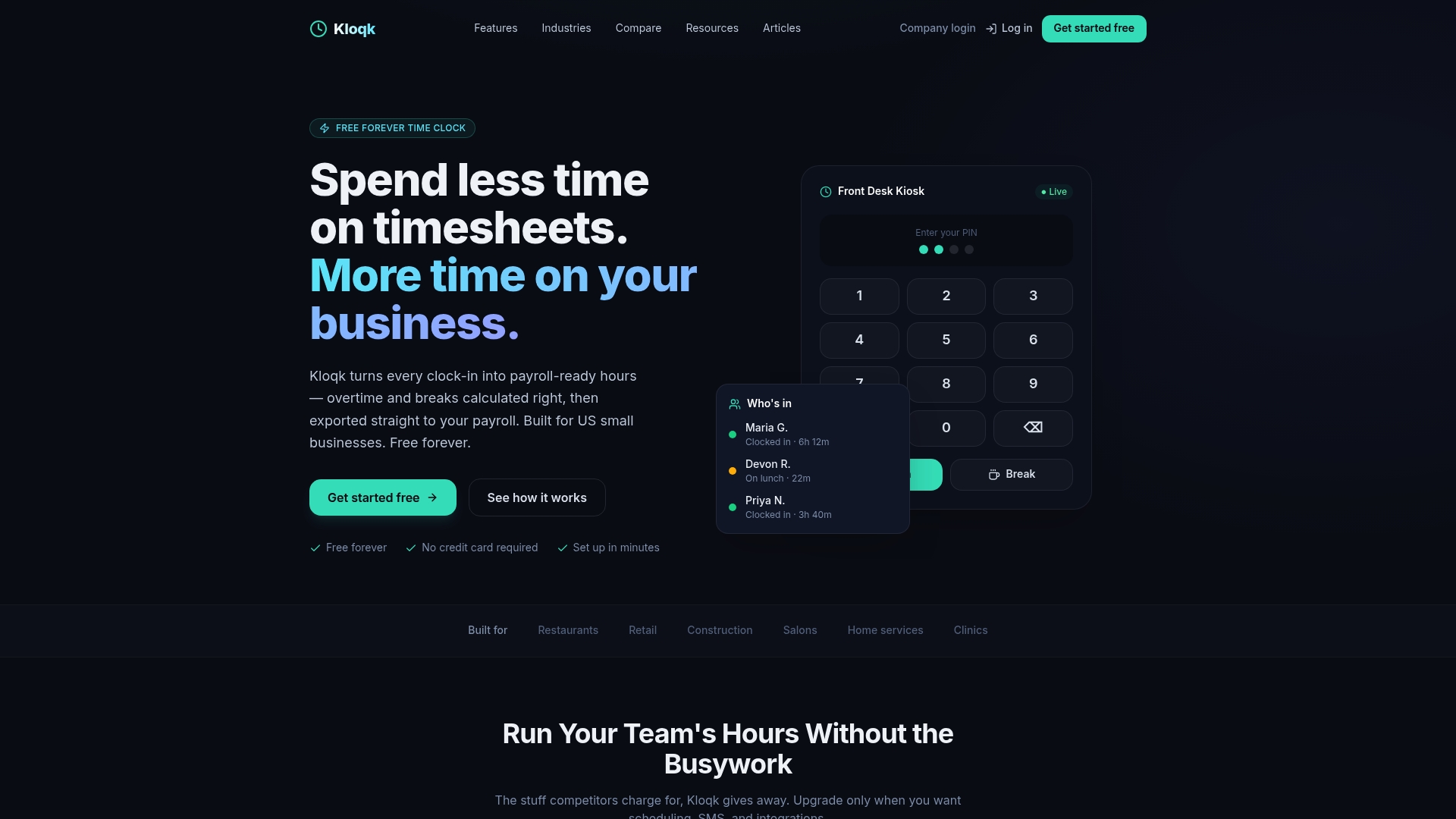
Start with the free time clock software for small business. If you later want scheduling, PTO or hiring tools, the paid plans are listed on the pricing page: Pro is $29 per month per location and Premium is $59 per month per location.
FAQ
Can a private employer give comp time instead of overtime pay?
Generally no. The Department of Labor says section 7(o) of the FLSA limits comp time instead of cash overtime to public agencies. A private employer must pay nonexempt employees at least 1.5 times the regular rate for hours over 40 in the workweek. California has a narrow statutory exception with strict written conditions.
What is the difference between comp time and overtime?
Overtime is cash pay at a premium rate for hours beyond the legal threshold. Comp time is paid time off earned instead of that cash. Public agencies may use comp time under federal rules, while private employers must generally pay the cash overtime.
Can I give an employee time off later in the same week to avoid overtime?
Yes, in most cases. The FLSA measures overtime per fixed seven-day workweek, and the DOL says the law does not regulate ordinary scheduling. If the employee’s total hours for that workweek stay at or under 40, no federal overtime is owed. Check your state’s rules and any agreement that limits schedule changes, and remember California counts daily overtime too.
What if my state has its own overtime law?
When federal and state overtime laws both apply, the employee is entitled to the standard that gives the higher pay, according to the DOL’s FLSA FAQ. Look up your state labor department’s rules, or ask an employment attorney, before you design a time-off policy.
Does a salaried employee qualify for comp time?
That depends first on whether the person is truly exempt. Exemption turns on job duties and earnings requirements, not title or salary alone. If the person is nonexempt, the overtime rules above apply even when they are paid a salary.
Sources
- elaws, FLSA Overtime Calculator Advisor, compensatory time off
- DOL Fact Sheet #23: Overtime Pay Requirements of the FLSA
- U.S. Small Business Administration: Answers to 5 Questions about Overtime Rules
- DOL Handy Reference Guide to the Fair Labor Standards Act
- DOL Fact Sheet #7: State and Local Governments Under the FLSA
- eCFR: 29 CFR Part 553 Subpart A, Section 7(o) compensatory time
- 29 CFR § 553.21 Statutory provisions
- California Labor Code section 204.3
- California DLSE: Overtime FAQ
- DOL: Questions and Answers About the Fair Labor Standards Act
- DOL Fact Sheet #17G: Salary Basis Requirement and the Part 541 Exemptions
Recommended
Sources
Every figure on this page traces to one of these. Primary law and government sources are listed first.
- 1. U.S. Department of Laborprimary
- 2. U.S. Department of Laborprimary
- 3. Electronic Code of Federal Regulationsprimary
- 4. Cornell Legal Information Instituteprimary
- 5. California Department of Industrial Relationsprimary
- 6. sba.gov
- 7. leginfo.legislature.ca.gov
Written by
Dana WhitfieldHR Compliance Lead
Dana writes about wage-and-hour law, FLSA overtime, and leave compliance for U.S. small businesses, translating dense regulations into plain steps owners can act on.
Keep Reading
Track Hours the Easy Way
Kloqk is a free time clock that handles punches, breaks, overtime, and payroll-ready reports.
Start free