6 Steps to Weekly WH-347 Compliance for Davis-Bacon Contractors

If your contract involves federal or federally assisted construction over $2,000, Davis-Bacon payroll rules apply to you, and two obligations kick in immediately. First, every laborer and mechanic on the job must receive at least the locally prevailing wage, made up of a basic hourly rate plus fringe benefits, exactly as listed on the applicable wage determination. Second, you must submit certified payroll records every week using WH-347 or an equivalent format, backed by a signed Statement of Compliance.
TL;DR:
- The worker’s site of work includes the construction location, staging areas, and fabrication sites set up solely for the project, but not general supply yards.
- Selecting the correct wage determination requires matching the county and construction category accurately, with project updates checked before work begins.
- Certified payroll must be submitted weekly using WH-347 or an equivalent form, including detailed employee classification, hours, pay, fringe benefits, and a signed compliance statement.
- Overtime pay under CWHSSA is calculated on the basic hourly rate excluding fringe benefits, with higher actual regular rates over the basic rate influencing the calculation.
- Maintaining detailed, accurate payroll records and enforcing documentation discipline at the start of the project significantly reduces audit risks and compliance issues.
Table of Contents
- Which Contracts and Workers Fall Under Davis-Bacon Rules
- How to Find and Apply the Correct Wage Determination
- Weekly Certified Payroll: WH-347 Fields and Submission Rules
- Overtime Rules Under CWHSSA and How to Calculate Them
- Fringe Benefits vs. Cash in Lieu: Getting the Documentation Right
- Recordkeeping, Site Postings, and What Triggers an Investigation
- Conformance Requests: Adding a Missing Job Classification
- Your Weekly Compliance Checklist for Certified Payroll
- Why Documentation Discipline Beats Reactive Fixes
- A Payroll System Built for Weekly Certified Payroll, Not Against It
- Sources
- FAQ
Which Contracts and Workers Fall Under Davis-Bacon Rules
The Davis-Bacon Act and its related acts cover federal or federally assisted contracts for construction, alteration, or repair once the contract value passes the Davis-Bacon applicability threshold. That threshold hasn’t moved in decades, so almost every meaningful public construction job lands inside the law’s reach. The coverage question isn’t really about dollar amounts. It’s about who counts as a “laborer or mechanic” and where the “site of the work” actually begins and ends.
“Site of the work” includes the physical construction location itself, plus adjacent or nearby staging areas, batch plants, and fabrication sites established specifically for that project. A worker mixing concrete at a dedicated batch plant a mile from the job is covered. A worker at a permanent commercial supply yard selling material to multiple projects generally is not, unless that yard was set up solely to serve the contract in question.
Recent enforcement activity has added a wrinkle worth flagging. On June 24, 2024, a federal court issued a nationwide preliminary injunction blocking three provisions of a final rule tied to material suppliers and certain truck driver coverage. The Wage and Hour Division responded with interim guidance clarifying that offsite delivery time for truck drivers generally doesn’t need to be treated as covered work while that injunction stands, even though the rest of the Davis-Bacon rule framework remains fully in force.
Coverage in practice comes down to a short list of questions:
- Does the contract exceed the applicability threshold and involve federal funds, federal assistance, or a federally guaranteed loan?
- Is the work construction, alteration, or repair, rather than pure supply or manufacturing?
- Does the worker perform manual or physical labor at the site of the work, as opposed to off-site fabrication at a permanent commercial facility?
- Is the worker a bona fide independent contractor, or functionally an employee subject to prevailing wage rules regardless of title?
Get any one of these wrong, and your entire payroll compliance strategy is built on the wrong foundation.
How to Find and Apply the Correct Wage Determination
Every Davis-Bacon wage determination lives on Sam, and picking the wrong one is one of the most common, and most expensive, mistakes contractors make. Wage determinations come in two flavors. A general wage determination covers a broad geographic area and construction category, and it applies automatically once the contracting agency incorporates it into the solicitation. A project wage determination is issued for a specific job when the general schedules don’t fit or the agency requests a tailored rate.
Selecting the right one means matching two variables precisely: the county (or counties) where the work happens, and the construction category, building, heavy, highway, or residential. A highway resurfacing job priced against a building-category wage determination will produce the wrong rates for every classification on the payroll, and that error compounds every single week you run payroll before catching it.
A few practical rules keep you out of trouble:
- Confirm the wage determination number and modification date printed on the contract match what’s currently posted on SAM.gov before you start work, since agencies sometimes issue updates mid-contract.
- If your project spans multiple counties, apply the correct determination to the portion of work performed in each one.
- If a classification of worker you need isn’t listed on the wage determination at all, that’s a conformance situation, not a reason to guess at a rate.
- Keep a dated screenshot or PDF of the wage determination you used, filed with the contract, since wage determination selection disputes are often traced back to which version was in effect on the award date.
When in doubt, ask the contracting officer to confirm the wage determination in writing rather than assuming your interpretation is correct.
Weekly Certified Payroll: WH-347 Fields and Submission Rules
Certified payroll isn’t optional paperwork you catch up on at the end of the job. It’s a weekly requirement, due for every week in which covered work occurred, and the prime contractor is on the hook for making sure every subcontractor’s payroll gets submitted too, not just its own. WH-347 is the standard form the Department of Labor provides, but any format is acceptable as long as it captures the required data and carries a signed Statement of Compliance.
Here’s what actually has to appear on that weekly submission:
- Employee identification. Full name and an identifying number, typically the last four digits of the Social Security number, never the full number, to limit exposure if records are lost or shared improperly.
- Work classification. The exact job classification from the wage determination, not a generic title like “laborer” when the person is actually running equipment classified separately.
- Hours worked. A daily breakdown showing straight time and overtime hours for each day of the workweek, not just a weekly total.
- Rate of pay. The basic hourly rate actually paid, shown separately from any fringe benefit amount.
- Fringe benefits. Either the dollar amount paid into a bona fide plan, or cash paid in lieu of fringe, clearly identified as such.
- Gross wages earned. Total pay for the project, plus, where applicable, gross pay from other work that week for cross-checking overtime.
- Deductions and net pay. Standard payroll deductions and the resulting net wage.
- Statement of Compliance. A signed certification that the payroll is accurate and that fringe benefits were paid as stated.
That Statement of Compliance carries real legal weight. Signing it falsely is subject to criminal penalties under 18 U.S.C. §1001, so it should never be treated as a rubber-stamp formality tacked onto a spreadsheet.
Electronic submission is allowed and, honestly, the smarter default for most contractors at this point. The requirements are straightforward: the system needs a legally valid electronic signature, the records have to remain accessible, and the Department of Labor needs access for at least three years after project completion. Our guide on preparing a weekly certified payroll form walks through common field-by-field mistakes if you want a deeper reference.
Pro Tip: Never store full Social Security numbers on any certified payroll export you share outside your own accounting system. The WH-347 instructions specifically call for the last four digits precisely because full SSNs create unnecessary liability if a payroll gets forwarded to the wrong inbox.
Overtime Rules Under CWHSSA and How to Calculate Them
Once a prime contract exceeds $100,000, the Contract Work Hours and Safety Standards Act layers a separate overtime requirement on top of Davis-Bacon’s prevailing wage mandate. CWHSSA requires at least one-and-one-half times the regular rate for every hour worked over 40 in a workweek, and this is where a lot of otherwise careful payroll departments trip up.
The mechanics matter here. Fringe benefits listed in the wage determination are generally excluded from the overtime premium calculation, so overtime gets computed on the basic hourly rate, not the basic rate plus fringe. But there’s a catch: if the worker’s actual regular rate, once you factor in bonuses or other compensation, ends up higher than the wage determination’s basic rate, the higher figure governs the overtime calculation instead.
Consider a laborer with a wage determination basic rate of $28 per hour and a fringe rate of $9 per hour, working 45 hours in a week:
- Straight time: 40 hours × $28 = $1,120 in basic wages, plus 45 hours × $9 = $405 in fringe.
- Overtime premium: 5 hours × ($28 × 1.5) = $210, calculated on the basic rate alone, not the $37 combined rate.
- Total pay for the week: $1,120 + $405 + $210 = $1,735.
The most common pitfall is applying the overtime multiplier to the combined basic-plus-fringe rate, which overstates the premium and creates a documentation mismatch that auditors flag almost immediately. For a fuller breakdown of the math with additional scenarios, Kloqk’s guide on how to calculate overtime pay covers edge cases like split classifications within a single week.
Fringe Benefits vs. Cash in Lieu: Getting the Documentation Right
Fringe benefits under Davis-Bacon aren’t limited to health insurance and retirement contributions, though those are the most common. A bona fide fringe benefit is any contribution to a plan that provides health, pension, vacation, or similar benefits, and the hourly credit is computed by dividing the total annual contribution by the total hours the plan is meant to cover.
Cash in lieu of fringe is exactly what it sounds like: paying the fringe dollar amount directly to the worker as wages instead of funding a benefit plan. That’s allowed, but it has to be clearly identified as cash in lieu on the payroll, not folded silently into the basic hourly rate. Unfunded plans, where a contractor self-insures rather than paying a third-party provider, require Department of Labor approval before the contractor can claim credit for them.
A few documentation points that separate clean payrolls from ones that draw scrutiny:
- Fringe contributions and cash-in-lieu payments need their own distinct fields on the payroll, never combined into a single “benefits” line.
- Overtime calculations should generally exclude fringe amounts from the premium base, matching the treatment described above.
- Unfunded or self-insured plans need DOL sign-off on file before you start claiming the credit, not after an auditor asks for it.
Get these three separated cleanly in your payroll system, and half of the fringe-related compliance headaches disappear on their own.
Recordkeeping, Site Postings, and What Triggers an Investigation
Davis-Bacon recordkeeping requirements run for at least three years after project completion, and the list of what to keep is longer than most contractors assume: certified payrolls, basic time and daily attendance records, proof of fringe benefit plan contributions, apprenticeship or trainee program registrations, and copies of every wage determination applied to the contract.

At the job site itself, two postings are mandatory: the applicable wage determination and Form WH-1321, the notice explaining employee rights under the Davis-Bacon Act. Both need to be posted somewhere workers actually pass by, not filed in a site trailer drawer.
The violations that trigger investigations most often are predictable:
- Misclassifying workers into a lower-paying category than their actual duties warrant.
- Failing to pay for all hours actually worked, including unrecorded overtime.
- Certified payrolls that are late, incomplete, or don’t reconcile with time records and fringe documentation.
- Missing or outdated wage determination postings at the site.
Enforcement consequences scale with severity. Contracting agencies can withhold contract payments to cover back wages, contractors may owe restitution directly to underpaid workers, and repeated or willful violations can lead to debarment from future federal contracts for up to three years. State-level prevailing wage laws sometimes run alongside these federal rules too, adding another layer worth checking; Kloqk’s overview of state labor law requirements for construction sites is a useful cross-reference when a project touches both.
Conformance Requests: Adding a Missing Job Classification
Sometimes the wage determination simply doesn’t include a classification you need on the job, maybe a specialized equipment operator or a trade that’s uncommon in that county. That’s what the conformance process, filed through SF-1444 or SF-308, exists to fix. It’s a narrow tool, though: it cannot be used to justify paying a lower rate than the determination would otherwise require, and the Wage and Hour Division scrutinizes requests that look like they’re trying to do exactly that.
A conformance request that actually gets approved generally follows this path:
- Confirm the classification genuinely doesn’t appear anywhere on the applicable wage determination, not just under a slightly different name.
- Document the specific duties the worker will perform, in enough detail that WHD can compare them to existing classifications.
- Propose a rate that bears a reasonable relationship to rates already listed for comparable work in the same wage determination.
- Submit the request through the contracting officer, since contractors generally can’t file conformance requests directly.
- Build in lead time. Approvals aren’t instant, and starting work under an unapproved classification is a risk, not a shortcut.
The best defense against classification disputes is simple: document duties before the dispute happens, not after, and loop in WHD early when a classification looks like it might not fit cleanly.
Your Weekly Compliance Checklist for Certified Payroll
Treat certified payroll like a recurring close process, not a scramble every Friday afternoon. A repeatable weekly rhythm looks like this:
- Verify the wage determination and classification assignments are still correct for the work performed that week.
- Reconcile approved time records against the payroll system, catching discrepancies before they become payroll entries.
- Compute fringe benefit credits and cash-in-lieu amounts separately, using the distinct fields discussed above.
- Generate the WH-347 or equivalent export directly from reconciled, approved data.
- Obtain a signed Statement of Compliance from someone with actual authority to certify it.
- Archive the week’s certified payroll, time records, and supporting fringe documentation together in the project file.
Automated time tracking earns its keep at steps two and three especially, as shown in the agency case study on construction client work at KHG Construction. A system that captures hours by classification automatically, flags overtime the moment someone crosses 40 hours, and masks identifiers before export removes a whole category of manual transcription errors that show up in DOL audits. It also makes subcontractor collection far less painful: requiring every subcontractor to submit hours in the same format the prime uses avoids the scramble to reformat five different spreadsheets every Friday.
When corrections are needed retroactively, don’t quietly fix the current week’s payroll and move on. File an amended certified payroll for the affected week, note the correction and the reason, and keep both versions on record. If the Department of Labor sends an information request, respond with the full documentation trail rather than a summary. Auditors trust contractors who can produce the underlying records fast.
Pro Tip: Build subcontractor payroll collection into your contract language up front, specifying the format and deadline. Chasing down a subcontractor’s certified payroll after the fact is far harder than making submission a condition of payment from day one.
Why Documentation Discipline Beats Reactive Fixes
The contractors who stay out of trouble with Davis-Bacon compliance aren’t the ones with the deepest legal budgets. They’re the ones who treat weekly certified payroll as a fixed process rather than a task that gets pushed to whenever there’s spare time. Classification decisions made carefully at the start of a project prevent far more pain than any correction filed after WHD comes asking questions.
Where I’d push back on common practice: too many compliance officers treat automation as a nice-to-have for later, once the project scales up. That’s backwards. The earlier you standardize how hours, classifications, and fringe amounts get captured, the fewer retroactive corrections you’ll be filing six months in. And when a classification or wage determination question genuinely isn’t clear, escalate to WHD or legal counsel immediately rather than guessing and hoping it doesn’t surface in an audit.
Saad
A Payroll System Built for Weekly Certified Payroll, Not Against It
Kloqk provides overtime calculations, break tracking, and payroll-ready exports available on its Free plan. That matters directly for Davis-Bacon compliance: the weekly checklist above depends on clean, classification-level hours data, and that’s exactly what Kloqk’s employee time tracking features are built to produce automatically as workers clock in and out.
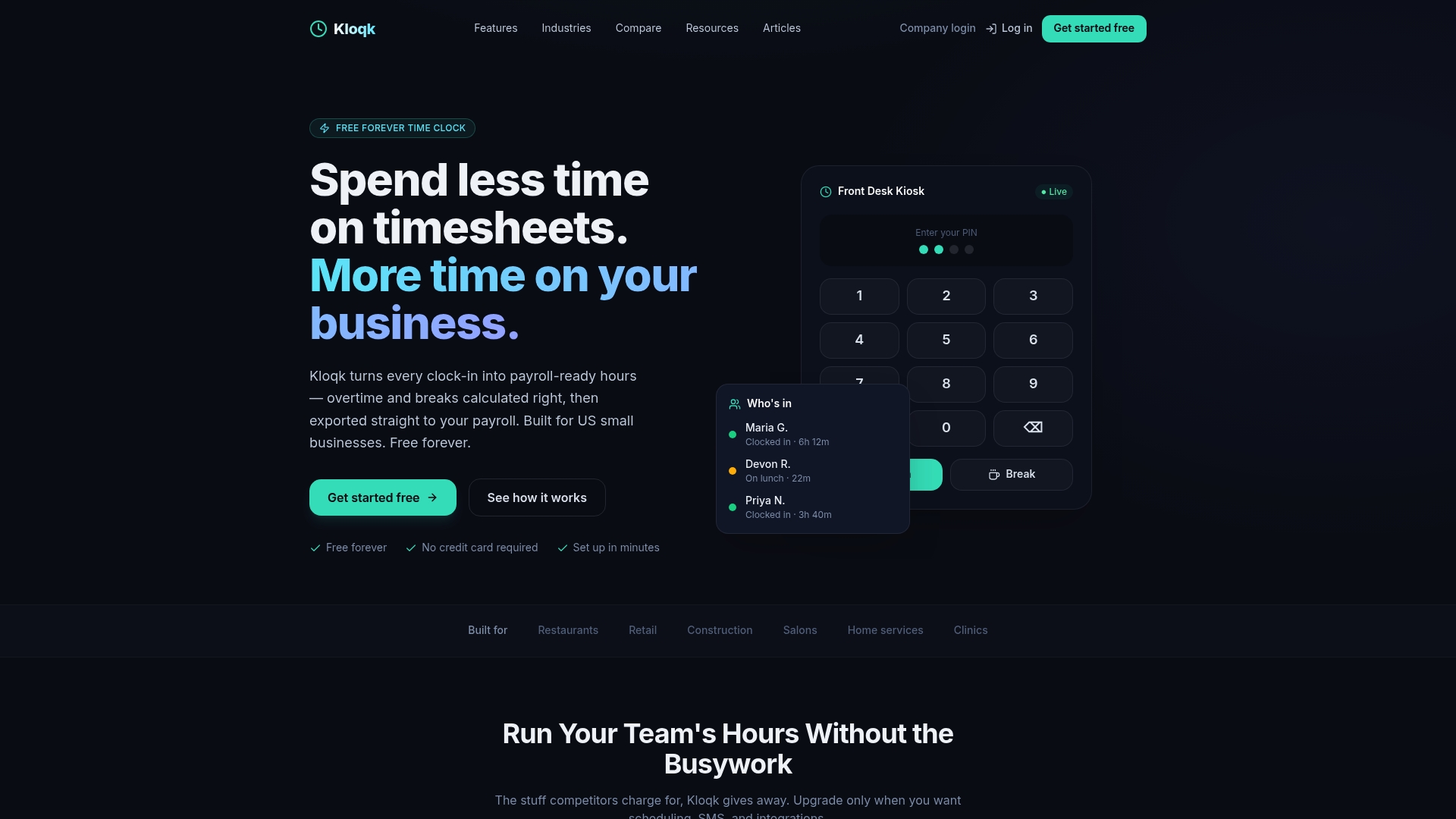
Photo verification confirms who actually clocked in, GPS geofencing keeps punches tied to the actual job site, and hours export in a format ready to drop into your WH-347 preparation instead of requiring manual re-entry from a paper timesheet. For multi-site contractors juggling crews across county lines and construction categories, the remote time tracking tools help keep each crew’s hours attributed to the right project without extra spreadsheet work.
If your current process still means rebuilding hours in a spreadsheet every Friday, it’s worth comparing what you’re doing manually against what the Free, Pro, and Premium plans handle automatically, starting with the free tier before deciding if the paid features fit your project size.
This article is general information, not a substitute for advice from a qualified lawyer. Consult a qualified legal professional about your own circumstances before acting on anything here.
Sources
- Fact Sheet #66: The Davis‑Bacon and Related Acts (DBRA)
- Instructions For Completing Davis‑Bacon and Related Acts Weekly Certified Payroll Form, WH‑347
- Sam
FAQ
Who Qualifies for Davis-Bacon Wages?
Any laborer or mechanic performing physical or manual work at the site of a covered federal or federally assisted construction contract exceeding $2,000 qualifies for prevailing wages under Davis-Bacon rules, regardless of their job title.
What Are the Weekly Payroll Requirements Under Davis-Bacon?
Contractors and subcontractors must submit certified payroll records every week that covered work occurs, using WH-347 or an equivalent format, including a signed Statement of Compliance covering hours, classifications, and fringe benefits paid.
What Are Common Davis-Bacon Violations?
The most frequent violations are misclassifying workers into lower-paying categories, failing to pay for all hours worked including overtime, and submitting incomplete or inaccurate certified payrolls that don’t reconcile with time records.
Does the Davis-Bacon Act Apply to All States?
Davis-Bacon applies nationwide to qualifying federal and federally assisted construction contracts regardless of state, though many states also have their own prevailing wage laws that can apply concurrently on state-funded projects.
Does Kloqk Help With Davis-Bacon Certified Payroll Compliance?
Certain free time tracking plans capture hours by classification, calculate overtime automatically, and export payroll-ready data to assist in preparing WH-347 certified payroll reports each week.
Recommended
Sources
Every figure on this page traces to one of these. Primary law and government sources are listed first.
- 1. U.S. Department of Laborprimary
- 2. sam.gov
- 3. dceo.illinois.gov
Written by
Dana WhitfieldHR Compliance Lead
Dana writes about wage-and-hour law, FLSA overtime, and leave compliance for U.S. small businesses, translating dense regulations into plain steps owners can act on.
Keep Reading
Track Hours the Easy Way
Kloqk is a free time clock that handles punches, breaks, overtime, and payroll-ready reports.
Start free