Weekly Certified Payroll Form: A Contractor's Guide

A weekly certified payroll form is a signed, weekly document that records every worker’s hours, job classification, wage rate, fringe benefit treatment, and net pay on a federally funded or federally assisted construction project. Its purpose is to prove that you paid workers at least the prevailing wage required under the Davis-Bacon and Related Acts. The U.S. Department of Labor’s Form WH-347 is the standard template, though it is technically optional. Your first move: download the WH-347 PDF, then open your contract and find the Davis-Bacon clause. That clause tells you the wage determination number, the contracting agency, and any project-specific submission instructions that override the federal default.
Table of Contents
- What is a weekly certified payroll form and why does the law require it?
- Who must submit certified payrolls each week?
- What data does a certified payroll report have to include?
- How to fill out Form WH-347 step by step
- What does the Statement of Compliance certify?
- Common mistakes that trigger violations and what they cost you
- How do state and local prevailing wage laws affect your reporting?
- What records do you need to keep and for how long?
- How prime contractors manage subcontractor certified payrolls
- How and where do you submit certified payrolls?
- Annotated sample: what a completed WH-347 row looks like
- Time-tracking practices that reduce WH-347 errors
- Key Takeaways
- The part of certified payroll compliance most contractors get wrong
- Kloqk turns field time data into payroll-ready WH-347 inputs
- Official forms, instructions, and state resources
What is a weekly certified payroll form and why does the law require it?
The legal foundation is the Davis-Bacon Act of 1931 and the Copeland Act, which together require contractors on covered federal construction contracts to pay workers no less than the locally prevailing wage and fringe benefit rates. The weekly certified payroll report is the enforcement mechanism. Without it, the contracting agency has no way to verify compliance.
Under 29 C.F.R. § 5.5(a)(3)(ii), contractors must submit a certified payroll to the appropriate federal agency each week, and each submission must include a signed Statement of Compliance. The requirement applies to federal construction contracts and to federally assisted contracts where Davis-Bacon clauses are incorporated by reference. That second category is broad: it covers contracts funded through HUD, the Federal Highway Administration, the Army Corps of Engineers, and dozens of other agencies.
Form WH-347 is the DOL’s ready-made template. Properly completed, it satisfies the reporting requirement. But the DOL is explicit that WH-347 is optional: any equivalent report containing all required data fields and the identical Statement of Compliance language is acceptable. That matters if your payroll software can export a formatted report. The data, not the form itself, is what the law demands.
Who must submit certified payrolls each week?
The short answer: every covered contractor and subcontractor performing work on a covered contract. Here is the breakdown.
Who must file:
- Prime contractors on federal or federally assisted construction contracts subject to Davis-Bacon
- All subcontractors at every tier performing covered work on the project
- Any contractor whose workers are on-site during a given week, even if the work is minor or incidental
- A payroll must be submitted for every week of the project, including weeks when no work is performed (submit a “no work” payroll for those weeks)
Who signs the Statement of Compliance:
The signature must come from a company official who paid the workers or who directly supervised payment. That is typically the owner, controller, payroll manager, or a designated authorized officer. The signer is personally certifying the accuracy of the payroll under penalty of law.
Prime contractor liability for subcontractors:
Prime contractors carry ultimate responsibility for project-wide compliance. If a subcontractor submits a late, incomplete, or inaccurate payroll, the prime can face withholdings and enforcement action. That is why most primes build a subcontractor payroll collection process into their project management workflow from day one. For a deeper look at how this plays out in practice, the construction payroll compliance guide covers prime and sub responsibilities in detail.
What data does a certified payroll report have to include?
The WH-347 instructions specify the required fields. Every weekly submission must contain all of them.

| Required Field | What to Report |
|---|---|
| Employee name and ID | Full legal name; last four digits of SSN or employee ID number |
| Work classification | The specific trade classification from the wage determination (e.g., Carpenter, Laborer, Electrician) |
| Hours worked daily | Hours for each day of the seven-day work week |
| Total weekly hours | Sum of all daily hours for the pay period |
| Hourly rate of pay | Basic cash wage rate paid |
| Fringe benefits | Amount paid to bona fide plans OR cash fringe paid directly to worker |
| Gross wages earned | Total earnings before deductions |
| Deductions | Federal/state tax withholding, FICA, and any other authorized deductions |
| Net wages paid | Take-home pay after all deductions |
| Employer and contract info | Contractor name, address, project name, contract number, and wage determination number |
Fringe benefit reporting is where many contractors make mistakes. The prevailing wage rate has two components: the basic cash wage and the fringe benefit rate. You can satisfy the fringe obligation in three ways: pay the full fringe amount into a bona fide benefit plan (health insurance, pension, vacation fund), pay it as additional cash directly to the worker, or use a combination. On the WH-347, you report which method you used and the dollar amount per hour. If you pay fringe into a plan, you list the plan name and the hourly credit. If you pay cash fringe, it shows up in the wage columns.
Every payroll submission must be accompanied by a signed Statement of Compliance. The WH-347 includes this on page 2, but if you use a custom report, you must reproduce the exact certification language.
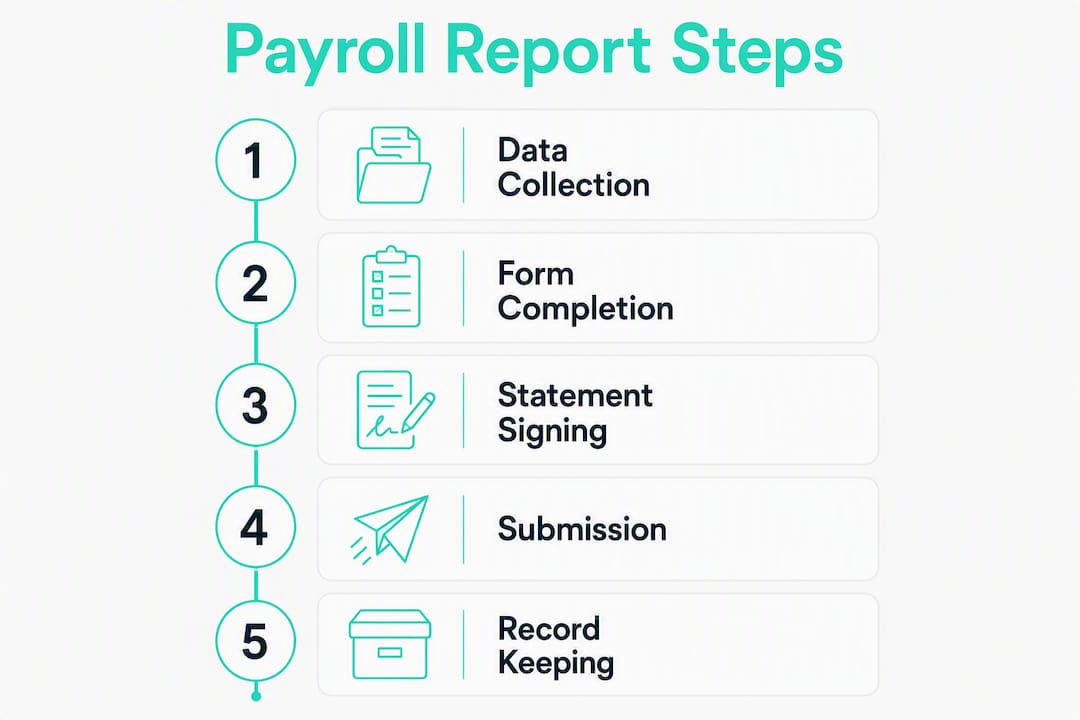
How to fill out Form WH-347 step by step
Before you start entering numbers, gather three things: your payroll export for the week, the applicable wage determination, and the contract number. With those in hand, the form moves quickly.
- List each worker on a separate rowEnter the worker’s full name and the last four digits of their Social Security number or an assigned employee ID.
Worked example for one employee:
| Field | Value |
|---|---|
| Worker | J. Rivera, Carpenter |
| Hours worked (Mon, Fri) | 8, 8, 8, 8, 8 = Total weekly hours |
| Gross wages (cash) | Total weekly hours × = $1,680.00 |
| Net wages paid | $1,680.00 − $422.52 = $1,257.48 |
| Fringe credit reported | $12.00/hr × Total weekly hours hrs = $480.00 paid to plan |
In this example, the fringe obligation is met entirely through plan contributions. The $480.00 does not appear in the gross wages column because it was never paid as cash to the worker. It is reported separately in the fringe column so the agency can verify the full prevailing wage was met.
You can download the fillable WH-347 PDF directly from the DOL. Some state agencies also host fillable copies, such as the Kansas Department of Commerce version, which replicates the federal fields.
What does the Statement of Compliance certify?
The Statement of Compliance is not a formality. It is a legal certification with real consequences if it is false. The WH-347 page 2 language, required verbatim (or identically) on any equivalent report, certifies three things:
The signer must be a company official with direct knowledge of payroll. A project superintendent who does not control payroll should not sign. If you use a custom payroll report instead of the WH-347, reproduce this language word for word on page 2 of your report. Paraphrasing is not acceptable.
Common mistakes that trigger violations and what they cost you
Certified payroll errors fall into a predictable set of categories. Knowing them in advance is cheaper than fixing them after an investigation.
The most common errors:
- Worker misclassification. Listing a journeyman carpenter as a laborer to pay a lower wage rate is the single most common Davis-Bacon violation. The wage determination specifies the correct classification for each type of work.
- Missing or incorrect fringe reporting. Failing to report fringe credits, or reporting a fringe amount that does not match plan contribution records, creates a gap the DOL can identify immediately.
- Late or missing weekly submissions. Every week of the project requires a payroll. Missing a week, even a slow one, is a violation.
- Math errors in gross or net wages. Manual calculations on large crews produce arithmetic mistakes. A single transposed digit can trigger a back-wage finding.
- Unsigned or improperly signed statements. A payroll submitted without a valid Statement of Compliance is treated as incomplete.
- Using the wrong wage determination. Projects sometimes span multiple wage determination areas. Using the wrong rate for a given location is a compliance failure.
Enforcement consequences range from administrative to severe. The contracting agency can withhold contract payments to cover back wages owed to workers. Repeated or willful violations can result in contract termination. The most serious outcome is debarment: the DOL can place a contractor on the ineligible list, barring them from federal contracts for up to three years. The Wage and Hour Division investigates complaints and can conduct audits without prior notice.
If you discover an error after submission:
- Correct the payroll immediately and prepare an amended submission.
- Notify the contracting officer in writing, explaining the error and the correction.
- Pay any back wages owed to affected workers promptly.
- Document every step: the original error, the correction, the payment, and the communication with the agency.
- Preserve all records related to the correction as part of your audit trail.
The manual cost of completing WH-347 forms is estimated by the DOL at approximately 55 minutes per payroll. On a project with multiple subcontractors and large crews, that burden compounds fast. Errors made under time pressure are common, which is why payroll errors from manual timesheets are worth addressing before they become enforcement issues.
How do state and local prevailing wage laws affect your reporting?
Federal Davis-Bacon covers federal and federally assisted contracts. But many states have their own prevailing wage laws, often called “little Davis-Bacon” statutes, that apply to state-funded public works projects. Some municipalities add another layer on top of that.
State requirements vary significantly. California, for example, requires contractors to submit certified payroll records electronically through the DIR’s Public Works Website Services using the state’s own system. New York has its own weekly payroll certification form that mirrors federal language but includes state-specific fields and submission instructions.
The practical steps for any project:
- Check the contract for the governing wage law (federal, state, or both).
- Identify the applicable wage determination and the agency that issued it.
- Find the agency’s preferred submission method (paper, email, or electronic portal).
- Confirm whether the state requires its own form or accepts the federal WH-347.
The DOL’s wage determination database at SAM.gov is the starting point for federal rates. For state rates, go directly to the state’s department of labor or public works agency. Do not rely on rates from a previous project. Wage determinations are updated periodically, and using an outdated rate is a violation even if you paid it in good faith.
What records do you need to keep and for how long?
Recordkeeping is not optional, and the retention period is longer than most contractors expect.
What to retain:
- Copies of every weekly certified payroll submitted, including any amended versions
- Timecards, time sheets, or time clock records for each worker, showing daily start and stop times
- The applicable wage determination for the project
- Fringe benefit plan documents and contribution records
- Apprenticeship registration certificates for any apprentices on the project
- Payroll tax records (941s, state withholding filings) for the project period
- Any correspondence with the contracting agency about payroll matters
How long to keep them: The Davis-Bacon regulations require contractors to maintain payroll records for at least three years after the project’s completion. Some agencies and state laws require longer retention. When in doubt, keep records for five years.
Preparing for an audit:
- Organize records by project, then by week. An auditor who can find what they need quickly is less likely to expand the scope of the review.
- Keep digital backups of all paper records. A flood, fire, or office move should not destroy your compliance documentation.
- Maintain a project binder (physical or digital) that includes the contract, wage determination, all certified payrolls, and fringe benefit documentation in one place.
- If an audit notice arrives, do not alter records. Respond to the agency’s request within the stated deadline and provide exactly what was requested.
Accurate timesheets are the foundation of a clean audit. If your time records do not match your certified payrolls, you have a problem that no amount of explanation will fix.
How prime contractors manage subcontractor certified payrolls
Prime contractors are responsible for the entire project’s compliance, which means they need a system for collecting, reviewing, and forwarding subcontractor payrolls. Most primes that handle this well use a centralized workflow.
Practical collection workflow:
Set a weekly internal deadline that is two to three days before the agency’s submission cutoff. Require all subcontractors to submit their certified payrolls to a single point of contact (a project administrator or compliance officer) by that internal deadline. Standardize the file format: either the WH-347 PDF or a specific software export that contains all required fields.
Verification steps before forwarding to the agency:
- Confirm the worker classifications match the wage determination for the work performed.
- Spot-check wage calculations on at least a sample of employee rows.
- Verify that fringe benefit documentation supports the credits claimed.
- Confirm the Statement of Compliance is signed by an authorized company official.
- Check that the payroll number is sequential and the pay period dates are correct.
Pro Tip: Set up a simple tracking spreadsheet with one row per subcontractor per week. Log the date received, the date reviewed, and the date submitted to the agency. When an auditor asks for your submission history, you can produce it in minutes instead of reconstructing it from email threads.
Prime contractor responsibilities extend beyond paperwork collection. If a subcontractor’s payroll reveals a classification error, the prime is expected to flag it and require a correction before the payroll goes to the agency.

How and where do you submit certified payrolls?
Submission method depends on the contracting agency and the contract terms. There is no single universal portal.
Common submission options:
- Paper submission: Mail or hand-deliver the completed WH-347 (or equivalent) to the contracting officer or designated agency representative. Always keep a copy and get a receipt or delivery confirmation.
- Email/PDF: Many agencies accept scanned signed payrolls by email. Confirm the correct email address with the contracting officer before the first submission.
- Electronic portals: Federal agencies increasingly use project management systems that include a payroll submission module. Some states, like California, require electronic submission through a dedicated state portal.
- Third-party compliance platforms: Some large prime contractors use compliance software that aggregates and submits payrolls on behalf of the project.
Checklist for every submission:
- Contract number and project name included in the header
- Wage determination number listed
- Correct pay period dates
- Sequential payroll number
- Signed Statement of Compliance with date
- All required employee data fields completed
If you do not receive an acknowledgment within a reasonable time (typically five to seven business days), follow up with the contracting officer in writing. Keep that follow-up email. Silence from the agency is not confirmation of receipt.
Annotated sample: what a completed WH-347 row looks like
The table below shows how a single employee’s data maps into the WH-347 fields. This is the format the contracting agency sees when they review your submission.
| WH-347 Field | Sample Entry | Notes |
|---|---|---|
| Contractor name | Apex Construction LLC | Legal business name |
| Project / contract no. | Project name / Contract number | From contract documents |
| Payroll no. | 7 | Sequential from project start |
| Week ending | Week ending date | Last day of the work week |
| Employee name | Maria Chen | Full legal name |
| Employee ID | XXX-XX-1234 | Last 4 digits of SSN |
| Classification | Ironworker | Exact wage determination classification |
| Mon, Fri hours | 8 / 8 / 8 / 8 / 8 | Daily hours; Sat/Sun blank |
| Total hours | Total weekly hours | Sum of daily hours |
| Rate of pay | $48.50/hr | Basic cash wage paid |
| Fringe (plan) | $14.20/hr | Paid to health + pension plan |
| Gross wages | Total weekly hours × $48.50 | |
| Deductions | Fed tax, FICA, state tax | |
| Net wages | Gross minus deductions | |
| Statement of Compliance | Signed by J. Apex, Owner | Page 2, date of signature |
The fringe column ($14.20/hr) is reported separately from gross wages because those dollars went to a benefit plan, not to the worker’s paycheck. The agency uses that figure to verify the total compensation ($48.50 + $14.20 = $62.70/hr) meets or exceeds the wage determination rate for ironworkers on this project.
For a blank fillable version, use the official DOL WH-347 PDF. The DOL instructions page walks through each field in detail and is worth bookmarking alongside the form itself.
Time-tracking practices that reduce WH-347 errors
The most common source of certified payroll errors is not the form itself. It is the underlying time data. If your crew’s hours are captured inaccurately or inconsistently, every downstream calculation on the WH-347 is wrong before you start.
Daily capture habits that matter:
- Clock in and out at the job site, not at the office. Field crew members should record time where the work happens.
- Assign job codes at the point of clock-in. If a worker performs two classifications in one day (laborer in the morning, equipment operator in the afternoon), those hours need to be captured separately. Mixing them into a single daily total creates a classification problem on the WH-347.
- Record breaks accurately. Davis-Bacon compliance depends on hours actually worked, not hours on-site.
- Close the week on Friday. All crew times should be submitted and verified before the weekend so the payroll export is ready for Monday processing.
Verification features that protect your data:
GPS geofencing confirms that clock-ins happen at the actual job site, not from a truck in the parking lot two miles away. Photo verification at clock-in creates a timestamped record that ties a specific person to a specific location and time. Both features produce an audit trail that supports your certified payroll if the agency ever questions a worker’s hours.
The DOL estimates approximately 55 minutes to manually complete a single WH-347. On a project with a crew of 20 across multiple subcontractors, that burden adds up fast. Payroll-ready time tracking exports, which map directly to WH-347 fields, can cut that time significantly. The real cost of manual work compounds across a full project season in ways that are easy to underestimate until you are doing it every week.
Kloqk offers free time tracking features built for exactly this kind of field operation: daily clock-ins with photo verification and GPS geofencing, overtime and break calculations, job-level time codes, and payroll-ready exports that map to standard payroll fields. For contractors managing WH-347 reporting, those exports reduce manual data entry and the classification errors that come with it.
Key Takeaways
A weekly certified payroll form is a legal requirement on every Davis-Bacon-covered project, and getting it right every week, with accurate classifications, correct fringe reporting, and a signed Statement of Compliance, is the only way to stay off the DOL’s enforcement radar.
| Point | Details |
|---|---|
| File every week without exception | Submit a certified payroll for every week of the project, including weeks with no work performed. |
| Fringe benefits must be documented | Report fringe as plan contributions or cash fringe; the total must meet the wage determination rate. |
| Prime contractors carry full liability | Primes are responsible for subcontractor payroll accuracy and should verify before forwarding to the agency. |
| Retain records for at least three years | Keep timecards, payrolls, wage determinations, and fringe documents for a minimum of three years post-completion. |
| Kloqk reduces manual WH-347 entry | Kloqk’s free payroll-ready exports, GPS geofencing, and photo verification map directly to required WH-347 fields. |
The part of certified payroll compliance most contractors get wrong
Most of the guidance on certified payroll focuses on the form. Fill in the fields, get the signature, submit on time. That is all true, but it misses the real failure point.
The problem is almost never the form. It is the week of data that feeds the form. A crew that clocks in at the trailer instead of the job site, a foreman who rounds hours to the nearest half-day, a payroll clerk who lumps two classifications into one row because it is faster: these are the errors that show up on the WH-347 and trigger back-wage findings. The form is just the surface. The underlying time capture is where compliance is won or lost.
There is also a habit that separates contractors who sail through audits from those who scramble: they close the week on Friday. Every crew member’s time is submitted and verified before the weekend. The payroll export is ready Monday morning. The WH-347 is filed by Wednesday. That rhythm, repeated every week, means there is never a backlog, never a rushed submission, and never a week where someone is reconstructing hours from memory.
The contractors who treat certified payroll as a Friday-afternoon afterthought are the ones who misclassify workers under pressure, miss a week, or submit an unsigned statement because they forgot to route it to the right person. The process is not complicated. It just requires consistency, and consistency requires a system.
Kloqk turns field time data into payroll-ready WH-347 inputs
Filling out a certified payroll report manually for a crew of any real size takes the better part of an hour, every single week, for the life of the project. Kloqk eliminates most of that work by capturing the data correctly at the source.
With Kloqk’s free employee time tracking, your crew clocks in and out at the job site with GPS geofencing and photo verification. Job-level time codes capture hours by classification, so the data that flows into your payroll export already matches the WH-347 field structure. Overtime and break calculations run automatically. The result is a payroll-ready timesheet that maps directly to the fields the DOL requires, without a spreadsheet, without manual arithmetic, and without the classification errors that come from reconstructing hours after the fact.
Start with Kloqk’s free time tracking and see how much of the WH-347 your payroll export can fill before you touch the form.
Official forms, instructions, and state resources
Every contractor on a Davis-Bacon project should have these resources bookmarked before the first payroll is due.
- Form WH-347 (fillable PDF): The official DOL template. Download this first. It is the standard format accepted by all federal agencies.
- WH-347 Instructions: The DOL’s field-by-field instructions, including the required Statement of Compliance language, regulatory citations (29 C.F.R. Parts 3 and 5), and submission mechanics. Read this before you fill out your first form.
- DOL WH-347 form page: The main DOL landing page for the form, with links to the PDF, instructions, and related Davis-Bacon guidance.
- Kansas Commerce WH-347 fillable PDF: An example of a state agency distributing a fillable WH-347 copy for contractor convenience.
For any project, start with the WH-347 PDF and instructions, then check your contract for agency-specific submission requirements. State and local projects may require a different form or a dedicated electronic portal. Confirm before the first payroll is due, not after.
Recommended
Sources
Every figure on this page traces to one of these. Primary law and government sources are listed first.
- 1. U.S. Department of Laborprimary
- 2. worker.gov
- 3. kansascommerce.gov
Written by
Marcus ReyesPayroll & Timekeeping Specialist
Marcus covers payroll accuracy, timesheets, and time tracking, the unglamorous mechanics that keep paychecks correct and audits painless.
Keep Reading
Track Hours the Easy Way
Kloqk is a free time clock that handles punches, breaks, overtime, and payroll-ready reports.
Start free