Payroll Error Correction Process: Guide for HR & SMBs

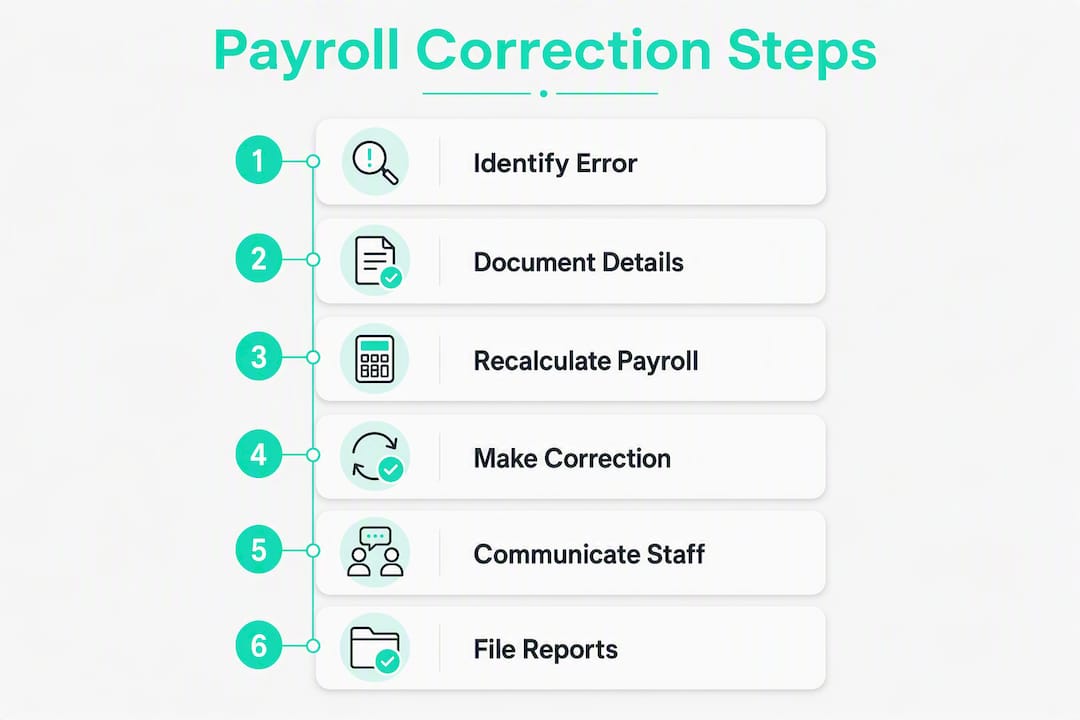
The payroll error correction process is a structured workflow for identifying, documenting, recalculating, and correcting mistakes in employee pay, then reporting any required changes to the IRS or state agencies. The moment you discover an error, your first move is to document it and secure the source records before anything else changes.
Start by creating a correction file with these four fields:
- Discovery date and who found the error
- Affected employees and the pay periods involved
- Original vs. corrected amounts (gross pay, taxes, deductions)
- Source documents (timecards, pay stubs, payroll register entries)
That file becomes your audit trail for every step that follows, from recalculation to IRS filings to employee conversations.
Table of Contents
- What types of payroll errors do HR teams encounter?
- How to identify and document a payroll error
- Current-period vs prior-period corrections: which path do you take?
- What federal forms and state rules apply to payroll corrections?
- Employee communication and overpayment recovery
- Preventing payroll errors with accurate time tracking
- How long does payroll correction take, and what does it cost?
- Key Takeaways
- The part most payroll guides skip
- Fewer corrections start with better time data
- Useful sources and further reading
What types of payroll errors do HR teams encounter?
Most payroll mistakes fall into predictable categories, and knowing which type you’re dealing with tells you immediately which correction path to take and whether a tax filing will follow.
- Incorrect deductions:A health insurance premium was deducted twice in one period. Requires a refund to the employee and a correction to benefit-plan records.
- Wrong tax withholding: Federal income tax was withheld at the wrong rate after a W-4 update wasn’t processed. May require a Form 941-X if the quarter has already closed.
The error types most likely to require tax-reporting follow-ups are wrong tax withholding, misclassification, and missed overtime, since all three affect the amounts reported on Form 941 and, potentially, on W-2s already issued.
How to identify and document a payroll error
Detection starts with reconciliation. Work through these four data sources in order: payroll register, time records, general ledger, and pay stubs. Discrepancies between any two of them are where errors hide.
Once you’ve found a discrepancy, build the correction file immediately. A well-structured file does two things: it gives you the inputs you need for accurate recalculation, and it protects you if a state agency or the IRS ever asks for documentation.
| Correction File Field | Why It Matters |
|---|---|
| Discovery date and discoverer | Establishes the timeline for prompt-payment compliance and IRS amendment deadlines |
| Affected employee(s) and pay period(s) | Scopes the correction and prevents over- or under-correcting adjacent periods |
| Original gross pay, taxes, and deductions | Required starting point for recalculation; never work backward from net pay |
| Corrected gross pay, taxes, and deductions | The verified output of your recalculation, signed off by a second reviewer |
| Source documents | Timecards, pay stubs, rate-change authorizations, benefit enrollment forms |
| Root cause | Identifies whether the error was a data-entry mistake, a system configuration issue, or a process gap |
| Approvals and communications | Records who authorized the correction and what was communicated to the employee |
A payroll reconciliation process that runs before every payroll close catches most of these discrepancies before they become corrections. The goal is to reconcile punch totals to approved hours, approved hours to the payroll register, and the payroll register to the general ledger, every single run.
Pro Tip: Assign a second reviewer to sign off on every correction file before any payment or amended filing goes out. A four-eyes rule catches calculation errors that the original discoverer often misses.
Current-period vs prior-period corrections: which path do you take?
The single most important decision in any payroll discrepancy resolution is whether the payroll run has already closed and whether a tax filing has already gone out. Those two facts determine everything else.
Same-period (current-period) correction: The error is found before the payroll run closes. You correct the data in the system, rerun the affected employee’s calculation, and the corrected amount goes out with the scheduled paycheck. No amended filing needed in most cases, since the quarter’s Form 941 hasn’t been submitted yet.
Prior-period correction: The run has closed, or the quarterly filing has already been submitted. Now you need an off-cycle payment or deduction, and potentially an amended federal form.
Current-period workflow
- Flag the error in the payroll system and place a hold on the affected employee’s record.
- Pull source documents (timecard, rate authorization, benefit form) and update the correction file.
- Recalculate gross pay first, then recompute Social Security, Medicare, and income tax withholding. Never adjust only net pay.
- Get a second-reviewer sign-off on the corrected figures.
- Release the corrected record into the current payroll run.
- Send the employee a written notice explaining what changed and why.
Prior-period workflow
- Document the error in the correction file with the original pay period and the date of discovery.
- Recalculate gross wages and all associated taxes for the affected period.
- Determine whether the quarterly Form 941 has been filed. If it has, you’ll need Form 941-X to adjust underreported or overreported employment taxes.
- Run an off-cycle payroll for underpayments. Off-cycle runs follow the same tax and withholding rules as scheduled runs, so treat them identically for deposit and reporting purposes.
- If W-2 wages have already been reported, prepare Form W-2c and W-3c.
- File any required state amended returns and check your state’s prompt-payment deadline for the gap between the original pay date and the correction date.
- Communicate the correction to the employee in writing, including the corrected amounts and the payment date.
Scenario A: A restaurant manager notices on a Tuesday that an employee’s Sunday overtime wasn’t calculated because the time-tracking system didn’t flag the seventh consecutive day. Payroll closes Friday. This is a current-period fix: update the hours, recalculate, and it goes out on schedule.
Scenario B: A construction company discovers in March that a federal income tax withholding rate was wrong for all of Q4 of the prior year. The Form 941 has been filed. That’s a prior-period correction requiring Form 941-X and, if W-2s were already issued, corrected W-2c forms for every affected employee.

What federal forms and state rules apply to payroll corrections?
Recalculating gross wages first before touching withholding or employer taxes is the non-negotiable starting point. Working backward from net pay creates cascading errors in Social Security, Medicare, and income tax reporting that are far harder to unwind than the original mistake.
Federal correction forms
- Form 941-X:Amends a previously filed Form 941 (quarterly employment tax return). Use it to correct underreported or overreported wages, tips, and taxes. The IRS allows either an adjustment process (credit against future deposits) or a claim process (refund request), depending on whether you overreported or underreported.
| Error Type | Likely Federal Action | Immediate Employer Step |
|---|---|---|
| Wrong tax withholding (prior quarter) | Form 941-X | Recalc gross wages; file 941-X; notify employee |
| Underpayment of wages | Off-cycle payroll run | Pay promptly; no amended filing if same quarter |
| Overpayment (W-2 already issued) | Form W-2c / W-3c | Recover overpayment per state rules; issue corrected W-2c |
| Worker misclassification | Form 941-X, W-2c, corrected 1099 | Consult tax counsel; file all amended forms |
| Missed employer FICA | Form 941-X | Pay balance due; check for interest and penalties |
State considerations: There is no single federal deadline for correcting non-tax payroll errors. State wage-and-hour agencies set prompt-payment rules, and those timelines vary significantly. California, for example, requires immediate payment of final wages in most termination situations, while other states allow the next regular payday. Check your state labor or wage-and-hour agency for the specific timeline that applies to your situation, since a correction that’s timely under federal rules may still be late under state law.
Employee communication and overpayment recovery
Written communication isn’t optional. Transparent, written notice reduces disputes, preserves morale, and creates a record that the employee was informed before any deduction or recovery action was taken.
What a correction notice should include:
- What happened (the specific error, stated plainly)
- Which pay period(s) were affected
- The original amount paid and the corrected amount
- The net difference (amount owed to the employee or to be recovered)
- When the corrected payment will arrive or when the deduction will occur
- A contact name and method for questions
Recovering an overpayment:
- Deduction from future wages: Only permissible if state law allows it and the employee has provided written consent. Many states cap how much can be withheld in a single pay period, and the deduction can never push the employee’s effective hourly rate below the applicable minimum wage.
- Written repayment plan: A structured schedule, signed by the employee, works well for larger overpayments spread across multiple periods.
- Lump-sum repayment: Appropriate when the employee agrees and the amount is manageable in a single payment.
- Written settlement for terminated employees: When the overpaid employee has already left, a formal written demand and settlement agreement is often the only practical path. Recovery through wage deduction is no longer available once employment ends.
State rules on wage deductions vary enough that what’s legal in one state is a wage violation in another. Always verify your state’s requirements before initiating any deduction.
Pro Tip: Keep the signed employee consent form and the repayment agreement in the correction file alongside the recalculation records. If a wage claim is ever filed, that documentation is your first line of defense.
Preventing payroll errors with accurate time tracking
The most cost-effective payroll error correction is the one you never have to run. Automating time capture and mapping time exports directly into payroll eliminates the manual data-entry step where most discrepancies originate. When hours flow from a verified clock-in directly into a payroll-ready export, the reconciliation step becomes a confirmation rather than a hunt for discrepancies.

Accurate source data, specifically verified timecards with overtime flags and authorized rate changes, is the single most effective prevention tactic available to small and mid-sized employers. The correction workflow described throughout this article becomes dramatically shorter when the inputs are clean.
Prevention checklist for payroll administrators:
- Automated clock-in with photo verification to confirm employee identity at punch
- GPS geofencing to prevent off-site or fraudulent clock-ins, particularly for field and construction crews
- Automatic overtime calculations that flag FLSA thresholds and state-specific rules before payroll closes
- Supervisor approval workflows for time edits, with a full audit trail of who changed what and when
- Payroll-ready exports that map directly to payroll system fields, eliminating manual re-entry
- Routine pre-payroll reconciliation: punch totals vs. approved hours vs. payroll register, every run
- Rate-change authorization controls that require a second approver before a new rate takes effect
Kloqk’s free time-tracking platform includes all of these controls, from photo capture at clock-in to GPS geofencing and payroll-ready exports, at no cost for core features. For teams dealing with payroll errors from manual timesheets, switching to automated clock-ins removes the data-entry layer where most errors start.
The downstream benefit shows up in the correction workflow itself. When a dispute arises, a timestamped, photo-verified punch record resolves it in minutes rather than days of back-and-forth over handwritten timesheets.
How long does payroll correction take, and what does it cost?
Timeline depends almost entirely on when the error was caught and how many employees are affected.
Typical timelines:
- Same-period fix: A few hours to a day, assuming the payroll run hasn’t closed and the recalculation is straightforward.
- Off-cycle payment: One to three business days, accounting for bank processing and ACH lead times.
- Prior-period correction with amended filing: Two to six weeks from discovery to IRS acknowledgment of Form 941-X, longer if state amended returns are also required.
- W-2c corrections: Weeks to months if multiple employees are affected and the annual filing window is already closed.
Cost drivers to track in your correction file:
- Staff hours for investigation, recalculation, and filing (often the largest cost for small teams)
- Off-cycle payroll processing fees charged by your payroll provider
- IRS interest and penalties on underreported taxes, which accrue from the original due date
- Benefit plan adjustments, including corrective contributions to 401(k) or FSA accounts
- Accounting clean-up to reconcile the general ledger after prior-period corrections
- Legal review costs when misclassification or wage-claim risk is involved
Pro Tip: Tag each correction entry in your ledger with a root-cause code: time-entry error, rate change, benefits mis-entry, tax setup. After a quarter, the pattern tells you exactly where to invest in controls. The costs of manual time tracking systems almost always show up first in correction frequency, not in the time-tracking budget itself.
Key Takeaways
A complete payroll error correction process runs from identification through documentation, recalculation, correction, reporting, and written employee communication, in that order, every time.
| Point | Details |
|---|---|
| Build the correction file first | Capture discovery date, affected employees, original vs. corrected amounts, and source documents before touching any figures. |
| Always recalculate gross wages first | Never adjust only net pay; recompute Social Security, Medicare, and withholding from gross to avoid cascading tax errors. |
| Match the form to the timing | Same-period errors rarely need amended filings; prior-period errors after a 941 filing require Form 941-X, and W-2 corrections require Form W-2c and W-3c. |
| Check state prompt-payment rules | Federal law sets tax amendment timelines; state wage-and-hour agencies set how fast you must pay, and those deadlines vary significantly by state. |
| Kloqk prevents errors at the source | Automated clock-ins, photo verification, GPS geofencing, and payroll-ready exports eliminate the manual entry step where most payroll discrepancies begin. |
The part most payroll guides skip
Most payroll correction guides treat the process as a compliance checklist. Get the form right, file on time, close the ticket. That framing misses the more expensive problem: the same errors keep happening because the root cause was never fixed.
The behavioral change that actually reduces correction volume isn’t a better correction workflow. It’s a daily reconciliation habit before payroll closes. Comparing punch totals to approved hours takes about ten minutes for a team of twenty. Catching a missed overtime flag or a rate-change that didn’t save costs nothing at that stage. Catching it after the run closes, after the Form 941 is filed, after the W-2 is issued, costs hours of staff time, potential IRS interest, and a conversation with an employee who now questions whether their pay is ever right.
Small teams in particular tend to skip pre-payroll reconciliation because it feels redundant when everyone “knows” the hours. That confidence is exactly where errors hide. A construction crew where the foreman approves time verbally, a restaurant where managers adjust punches manually, a clinic where part-time staff clock in on paper: these are the environments where a ten-minute daily check pays for itself many times over.
The other thing guides understate is the trust cost. An employee who receives a wrong paycheck, especially an underpayment, doesn’t just experience an inconvenience. They start watching every paycheck. That vigilance is reasonable, but it creates friction that a single well-communicated, fast correction can largely prevent. The written notice isn’t bureaucratic formality. It’s the fastest way to restore confidence.
Fewer corrections start with better time data
Every off-cycle payroll run, every Form 941-X, every overpayment recovery conversation traces back to a data problem upstream. Kloqk’s free employee time tracking platform is built specifically to eliminate that upstream problem for small U.S. businesses.

Clock-ins are verified with photo capture. Field crews are geofenced so only on-site punches count. Overtime calculates automatically against FLSA thresholds and state rules. Every time edit carries an audit trail. When payroll day arrives, you export payroll-ready hours directly into your payroll system, no manual re-entry, no transcription errors, no reconciliation surprises.
For teams currently dealing with manual timesheet errors, the shift to automated clock-ins typically cuts correction volume in the first pay period. The core platform is free, with no per-seat fees for time tracking, overtime calculations, or payroll exports.
Start with Kloqk’s free time tracking today and give your next payroll run cleaner inputs than the last one.
Useful sources and further reading
- IRS: Correcting Employment Taxes, the authoritative source for Form 941-X procedures, adjustment vs. claim options, and federal tax amendment rules. Start here for any tax-related correction.
- IRS Form 941-X Instructions, line-by-line guidance for completing the amended quarterly return; essential for prior-period tax corrections.
- IRS Form 944-X Instructions, the annual-filer equivalent of 941-X instructions, for employers on the annual filing schedule.
- SHRM: Must Payroll Errors Be Corrected Immediately? practical HR guidance on timing decisions and state prompt-payment obligations.
- LegalClarity: Payroll Correction Form Guide, explains internal correction form requirements and how they connect to federal wage-record obligations.
- Payroll Reconciliation: A Complete Guide, partner resource covering reconciliation controls and audit-trail best practices; useful for building the pre-payroll close process.
- Kloqk: Payroll Errors from Manual Timesheets, covers how manual time entry creates payroll errors and the controls that prevent them; best starting point for prevention tactics.
- Kloqk: Why Accurate Hours Matter for Payroll explains the compliance and operational case for payroll-ready time data, with practical guidance for small business payroll administrators.
Recommended
Sources
Every figure on this page traces to one of these. Primary law and government sources are listed first.
- 1. Internal Revenue Serviceprimary
- 2. SHRMprimary
- 3. gov.uk
- 4. ledgeronecfo.com
- 5. spitzcpa.com
Written by
Marcus ReyesPayroll & Timekeeping Specialist
Marcus covers payroll accuracy, timesheets, and time tracking, the unglamorous mechanics that keep paychecks correct and audits painless.
Keep Reading
Track Hours the Easy Way
Kloqk is a free time clock that handles punches, breaks, overtime, and payroll-ready reports.
Start free