6 Steps to Payroll Ready Labor Cost Tracking for Small Businesses

Labor cost tracking means converting clock-ins into payroll-ready hours, with overtime, breaks, and pay adjustments already applied, not project job costing. The fastest way to get there is a time clock that calculates overtime automatically, enforces break rules, and exports hours in a format that your payroll system accepts. A free option like Kloqk does this without the paywalled features many competitors charge for.
TL;DR:
- Automatic overtime calculation and configurable break enforcement reduce manual errors and ensure compliance with industry and state rules.
- Accurate payroll data requires recording employee identifiers, clock-in and out times, break periods, pay rates, tips, bonuses, and overrides to prevent pay inaccuracies.
- Verifying clock-ins with photo capture or GPS helps prevent buddy punching and maintains data integrity for small, mobile, or multi-location teams.
- Testing payroll exports for at least one pay period before full deployment catches discrepancies in overtime, tips, or bonuses, avoiding costly corrections later.
- Maintaining records for at least two to three years, backing up data, and conducting periodic audits are essential to meet legal requirements and ensure payroll accuracy.
Table of Contents
- What exact data your payroll needs from time tracking
- Which time clock features directly reduce payroll errors and labor costs
- Set up a payroll-ready workflow in six practical steps
- Compliance essentials: FLSA recordkeeping, retention, and practical audit habits
- Common pitfalls and pro tips to avoid costly payroll mistakes
- An honest look at what makes payroll-ready tracking work
- Try a free, payroll-ready time clock built for small teams
- Sources
- FAQ
What exact data your payroll needs from time tracking
Payroll can only be as accurate as the data feeding it. Missing or inconsistent fields are the leading cause of paycheck errors and after-the-fact corrections.
At minimum, your time tracking system needs to capture:
- Employee identifier: links hours to the correct pay rate and tax profile.
- Clock-in and clock-out timestamps: the raw basis for every hour paid.
- Break start and end times: needed to separate paid time from unpaid meal periods.
- Daily and weekly hour totals: the numbers’ payroll actually runs on.
- Overtime flags: mark which hours cross the threshold for premium pay.
- Pay rates and shift premiums: needed when an employee works multiple roles at different rates.
- Tips and nondiscretionary bonuses: these affect the regular rate used for overtime.
- Exception notes: missed punches, manager overrides, or manual adjustments.
A restaurant that logs hours but not breaks, for example, cannot tell whether a server actually took an unpaid meal period, which makes total paid hours unreliable. A construction crew that records shift totals but not overtime flags risks underpaying premium hours on a 50-hour week. Each field exists to answer a specific payroll question, and skipping one usually means someone reconstructs it manually later.
Which time clock features directly reduce payroll errors and labor costs
Not every feature matters equally. Some directly prevent the errors that cost owners money and time; others are just convenience.
- Automatic overtime rules: the system should apply overtime once weekly hours pass the threshold, without a manager doing math by hand.
- Configurable break enforcement: break rules vary by state and industry, so the clock should let you set required break lengths and flag missed ones.
- Payroll-ready exports: CSV exports or direct integrations with common payroll providers save the step of retyping hours into another system.
- Verification at clock-in: photo capture and GPS geofencing confirm the right person clocked in from the right location.
- Audit logs and reporting: a record of edits and overrides matters if you’re ever asked to justify a paycheck.
- Unlimited employees on a free tier: growing teams shouldn’t hit a wall or a new invoice just for adding staff.
Kiosk mode works well for a single restaurant location where staff punch in on a shared tablet, while mobile clock-in fits construction and field service crews spread across job sites.
Pro Tip: Test the payroll export with a single pay period before rolling it out to your whole team. A small mismatch is easy to catch and fix early, hard to unwind after three payrolls.
Set up a payroll-ready workflow in six practical steps
Getting from a time clock to a clean payroll run takes a handful of deliberate steps, not guesswork.
- Set overtime and break rules to match your state and industry requirements.
- Add pay rates and shift premiums for each role, including any differential pay.
- Enroll employees and turn on verification, such as photo capture or geofencing.
- Run a controlled test payroll for one department or pay period.
- Reconcile exceptions like missed punches or manager overrides before finalizing.
- Export and validate the payroll file against your manual calculations.
On that first run, check for a few common red flags:
- Overtime hours that don’t match a manual recount.
- Break deductions that appear on days no break was logged.
- Tips or bonuses missing from the export entirely.
Tips and nondiscretionary bonuses deserve particular attention. The Society for Human Resource Management notes that nondiscretionary bonuses must be folded into the regular rate used to calculate overtime, so your export needs to reflect that recalculation, not just the base hourly rate. If your system can’t do this automatically, flag any week with both overtime and a bonus for manual review before payroll finalizes.
Compliance essentials: FLSA recordkeeping, retention, and practical audit habits
Recordkeeping isn’t optional, and the retention periods are specific. The Department of Labor requires covered employers to keep payroll records for at least three years, while records used to compute wages, such as time cards and schedules, must be kept for two years.
The FLSA Hours Worked Advisor clarifies that a time clock isn’t legally required, but whatever method you use must produce accurate records, and de minimis time can only be disregarded in narrow circumstances, not as a general rounding practice.
A time clock with photo and GPS verification is one documented way small employers can meet FLSA’s accuracy requirement for hours worked, according to the Department of Labor.
Build these habits into a regular schedule:
- Back up exported payroll files separately from your time tracking system.
- Keep timecards for at least two years and payroll records for at least three.
- Run a quarterly audit comparing exported hours against a manual sample.
- Document any manual overrides at the time they happen, not after the fact.
Common pitfalls and pro tips to avoid costly payroll mistakes
Three mistakes account for most of the payroll headaches small employers run into.
- Ignoring nondiscretionary bonuses in overtime math: a bonus tied to performance or attendance must raise the regular rate for that week, not just get added on top.
- Buddy punching: one employee clocking in for another inflates hours without anyone noticing until payroll totals look off.
- Rounding and early or late punches: rounding rules that consistently favor the employer, rather than a neutral standard, invite wage claims.
Pro Tip: Require photo capture or GPS confirmation at clock-in for any team spread across shifts or locations. It closes the buddy-punching gap faster than a policy memo ever will.
An honest look at what makes payroll-ready tracking work

Most labor cost tracking advice treats compliance like a checklist you complete once and forget. In practice, the businesses that stay out of trouble treat it like a habit: they reconcile a sample of hours every pay period, not just when something looks wrong. The gap between what time tracking software promises and what it delivers usually comes down to configuration, not the tool itself. A system with every feature switched off performs no better than a paper timesheet.
Helping restaurants and construction crews move off spreadsheets and onto structured time clocks tends to expose the same issue every time: the software was fine, but nobody had set the overtime or break rules correctly before going live. That single setup step, tested against one real payroll run, prevents most of the errors this article covers.
Saad
Try a free, payroll-ready time clock built for small teams
Running payroll shouldn’t mean paying extra just to get overtime math and break tracking right. Kloqk keeps its core time clock free, including overtime calculations, break tracking, and payroll exports that most competitors charge for elsewhere.
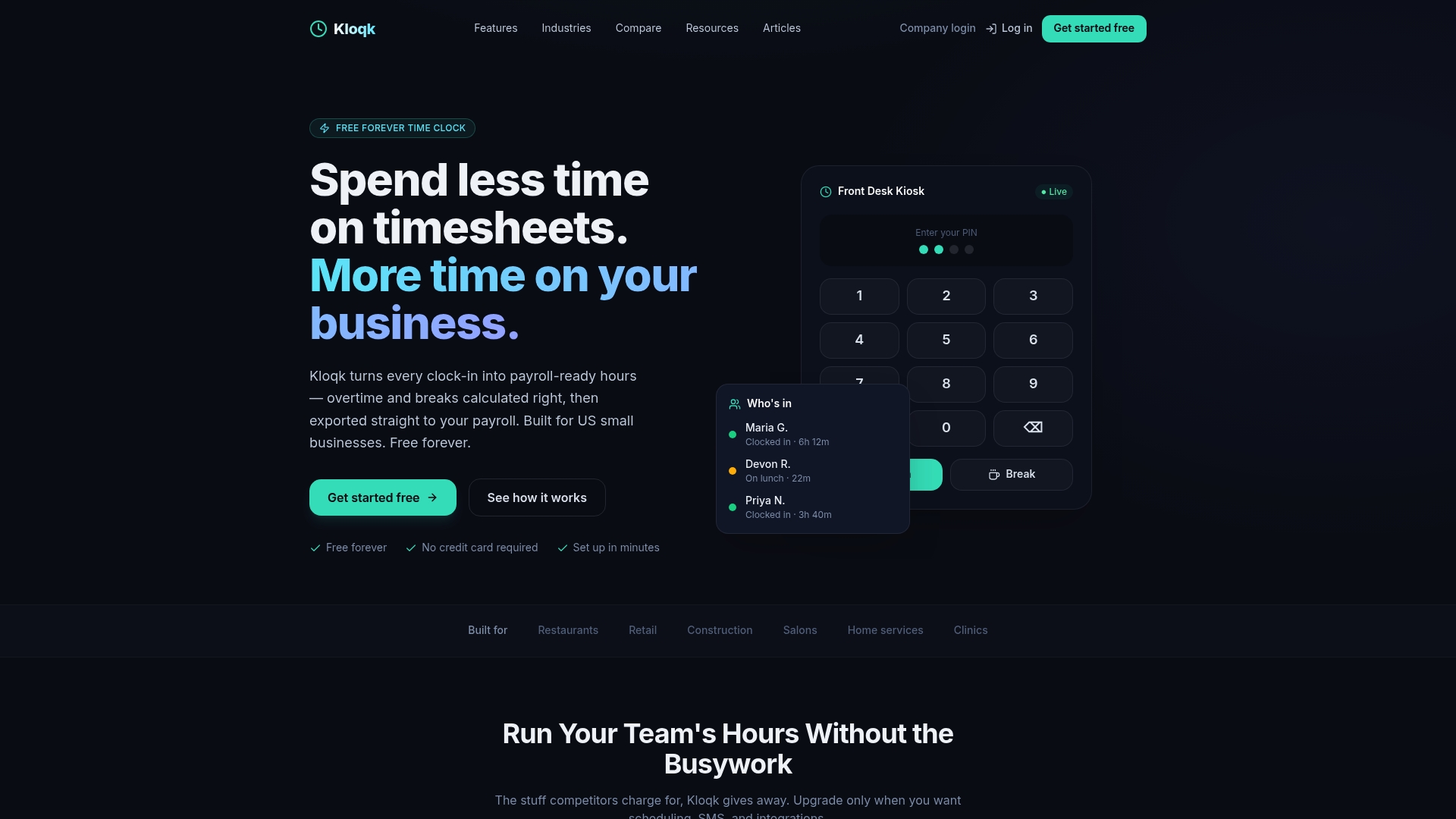
- Overtime and break rules apply automatically once you set them.
- Photo capture and GPS geofencing confirm who clocked in and from where.
- Payroll exports are ready to hand off without reformatting.
Test it with one pay period, check the export against your current process, and see the pricing and plans if you later want scheduling or PTO tools on top.
Sources
- Fact Sheet #21: Recordkeeping Requirements under the Fair Labor Standards Act (FLSA) | U.S. Department of Labor
- elaws, FLSA Hours Worked Advisor
- Ensure Overtime Is Properly Calculated When Bonuses Are in Play | SHRM
FAQ
What counts as labor cost tracking versus job costing?
Labor cost tracking here means turning employee clock-ins into payroll-ready hours, with overtime, breaks, and pay adjustments applied correctly. It’s distinct from assigning those hours to specific project budgets, which is a separate accounting process.
How long do I need to keep time and payroll records?
The Department of Labor requires payroll records to be kept for at least three years, while records used to compute wages, like time cards, must be kept for at least two years. Keeping digital backups of both makes an audit far less stressful.
Do nondiscretionary bonuses change overtime pay?
Yes. Nondiscretionary bonuses must be included in the regular rate used to calculate overtime for that pay period, according to SHRM, so payroll systems need to recalculate rather than simply add the bonus on top.
Is a time clock legally required to track hours worked?
No, the FLSA Hours Worked Advisor confirms a time clock isn’t mandatory, but whatever method you use must produce accurate records of hours worked. Most small employers find a digital time clock easier to defend in an audit than handwritten logs.
What features should a small business look for in a time clock?
Look for automatic overtime and break rules, payroll-ready exports, and verification features like photo capture or GPS geofencing to prevent buddy punching. Some time tracking providers offer these features on free plans that cover unlimited employees without a per-seat fee.
Recommended
Sources
Every figure on this page traces to one of these. Primary law and government sources are listed first.
- 1. SHRMprimary
- 2. U.S. Department of Laborprimary
- 3. U.S. Department of Laborprimary
Written by
Marcus ReyesPayroll & Timekeeping Specialist
Marcus covers payroll accuracy, timesheets, and time tracking, the unglamorous mechanics that keep paychecks correct and audits painless.
Keep Reading
Track Hours the Easy Way
Kloqk is a free time clock that handles punches, breaks, overtime, and payroll-ready reports.
Start free