Small Business Meal Break Tracking: When 30 Minutes Is Paid

Track every minute worked: count paid short rest breaks and treat only 30+ minute bona fide meal periods as unpaid when employees are fully relieved of duty, as the Department of Labor’s break guidance describes. Success means a consistent policy, auditable records, and timely corrections. Kloqk is one practical tool for putting those controls in place.
TL;DR:
- Federal law counts breaks lasting 5 to 20 minutes as paid work; meal periods of 30 minutes or more are unpaid only when employees are fully relieved.
- When federal and state rules differ, employers must follow the more protective rule, and some states require premium pay for missed meal periods.
- Explicit punches record meal start and end times; managers should approve edits, while automatic deductions of 30 minutes risk underpaying employees who work through lunch.
- For a missed break, verify the claim against timesheets and audit logs, correct payroll promptly, document the approver, and retain original and corrected records together.
Table of Contents
- How do federal and state rules define meal and rest breaks?
- Why does accurate meal-break tracking matter for payroll?
- Which methods work best to record meal breaks?
- How do you roll out a break policy step by step?
- How should you handle missed breaks and payroll corrections?
- What controls reduce time and break disputes?
- How we help small businesses keep break records audit-ready
- Why is the paper policy the least important part of break compliance?
- Where can you start tracking meals breaks with Kloqk today?
- FAQ
- Sources
How do federal and state rules define meal and rest breaks?
The Fair Labor Standards Act (FLSA) does not require employers to provide meal or rest breaks. It does, however, decide what counts as paid time when you offer them. Short rest breaks of roughly 5 to 20 minutes must be counted as hours worked, while a bona fide meal period of 30 minutes or longer generally need not be paid if the employee is completely relieved of duty, according to the Department of Labor.
Here is what that means in practice:
- A 10-minute coffee break is paid time and counts toward overtime.
- A 30-minute lunch is unpaid only when the employee can leave the work area and is not answering calls or watching a counter.
- A meal period becomes payable when the employee is not truly relieved, as Fact Sheet #22 explains.
- Many states add their own break rules, and when both laws apply the employee gets the more protective one, per the FLSA Hours Worked Advisor.
State rules can be strict. Our guides to California lunch break law and Washington State break laws show how far they can go beyond the federal baseline. For a plain-language overview, see whether lunch breaks are paid.
Why does accurate meal-break tracking matter for payroll?
Bad break data turns into bad paychecks. Short paid breaks count toward hours worked, so they push people toward overtime thresholds. A meal period wrongly treated as unpaid can quietly underpay an employee every single shift, and those small gaps add up to back-pay claims.
The risks are concrete:
- Back-pay liability when unpaid meal time turns out to be compensable
- Overtime miscalculated because paid rest breaks were left out
- Fines or premium pay under stricter state rules
- Employee disputes that erode trust and eat up HR hours
Capture every minute worked. The Department of Labor’s hours worked guidance points toward recording all time, and automated software reduces the rounding and manual-entry errors that cause payroll disputes.
Leaning on “de minimis” assumptions is a weak defense. A system that records the actual punch is a stronger one.
Which methods work best to record meal breaks?
You have several options, and each one needs configuration to be defensible.
- Manual records. Supervisor timecards or signed paper logs cost nothing to start, but they are prone to missed entries, guessed times and lost paper. If you use them, set a retention rule and require a signature on every sheet.
- Explicit punches. Require employees to punch out and back in for each meal period at a kiosk or time clock. The record shows when the meal began and ended, which is hard to dispute later. Route any edits through a manager approval.
- Mobile apps and kiosks. Mobile punches let field and remote teams record breaks too. GPS geofencing confirms where a punch happened, and photo verification confirms who made it.
- Auto-deduction rules. Automatically removing 30 minutes from every shift is convenient but risky. If an employee works through lunch, the deduction takes pay they earned. Use it only when you can monitor exceptions closely, and prefer explicit punches otherwise.
- Reports. Whatever you choose, review missed-break reports, exception queues and exportable payroll-ready timesheets on a regular schedule.
Our article on avoiding back pay from 30-minute meal break deductions walks through the most common deduction mistakes.
Three configuration habits make any method stronger:
- Lock the original punch so edits are added, never overwritten.
- Flag shifts with no meal punch at all.
- Export timesheets directly to payroll instead of retyping them.
How do you roll out a break policy step by step?
A policy only protects you if people follow it and you can prove they did. Use this checklist:
- Draft the policy. Define break types, durations, which are paid or unpaid, and what employees may and may not do during a meal period. Our copy-ready break policy examples give you language to adapt.
- Assign owners. Name who approves edits, who audits records each month, and who investigates missed-break claims.
- Train and collect acknowledgments. Walk staff through the rules, distribute the written policy and keep signed acknowledgments on file.
- Pilot with one team. Run it for a few pay periods, collect feedback and fix the recurring causes of exceptions before going company-wide.
- Review and adjust. Update the policy when state rules or your shift patterns change.
Pro Tip: Start your pilot with the team that has the most missed-break exceptions today, because fixing that group first shows you where the policy actually breaks down.
How should you handle missed breaks and payroll corrections?
Missed breaks will happen, so build a repeatable fix. Detect them through exception reports, employee claims and audit log reviews. Then follow one workflow every time:
- Document the claim with date, shift and what happened.
- Verify it against the timesheet and audit log.
- Apply the payroll correction in the next cycle, or sooner if state law requires.
- Record the reason and the approver.
Some states require premium pay or penalties for missed meal periods, so check your state’s rules and the Department of Labor’s break overview before you decide how to pay. Keep the original and corrected records together so an auditor can see both the mistake and the fix.
What controls reduce time and break disputes?
Most disputes come down to “prove it.” Controls make proof easy.
- Require manager approval for every edit, and keep an immutable audit trail with exportable payroll records.
- Favor explicit punches over auto-deductions unless you monitor exceptions strictly.
- Use photo verification and geofencing to reduce time theft and confirm where punches happen.
- Run routine audits, and share simple break reports with staff so no one is surprised by their timesheet.
- Retain records for the period your state and federal rules require.
Pro Tip: Show employees their own break history each pay period; people correct errors fast when they can see them.
How we help small businesses keep break records audit-ready
We built Kloqk for small teams that cannot afford payroll cleanup. Our free core includes break calculations, photo verification, GPS geofencing and payroll exports, so the controls in this guide are available without a budget fight. The goal is simple: fewer payroll edits and fewer disputed pay claims. Our resources are there for a quick pilot.
Why is the paper policy the least important part of break compliance?
Most advice stops at “write a policy and have employees sign it.” I think that is backwards. A policy nobody can verify is a statement of intent, and an investigator or plaintiff’s lawyer will ask for the records, not the handbook.
What the research here supports is that the punch record is the real policy. If the log shows a clean 30-minute meal period with the employee relieved of duty, you are in a strong position. If it shows nothing, or a rounded guess, the handbook will not save you.

Auto-deduction is the most overrated shortcut. It feels efficient, yet it assumes every employee took every break, which is the exact assumption that creates back-pay claims.
Prioritize in this order: capture real punches, lock the audit trail, route edits through approvers, and only then polish the policy wording. Fix the data first, and the disputes shrink on their own.
Saad
Where can you start tracking meals breaks with Kloqk today?
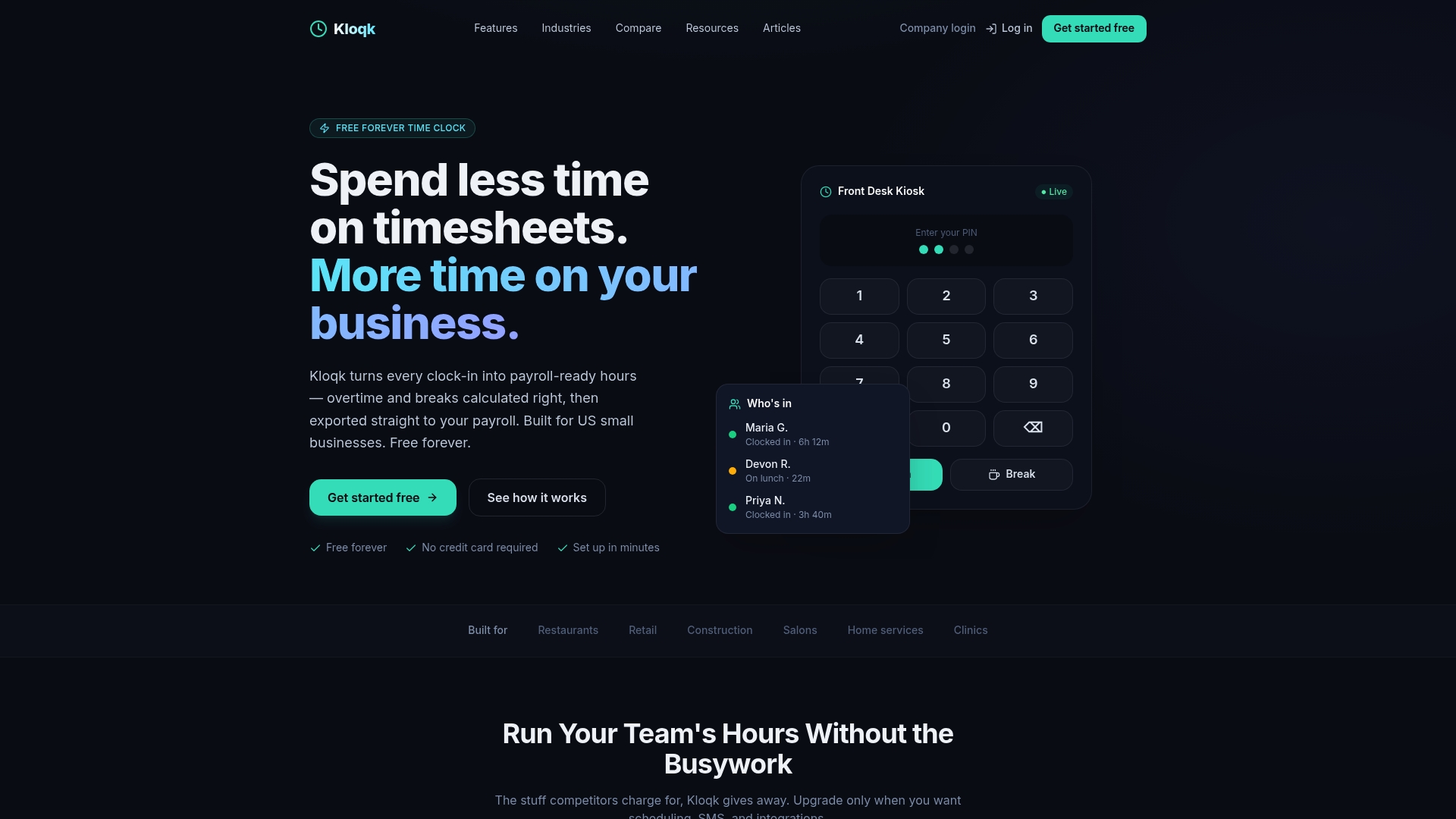
We offer explicit punch tracking, automatic break calculations and payroll-ready exports, and the core is free. Pair it with the policy templates above and you can pilot the whole process with one team. See the employee time tracking features or compare plans on our pricing page, where Pro runs $29 per month per location and Premium $59 per month per location. Set up your free account and run your first pilot pay period.
FAQ
Are employers required to give meal breaks under federal law?
No. The FLSA does not require meal or rest breaks. When you do provide them, the Department of Labor says short rest breaks are paid and bona fide meal periods can be unpaid if employees are fully relieved. State law may require breaks anyway.
When does an unpaid meal break become paid time?
It becomes paid when the employee is not completely relieved of duty. Answering calls, covering a counter or working while eating all turn meal time into hours worked, as Fact Sheet #22 explains.
Is auto-deducting meal breaks a good idea?
Usually not on its own. Auto-deduction can remove pay for employees who worked through lunch. Explicit punches are safer, and you should use deductions only with strict exception reports.
How do I fix a missed meal break in payroll?
Document the claim, check the timesheet and audit log, apply the correction, and record the reason and approver. Keep original and corrected records together, and check your state’s rules for premium pay.
Sources
- Breaks and Meal Periods | U.S. Department of Labor
- Fact Sheet #22: Hours Worked Under the Fair Labor Standards Act (FLSA) | U.S. Department of Labor
Recommended
Sources
Every figure on this page traces to one of these. Primary law and government sources are listed first.
- 1. U.S. Department of Laborprimary
- 2. U.S. Department of Laborprimary
Written by
Priya NairPeople Operations Writer
Priya focuses on HR and hiring for small teams, onboarding, scheduling people fairly, and the day-to-day of managing hourly staff without an HR department.
Keep Reading
Track Hours the Easy Way
Kloqk is a free time clock that handles punches, breaks, overtime, and payroll-ready reports.
Start free