On-Call Pay Rules: When Standby Time Must Be Paid

On-call time is paid under federal law when it is really work time. That means the employee must stay on your premises, or so close by that they can’t use the time for themselves. A person who waits at home with a phone and can live a normal life is usually not working. Any time they spend responding to a call is paid like any other work, and some states add their own rules on top.
This guide covers what the Fair Labor Standards Act (FLSA) says, how to pay a standby rate, how call-ins and overtime work, and where state law goes further. It is written for owners and managers of small hourly teams: restaurants, clinics, construction crews, salons and retail.
TL;DR
- Under the FLSA, on-call time is paid when the employee is “engaged to wait”: required to stay on premises, or restricted so much that personal use of the time is not practical.
- Free, off-premises on-call time is generally unpaid, but every minute spent answering a call, working and traveling for work is hours worked.
- A standby stipend is optional under federal law, but if you pay one it goes into the regular rate for overtime.
- California, New York and other states have their own standby, call-in and reporting-time rules, so check your state before you copy a federal-only policy.
- Record the call, the work and the travel from start to finish. Good time records are your best defense in a wage claim.
Table of Contents
- The federal test: engaged to wait or waiting to be engaged
- What makes off-premises on-call time paid
- Paid time versus a standby stipend
- When the call comes: pay for responding
- Minimum wage, overtime and the workweek
- State rules that go further than federal law
- Can an employee refuse to be on call?
- Write an on-call policy that holds up
- Recordkeeping: where on-call pay claims are won or lost
- Track call-outs without extra paperwork
- FAQ
- Sources
The federal test: engaged to wait or waiting to be engaged
The FLSA does not use the phrase “on-call pay.” It asks one question: is this time “hours worked”? The U.S. Department of Labor explains in Fact Sheet #22 that an employee who must remain on call on the employer’s premises is working. An employee who is required to stay at home, or who only leaves contact information, generally is not. Extra restrictions can change that answer.
The regulation behind this is 29 C.F.R. §785.17. It says on-call time counts as work when the employee must stay on the premises, or so close to them that the time can’t be used effectively for personal purposes.
The DOL describes the underlying idea as two situations:
- Engaged to wait. Inactivity is compensable because the waiting itself is the job. A firefighter sitting in the station, or a technician required to stay in an on-call room, is an example.
- Waiting to be engaged. The employee is free to use the time for their own purposes and is simply reachable. This is generally not paid.
There is no bright-line list. The eCFR explains that whether waiting is work depends on the agreement between the parties, how it works in practice, the nature of the service and all the circumstances, applying common sense. The DOL’s own eLaws advisor says it is a fact-specific question, and gives examples such as staying in a hospital on-call room or staying within a set distance while carrying a pager.
What makes off-premises on-call time paid
Many small businesses assume that on-call at home is always unpaid. The better rule: it is generally unpaid until restrictions or call frequency take away the employee’s ability to use the time for themselves. The DOL’s Field Operations Handbook says free off-premises on-call time is generally not hours worked unless the restrictions or the frequency of calls effectively prevent personal use.
In practice, ask these questions about each on-call arrangement:
| Question | Points toward unpaid waiting | Points toward paid time |
|---|---|---|
| Where must the employee be? | Anywhere they choose | On your premises or a fixed location |
| How fast must they respond? | Reasonable window to arrive | A short window that rules out normal activities |
| How often are they called? | Occasionally | So often that they can’t plan anything |
| What can they do while waiting? | Sleep, travel, socialize, run errands | Little beyond sitting by the phone |
| Are there other limits? | Carry a phone | Must stay sober and within a few minutes of site, or keep equipment running |
No single factor decides it. A restaurant manager who is simply asked to answer the phone on Sunday is in a different position from a maintenance tech who must be on site within ten minutes and gets called out three nights a week. If the second arrangement leaves no real freedom, treat the whole period as work time and pay for it.
Paid time versus a standby stipend
Some employers pay a flat amount just for being available, such as a daily or weekly on-call stipend. Federal law does not require a separate standby rate for time that is not hours worked. Your options are:
- Pay nothing for free, off-premises standby, and pay in full for time actually worked. Common for occasional on-call.
- Pay a stipend for availability. Useful for recruiting and fairness when on-call is frequent.
- Pay all restricted on-call time as hours worked. Required when the time is compensable.
The Texas Workforce Commission notes that an employer may agree in writing to pay compensable on-call or nonproductive time at a lower rate, provided the rate is at least minimum wage and the time is accurately recorded. When more than one rate applies in a week, overtime has to be figured with a weighted-average regular rate.
Put the arrangement in writing before it starts. Say what counts as on-call, the rate or stipend, how call-outs are paid, and how travel is handled.
A stipend still affects overtime
This is the part small employers miss. Even when the standby period itself is not counted as hours worked, a stipend is pay for employment. Tennessee’s municipal-employer FLSA guidance from the University of Tennessee’s CTAS states that a nonworking on-call payment must be included in the regular rate.
Its worked example adds $25 of on-call pay to $320 of straight-time pay and $32 for four weekend hours. That gives $377 in total remuneration, an $8.57 regular rate over 44 hours, and an additional overtime amount of $17.16. The same method applies in the private sector: add up what the employee earned for the week, divide by hours worked, and pay the extra half-time premium on hours over 40.

For a deeper walkthrough of how overtime is figured, see our FLSA overtime rules guide.
When the call comes: pay for responding

Whatever you decide about the waiting, work done in response is hours worked. The Field Operations Handbook treats the time actually spent responding, doing the assignment and making required work-related travel as hours worked. An employer can generally require an employee to report after a call if that is lawful and consistent with the employment relationship or governing agreement. The time actually working, including required travel connected to the assignment, must be recorded and paid.
A call-out has a few moving parts:
- The phone call itself. Troubleshooting by phone or text is work. Ten minutes of fixing a problem is ten minutes of paid time, not zero.
- Travel to the site. Required travel from home to a call-out can be compensable. Our travel time pay checklist covers the common situations.
- The work. All of it, through to the end of the task.
- The trip back. Record it too when it is part of the assignment.
Example: a clinic’s facilities lead is on call from Friday evening to Monday morning at home, with no location limit. Saturday at 9:40 p.m. an alarm fault comes in. She spends 20 minutes on the phone, drives 25 minutes to the clinic, works 50 minutes, and drives home for 25 minutes. If the travel is part of the assignment, the recorded time is 2 hours. It is added to her regular hours for the week. If she already worked 40 hours, all 2 hours are overtime at one and one-half times her regular rate.
Minimum wage, overtime and the workweek
On-call hours that count as work fall under the same rules as every other hour. According to the DOL, covered nonexempt employees must receive at least the applicable minimum wage for hours worked, and one and one-half times the regular rate for hours over 40 in a workweek. The Field Operations Handbook adds that compensable on-call time must be included when computing overtime.
Two points help avoid mistakes:
- Federal overtime is weekly. Working more than eight hours in a day, or on a weekend or holiday, does not by itself trigger federal overtime, according to the Tennessee guidance. Special rules and state laws can differ.
- Short calls add up. Eight 15-minute calls spread across a week are two hours of work. If you skip them, you may be short on overtime for someone who is otherwise at 40 hours.
Exempt employees are a separate category, and salary alone does not make someone exempt. If you are unsure whether a person qualifies, treat that as a question for the DOL’s Wage and Hour Division or an employment attorney.
State rules that go further than federal law
Federal law is the floor. Several states add standby, call-in or reporting-time rules, and the more protective rule applies. A few examples:
- California. The Department of Industrial Relations says on-call or standby time at the worksite is hours worked and must be paid even if the employee does nothing but wait. Off-site standby depends on the restrictions you impose. California also has reporting-time and daily overtime rules. Our California overtime explainer covers the daily thresholds.
- New York. State regulations define standby pay as compensation for being available to work in at least one covered setting. Separately, the minimum wage order covers time an employee is permitted to work or required to be available for work at a place the employer prescribes. Residential employees’ normal sleep time and time when they are free to leave are generally excluded.
- Texas. Guidance for certain state agencies authorizes standby credits of one hour for each weekday on-call day and two hours for each weekend or holiday on-call day, on top of actual hours. That is an agency rule, and it limits FLSA hours-worked treatment for nonexempt staff to what federal law requires. It is not a requirement for private employers.
Some states and cities also have predictive scheduling or reporting-time pay, which can apply when you cancel or change a shift. Look at your state labor department’s page for the current rules before you set a policy, and apply the stricter standard if you have staff in more than one state.
Can an employee refuse to be on call?
There is no single federal rule that gives employees a right to refuse. The answer usually comes from three places: the employment agreement or union contract, your written policy, and state or local law. Where staff were told about on-call duty when hired and it is written down, refusing a scheduled shift can be treated like missing any other shift. Employees may also have protections that apply in specific situations, such as a disability accommodation or protected leave.
The practical fix is simple. Put on-call expectations in the offer letter or handbook, publish the rotation well ahead of time, and let people swap shifts. Clear expectations reduce disputes, and a fair rotation keeps morale up. If a particular refusal raises a legal question, talk to an employment attorney in your state before disciplining anyone.
Write an on-call policy that holds up
A policy that answers these points covers most of what a wage investigator would ask:
- Define on-call. Who is on the rotation, for what days, and what response time is expected.
- State the restrictions. Location, response window, equipment, alcohol rules. Remember the more you restrict, the more likely the time is paid.
- Set the pay. Hourly rate for time worked, any stipend, minimum-pay or call-in rules your state requires.
- Explain how to log work. Phone support, remote work, travel and return time all go on the timesheet.
- Cover overtime. Say that on-call stipends and call-out time are included in the regular rate and overtime calculations.
- Give a way to correct errors. Employees should know how to flag a missing call.
Our guides on what “on the clock” means legally and on flexible work schedules can help you fit on-call into your wider scheduling policy.
Recordkeeping: where on-call pay claims are won or lost
Non-exempt employees’ records must show hours worked each workday and workweek, the regular rate, straight-time earnings, overtime compensation, the basis of pay, deductions, and when the workweek begins, according to a summary of the FLSA recordkeeping rules. A text that says “fixed it remotely” is not enough. You want a time entry.
The FLSA does not require a particular time-clock method. If you use a time clock, rounding is acceptable only when it does not result in failure to pay for all time actually worked. That matters for short call-outs: rounding a 12-minute call down to zero every time can add up to unpaid wages. See our time rounding rules for how to do it safely.
A few habits make call-outs easy to record:
- Have employees clock in from their phone the moment they start responding, and clock out when they finish.
- Track travel as its own entry or note so it is visible at payroll time.
- Review the week’s entries for on-call staff before running payroll.
- Keep the on-call schedule with the timesheets, so you can show who was on duty and when.
If your team also logs calls in a maintenance or work-order system, keep the two aligned. A structured employee timesheet records section is one way to tie pay for calls, remote work and other on-call tasks back to the original request.
Our view on on-call pay
Most on-call pay problems we see are not about bad intentions. They come from missing minutes. A manager takes a quick call at dinner, a tech fixes a fault from their couch, and nobody writes it down. Those minutes are hours worked, and they are the first thing a wage claim looks for.
That is why we built Kloqk around making the punch easy. Our free plan has unlimited employees, with overtime and break calculations and payroll-ready timesheets, so an on-call employee can clock in from a phone the moment they start responding. Photo verification and mobile punching mean the record shows who worked and when, and you do not pay extra to keep your records clean.
We design Kloqk to follow federal and state labor law rules in its calculations, but the policy is still yours. Decide what counts as on-call, write it down, and make every call-out leave a time entry. Do that, and standby pay stops being a guess.
Saad
Track call-outs without extra paperwork
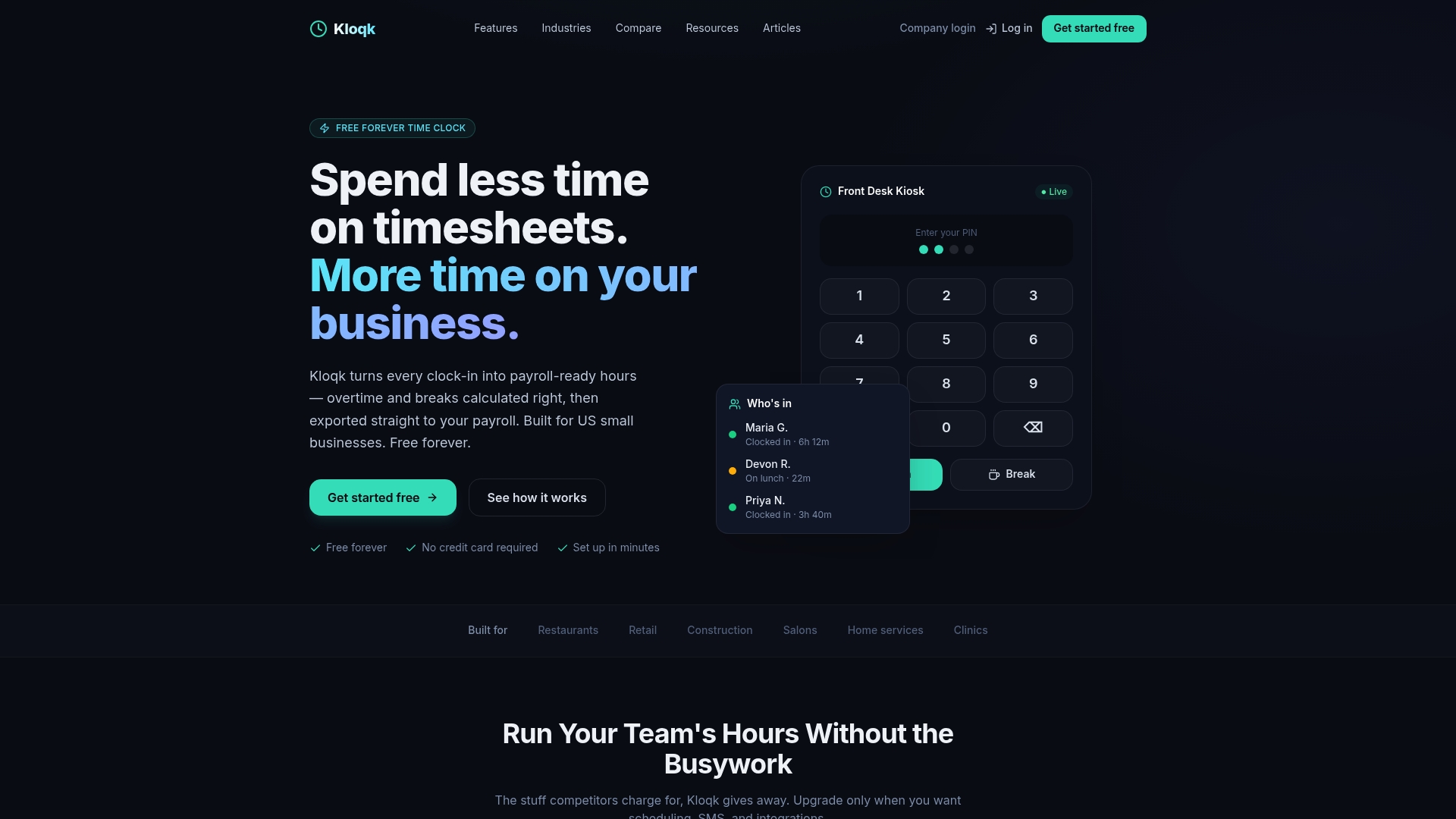
If your on-call staff are still texting you their hours, a simple time clock fixes most of the problem. Kloqk’s free time clock software turns clock-ins into payroll-ready hours, with overtime and break calculations included. Employees punch from the mobile app or a shared kiosk, and you export hours to payroll.
When you need more, the optional paid plans are Pro at $29 per month per location and Premium at $59 per month per location, with scheduling, PTO and other upgrades. You can compare them on the pricing page. For crews that work on the road, the GPS time clock page explains location-based punching, and our overtime tracking software page shows how break and overtime rules are handled by state.
FAQ
Do I still get paid if I’m on call?
It depends on how restricted you are. If you must stay on your employer’s premises, or so close that you can’t use the time for yourself, the time is generally paid. If you are free to go about your life and just need to be reachable, the waiting is generally unpaid. Any time you spend answering calls or working is always paid.
Is on-call time counted toward overtime?
Yes, when it is hours worked. Compensable on-call time and call-out time are added to your other hours in the workweek. Under the FLSA, nonexempt employees get one and one-half times their regular rate after 40 hours. A standby stipend is also part of the regular rate used to compute that overtime.
Do employers have to pay a separate standby rate?
Not under federal law for free off-premises standby, but it is a common practice and some states have their own rules. If the time is compensable, it can be paid at an agreed rate as long as that rate is at least minimum wage and the time is recorded. Check your state’s rules, since some require specific standby or call-in pay.
Is travel to a call-out paid?
Required work-related travel connected to the assignment is generally hours worked and should be recorded. Ordinary commuting before a regular shift is treated differently. Because call-outs can be a gray area, record the start and end of the trip and apply your written policy consistently.
Sources
- DOL Fact Sheet #22: Hours Worked Under the FLSA
- 29 CFR Part 785, Hours Worked (eCFR)
- 29 CFR Part 785 Subpart C, Application of Principles (eCFR)
- DOL eLaws FLSA Hours Worked Advisor
- DOL Field Operations Handbook, Chapter 31
- Texas Workforce Commission: Waiting or On-Call Time
- Tennessee CTAS: Fair Labor Standards Act (FLSA)
- California DIR: Call Back and Stand By Time
- New York Codes: On-call pay (standby)
- New York wage regulation, Unofficial Codes, Rules and Regulations
- Texas Payroll/Personnel Resource: Stand-By/On-Call Pay
- 29 C.F.R. Part 785 (Justia)
- FLSA recordkeeping summary (Legal Clarity)
Recommended
Sources
Every figure on this page traces to one of these. Primary law and government sources are listed first.
- 1. U.S. Department of Laborprimary
- 2. Electronic Code of Federal Regulationsprimary
- 3. U.S. Department of Laborprimary
- 4. California Department of Industrial Relationsprimary
- 5. efte.twc.texas.gov
- 6. ctas.tennessee.edu
- 7. regs.health.ny.gov
- 8. govt.westlaw.com
- 9. fmx.cpa.texas.gov
- 10. legalclarity.org
- 11. law.justia.com
Written by
Dana WhitfieldHR Compliance Lead
Dana writes about wage-and-hour law, FLSA overtime, and leave compliance for U.S. small businesses, translating dense regulations into plain steps owners can act on.
Keep Reading
Track Hours the Easy Way
Kloqk is a free time clock that handles punches, breaks, overtime, and payroll-ready reports.
Start free