Prevent 40 Hour Overtime Claims: U.S. Playbook for Travel Pay

Ordinary commuting is unpaid, full stop. Travel counts as paid hours worked when it’s part of an employee’s principal job duties, a special one-day out-of-town assignment, or overnight travel that overlaps normal working hours. Some states, notably California, extend that protection further, so federal rules are the floor, not the ceiling.
TL;DR:
- Employees traveling between job sites during a shift or on same-day out-of-town assignments must be paid for travel time, minus their normal commute.
- Travel during an employee’s regular work hours, including overnight trips, counts as hours worked and must be included in overtime calculations.
- Nonexempt employees who surpass 40 hours after including compensable travel should be paid overtime at their regular rate, with proper documentation of travel time.
- State-specific rules, especially in California, may require broader travel pay coverage beyond federal standards, particularly when employer-controlled transportation is involved.
- Implementing a written travel pay policy with pre-approvals, accurate timekeeping, and technology like GPS or photo verification reduces the risk of wage violations.
Table of Contents
- Which Travel Situations Trigger Travel Time Pay Rules
- How Do You Calculate Overtime When Travel Counts?
- Does California Require More Travel Pay Than Federal Law?
- Building a Travel Pay Policy That Holds Up in an Audit
- What Technology Actually Reduces Travel-Pay Errors?
- A Small Employer’s Priority List for Travel Pay
- Try Kloqk to Capture Travel Hours Without the Manual Math
- Sources
- FAQ
Which Travel Situations Trigger Travel Time Pay Rules
The federal baseline comes from the Fact Sheet #22 on hours worked under the FLSA, and it draws a sharper line than most employers expect. Three scenarios routinely get miscoded on timesheets.
- Job-site to job-site travel. If an electrician drives from one client’s building to another mid-shift, that drive time is hours worked. It’s not commuting; it’s part of the job.
- Special one-day assignments. Send an office worker who normally reports to a fixed location to a client meeting in another city, same-day return, and the travel is compensable. You may deduct the employee’s ordinary commute time from that total.
- Overnight travel. Time spent traveling during the employee’s normal working hours is paid, even on a Saturday, because the University of Illinois HR guidance on compensable travel confirms the clock doesn’t stop just because it’s a weekend.
Here’s the arithmetic that trips people up. An employee who normally commutes a certain amount of time is sent on a one-day trip requiring longer travel. You pay the total travel time minus the amount of their normal commute, not the full travel time.
Passenger travel that falls outside an employee’s regular working hours, like flying home at 9 p.m. after a 9-to-5 shift, generally isn’t compensable. Ordinary home-to-work commuting stays unpaid under the Portal-to-Portal Act commentary in 29 C.F.R. § 785, regardless of how far the employee lives from the office.
How Do You Calculate Overtime When Travel Counts?
Compensable travel hours get added to the employee’s total for the week before you check overtime thresholds. Skip this step and you’ll underpay nonexempt staff without realizing it.
- Log the travel hours separately from work hours. Tag them so payroll can see exactly what pushed the week over 40 hours.
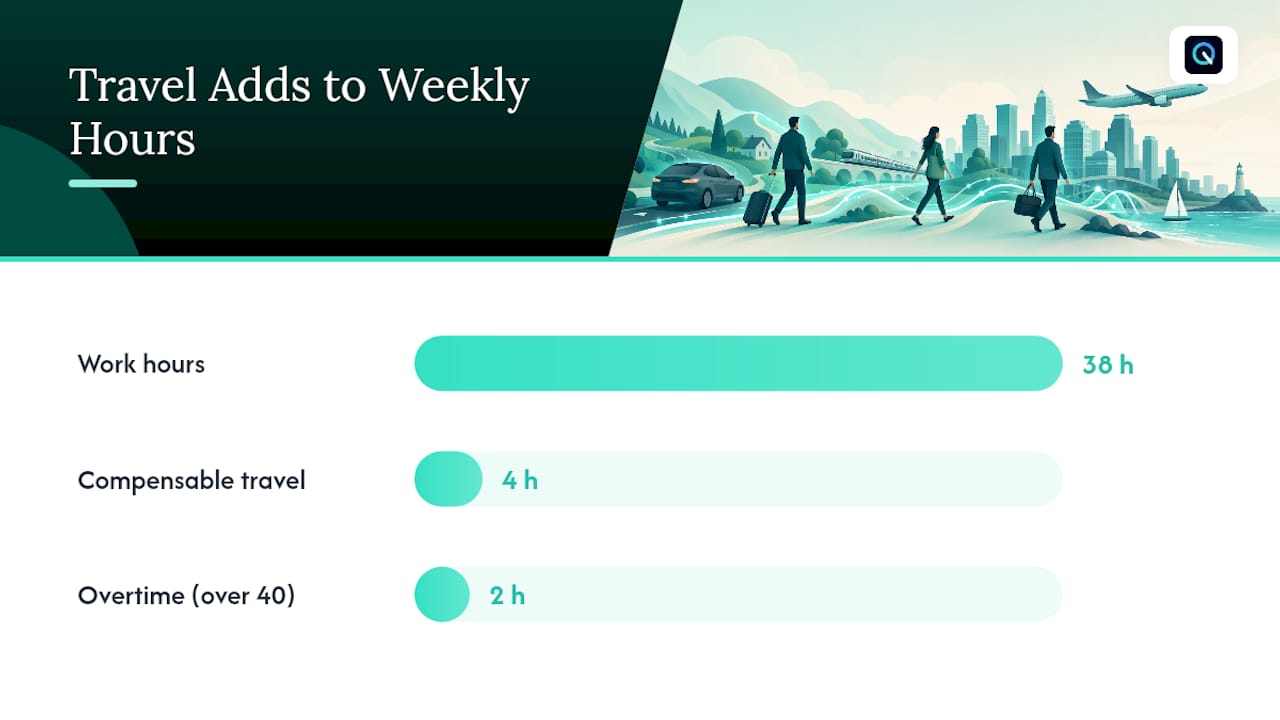
- Add compensable travel to the weekly total. A nonexempt employee who works 38 hours and logs 4 hours of compensable overnight travel is now at 42 hours, meaning 2 hours of overtime.
- Deduct the normal commute for same-day out-of-town trips, and write down how you calculated the deduction so you can reproduce it in an audit.
- Apply time-and-a-half to any hours over 40, using the employee’s regular rate, which may include certain bonuses or shift differentials depending on how they’re paid.
Salaried exempt employees generally don’t trigger overtime from travel since they’re paid a fixed salary regardless of hours, but nonexempt workers are where the exposure lives. A single unplanned overnight trip can quietly turn a 39-hour week into a 44-hour one, and the MIT HR guidance on compensating hourly employees during business travel walks through exactly this kind of day-one, day-two accounting.
Pro Tip: Run a quarterly audit pulling every timesheet with a “travel” tag and cross-checking it against payroll exports. Most missed overtime from travel gets caught only after an employee complains, not before.
Recordkeeping is what saves you in a Department of Labor audit. Keep timecards showing clock-in and clock-out at each location, timestamps for travel start and end, and written travel approvals tied to each trip. If you’re unsure how exempt classification interacts with travel pay, it’s worth reviewing how salaried employees and overtime actually work before you assume a salaried title means no travel liability at all. And if your payroll system rounds travel minutes, make sure that rounding follows the same FLSA time rounding rules you apply to regular shifts.
Does California Require More Travel Pay Than Federal Law?
Yes, in several respects. California and a handful of other states treat travel time more broadly than the FLSA does, particularly when the employer controls the transportation or the travel destination. An employee required to report to a distant job site and ride in an employer-provided van, for instance, may have that ride time counted as hours worked under state law even where federal rules might not require it.
This is where employers get burned. They build a travel-pay policy around DOL Fact Sheet #22 and the Portal-to-Portal Act, assume it covers every location they operate in, and never check whether their state labor department has stricter rules for meal periods, sleep time on multi-day trips, or employer-vehicle mandates.
Before finalizing a policy, verify:
- Your state labor department’s specific guidance on travel time (not just the federal fact sheet).
- Meal-break and sleep-time rules for overnight or multi-day travel.
- Whether employer-provided or employer-required vehicles change the compensability of ride time.
- How mileage and expense reimbursement interact with minimum wage and overtime calculations, since reimbursements aren’t the same as wages.
When state and federal rules conflict, the more protective standard wins. If you operate in multiple states, that means separate policy language per state, not one blanket national policy. When in doubt, a quick call to your state’s labor office or employment counsel costs far less than a wage claim.
Building a Travel Pay Policy That Holds Up in an Audit
A verbal understanding of “we pay for travel sometimes” is not a policy. Write down the specifics before an employee questions their paycheck, not after.
- Define what counts as compensable travel in plain language: job-site-to-job-site, same-day out-of-town assignments, and overnight trips during normal hours.
- Require pre-approval for any trip expected to generate travel pay, so there’s a paper trail before the trip happens, not a reconstruction after.
- Spell out the commute deduction method for same-day assignments and apply it consistently across every employee, every time.
- Note what happens if an employee works while traveling (answering emails on a flight, for example), since that time is generally compensable regardless of the mode of transportation.
On the timekeeping side, require clock-ins at job sites or via mobile punch, and require a short note for any out-of-town same-day trip explaining departure and return times. Retain pre-approvals, itineraries, timestamps, and payroll exports for at least the period your state’s wage claim statute allows, typically several years.
Pro Tip: If you’re piloting GPS or photo verification for travel tracking, get written consent and set a clear data retention window before you turn it on. Employees are far more comfortable with location tracking when they know exactly what’s collected and for how long it’s kept.
Written policy, consistently applied, is what the JMU HR guidance on nonexempt travel time points to as the difference between a defensible payroll process and a wage claim waiting to happen.
What Technology Actually Reduces Travel-Pay Errors?
Paper timesheets and manual math are where most travel-pay mistakes happen, not bad intentions. The fix isn’t complicated software, it’s the right handful of features applied consistently.
- GPS geofencing confirms when an employee actually arrived at a job site, which matters when job-site-to-job-site travel is the compensable event.
- Photo verification at clock-in stops buddy punching from inflating or obscuring travel-related hours.
- Automatic overtime flags catch the week a routine trip pushes a nonexempt employee past 40 hours before payroll runs, not after.
- Payroll-ready export formats cut the manual re-entry that introduces errors between the time clock and the paycheck.
A workable field workflow looks like this: pre-approve the trip, have the employee clock in at the origin and again at the destination, let the system auto-tag the gap as travel time, then export to payroll with the commute deduction already noted. Foremen and field supervisors managing crews across multiple sites face this exact problem daily, and how foremen track crew hours on the job site covers the practical side of making that handoff work in the field, not just on paper.
A Small Employer’s Priority List for Travel Pay
If you run a small crew, don’t try to solve every edge case first. Write clear travel-pay language and require pre-approval before anything else. Then get timestamps into a system that exports payroll-ready records instead of a spreadsheet you reconcile by hand. Where you can, schedule travel outside normal working hours to legitimately limit paid exposure. It won’t eliminate the liability, but it narrows it.
Saad
Try Kloqk to Capture Travel Hours Without the Manual Math
Kloqk provides core features like overtime calculations, break tracking, GPS geofencing, and photo verification to help confirm clock-in locations, with these tools available in its free plan without an employee limit.
A 30-day pilot is the fastest way to see if it fits your crew. Set up geofencing around your job sites, run it with a small group of nonexempt employees for one pay cycle, then check whether the payroll export flags travel-driven overtime correctly before you roll it out company-wide. If you need scheduling or PTO tools layered on top later, the Pro and Premium tiers add those without disrupting the free time clock you’re already running. Start by reviewing the employee time tracking features and comparing the Free, Pro, and Premium plans to see which fits your crew size right now.
Sources
- Fact Sheet #22: Hours Worked Under the Fair Labor Standards Act (FLSA) | U.S. Department of Labor
- 29 C.F.R. § 785 Travel time (Portal-to-Portal Act commentary) | eCFR
- Travel and compensable time guidance University of Illinois HR page
- Hourly employees: compensation during business travel MIT HR
This article is general information, not a substitute for advice from a qualified lawyer. Consult a qualified legal professional about your own circumstances before acting on anything here.
FAQ
Is Commuting to Work Considered Paid Travel Time?
No. Ordinary home-to-work commuting is not compensable under the Portal-to-Portal Act, regardless of commute length. This holds whether the employee reports to one fixed site or different locations day to day.
Do You Have to Pay for Travel on a Same-Day Out-of-Town Trip?
Yes, but you may deduct the employee’s normal commute time from the total travel time, according to DOL Fact Sheet #22. Document the deduction method and apply it the same way for every trip.
Does Overnight Travel Count as Hours Worked?
It counts when the travel falls within the employee’s normal working hours, even on a weekend, per University of Illinois HR guidance. Passenger travel outside those normal hours generally isn’t compensable.
Can State Law Require More Travel Pay Than Federal Rules?
Yes. States like California can require pay for employer-controlled travel that federal law wouldn’t necessarily cover, so check your state labor department’s guidance before finalizing policy.
Does Kloqk Track Travel Time for Payroll?
Kloqk’s free plan includes GPS geofencing and mobile clock-ins that tag job-site arrivals, plus payroll-ready exports and automatic overtime flags. Pricing details for the Pro and Premium upgrade tiers are listed on the Kloqk pricing page.
Recommended
Sources
Every figure on this page traces to one of these. Primary law and government sources are listed first.
- 1. U.S. Department of Laborprimary
- 2. Electronic Code of Federal Regulationsprimary
- 3. answers.uillinois.edu
- 4. hr.mit.edu
- 5. jmu.edu
- 6. blog.subascent.com
Written by
Dana WhitfieldHR Compliance Lead
Dana writes about wage-and-hour law, FLSA overtime, and leave compliance for U.S. small businesses, translating dense regulations into plain steps owners can act on.
Keep Reading
Track Hours the Easy Way
Kloqk is a free time clock that handles punches, breaks, overtime, and payroll-ready reports.
Start free