Stop 40-Hour Overtime: Shift Swap Policy and 4-Step Rollout for HR

A shift swap policy is a written rule set that governs when and how employees trade scheduled shifts. The single rule that matters most: no swap is valid until a manager approves it, confirms both employees are qualified for the role, and the exchange gets logged in writing. Groups like the Georgetown University HR policy office and standards under the FLSA back this exact structure, and scheduling tools exist to enforce it automatically.
TL;DR:
- Managers must approve and log every shift swap to prevent unqualified staff working, overtime issues, and scheduling disputes.
- Swap eligibility should be role-specific with clear notice periods and approval workflows to ensure proper oversight and accountability.
- Enforcing software must require electronic confirmation from both employees and manager approval before shifts change hands automatically.
- Records of swap requests and approvals should be stored for at least two to three years, with regular audits to identify overuse or compliance issues.
- Small businesses benefit from automation tools that tie swap verification directly into payroll and time tracking, reducing manual oversight and errors.
Table of Contents
- What Is a Shift Swap and When Do Employees Use One?
- Why You Need a Written Shift Swap Policy
- The Core Components Every Shift Swap Policy Needs
- How to Roll Out a Shift Swap Policy in Four Steps
- Best Practices and Tools for Low-Friction Shift Swaps
- Legal and Compliance Flags to Check Before You Publish
- Keeping Records Straight: Audits, Retention, and No-Shows
- Balancing Flexibility With Operational Risk
- Put Your Shift Swap Rules on Autopilot With Kloqk
- Sources
- FAQ
What Is a Shift Swap and When Do Employees Use One?
A shift swap happens when one employee trades an assigned shift with a coworker, and both people work a shift that wasn’t originally theirs. It’s different from a manager-assigned schedule change, where the business, not the employee, initiates the adjustment. A shift swap is voluntary and employee-driven; a reassignment is not.
Real-world triggers tend to fall into a short list:
- A sick kid, a doctor’s appointment, or a family emergency that comes up with almost no warning
- Two coworkers agreeing to trade weekends so one can attend a wedding
- A scheduling conflict with a second job or school commitment
- Someone picking up an extra shift purely for the additional pay
Done right, swaps give employees real flexibility without costing the business coverage. Done wrong, they create unqualified staff on the floor, unplanned overtime, and a manager who finds out about the trade after the shift already happened.
Why You Need a Written Shift Swap Policy
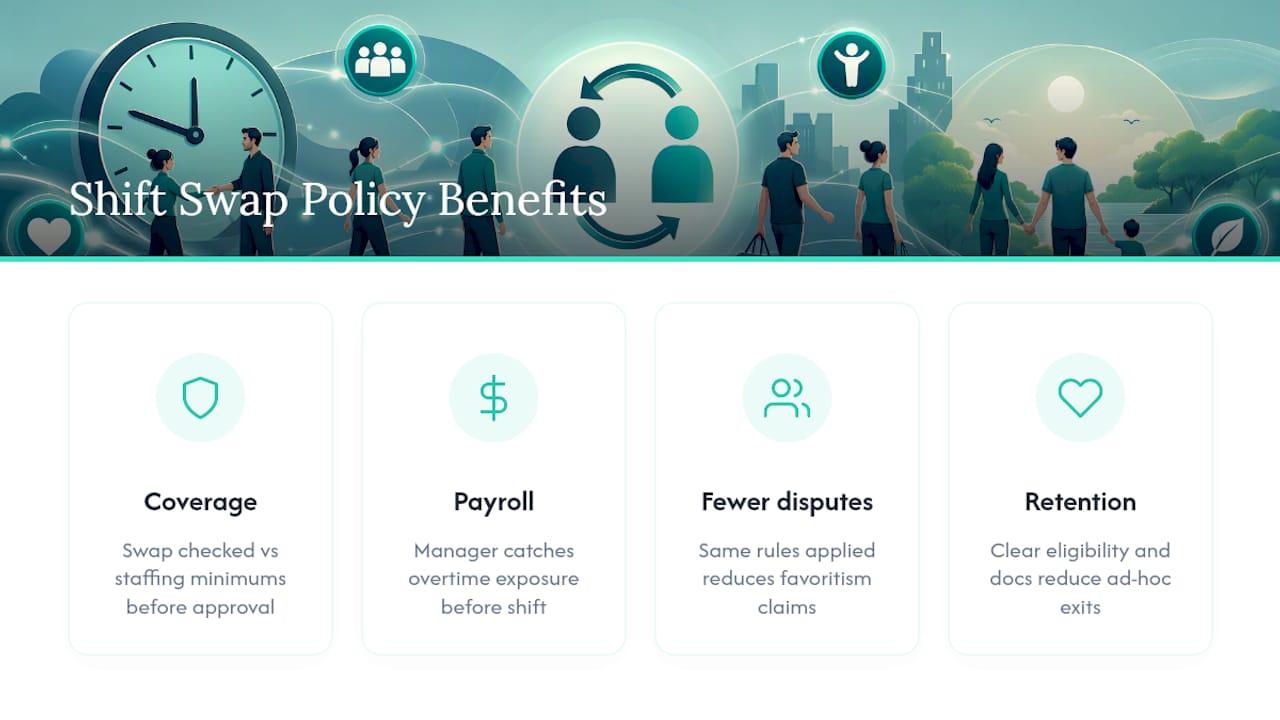
Without written rules, swaps happen by text message and group chat, and nobody outside those two employees knows the shift changed hands until a customer complaint or a payroll error surfaces it. A documented policy fixes four problems at once.
It protects coverage, because every swap gets checked against staffing minimums before it’s approved rather than after. It protects payroll, because a manager can catch overtime exposure before the shift happens instead of during a pay period reconciliation. It cuts down on disputes, since employees can see the same rules applied the same way every time, which matters more than most managers realize when it comes to perceptions of favoritism. And it helps retention: structured swap policies with clear eligibility, approval, and documentation reduce ad-hoc scheduling and disputes, which keeps hourly staff from quietly job-hunting after one too many unfair schedule fights.
The Core Components Every Shift Swap Policy Needs
An enforceable policy needs specific, checkable rules, not vague language about “reasonable” swaps. Here’s what belongs in the handbook.
- Scope. State which roles, locations, and employment types the policy covers, and whether it applies to full-time, part-time, and seasonal staff equally.
- Eligibility and swap groups. Define who can cover whom using concrete job titles and certifications, not phrases like “similarly qualified.” A line cook can’t cover a certified forklift operator, and the policy should say so explicitly.
- Notice periods. Require a minimum request window, commonly somewhere between 24 and 72 hours for routine swaps, with a separate emergency path for same-day situations.
- Approval workflow. Name who approves swaps, what the manager’s response deadline is, and what happens if no one responds in time (a default deny is safer than a default approval).
- Documentation. Specify what gets recorded, where it’s stored, and for how long. Under LegalClarity’s guidance, approved swaps must be logged before they take effect, and until that approval lands, both employees stay responsible for their original shift.
- Overtime and rest-period impact. State that no swap can push an employee over overtime thresholds or violate required rest periods without manager sign-off on the cost.
- Cancellations and no-shows. Cover what happens if the covering employee backs out, and who’s on the hook if nobody shows up.
- Accommodation and legal interplay. Note that accommodation requests under the ADA or fair workweek notice rules may override standard swap timing.
Pro Tip: Build your swap-group list as an actual table of job titles and required certifications, not a sentence of prose. It’s the single fastest way to end “I thought I was qualified to cover that” disputes.
For a starting template you can adapt, the employee shift schedule template gives you a working structure to layer swap documentation into.
How to Roll Out a Shift Swap Policy in Four Steps
Publishing a policy on day one without testing it is how HR teams end up rewriting the handbook three months later. A phased rollout catches problems while they’re still small.
- Draft using the checklist above. Set your notice window and eligibility rules based on how your business actually staffs shifts, not a generic template.
- Pilot with one team for two to four weeks. Track how often swaps get requested, how long managers take to approve them, and how many result in no-shows. Piloting with a single team surfaces edge cases fast, like a role that has far more last-minute swap requests than you expected.
- Train managers and publish the policy company-wide. Walk through real examples in a short Q&A session, since managers who don’t understand the auto-deny logic will approve exceptions anyway.
- Configure your scheduling and time-tracking software to enforce it. Set the system to require both-party confirmation and manager sign-off before a swap is active, and to log every change automatically.
Once it’s live, audit the results after 60 to 90 days. Look at approval turnaround time, overtime incidents tied to swaps, and any team where you’re seeing repeated exceptions to the eligibility rules. Update the language and rerun the pilot in any location where the numbers look off.
Best Practices and Tools for Low-Friction Shift Swaps
The policy on paper only works if the system enforcing it doesn’t have gaps. A few configuration choices make the difference between a policy that runs itself and one that needs a manager babysitting every request.
- Require both employees to confirm the swap electronically, and require manager approval before it’s active, not after.
- Build swap groups by role and certification inside your scheduling software so the system physically can’t match an unqualified employee to a shift.
- Set auto-deny rules for any swap that would push someone into overtime or violate a required rest period, so a tired manager approving requests at 11 PM doesn’t miss it.
- Tie every approved swap to an audit trail that flows straight into payroll, so hours get paid to the person who actually worked them.
That last point isn’t a minor detail. Self-service scheduling tools can drive meaningfully higher retention among younger hourly staff, largely because employees get flexibility without waiting on a manager to manually rework the schedule. The 40-hour overtime baseline is worth reviewing alongside your swap rules, since overtime miscalculations are the single most common payroll error tied to unmanaged swaps.
Legal and Compliance Flags to Check Before You Publish
A shift swap policy touches employment law in more places than most HR teams expect, and a few of them carry real payroll consequences.
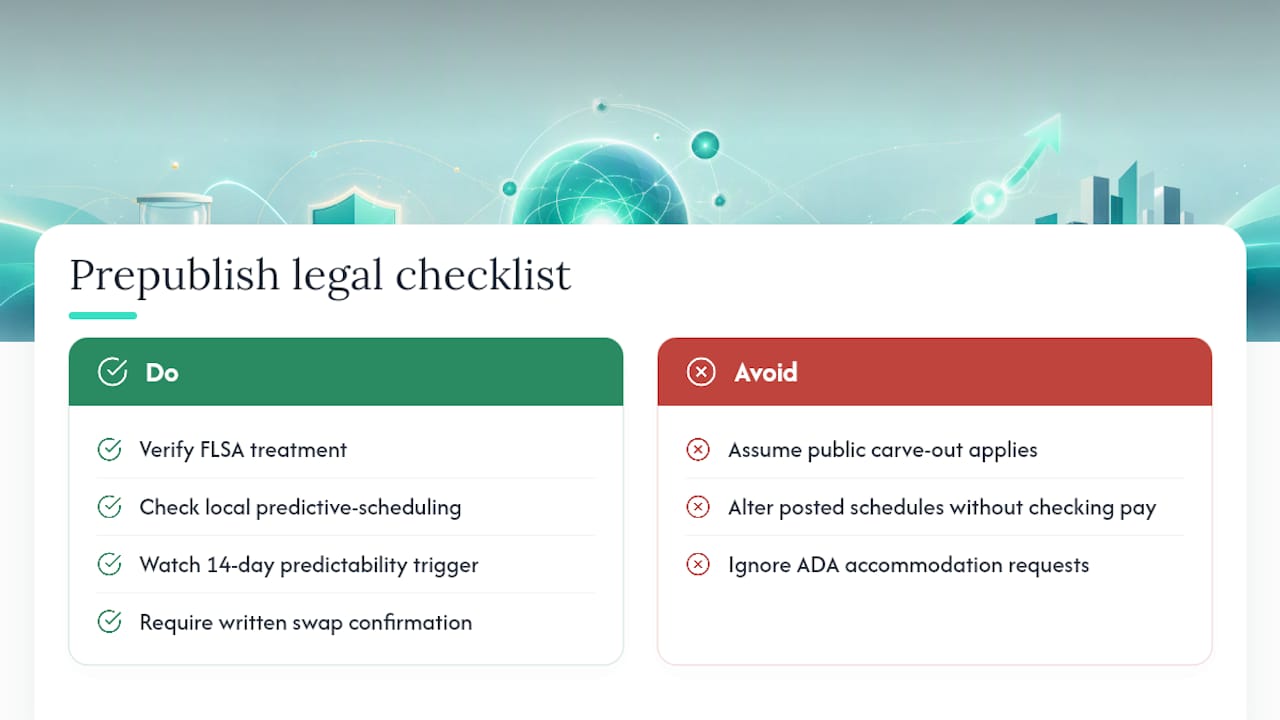
The FLSA treats swaps differently depending on employer type. Public agencies can use section 7(p)(3) to treat voluntary substitutions differently for overtime calculations, but private-sector employers don’t get that carve-out. Every swapped hour still counts toward the standard overtime threshold.
Predictive scheduling laws, sometimes called fair workweek ordinances, exist in a handful of U.S. jurisdictions. Where they apply, employers who change a posted schedule with too little notice can owe predictability pay, typically triggered by posted schedules under 14 days out. Voluntary employee-initiated swaps are usually treated differently than employer-driven changes, but the exact treatment depends on the specific ordinance, so verify it locally.
Reasonable accommodation obligations under the ADA can override standard swap timing when an employee’s request ties to a documented medical or religious need. And regardless of jurisdiction, require written confirmation of every voluntary swap. It’s the cheapest insurance against a wage dispute months later.
Keeping Records Straight: Audits, Retention, and No-Shows
Approvals mean nothing if nobody can find them later. Store every swap request and approval in one system, tied to the shift date and both employees’ names, and keep records for at least the period your state requires for wage and hour documentation, generally two to three years.
- Have managers review swap logs weekly, watching specifically for overtime risk and any employee getting repeated exceptions to eligibility rules.
- Set a clear consequence for an employee who was approved to cover a shift and doesn’t show. A documented no-show should trigger the same disciplinary process as missing an originally assigned shift.
- Reconcile payroll against actual swap records before each pay run, not after, so hours land with the person who worked them.
If discrepancies keep showing up between scheduled and worked hours, the time clock discrepancy review guide walks through how to trace the gap back to its source.
Balancing Flexibility With Operational Risk
Most HR teams overcorrect in one direction. Either they lock swaps down so tightly that employees stop bothering to request them and just call out instead, or they leave the process loose enough that unqualified staff end up covering specialized shifts. Neither extreme protects the business.
The right call depends on scale. A five-person clinic can centralize every approval through one office manager without creating a bottleneck. A 40-location restaurant group can’t, and needs delegated approval authority at the store level with software enforcing the guardrails centrally. Small businesses in particular benefit from tools that automate the checking, since owners rarely have a dedicated HR staffer reviewing every swap request by hand, and time tracking software exists to close that gap without adding headcount.
Saad
Put Your Shift Swap Rules on Autopilot With Kloqk
Writing the policy is half the work. Enforcing it every single pay period, without a manager manually cross-checking every trade, is the other half. Some scheduling software is built to handle exactly that gap for small teams that can’t justify a dedicated scheduling department.
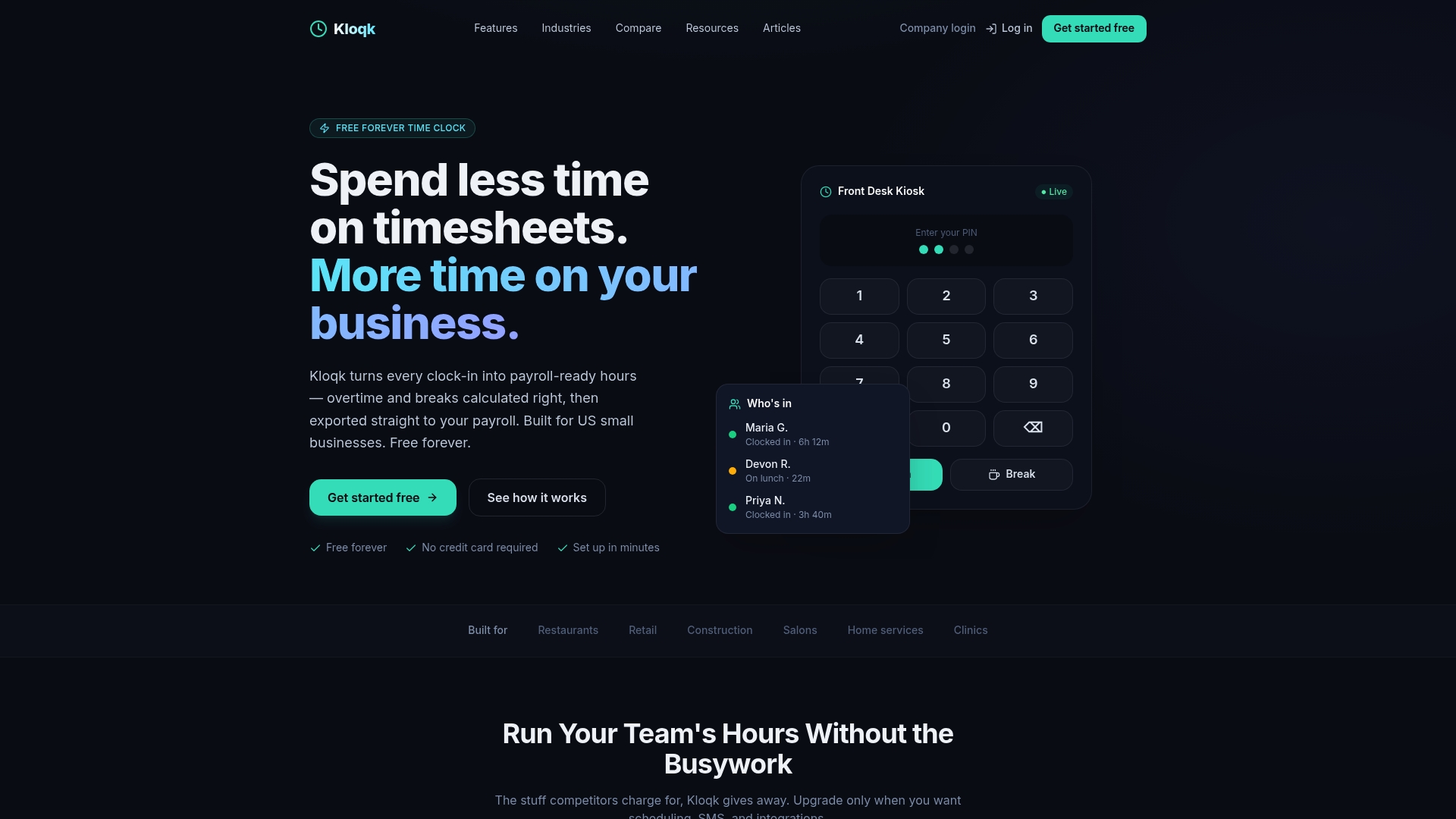
Once your swap policy is written, Kloqk lets you configure the system to require manager sign-off before any swap becomes active, and it keeps a timestamped audit trail of every approval tied directly to payroll. Overtime calculations run automatically, so a swap that would push someone past 40 hours gets flagged before it happens instead of during payroll reconciliation. Photo verification and GPS geofencing confirm the right person actually clocked in for the covered shift, which matters when two employees have traded places on paper but the schedule still needs a real accountability check. All of this runs on the free tier. Set up your free time tracking account and connect it to your existing schedule to see how approvals and payroll exports line up on your very next pay run.
Sources
- Shift Swap Policy Example: Rules and Requirements, LegalClarity
- Employee Schedule Changes: Laws, Notice, and Policy | FirstHR
- 801: Work day and work shift changes | Georgetown University
- Non-Desk Employee Shift Change Best Practices | Yourco
FAQ
Are Employees Allowed to Swap Shifts?
Yes, in most workplaces, as long as the swap follows the written policy: manager approval, role/qualification match, and documented confirmation before the swap takes effect.
How Do You Refuse a Shift Swap Request?
A manager can deny a swap if the covering employee isn’t qualified for the role, the trade would create overtime or a rest-period violation, or the request misses the required notice window; the denial reason should be documented.
How Much Notice Does an Employer Have to Give to Change a Shift?
It depends on jurisdiction. In areas with predictive scheduling laws, employers typically must post schedules 14 days ahead and pay predictability pay for late changes, while other locations have no statutory minimum beyond general labor standards.
Does a Manager Have to Approve a Shift Swap?
Yes. A swap should never be considered final until a manager confirms eligibility and coverage and logs the approval; swaps recorded before taking effect protect both the business and the employees involved.
Recommended
Sources
Every figure on this page traces to one of these. Primary law and government sources are listed first.
Written by
Dana WhitfieldHR Compliance Lead
Dana writes about wage-and-hour law, FLSA overtime, and leave compliance for U.S. small businesses, translating dense regulations into plain steps owners can act on.
Keep Reading
Track Hours the Easy Way
Kloqk is a free time clock that handles punches, breaks, overtime, and payroll-ready reports.
Start free