Restaurant Overtime Rules Owners & Managers Can Fix to Avoid Back Pay

For U.S. restaurants, nonexempt employees must receive 1.5 times their regular rate for hours worked over 40 in a workweek, with special rules for tipped staff and state level variations that can raise the bar higher. If your state or city sets a stricter standard, that standard controls, not the federal minimum. When you suspect a payroll error, stop, pull the timecards, and recalculate before you run another cycle.
TL;DR:
- Many states and cities impose stricter overtime rules, such as daily overtime after 8 hours in a single day, requiring compliance beyond federal minimum standards.
- Correct calculation of the regular rate must include nondiscretionary bonuses, shift differentials, and tips, especially when claiming tip credits or handling multiple pay rates.
- Employers must keep detailed records of hours, tips, and wage components for at least two to three years to defend against wage claims and audits.
- Misclassifying managers, omitting nondiscretionary bonuses, treating service charges as tips, or making illegal deductions are common payroll mistakes that trigger overtime disputes.
- Part-time and split-shift workers accrue overtime like full-timers, and tracking total hours across shifts or locations prevents miscalculations and ensures proper pay.
Table of Contents
- Federal overtime rules: how the FLSA calculates your pay
- Tipped employees and the tip credit: getting the math right
- Exempt versus nonexempt: who actually qualifies for a salary
- State and local rules that override the federal floor
- Recordkeeping and timekeeping that hold up under scrutiny
- The payroll mistakes that trigger overtime claims
- Why precise time tracking protects your payroll
- Overtime for part-time and split-shift restaurant workers
- Calculating overtime for employees working multiple roles
- On-call time and travel time: what counts toward overtime
- How union contracts can change overtime calculations
- Penalties for getting overtime wrong
- A manager’s quick triage when you suspect a payroll mistake
- Try a time clock built for overtime accuracy
- Sources
- FAQ
Federal overtime rules: how the FLSA calculates your pay
The Fair Labor Standards Act sets the baseline every restaurant in the country has to meet. A workweek is any fixed, recurring period of 168 hours, seven consecutive 24 hour periods, and it does not have to match the calendar week. Overtime applies once a nonexempt employee crosses 40 hours worked in that single workweek, regardless of hourly rate, shift pattern, or pay period length.
The regular rate is not simply the hourly wage. It is total straight-time earnings divided by total hours worked in the workweek, and it must include most forms of pay tied to hours or performance.
- Add up all straight-time earnings for the week, including hourly wages, nondiscretionary bonuses, and shift differentials.
- Divide that total by hours actually worked to get the regular rate.
- Multiply the regular rate by 0.5 for each overtime hour, then add that premium to straight-time pay already earned for those hours.
Say a line cook works 45 hours at $16 per hour with no bonus that week. Straight-time pay is $720. The regular rate is $16. The overtime premium is $8 per hour for the five overtime hours, or $40, for a total weekly paycheck of $760.
The federal overtime premium is a half-time premium added on top of straight-time pay for hours worked over 40 in a workweek, according to the Department of Labor. That premium calculation is the one restaurants get wrong most often when bonuses or multiple pay rates enter the picture, a point covered in more depth in this step-by-step overtime calculation guide.

Tipped employees and the tip credit: getting the math right
Tip credit changes the regular rate calculation, which is often where payroll mistakes occur. Under federal law, employers may pay a lower direct cash wage and claim a tip credit toward the federal minimum wage, according to Fact Sheet #15. The regular rate for overtime purposes is still based on the full minimum wage, not the reduced cash wage, so the tip credit itself does not shrink overtime pay.
- Calculate the regular rate using the full applicable minimum wage, not the direct cash wage paid.
- Multiply the regular rate by 1.5 to get the full overtime rate.
- Subtract the same tip credit amount from that overtime rate to find what you owe directly.
- Pay the difference in cash wages; tips still cover the credited portion.
Worked examples using this method appear on the elaws overtime calculator for tipped employees, which uses the $7.25 federal minimum wage as its baseline.
| Item | Federal amount |
|---|---|
| Federal minimum wage | $7.25 per hour |
| Minimum direct cash wage | the federally mandated minimum direct cash wage for tipped employees |
| Maximum tip credit | the federally allowed maximum tip credit per hour |
| Overtime rate before credit | $10.88 per hour |
| Overtime rate owed directly | the difference between the overtime rate and the tip credit, reflecting what the employer must pay in cash wages |
Compulsory service charges, the automatic 18% or 20% added to large parties, are not tips under federal law and must be folded into the regular rate rather than treated as gratuities. Employers claiming a tip credit must also keep records showing the amount of tips each employee received and the credit amount claimed for every workweek, a requirement detailed further in Fact Sheet #15.
Exempt versus nonexempt: who actually qualifies for a salary
Salaried restaurant managers are not automatically exempt from overtime. Exemption under the executive, administrative, or professional (EAP) categories requires passing three separate tests, and missing any one of them means the employee is owed overtime regardless of title.
- Salary basis test: the employee receives a predetermined, fixed salary that does not fluctuate based on hours or quality of work.
- Salary level test: the DOL currently applies the 2019 salary-level threshold of $684 per week while litigation over newer rules continues, according to the Department of Labor.
- Primary duties test: the employee’s main job function must genuinely involve management, independent judgment, or specialized professional work, not routine line duties.
- Highly compensated employee threshold: a shortened duties test applies at $107,432 per year under the same 2019 methodology.
The most common failure point in restaurants is a “manager” who spends most of a shift cooking, running food, or working the register alongside hourly staff. When line duties dominate the workweek, the primary duties test usually fails, and the exemption does not hold no matter what the salary looks like. The complete guide to FLSA overtime rules walks through duties-test scenarios in more detail.
State and local rules that override the federal floor
Federal law sets a floor, not a ceiling. When a state or city imposes a stricter standard, that stricter standard controls, and restaurants operating in multiple jurisdictions need to track each one separately.
- California requires daily overtime after 8 hours in a single day, not just after 40 in a week, along with split-shift pay and specific meal and rest break timing rules.
- Several states set minimum wages well above the federal $7.25 floor, which changes the tip credit math even when the employer still claims a credit.
- Some cities layer on predictive scheduling or premium pay rules on top of state law, adding another compliance layer for multi-location operators.
State labor departments generally require compliance with whichever rule, federal, state, or local, benefits the employee most, and the Department of Labor’s summary of state rest-period and meal rules is a useful starting point for checking variations before you assume federal rules are enough.
Pro Tip: Build a one-page compliance matrix for each operating location listing minimum wage, tip credit limit, daily overtime threshold, and meal/rest rules, and check it before every payroll run.
Recordkeeping and timekeeping that hold up under scrutiny
Good records are your best defense in a wage claim or audit, and federal law is specific about what to keep and for how long. Under Fact Sheet #21, employers must retain payroll records for three years and records used to compute wages, such as timecards and work schedules, for two years.
- Keep timecards, schedules, and wage computation worksheets for at least two years, and payroll summaries for three.
- Record the amount of tips reported and the tip credit claimed for every tipped employee, every workweek.
- Use time clocks with exception reporting so missed punches and edited entries get flagged instead of buried.
- Reconcile hours at the end of each pay period rather than waiting for a complaint to surface an error.
Pro Tip: Photo verification and GPS geofencing can create timestamped records that are far harder to dispute than a handwritten timesheet if a Wage and Hour Division investigator asks for proof.
The payroll mistakes that trigger overtime claims
Most restaurant overtime disputes trace back to a handful of repeat offenders, and each one has a straightforward fix.
- Misclassifying managers as exempt without confirming they pass the duties and salary tests, an issue best caught by a duties audit before you set the title.
- Leaving nondiscretionary bonuses out of the regular rate. WHD opinion letters such as FLSA2026-2 confirm that bonuses tied to attendance, performance, or retention must be folded into the regular rate before overtime is calculated.
- Treating service charges as tips, which understates the regular rate and shortchanges the overtime premium.
- Making illegal deductions, such as charging servers for walkouts or till shortages in a way that drops effective pay below minimum wage or cuts into overtime owed.
Fixing these four issues before your next audit or complaint is far cheaper than fixing them after one, a theme explored further in why accurate hours matter for payroll.
Why precise time tracking protects your payroll
Wage claims usually start with a hole in the record, not a dispute over the law itself. Kloqk’s free plan generates payroll-ready timesheets with overtime and break calculations built in, so the math described above happens automatically instead of on a spreadsheet at 11 PM on a Sunday.
- Photo verification confirms who actually clocked in, closing a common gap in buddy-punching disputes.
- GPS geofencing flags clock-ins outside the restaurant’s location, supporting hours-worked records if a claim is ever filed.
- Payroll-ready exports line up directly with the wage computation records Fact Sheet #21 expects employers to retain.
These features map directly onto what a Wage and Hour Division investigator asks for first: accurate hours, accurate rates, and a clean paper trail.
Overtime for part-time and split-shift restaurant workers
Part-time status has no bearing on overtime eligibility. A nonexempt part-time server who happens to pick up extra shifts and crosses 40 hours in a single workweek is owed the same 1.5 times premium as a full-time line cook, regardless of how the schedule was originally set up. Restaurants that treat part-timers as automatically safe from overtime because of their usual schedule are the ones most likely to get caught off guard during a busy holiday week or when covering for a sick coworker.
Split shifts, common in restaurants running a lunch and dinner service with a gap in between, do not change the overtime calculation itself, but they do interact with state rules in ways owners often miss. California, for example, requires an extra hour of pay at the minimum wage when a split shift schedule is used, on top of any overtime owed for hours worked past the daily or weekly threshold. Even where no split-shift premium applies, every hour on both ends of the split still counts toward the 40 hour weekly overtime threshold and, in daily-overtime states, toward the daily threshold as well.
The practical fix is to track total hours across both shift segments in the same timekeeping system rather than treating the lunch and dinner shifts as separate events. A time clock that aggregates punches automatically, rather than relying on a manager to add up two separate handwritten entries, removes the most common source of split-shift miscalculation.
Calculating overtime for employees working multiple roles
Servers who also bartend, or line cooks who pick up prep shifts, are common in restaurants, and the FLSA treats all of it as one job for overtime purposes as long as it is the same employer. All hours worked across different roles or duties within the same restaurant get combined into a single weekly total, and overtime applies once that combined total passes 40 hours, even if no single role on its own would have triggered it.
When an employee works at two different pay rates in the same workweek, such as a lower rate for prep work and a higher rate for serving, the regular rate becomes a weighted average. Add total earnings from all roles together, divide by total hours worked in all roles, and use that blended regular rate to calculate the overtime premium, unless the employer and employee agreed in advance to a different, FLSA-compliant method for multi-rate overtime.

Joint-employment and common-ownership arrangements complicate this further. When a restaurant group operates multiple locations under shared ownership or staffing, hours worked across related establishments in the same workweek may need to be aggregated for a single employee, even if each location runs its own schedule. Owners with multiple locations under one legal entity or a shared staffing pool should treat this as a standing payroll check rather than an occasional one.
On-call time and travel time: what counts toward overtime
Whether on-call time counts as hours worked depends on how much freedom the employee has during that time. An employee required to stay on the restaurant’s premises, or one whose movements are so restricted that the time is not genuinely their own, is generally considered to be working, and that time counts toward the 40 hour overtime threshold. An employee who is simply told to keep a phone on and can otherwise go about normal activities is typically not working during that on-call period.
Travel time follows a similar principle. A normal commute from home to the restaurant is not compensable, but travel between job sites during the same workday, such as a manager driving from one restaurant location to another to cover a shift, generally is. That travel time counts as hours worked and factors into the weekly overtime calculation the same way any other work time does.
Restaurants that rely on floating staff between locations should track travel time between sites separately from the commute, since misclassifying compensable inter-location travel as an ordinary commute is a quiet but recurring source of underpaid overtime.
How union contracts can change overtime calculations
Collective bargaining agreements can modify certain overtime provisions, but they cannot waive the core federal floor set by the FLSA. A union contract might establish daily overtime after 8 hours instead of relying solely on the 40 hour weekly threshold, or it might set a higher overtime multiplier than the federal 1.5 times minimum, both of which are permitted because they exceed the federal standard rather than fall short of it.
Where union agreements get restaurants into trouble is when a provision is read as replacing a federal requirement rather than adding to it. A contract cannot, for instance, redefine the regular rate to exclude nondiscretionary bonuses, or set a lower overtime multiplier than federal law requires, even with union agreement, because the FLSA sets a floor that private contracts cannot go beneath. Restaurants operating under a union contract should have the agreement reviewed against current FLSA and state requirements periodically, since state minimum wage or overtime thresholds can shift without a corresponding update to older contract language.
Penalties for getting overtime wrong
Overtime violations carry real financial exposure, and the consequences compound the longer an error goes unnoticed. An employer found to have violated FLSA overtime provisions is generally liable for back wages covering the unpaid overtime, and courts frequently award liquidated damages equal to that same back-pay amount, effectively doubling the liability for each affected employee across the violation period.
Willful violations extend the statute of limitations further and can trigger civil penalties on top of back pay, particularly when a Wage and Hour Division investigation finds a pattern rather than an isolated mistake. Repeat or willful violations can also draw additional scrutiny to other locations under the same ownership, since investigators often expand a single complaint into a broader review once they find a systemic issue like unrecorded overtime or a misapplied tip credit.
Beyond the direct financial cost, wage claims tend to surface publicly through court filings or Department of Labor press releases, which can affect hiring and reputation in a local market long after the case itself is resolved. The cheapest fix is almost always the one applied before a complaint is filed, not after.
A manager’s quick triage when you suspect a payroll mistake
When I find a potential overtime error, I stop running new payroll immediately, pull the affected timecards, and recalculate by hand using the actual regular rate. I loop in whoever handles payroll or legal counsel before making any correction, and I tell affected staff plainly that pay is being reviewed rather than letting rumors fill the gap.
Saad
Try a time clock built for overtime accuracy
Restaurant payroll gets complicated fast once tip credits, split shifts, and multiple pay rates enter the picture, and most time clock software charges extra for the exact features that keep you compliant.
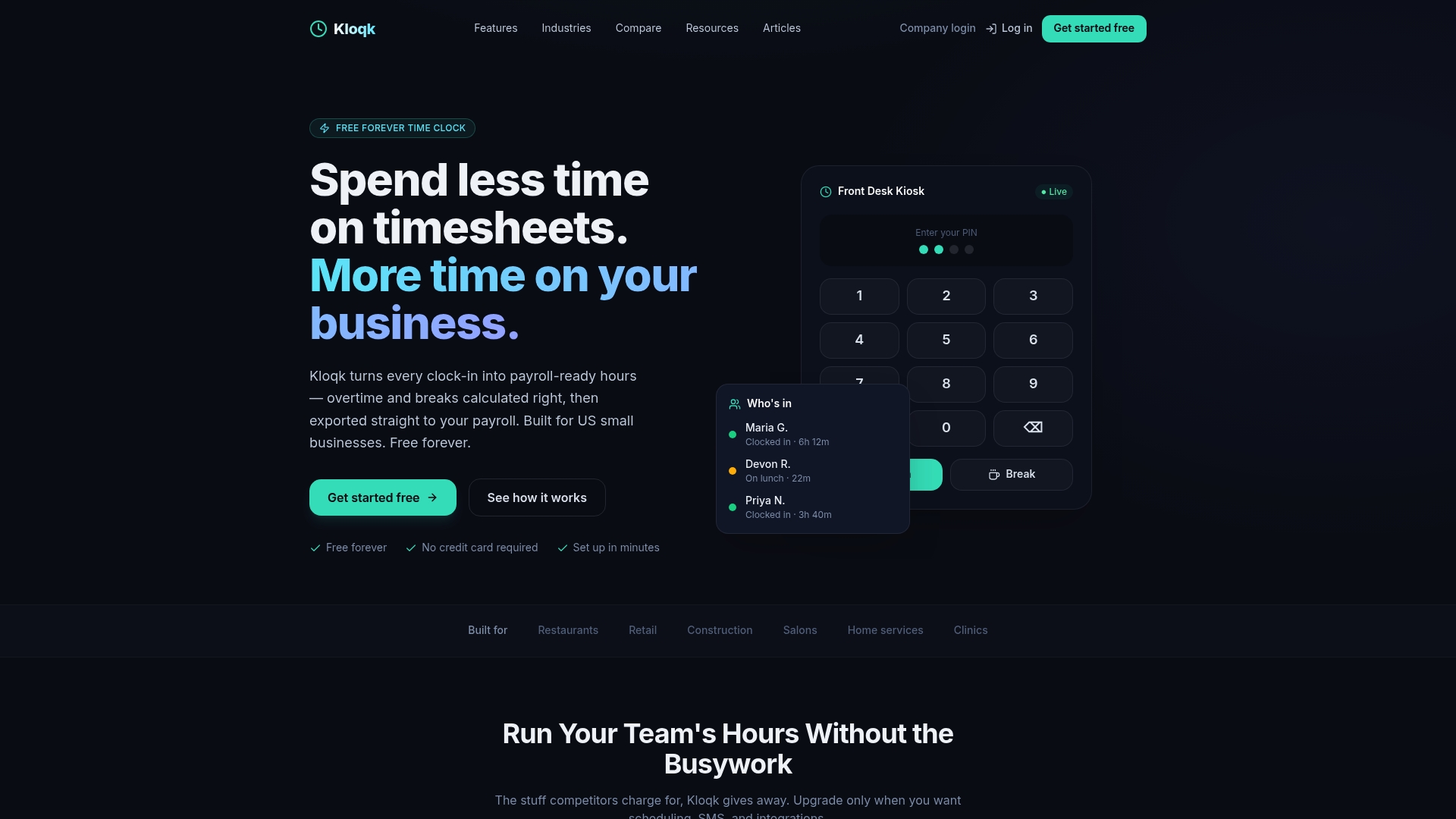
There are free time clock plans that include overtime calculations, break tracking, and payroll-ready exports at no cost, features that competitors typically put behind a paywall. Before adopting any time clock, check whether it actually calculates the regular rate correctly for tipped and multi-rate employees, not just total hours.
- Overtime and break calculations are built into every timesheet, matching the regular rate math covered above.
- Photo verification and GPS geofencing cut down on buddy punching and off-site clock-ins.
- Payroll-ready exports line up with the wage records Fact Sheet #21 expects employers to keep on file.
| Plan | Price | Best for |
|---|---|---|
| Free | No published price | Restaurants that need overtime-safe time tracking without a subscription |
| Pro | $29 per month per location | Locations that also need scheduling and PTO tracking |
| Premium | $59 per month per location | Multi-feature operations needing integrations and onboarding tools |
Some free tier time clock apps offer unlimited employees, whereas many competing time clock apps charge extra to remove user limits. Check the full feature list or compare plans on the pricing page to see what fits your location.
This article is general information, not a substitute for advice from a qualified lawyer. Consult a qualified legal professional about your own circumstances before acting on anything here.
Sources
- elaws Overtime calculation examples for tipped employees
- U.S. Department of Labor guidance on overtime rule status
FAQ
How does overtime work in the restaurant industry?
Nonexempt restaurant employees earn 1.5 times their regular rate for every hour worked past 40 in a single workweek, and the regular rate includes cash wages, tip credit value, and nondiscretionary bonuses. Tipped employees follow the same 40 hour threshold, but the calculation accounts for the tip credit claimed against the minimum wage.
What is the new overtime rule for 2026?
The Department of Labor currently applies the 2019 salary-level standard of $684 per week for the EAP exemption while litigation over more recent rulemaking continues, according to the Department of Labor. There is no separate new federal overtime rate rule for tipped or hourly restaurant staff beyond the standard 1.5 times premium after 40 hours.
Is it federal law to get paid overtime after 40 hours?
Yes, the Fair Labor Standards Act requires nonexempt employees to receive 1.5 times their regular rate for hours worked over 40 in a workweek. States and cities can set stricter rules, such as daily overtime, but they cannot fall below this federal floor.
What is the new OT rule?
As of now, the DOL applies the 2019 EAP salary threshold of $684 per week rather than a newer standard, since litigation over more recent rulemaking is ongoing, per the Department of Labor. Restaurants should keep checking DOL guidance directly rather than assuming a higher threshold applies until the litigation resolves.
Recommended
Sources
Every figure on this page traces to one of these. Primary law and government sources are listed first.
- 1. U.S. Department of Laborprimary
- 2. U.S. Department of Laborprimary
Written by
Dana WhitfieldHR Compliance Lead
Dana writes about wage-and-hour law, FLSA overtime, and leave compliance for U.S. small businesses, translating dense regulations into plain steps owners can act on.
Keep Reading
Track Hours the Easy Way
Kloqk is a free time clock that handles punches, breaks, overtime, and payroll-ready reports.
Start free