Avoid Back Pay: Tip Credit Rules US Employers Need in 2026

Yes, an employer can claim a tip credit under federal law, but only by meeting three conditions at once: paying a cash wage of at least $2.13 an hour, keeping the combined cash wage plus tips at or above $7.25, and giving employees proper advance notice. The maximum federal tip credit is up to the federal limit allowed by law. Miss any of those three pieces in a given workweek, and the credit disappears for that week, not just the shortfall.
TL;DR:
- Employers must pay a cash wage of at least $2.13 an hour, keep tips plus cash wages at or above $7.25, and provide proper notice to claim a tip credit.
- The tip credit becomes invalid if any of the three conditions are not met in a workweek, requiring full minimum wage payments retroactively.
- Overtime for tipped employees should be calculated based on the full minimum wage minus the tip credit, often resulting in higher hourly rates than just multiplying $2.13 by 1.5.
- Seven states ban the tip credit entirely, requiring full state minimum wages regardless of tips, and payroll must be recalculated whenever state minimum wages change.
- Maintaining detailed, task-coded time records and issuing signed notices are critical for compliance and defending against DOL audits.
Table of Contents
- Federal Tip Credit Rules Under the FLSA
- How to Calculate Tip Credit, Make-Up Pay, and Overtime
- Dual Jobs, the 80/20 Rule, and Task-Level Tracking
- State Law and the States That Ban Tip Credit Entirely
- Tip Pooling and Service Charges: Who Actually Gets a Share
- FICA Tip Credit vs. FLSA Tip Credit: Don’t Confuse the Two
- A Compliance Checklist HR Can Actually Run
- Why Task-Level Timekeeping Is the Real Compliance Lever
- How Kloqk Keeps Your Tip Credit Math Defensible
- Sources
- FAQ
Federal Tip Credit Rules Under the FLSA
The tip credit exists because of FLSA Section 3(m), and the mechanics live in 29 CFR Part 531. The math is simple. Pay at least the federally prescribed cash wage, take the allowed tip credit, and the tips must combine with cash wages to meet or exceed the federal minimum wage every single workweek.
Before you ever apply the credit, employees need advance notice covering:
- The cash wage you’re paying and the tip credit amount you intend to claim
- Confirmation that the credit won’t exceed the actual tips received
- Notice that all tips belong to the employee except for a valid tip pool
- A statement that the credit doesn’t apply unless the employee has been informed
A “tipped employee” under Fact Sheet #15 is someone who customarily and regularly receives more than $30 a month in tips. Managers and supervisors don’t qualify for the credit themselves and can’t be counted in tip pools when you’re taking it. Get the notice wrong, and the DOL can disallow the credit retroactively for the entire workweek, which means owing full minimum wage for hours you thought were already covered.
How to Calculate Tip Credit, Make-Up Pay, and Overtime
The formula is full minimum wage minus cash wage to determine the tip credit, subject to federal limits and requirements.
- Check the weekly total. If an employee worked 30 hours at $2.13 cash and earned $180 in tips, that’s $63.90 cash plus $180 in tips, or $243.90 against a $217.50 minimum wage floor. No shortfall.
- Cover any gap. If that same employee only earned $100 in tips, total pay would be $163.90, which is $53.60 short of $217.50. You owe that difference as make-up pay before the workweek closes.
- Calculate overtime correctly. Overtime for tipped employees is 1.5 times the full minimum wage minus the tip credit, not 1.5 times the reduced cash wage.
Using the DOL’s own worked example, the cash-wage overtime rate comes to roughly $5.76 an hour: 1.5 times $7.25, minus the $5.12 credit. Payroll systems that just multiply $2.13 by 1.5 are shortchanging every overtime hour a tipped employee works, and that mistake compounds fast in a busy kitchen or bar.
Dual Jobs, the 80/20 Rule, and Task-Level Tracking
The old “80/20 rule” said tipped employees could spend up to 20% of their time on side work like rolling silverware or wiping down tables before losing the tip credit for that time. That bright-line percentage went through a 2021 rule change, court challenges, and a 2024 vacatur, and there is currently no single federal percentage threshold employers can rely on.
The working test now is whether a task is “directly related” to tip-producing work or “unrelated” to it. That distinction is harder to document than a flat 20% cutoff, which means your timekeeping has to work harder too. HR teams should be capturing:
- Task or job code for each punch, not just a start and stop time
- Physical location, especially for staff who move between front-of-house and back-of-house duties
- A signed acknowledgment tying the employee to the applicable wage rate for that task
Pro Tip: Don’t treat task coding as a nice-to-have. If a DOL investigator can’t see a clear breakdown of tip-producing versus unrelated work, the default assumption tends to run against the employer for the whole workweek, not just the disputed hours.
State Law and the States That Ban Tip Credit Entirely
Federal law sets the floor, not the ceiling. When a state minimum wage or cash-wage requirement is more protective than the federal standard, the state rule wins, and you have to run payroll on whichever number gives the employee more money.
Seven states currently eliminate the tip credit entirely, requiring full state minimum wage in cash regardless of tips earned:
- Alaska
- California
- Minnesota
- Montana
- Nevada
- Oregon
- Washington
Some cities and Washington, DC, are phasing out tip credits on their own timelines under One Fair Wage style measures, even in states where a credit is otherwise legal. If you operate in more than one state, a single payroll template will eventually get you in trouble.
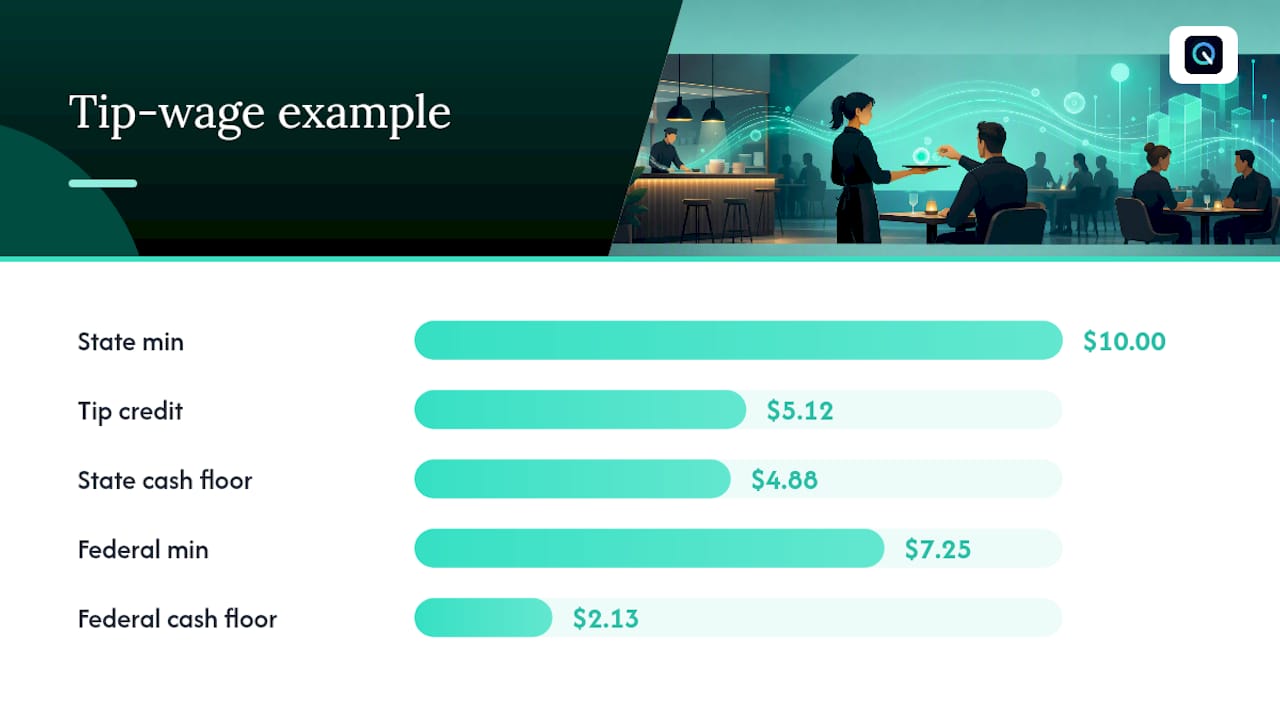
Three things need to happen on a recurring basis: verify each state’s current cash-wage floor and maximum credit, calendar the annual or scheduled rate changes so nobody finds out from an employee complaint, and rebuild the tip credit calculation whenever a state minimum wage moves. If a state minimum rises to $10.00 while the federal minimum sits at $7.25, and that state still allows a $5.12 credit, your cash wage floor becomes $4.88, not $2.13. Skipping that recalculation is one of the most common multi-location payroll errors.
Tip Pooling and Service Charges: Who Actually Gets a Share
The rule is straightforward on paper and easy to get wrong in practice: if you’re taking the tip credit, managers and supervisors cannot be included in the tip pool under 29 CFR Part 531. Back-of-house staff, like line cooks and dishwashers, can only join a valid pool if you pay full minimum wage and skip the credit entirely.
Service charges are a different animal. A mandatory 18% banquet fee or delivery surcharge is treated as employer revenue and counts as wages if distributed, not as a tip, and it never factors into your tip credit math.
Audit your pool composition on a regular cycle:
- Confirm no manager or supervisor title appears in the distribution list
- Separate service charge revenue from tip income in your accounting
- Document the pooling formula in writing and keep it consistent across pay periods
FICA Tip Credit vs. FLSA Tip Credit: Don’t Confuse the Two
The FLSA tip credit reduces what you owe employees in cash wages. The FICA tip credit under IRC §45B is a completely separate benefit: a tax credit that lets you recover the employer share of Social Security and Medicare taxes paid on reported tips above the wages already counted toward minimum wage. One is a wage-law obligation. The other is a tax break claimed on your return.
Payroll and tax teams should treat these as two distinct reconciliations, not one combined calculation:
- File Form 8846 to claim the FICA tip credit
- Large food and beverage employers may also need Form 8027 for annual tip reporting
- Keep tip reporting records separate from wage-floor compliance documentation, since auditors for each program ask different questions
The most common payroll mistake here isn’t confusing the forms. It’s running overtime calculations off the reduced cash wage instead of the full minimum wage, an error that shows up in both wage audits and tax filings once someone finally checks the math.
A Compliance Checklist HR Can Actually Run
- Issue and store signed tip-credit notices. Get a signed acknowledgment at hire and whenever the cash wage or credit amount changes, and keep it in the personnel file.
- Build per-state payroll templates. Set up separate wage rules for each state you operate in, with the correct cash-wage floor and maximum credit for that jurisdiction.
- Use task-coded time entries. Every punch should carry a job code so you can defend the tip credit if duties get questioned during an audit.
- Automate weekly shortfall checks. Payroll should flag any employee whose cash wage plus tips falls below the applicable minimum before the pay run finalizes, not after.
- Audit tip pools quarterly. Confirm manager exclusion and correct service-charge treatment every three months, not just once a year.
- Assign ownership. Someone specific, not “payroll in general,” should own the statutory calendar and weekly shortfall review.
Pro Tip: Retention matters as much as accuracy. DOL and IRS reviews can reach back two or three years, so notices, task codes, and shortfall corrections need to survive in your records long after the pay period closes.
Why Task-Level Timekeeping Is the Real Compliance Lever
The tip credit is all or nothing for a workweek. Miss one notice requirement or one shortfall check, and you owe full minimum wage retroactively, no partial credit. Automated, task-coded timekeeping is the cheapest insurance against that outcome, cheaper than the back-pay and liquidated damages that follow a failed audit. Everything in the checklist above points to one conclusion: the employers who avoid trouble are the ones whose systems catch the shortfall before the DOL does.
Saad
How Kloqk Keeps Your Tip Credit Math Defensible
Kloqk offers controls to support the requirements discussed in this article. Features like task-coded time entries, built-in overtime calculations, break tracking, and payroll-ready exports help reduce manual work on tip-credit calculations.

Photo verification and GPS geofencing can provide proof for audits by showing who clocked in and where, while signed acknowledgments can be stored alongside timesheets. That combination is what turns a workweek shortfall from a surprise back-pay liability into a flagged correction before payroll runs. Explore how Kloqk’s employee time tracking handles task coding and overtime, or check the Free, Pro, and Premium plans to see which tier fits your locations. Start with the free tier today and see your first payroll-ready export by next pay period.
This article is general information, not a substitute for advice from a qualified lawyer. Consult a qualified legal professional about your own circumstances before acting on anything here.
Sources
- Tip Regulations under the Fair Labor Standards Act (FLSA)
- FICA Tip Credit for employers
- 29 CFR Part 531, Subpart D (Tipped Employees)
- DOL overtime calculator example for tipped employees
FAQ
Which States Do Not Allow Tip Credit?
Seven states ban the tip credit outright and require full state minimum wage in cash: Alaska, California, Minnesota, Montana, Nevada, Oregon, and Washington. Several cities and Washington, DC, are also phasing out tip credits on their own schedules even where the state itself still permits one.
What Is the 80/20 Rule for Tip Credit?
The 80/20 rule limited tipped employees to spending no more than 20% of their time on side work before losing the tip credit for those hours. Regulatory changes and a 2024 court vacatur removed that fixed percentage, leaving a “directly related versus unrelated” duties test with no federal bright-line number.
Who Qualifies for the Tip Credit?
An employee qualifies as “tipped” under Fact Sheet #15 if they customarily and regularly receive more than $30 a month in tips. Managers and supervisors don’t count toward tip pools when the employer takes the credit, even if they occasionally receive tips themselves.
What Are the Downsides of Tip Credit?
The biggest risk is the all-or-nothing structure: one missed notice, wage-floor failure, or recordkeeping gap can invalidate the credit for an entire workweek, triggering full back-pay liability. State law variation adds another layer, since seven states ban the credit entirely and others set higher cash-wage floors than the federal $2.13 minimum.
What Does Kloqk Cost for Tip Credit Tracking?
Kloqk’s core time tracking features, including overtime calculations and payroll exports, are free with no published price limit. Paid Pro and Premium tiers add scheduling, PTO, and GPS geofencing starting at $29 per month per location.
Recommended
Sources
Every figure on this page traces to one of these. Primary law and government sources are listed first.
- 1. U.S. Department of Laborprimary
- 2. Electronic Code of Federal Regulationsprimary
- 3. U.S. Department of Laborprimary
- 4. Internal Revenue Serviceprimary
- 5. jacksonlewis.com
- 6. unblock.federalregister.gov
- 7. beancount.io
Written by
Marcus ReyesPayroll & Timekeeping Specialist
Marcus covers payroll accuracy, timesheets, and time tracking, the unglamorous mechanics that keep paychecks correct and audits painless.
Keep Reading
Track Hours the Easy Way
Kloqk is a free time clock that handles punches, breaks, overtime, and payroll-ready reports.
Start free