How to Track Nurse Shift Differentials for Payroll Accuracy

Include shift differentials in the nurse’s regular rate, tag qualifying hours by shift type as they’re worked, and calculate overtime on the blended rate, not the base rate alone. That’s the whole compliance obligation in one sentence, and it’s where most payroll teams quietly go wrong.
Here’s the action checklist to run today, before you touch another pay run:
- Pull the employee handbook or union contract and confirm exactly which shifts, hours, and premiums qualify for differential pay.
- Grab last week’s pay stub and check whether overtime was calculated on the base rate or the blended rate that includes differentials.
- Confirm in writing whether differentials stack (night plus weekend plus charge, for example) or whether only the highest applicable premium applies.
- Set up shift tags in your time tracking system now: night, evening, weekend, holiday, and charge nurse, at minimum.
The Department of Labor’s overtime guidance is unambiguous on one point that trips up even experienced payroll administrators: non-discretionary shift differentials count as part of the regular rate of pay. If your system calculates time-and-a-half on the $38 base rate instead of the $41 blended rate that includes a night differential, you’re underpaying overtime and building a liability that compounds every pay period.
Key Takeaways
Shift differentials must be included in the regular rate for overtime calculations, and accurate tracking depends on tagging hours by shift type at the moment they’re worked, not after.
| Point | Details |
|---|---|
| Include differentials in OT math | Calculate overtime on the blended rate (base plus differential), never on base pay alone, per federal wage law. |
| Tag hours at the point of punch | Flag shift type, weekend, holiday, and charge status in real time to avoid retroactive reconstruction errors. |
| Reconcile before every payroll run | Compare flagged differential hours against the actual schedule to catch missing tags before pay stubs go out. |
| Document stacking rules in writing | Specify whether premiums combine or whether the highest one applies, and put it in the handbook or union contract. |
| Automate with a configurable system | Tools like Kloqk apply differential windows and blended-rate overtime automatically, cutting manual reconciliation work. |
Table of Contents
- What Is a Nurse Shift Differential and How Is It Calculated?
- How Do You Calculate Nurse Shift Differential Pay Correctly?
- How Should You Record Differential Hours in Your Timekeeping System?
- How Do Shift Differentials Interact With Overtime and Other Premiums?
- What Should a Written Shift Differential Policy Include?
- What Should Payroll Check Before Finalizing Nurse Pay?
- How Can Software Automate Shift Differential Tracking?
- What Payroll Teams Consistently Get Wrong About Differentials
- Automate Nurse Shift Differential Tracking With Kloqk
- Where to Verify Shift Differential Rules and Benchmarks
- Frequently Asked Questions About Nurse Shift Differentials
- Sources
What Is a Nurse Shift Differential and How Is It Calculated?
A shift differential is extra pay a hospital or clinic adds to a nurse’s base hourly rate for working hours the facility considers less desirable or harder to staff. Nights, weekends, and holidays top that list almost everywhere, because fewer nurses want them and patient care can’t stop just because it’s 3 a.m. on a Sunday.
Facilities structure differentials two ways. A flat-dollar differential adds a fixed amount per hour, say $3.50 for nights, regardless of the nurse’s base pay. A percentage differential adds a set percent of the base rate instead, commonly 10% to 20% for nights and 5% to 15% for weekends, according to NurseSalaryData’s 2026 benchmarking. The percentage model scales with seniority; a nurse earning $45 an hour gets a bigger dollar boost than one earning $32 for the identical shift, which some facilities view as fairer and others view as an unpredictable payroll cost.
Shift windows matter more than most policies spell out. A common night differential window runs through typical overnight hours, but exact start and end times vary by system. Weekend differentials might apply to the calendar weekend (Saturday and Sunday) or to a “weekend shift” definition tied to the start time of a 12-hour shift that begins Friday night. If your timekeeping system tags shifts by calendar date instead of by the shift’s actual start and end times, you will misclassify a chunk of legitimate differential hours every single pay period.
A nurse who picks up a 7 p.m. Friday to 7 a.m. Saturday shift is working a night shift and, depending on the policy, may also trigger the weekend differential for the Saturday-morning hours. Get the window definition wrong and you either underpay her or overpay her, both of which show up in an audit eventually.
Specialty and charge differentials layer on top of the shift-timing categories. A charge nurse premium, an ICU or ER specialty differential, and a night differential can all apply to the same person on the same shift, which is exactly where stacking rules and payroll math start to get complicated.
How Do You Calculate Nurse Shift Differential Pay Correctly?
Calculating shift differential pay comes down to three steps: identify the differential type and qualifying hours, compute the blended hourly rate, then run overtime off that blended rate, never the base rate.
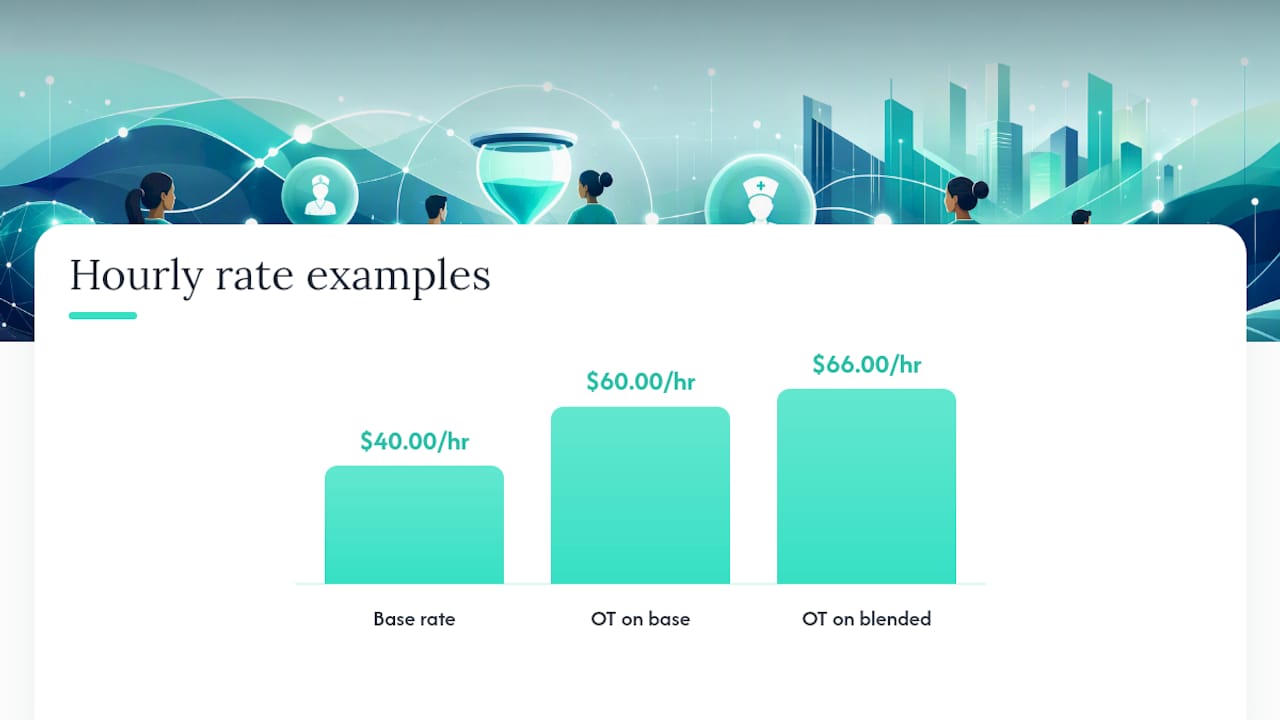
Step 1: Identify base rate, differential type, and qualifying hours. Say a nurse’s base rate is $40 an hour. She works a 12-hour night shift with a $4 flat-dollar night differential. That’s straightforward.
Step 2: Compute the blended hourly rate.
- Flat-dollar: $40.00 base + $4.00 night differential = $44.00 blended rate.
- Percentage: $40.00 base × 15% = $6.00, so $40.00 + $6.00 = $46.00 blended rate.
Step 3: Calculate overtime on the blended rate. This is the step that generates the most wage claims in healthcare. Under 29 CFR 778.207, non-discretionary shift differentials are part of the “regular rate” used to compute overtime, so any hours over 40 in a workweek get paid at 1.5 times the blended rate, not the base rate.
Here’s the same nurse working 44 hours in a week, all on night shift with the $4 flat differential:
- Incorrect (common error): OT calculated on base only: $40 × 1.5 = $60/hour for the 4 OT hours = $240.
- Correct: OT calculated on blended rate: $44 × 1.5 = $66/hour for the 4 OT hours = $264.
That $24 gap on a single week, multiplied across a unit of 30 night-shift nurses working occasional overtime, adds up fast, and it’s the exact kind of error the DOL’s overtime pay guidance flags as a routine compliance failure in healthcare settings.
The stacked scenario shows why nurses who work weekend nights consistently often out-earn colleagues on a purely percentage-based night schedule, even at the same base rate. It’s also why payroll teams need airtight stacking rules documented before a nurse ever picks up that shift.
How Should You Record Differential Hours in Your Timekeeping System?
Tag every punch by shift type at the moment it’s clocked, not after the fact during payroll processing. Retroactive tagging is where most differential errors originate, because whoever runs payroll is reconstructing which hours qualified from memory or from a paper schedule that doesn’t match what actually happened.

Set up your time tracking system with these fields as a baseline: shift type (day, evening, night), a weekend flag, a holiday flag, a specialty or unit tag, and a charge nurse flag. Each of these should be independently selectable, since a single shift can trigger more than one.
Punch rounding policies matter here too. If your system rounds punches to the nearest quarter hour, a nurse who clocks in at 6:52 p.m. for a shift with a 7 p.m. night-differential start could be rounded into or out of differential eligibility depending on which direction the rounding runs. DOL Fact Sheet 53 on hours worked in healthcare makes clear that rounding practices need to be neutral, not systematically favorable to the employer, or they become a wage claim waiting to happen.
Orientation exceptions deserve their own line in the policy. A nurse hired for permanent night shift who spends the first two weeks training on days should be paid at whatever rate the offer letter specifies for orientation, whether that’s day rate, night rate, or a guaranteed differential regardless of the actual shift worked. Document this explicitly, because it’s one of the most common sources of new-hire pay disputes.
Pro Tip: Run a weekly spot check comparing the number of hours flagged as “night” in your time system against the actual staffing schedule for that unit. A mismatch of more than a few hours usually means someone forgot to select a tag, not that the schedule changed.
Before you approve any pay run, pull a sample of five night-shift nurses and manually verify their differential tag matches their scheduled shift. It takes ten minutes and it catches the errors that a full system audit would take hours to find.
How Do Shift Differentials Interact With Overtime and Other Premiums?
Shift differentials are part of the regular rate for overtime purposes, full stop, and that single rule under 29 CFR 778.207 governs every other interaction discussed in this section.
Stacking policy determines whether multiple premiums combine or whether the highest one wins. Consider a charge nurse working a holiday night shift:
- Stacking policy: Night differential ($4) + charge premium ($3) + holiday pay (time-and-a-half base) all apply simultaneously, and overtime, if triggered, calculates off the full blended rate including all three.
- Non-stacking policy: Only the highest single premium applies, so the nurse gets whichever of night, charge, or holiday pays the most, not all three combined.
The dollar difference between these two policies on a single 12-hour holiday night shift for a $40 base-rate nurse can run $80 to $120, depending on the specific premium values. Multiply that across a hospital’s holiday staffing roster and the stacking decision becomes a real line item, not a technicality.
The most expensive and most common employer error remains calculating overtime on the base rate while paying differentials separately as a flat add-on that never touches the OT math. DOL Fact Sheet 54 on healthcare overtime addresses this directly because healthcare’s mix of 8-hour, 10-hour, and 12-hour shifts, plus the 8/80 overtime option some hospitals use, makes it easier to lose track of which rate should anchor the overtime calculation.
- Holiday pay commonly stacks with a shift differential but not with a charge premium, depending on policy language.
- Specialty premiums (ICU, ER, OR) typically apply per shift worked in that unit, regardless of time of day, and stack with night or weekend differentials unless the policy states otherwise.
- Charge nurse premiums usually apply only for the hours actually spent in the charge role, which can create partial-shift tracking requirements most timekeeping systems aren’t configured to handle out of the box.
What Should a Written Shift Differential Policy Include?
A written policy needs six elements to hold up under an audit or a wage dispute: eligibility criteria, exact qualifying hours, the calculation method, stacking rules, any caps, and orientation exceptions.
Eligibility should state which employment classifications qualify. Per diem and travel nurses often have different differential structures than staff nurses, and a policy silent on this point invites inconsistent application across a facility. Exact qualifying hours need start and end times stated in clock time, not vague phrases like “night shift,” because “night shift” means different things on different units.
That’s a workable one-paragraph template. Adapt the dollar figures and windows to your facility, but keep the structure: rate, exact window, and an explicit stacking and overtime statement.
| Policy Element | What to Specify | Where It’s Documented |
|---|---|---|
| Eligibility | Employment classification, probationary period rules | Employee handbook or CBA |
| Qualifying hours | Exact clock-time start and end for each differential type | Payroll policy manual |
| Calculation method | Flat dollar or percentage, and what the percentage applies to | Offer letter and handbook |
| Stacking rules | Whether multiple premiums combine or the highest one governs | Union contract or HR policy |
| Caps/maximums | Any dollar or percentage ceiling on combined premiums | HR policy manual |
Recordkeeping requirements mean every pay stub should itemize differential pay separately from base pay, not bury it in a single gross-pay line. Nurses covered by a union contract should be able to find the exact differential language in their collective bargaining agreement, and HR should keep a signed acknowledgment on file whenever a nurse negotiates a nonstandard arrangement, like a guaranteed weekend-only schedule with a locked differential rate.
What Should Payroll Check Before Finalizing Nurse Pay?
Run a reconciliation pass that compares flagged differential hours against the actual published schedule for every nurse before the payroll run closes, not after.
Pull a report of hours tagged as night, weekend, or holiday and cross-reference it against the unit’s staffing schedule for the same pay period. Any hours on the schedule that don’t show a matching tag in the time system are the first place to look for missed differential pay.
The single most common finding in a payroll audit isn’t fraud, it’s a forgotten tag: a nurse picked up an extra night shift through a shift-swap app, and nobody updated the time system’s differential flag before the punch happened.
Watch for these specific error patterns during reconciliation:
- Hours flagged as night or weekend but paid at the base rate with no differential line on the stub.
- Manual timesheet overrides that reset a shift tag to the default (day) after a supervisor edit.
- Orientation-period hours paid at the wrong rate because the exception wasn’t coded before the new hire’s first pay period.
- Overtime hours calculated against base rate instead of the blended rate, visible by comparing the OT rate on the stub to 1.5 times the base rate, if they match, that’s the error.
Run a filtered report for any pay period where a nurse’s total hours exceeded 40 and check whether the OT rate on that stub equals 1.5 times base or 1.5 times blended. If it’s the former, that’s a retro-pay correction waiting to happen, and the sooner it’s caught, the smaller the back-pay liability.
For confirmed errors, the correction workflow should include a written retro-pay calculation showing the original stub, the corrected blended-rate math, the dollar difference, and the date it was paid out. Keep that documentation for at least the retention period your state labor agency requires.
How Can Software Automate Shift Differential Tracking?
Look for five specific features when evaluating a time-tracking tool for differential accuracy: configurable shift-window tags, a stacking toggle, automatic blended-rate overtime calculation, an audit log, and a payroll export format that itemizes differential pay by type.

Configurable windows matter because your facility’s 7 p.m. to 7 a.m. night window is not universal, and a system that hardcodes a “night shift” definition without letting you adjust the start and end times will misclassify hours on any unit with a nonstandard schedule. A stacking toggle lets payroll switch between “highest premium wins” and “all premiums combine” without manually recalculating every affected pay stub.
Implementation runs in three phases:
- Configure pay rules. Enter every differential type, rate, qualifying window, and stacking rule directly into the system before importing a single schedule.
- Map schedules and tags. Import the unit schedule and confirm every shift auto-tags correctly against the configured windows; spot-check a sample against the paper or app-based schedule.
- Run a parallel payroll test. Process one full pay period through both the new system and your existing method, then reconcile line by line before switching over completely.
The operational payoff is fewer manual corrections and a defensible audit trail if a wage claim ever surfaces. A system with photo verification and GPS geofencing at clock-in adds another layer: it confirms the nurse was physically on-site when a differential-eligible shift started, which matters when a disputed punch time is the difference between a nurse qualifying for the night window or missing it by six minutes.
Pro Tip: Pilot any new differential tracking setup on a single unit for one full pay cycle before rolling it out facility-wide. Night shift ICU staffing tends to surface the widest range of edge cases (stacking, orientation, charge premiums) faster than any other unit.
What Payroll Teams Consistently Get Wrong About Differentials
Most payroll errors in this area aren’t calculation mistakes, they’re sequencing mistakes. Teams build the differential tracking system before they’ve nailed down the overtime math, which means they end up rebuilding the OT logic later once someone notices the blended-rate gap on an audit.
The fix is to tackle overtime math first. Confirm your system calculates OT on the blended rate before you spend a single hour configuring shift tags or stacking rules, because if that foundational calculation is wrong, everything built on top of it inherits the error. Stacking rules and policy documentation come second, once the math is verified correct.
Involve nursing leadership early, not as a courtesy but as a practical necessity. Nurse managers know the real staffing patterns, the shift-swap habits, and the edge cases (like a nurse who floats between units with different differential rates) that payroll teams rarely see until a dispute lands on their desk. A thirty-minute conversation with a charge nurse before you finalize your shift-window definitions will surface problems no amount of policy drafting catches on its own.
The medium-term move is automation, not because manual tracking is impossible but because it doesn’t scale past a handful of nurses without regular errors. The long-term move is a policy review cycle, ideally annual, that revisits differential rates against current market benchmarks and confirms the written policy still matches what payroll actually does in practice. Policies drift from practice quietly, and the gap only becomes visible during an audit or a wage claim.
Automate Nurse Shift Differential Tracking With Kloqk
Every workaround this article describes, the manual tag audits, the pay-stub spot checks, the parallel payroll tests, exists because most time tracking systems weren’t built with shift differentials in mind. Kloqk’s free time tracking platform handles configurable differential windows, stacking toggles, and blended-rate overtime calculation as part of its core feature set, at no cost, so payroll doesn’t have to reverse-engineer the math after the fact.
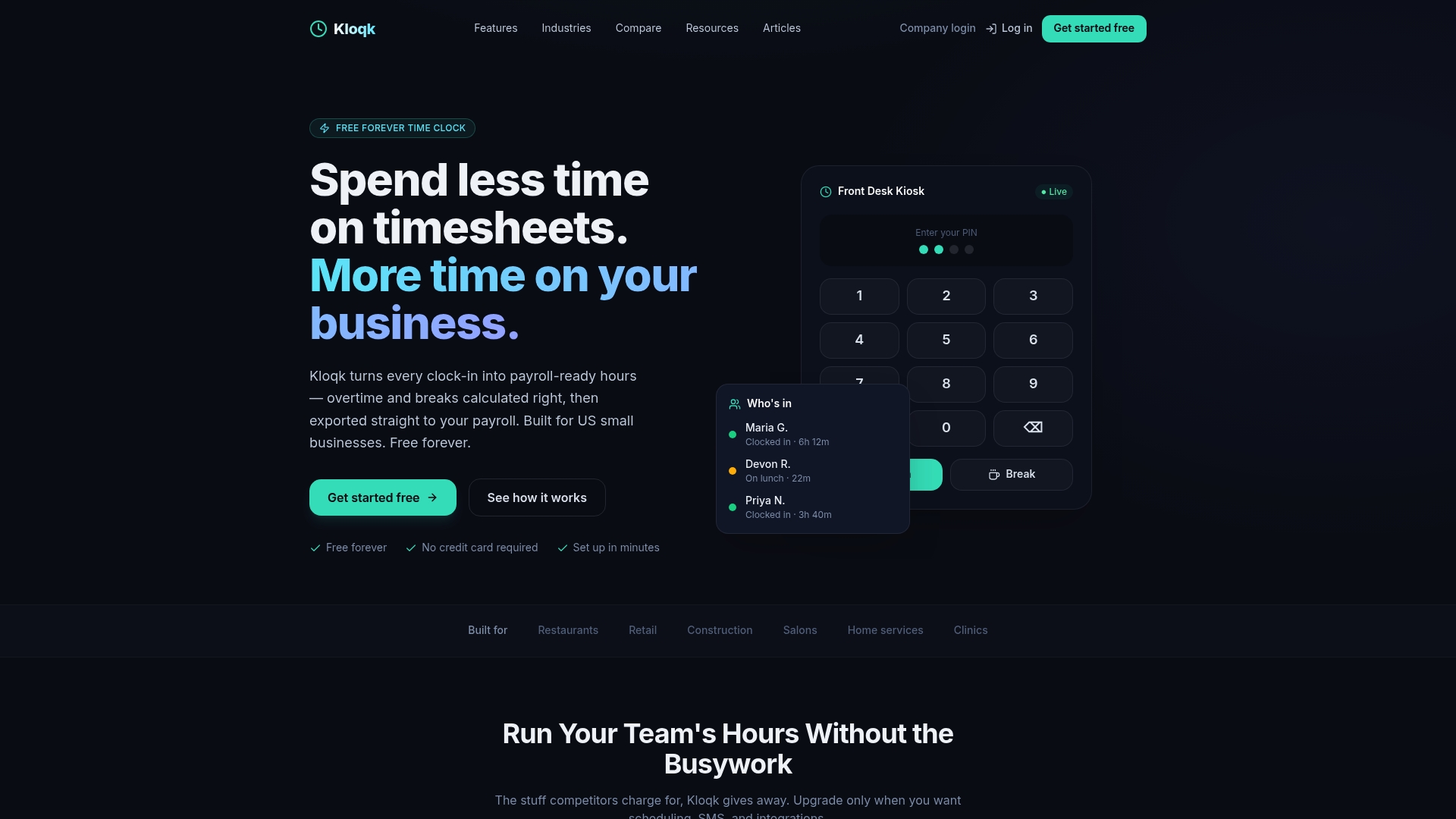
Photo verification and GPS clock-ins confirm a nurse was physically on-site when a differential-eligible shift began, closing the exact loophole that turns a disputed six-minute punch into a payroll headache. Every tagged hour, every override, and every stacking decision logs to an audit trail, which is the documentation you’ll want on hand if a wage claim ever surfaces.
Piloting it takes three steps: set your pay rules (differential rates, windows, and stacking policy), import one unit’s schedule to confirm the tags map correctly, and run two full pay periods in parallel against your current system before switching over. Start a free trial on one unit and reconcile the first pay period yourself, most payroll teams know within a single cycle whether the automated math matches what they’d have calculated by hand.
Where to Verify Shift Differential Rules and Benchmarks
- U.S. Department of Labor Overtime: the primary federal source for confirming that non-discretionary differentials belong in the regular rate calculation.
- U.S. Department of Labor FLSA overview: background on the broader wage and hour law that governs differential pay obligations.
- 29 CFR 778.207: the specific regulation defining how non-discretionary premiums factor into the regular rate.
- Bureau of Labor Statistics Healthcare occupations: wage benchmarking data for RN base pay across regions.
- DOL Fact Sheet 54 Overtime for the healthcare industry: healthcare-specific overtime scenarios, including 8/80 rules.
- Nurse Salary with Shift Differential 2026: benchmark ranges for percentage-based night and weekend differentials by region.
Frequently Asked Questions About Nurse Shift Differentials
Do you have to include shift differentials when calculating overtime? Yes. Under 29 CFR 778.207, non-discretionary shift differentials are part of the regular rate of pay, and overtime must be calculated on that blended rate, not the base hourly rate alone.
What’s a typical night shift differential for nurses? Night differentials commonly range from a flat $2 to $6 per hour or 10% to 20% of base pay, though exact rates vary widely by facility, region, and whether the position is staff, per diem, or travel. Check your facility’s handbook or regional benchmarking data for a specific figure.
Can shift differentials stack with each other? It depends entirely on employer policy or union contract terms. Some facilities allow night, weekend, and specialty differentials to combine on the same shift, while others pay only the single highest-value premium. Confirm this in writing before assuming either applies.
What’s the most common payroll error with shift differentials? Calculating overtime on the base hourly rate instead of the blended rate that includes the differential. This single error is responsible for most wage claims tied to differential pay in healthcare settings.
How should orientation pay work for a nurse hired onto night shift? Document it explicitly in the offer letter or policy: some facilities pay the night differential during day-shift orientation to honor the negotiated rate, while others pay whatever rate matches the shift actually worked. Either approach is defensible as long as it’s written down and applied consistently.
This article provides general payroll and compliance information, not legal advice. Confirm current federal and state wage rules, along with any applicable union contract terms, with the Department of Labor or a qualified employment law professional before finalizing payroll policy.
This article is general information, not a substitute for advice from a qualified financial advisor. Consult a qualified financial professional about your own circumstances before acting on anything here.
Sources
- U.S. Dept. of Labor Overtime
- U.S. Dept. of Labor FLSA overview
- 29 CFR 778.207 Regular rate; non-discretionary bonuses and premiums
- Bureau of Labor Statistics Healthcare occupations
- Nurse Salary with Shift Differential 2026 | Nurse Salary Data
Recommended
Sources
Every figure on this page traces to one of these. Primary law and government sources are listed first.
- 1. U.S. Department of Laborprimary
- 2. Cornell Legal Information Instituteprimary
- 3. U.S. Bureau of Labor Statisticsprimary
- 4. nursesalarydata.com
- 5. nightowling.com
Written by
Marcus ReyesPayroll & Timekeeping Specialist
Marcus covers payroll accuracy, timesheets, and time tracking, the unglamorous mechanics that keep paychecks correct and audits painless.
Keep Reading
Track Hours the Easy Way
Kloqk is a free time clock that handles punches, breaks, overtime, and payroll-ready reports.
Start free