Minimum Shift Length Laws: What US Employers Must Pay

There is no federal minimum shift length. The Fair Labor Standards Act has no provisions on employee scheduling beyond certain child labor rules, so in most states you can schedule a two-hour shift. The catch is reporting-time pay: a handful of states and Washington, D.C. require you to pay a minimum number of hours when someone shows up for a scheduled shift and you send them home early. If you run a restaurant, retail shop, clinic or job site, the rule that applies to you depends on where your location sits, and your time records are what prove you paid correctly. A time clock that captures every punch, break and early send-home gives you those records without spreadsheets, and ours is free to start.
TL;DR
- Federal law sets no minimum shift length and no minimum number of paid hours for an hourly employee. Most states follow that default.
- Reporting-time pay laws exist in California, Massachusetts, Connecticut, New Hampshire, New York, New Jersey, Rhode Island and D.C. Each has its own minimum, from 1 hour to 4 hours or more.
- The guarantee usually applies when an employee reports as scheduled and gets less work than expected, not to shifts you cancel in advance.
- Meal and rest breaks are a separate set of state rules, and overtime after 40 hours a week is federal.
- Log every punch and every early release with a timestamp, so you can show what was scheduled, what was worked and what was paid.
Table of Contents
- What federal law says about shift length
- Reporting-time pay: the rule behind “minimum shift”
- How the main states compare
- Worked examples
- Exceptions that can excuse the payment
- Breaks are a different question
- Why short shifts create payroll risk
- A simple routine for staying compliant
- Put the rules on a time clock
- FAQ
- Sources
What federal law says about shift length
The FLSA covers three things that matter here: the minimum wage, overtime, and what counts as hours worked. It says nothing about how long a shift must be. The Department of Labor states that an employer may change an employee’s work hours without prior notice or consent, unless a prior agreement says otherwise.
The federal minimum wage is $7.25 per hour, in effect since July 24, 2009, and covered nonexempt employees must be paid at least one and a half times their regular rate for hours over 40 in a workweek. Each workweek stands on its own. Many states set a higher minimum wage, and where they do, the higher rate applies.
So what is the shortest shift an adult can legally work? In most states, as short as you schedule it. North Carolina’s labor department says plainly that neither state nor federal law requires paying a minimum number of hours to hourly or nonexempt salaried employees: you pay for the hours actually worked. If you operate there, our North Carolina labor law guide covers the wage, hour and break rules in one place.
Two caveats keep this from being a free-for-all. Minors face separate hour limits under child labor rules, and some employers have written policies, union contracts or offer letters that promise a minimum. If you promised four hours in writing, that promise can bind you even where the law does not.

Reporting-time pay: the rule behind “minimum shift”
When people search for minimum shift laws, what they usually mean is reporting-time pay, sometimes called show-up pay. It is a guarantee that an employee who reports for a scheduled shift gets paid for a minimum number of hours, even if you send them home early because business is slow.
It is a payment rule, not a scheduling rule. In most places it does not stop you from scheduling a short shift. A Seyfarth Shaw practice guide on Massachusetts makes this point: the requirement does not prohibit scheduling shifts under three hours. It only sets what you owe when someone shows up for a longer scheduled shift and you cut it short.
According to one summary of state laws, seven states plus D.C. have adult reporting-time laws: California, Massachusetts, Connecticut, New Hampshire, New York, New Jersey and Rhode Island. Oregon’s applies only to minors. These rules apply to nonexempt employees, meaning those entitled to minimum wage and overtime. Salaried exempt managers are generally outside them. Laws change, so confirm current terms with your state labor department before you rely on a figure.
How the main states compare
This table summarizes the rules reported by official and professional sources. Treat it as a starting point and check your state agency for the current text.
| Jurisdiction | Who it covers | What you owe when the employee reports |
|---|---|---|
| California | Nonexempt employees | Half the usual or scheduled day, never less than 2 hours or more than 4, at the regular rate |
| Massachusetts | Nonexempt employees scheduled 3+ hours, except charitable organizations | At least 3 hours at minimum wage |
| New York | Nonexempt employees, with exceptions for workers under separate wage orders | At least 4 hours at minimum wage, or the scheduled shift if shorter. Hospitality workers have 3, 6 or 8 hours depending on shifts |
| Rhode Island | Most nonexempt employees | A minimum of 3 hours at the regular rate, even for shifts scheduled shorter |
| District of Columbia | Most nonexempt employees | 4 times the minimum wage when no work is given, plus a 1-hour split-shift premium in some cases |
| Connecticut | Limited industries, such as mercantile and restaurant work | Applies only when workers in those industries are sent home early |
| New Hampshire | Nonexempt employees, excluding county and municipal staff | 2 hours at the regular rate |
| New Jersey | Nonexempt employees | A minimum of 1 hour at the usual rate unless the agreed weekly hours are already worked |
Sources for the table: California comes from the state labor standards office. Massachusetts, New York, Rhode Island and D.C. come from A Better Balance’s state fact sheet. Connecticut, New Hampshire’s exemption and Massachusetts’ three-hour threshold are in a National Women’s Law Center fact sheet, and the New Hampshire and New Jersey amounts are in a state-by-state summary.
If you operate in several states, you have several rules. Our guide to reporting time pay and what employers owe when shifts get cut goes deeper on the mechanics.
Worked examples
California: an eight-hour shift cut short
Say a retail employee is scheduled for eight hours and you send them home after 90 minutes. The half-day rule means the guarantee is half of the scheduled day, which is four hours, within the 2-to-4-hour range. The employee is owed pay equal to four hours at the regular rate, so you owe the 90 minutes worked plus the shortfall up to that guarantee. A second report on the same day with under two hours of work triggers a two-hour payment, according to the state’s reporting-time FAQ.
California’s labor office also notes that the employee does not always have to be physically at your site. Under a 2019 court decision, logging on remotely or even phoning in two hours before a shift can count as reporting.
Massachusetts: three-hour guarantee
An employee scheduled for four hours reports and works one. The Seyfarth guide explains the result: one hour at the regular rate, plus two hours at the minimum wage or above, to reach three hours. If you call before the shift to cancel, nothing is owed under this rule because the employee never reported.
Rhode Island: the short scheduled shift
Rhode Island is the one that surprises owners. A summary of its law says the three-hour minimum applies even to regularly scheduled shifts under three hours, so a two-hour scheduled shift is paid as three. If you run short split shifts there, build that into your labor budget.

Exceptions that can excuse the payment
Reporting pay is not unconditional. California’s rules carve out threats to employees or property, civil-authority recommendations, public utility failures, and acts of God or other causes outside your control. They also do not apply to paid standby employees or to regularly scheduled shifts under two hours, per the state labor standards office.
More broadly, one summary notes that most states waive the obligation when the employer made a good-faith effort to tell the employee in advance of a closure or schedule change, and many exempt events like tornadoes or floods. The practical lesson is documentation. A cancellation you can prove you sent, with a time attached, is far easier to defend than one you remember sending.
Two more points trip up owners:
- Penalties can follow a missed payment. In California, reporting-time pay counts as wages, so leaving it unpaid at termination can trigger waiting-time penalties under Labor Code section 203.
- It affects overtime math. Show-up pay required by state or local law that is not payment for hours worked can be left out of the regular rate only if it is paid infrequently or sporadically, and it cannot be credited toward overtime owed. The Labor Department’s Fact Sheet 56B explains the same treatment. Pay for hours actually worked always counts. If you pay reporting pay often, talk to your payroll provider or an employment attorney about the regular rate.
To see how the regular rate feeds overtime, use our step-by-step overtime guide or the free overtime calculator.
Breaks are a different question
Owners often mix shift length with breaks, and the two have different rules. The FLSA does not require meal or rest breaks, and where a state has no requirement, breaks are a matter of agreement between employer and employee. States then add their own rules, which often depend on how long the shift is.
A few examples from the Labor Department’s state surveys:
- Illinois requires a 20-minute meal period no later than five hours after work begins for employees working 7.5 continuous hours or more. Massachusetts gives a 30-minute meal break for each six hours worked in a calendar day.
- California requires a paid 10-minute rest period for each four hours worked or major fraction, and not for daily work under 3.5 hours. Washington requires a paid 10-minute rest period per four-hour work period.
- Connecticut requires a 30-minute meal period after 7.5 or more consecutive hours, per a 2026 summary of its statute, and has no state rest-break mandate.
So does a seven-hour shift need a break? In many states no, and in some yes. It depends entirely on the state. Our rest break glossary entry defines the terms, and our overtime tracking software with break rules by state page shows how break tracking works in the product.
Why short shifts create payroll risk
The legal minimum is only part of the picture. Short and cut shifts cause errors in three places:
- Punch accuracy. A person who clocks in, is sent home and clocks out leaves a short record. Without a clear timestamp you cannot show the reporting guarantee was met.
- Split shifts. Lunch and dinner crews in a restaurant often work two blocks in one day. Some jurisdictions, like D.C., add a split-shift premium.
- Weekly overtime. Extra guaranteed hours can push an employee over 40 hours in a week, and the 1.5x overtime after 40 hours rule then applies. Restaurants in particular should review the overtime mistakes owners can fix.
Salaried staff are a separate matter. Whether a salaried worker gets overtime depends on exemption tests, covered in our guide to salaried overtime and the FLSA overtime rules.
A simple routine for staying compliant
Whatever your state, this routine covers the ground:
- Identify your rule. Check whether your state or city has reporting-time pay, and which employees it covers. Check the labor department’s page, not only a summary.
- Write your scheduling policy. State how far in advance you cancel shifts and how you notify staff.
- Record scheduled versus worked time. Keep the scheduled shift and the actual punches side by side.
- Flag early releases. When you send someone home, mark it so payroll can check the guarantee.
- Review each pay period. Compare hours worked with the guaranteed minimum before you run payroll.
- Keep records. Retain timesheets, cancellation messages and pay stubs.
Our guide to tracking employee hours walks through methods for the recording steps.
Our view: the record is the protection
Most small employers we talk about with do not break shift-length laws on purpose. They get caught because a punch was missing, a send-home was never recorded, or overtime was figured by hand at the end of a busy week. The law around minimum shifts is a patchwork, and you cannot memorize eight jurisdictions’ rules.
That is why we built the free core of Kloqk around clean time records: payroll-ready timesheets, overtime and break calculations, photo verification on clock-ins, and payroll exports, for unlimited employees, with compliance with federal and state labor laws built into the framework. Our view is that accurate hours should not sit behind a paywall, because the owners who need them most are the ones watching every dollar.
When you are ready for more, optional upgrades add scheduling, PTO and hiring tools, so you can plan shifts and see scheduled versus worked time in one place.
Saad
Put the rules on a time clock
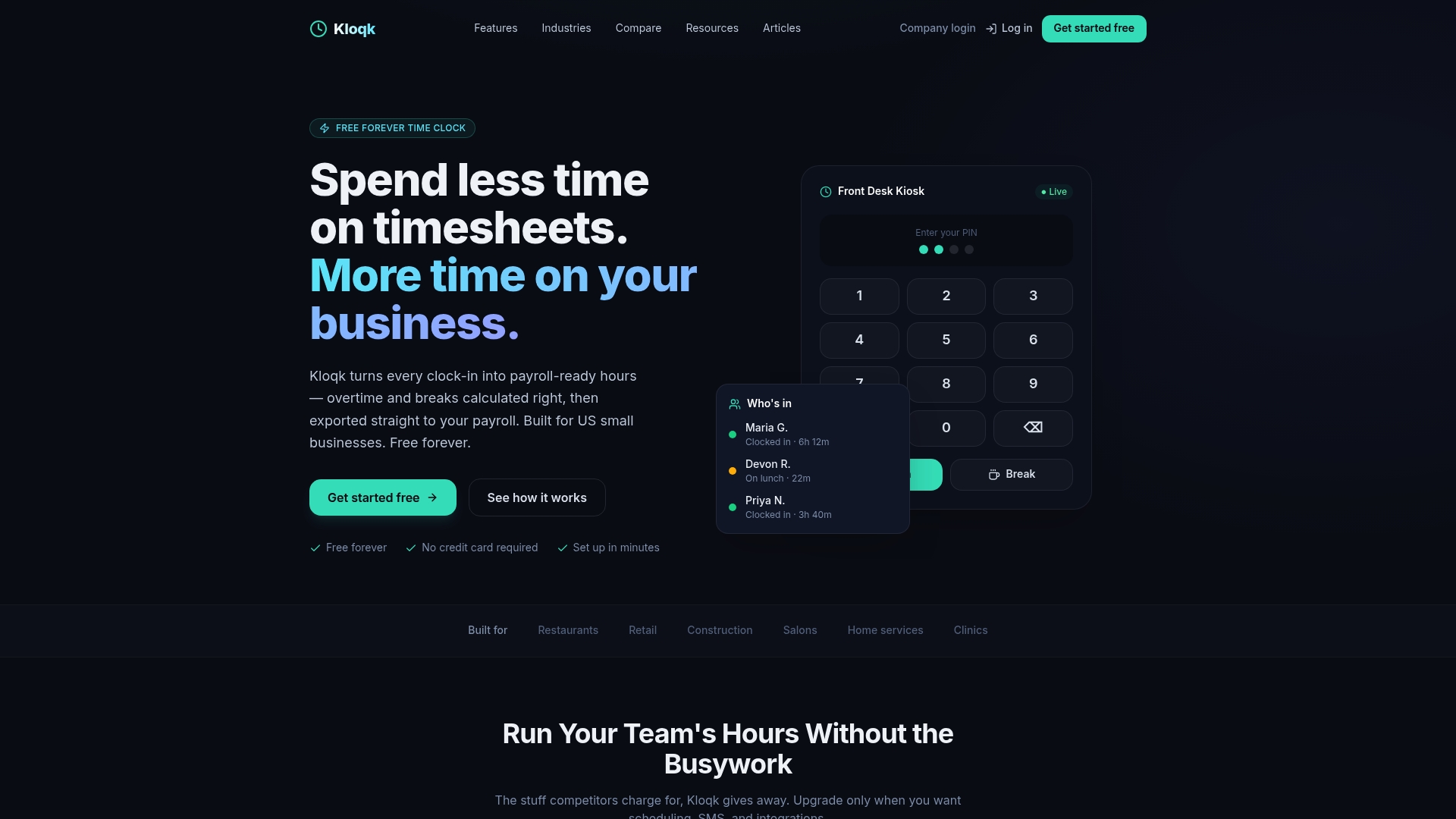
Kloqk is time clock software for small businesses in restaurants, retail, construction, clinics and salons. The Free plan turns clock-ins into payroll-ready hours with overtime and break calculations, photo verification, team dashboards, payroll exports, and mobile and kiosk punching, so a franchise location or a city office can put a shared tablet at the door.
If you need more, Pro is $29 per month per location and Premium is $59 per month per location. Both are optional, and the features available on each are listed on the pricing page. For job sites and multiple locations, our GPS time clock with geofencing ties punches to where people actually are. You can start with free time clock software for small business or see employee time tracking in detail.
FAQ
Is there a legal minimum shift length in the US?
Not at the federal level. The FLSA does not regulate scheduling, so in most states you can schedule a shift of any length. A few states, including California, Massachusetts, New York and Rhode Island, require reporting-time pay when an employee shows up and gets less work than scheduled.
Do I have to pay for four hours if I send someone home early?
Only in some places. New York and D.C. set four-hour-based minimums, while California uses half the scheduled shift with a two-hour floor and four-hour cap. Most other states require payment only for the hours worked, so check your state labor department.
Does reporting-time pay apply if I cancel the shift ahead of time?
Usually not, because the employee never reported. A Massachusetts practice guide says nothing is owed when the employer calls before the report time to cancel. Many states also excuse the payment when you made a good-faith effort to give advance notice, so keep proof of when and how you told the employee.
Do I have to give a break on a seven-hour shift?
The FLSA does not require breaks. State rules vary: Illinois requires a meal period at 7.5 continuous hours, California requires paid 10-minute rest periods for every four hours or major fraction, and many states require nothing. Check your state’s rule before setting break policy.
Do exempt salaried employees get reporting-time pay?
The reporting-time rules apply to nonexempt employees. Exempt salaried employees generally fall outside them, though whether someone is truly exempt depends on the duties and salary tests, so confirm classification before relying on it.
Sources
- Questions and Answers About the Fair Labor Standards Act (US Department of Labor)
- Handy Reference Guide to the Fair Labor Standards Act (US Department of Labor)
- Maximum/Minimum Hours Worked (North Carolina Department of Labor)
- Reporting Time Pay FAQ (California DLSE)
- Reporting Time Pay FAQ, exceptions and remote reporting (California DLSE)
- State and City Laws and Regulations on Fair and Flexible Scheduling (A Better Balance)
- Reporting Time Pay Fact Sheet (National Women’s Law Center)
- Reporting Time Pay Varies By State Explained (Labor Law Education Center)
- Mass-Peculiarities (Seyfarth Shaw LLP)
- Fact Sheet 56B: State and Local Scheduling Law Penalties and the Regular Rate (US Department of Labor)
- 29 CFR 778.220, Show-up or reporting pay (Cornell Legal Information Institute)
- Minimum Length of Meal Period Required under State Law (US Department of Labor)
- Minimum Paid Rest Period Requirements under State Law (US Department of Labor)
- Connecticut Employment Law 2026 (RemoteLaws)
Recommended
Sources
Every figure on this page traces to one of these. Primary law and government sources are listed first.
- 1. U.S. Department of Laborprimary
- 2. California Department of Industrial Relationsprimary
- 3. Cornell Legal Information Instituteprimary
- 4. labor.nc.gov
- 5. seyfarth.com
- 6. laborlawcenter.com
- 7. abetterbalance.org
- 8. nwlc.org
- 9. remotelaws.com
Written by
Kloqk teamKloqk
Written by the people who build Kloqk's time clock, timesheets and payroll exports. Prices and laws link to the source we checked, with the date we checked it.
Keep Reading
Track Hours the Easy Way
Kloqk is a free time clock that handles punches, breaks, overtime, and payroll-ready reports.
Start free