Texas Break Laws: What Employers Must and Must Not Do

Texas does not require private employers to give adult employees meal breaks or rest breaks. Federal law doesn’t either. But once you offer a break, federal wage rules decide whether you have to pay for it, and that is where most Texas employers get into trouble.
This guide covers what the rules say, when a lunch break turns into paid time, and how to keep clean records.
TL;DR
- Texas has no state meal or rest break requirement for adult workers, and federal law does not require lunch or coffee breaks either.
- Short breaks of about 5 to 20 minutes that you offer must be paid. Real meal periods of 30 minutes or more can be unpaid only if the employee is fully relieved of duty.
- If an employee works during an unpaid lunch, you owe pay for that time, even if your policy says no work.
- Some breaks are required anyway: nursing mothers’ pumping breaks and reasonable accommodations under the ADA.
- Write a break policy and record punches so you can prove what happened.
Table of Contents
- Are breaks required in Texas?
- Texas lunch break rules: when a meal break can be unpaid
- Texas rest break rules: short breaks are paid
- Breaks Texas employers must allow
- How breaks affect overtime
- A practical Texas break policy
- Perspective
- Tracking Texas breaks with Kloqk
- FAQ
- Sources
Are breaks required in Texas?
No. The Texas Workforce Commission states that neither Texas nor federal law generally requires employers to provide meal or rest breaks. Where a state doesn’t require breaks, the Department of Labor says they are a matter of agreement between employer and employee.
That answers a common question: if you work a five-hour shift, nothing in federal law requires a lunch or other break. Your employer’s policy or an agreement may still provide one.
It also means that a boss who skips breaks isn’t automatically breaking the law. The legal risk lies in how you pay and record time, not in whether you offered a break.
How long can someone work without a break?
There is no Texas rule on the longest stretch without a break. The Texas Workforce Commission also says that, with narrow exceptions for certain regulated industries or collective bargaining agreements, adults and 16- and 17-year-olds may work, and may be required to work, unlimited hours in a day. Texas generally has no maximum shift length for adults.
That does not mean unlimited hours are free. For most nonexempt employees, overtime is owed for hours over 40 in a seven-day workweek. A long shift with no break costs you overtime and also tends to cost you in fatigue and mistakes. The Texas Workforce Commission itself notes that skipping reasonable breaks can lead to burnout, fatigue and lower motivation.
Does the same apply in Dallas, Houston or San Antonio?
Yes. These are state and federal rules, and the cities don’t add their own meal break mandates for private employers. If you run several locations across Texas, one policy covers them all. If you also have staff in another state, check that state separately, because places like California and Washington do require breaks.
Texas lunch break rules: when a meal break can be unpaid
Under federal rules, a bona fide meal period, typically 30 minutes or more, is not work time and need not be paid. The condition is that the employee is completely relieved from duty. Fact Sheet #22 explains the same test.
You may set the terms of the meal break: when it happens, how long it lasts, where it can be taken, and whether any work is allowed. But the details matter.
The “working lunch” trap
The Texas Workforce Commission is direct on this: duties performed while trying to eat make the meal time compensable. Texas school-board HR advisers make the same point: even if you forbid work during lunch, you must pay the employee if work is performed anyway.
Common situations that turn unpaid lunch into paid time:
- A cashier eats at the register and answers customers.
- A front-desk worker eats at her desk and picks up the phone.
- A foreman eats on site and takes calls from subcontractors.
- A clinic employee is told to stay available for patient questions.
If employees stay at their desks where they can be interrupted, a “no work” rule is hard to enforce. The safest approach is to have people step away, or to pay for the time.
Short lunches
A 20-minute lunch is not a bona fide meal period in the federal framework. Short rest periods, usually 20 minutes or less, must be counted as hours worked. If your shop gives a 15- or 20-minute lunch, pay for it.
For more on the pay side, see our guide on whether lunch breaks are paid and our Texas lunch break guide.
Texas rest break rules: short breaks are paid
No Texas law requires 10- or 15-minute rest breaks. But if you give them, the Department of Labor says short breaks, usually 5 to 20 minutes, are compensable hours. Short rest periods promote efficiency and are customarily paid as working time.
So a smoke break, a coffee break and a bathroom break are all paid time if the employer allows them. You can’t deduct them from a timesheet.
Employees who stretch their breaks
You are not stuck paying for abuse. The DOL says you may refuse to count unauthorized extensions of breaks as hours worked if you’ve clearly communicated that break limits are strict and that extensions will be disciplined. The Texas Workforce Commission likewise says employers may use disciplinary processes for unauthorized extensions or unauthorized work during breaks.
The key word is communicated. Put the limits in writing, and apply them the same way to everyone.
Breaks Texas employers must allow
The lack of a general rule has exceptions.
Nursing mothers. Under the 2010 health care reform law, the FLSA requires employers to allow reasonable break times for a nursing mother to express breast milk during the first year after the child’s birth.
Disability accommodations. Under the ADA, employers with 15 or more employees must provide reasonable accommodations, which may include additional breaks for employees with a disability, unless that creates an undue hardship. If someone asks for this, talk to your HR adviser or employment attorney before you say no.
Contracts and policies. If your handbook, offer letter or a collective bargaining agreement promises a lunch break, you’ve made it a commitment. Follow it.
Long on-call shifts. For employees on duty for 24 hours or more, federal rules allow excluding a sleep period of up to 8 hours only if adequate sleeping facilities exist, uninterrupted sleep is usually possible, and at least 5 hours are actually taken.

How breaks affect overtime
Break handling and overtime are tied together. If an employee works through an unpaid 30-minute lunch and the system still subtracts it, you’re underpaying. Do that daily for a few weeks and a worker can slip past 40 hours without anyone noticing.
Here is a simple example. A line cook clocks 8:00 to 4:30 five days a week, with a 30-minute auto-deducted lunch. If he actually worked through lunch on three days, you owe 1.5 extra hours that week. Combined with a few early starts, that can push him over 40 hours, and the extra time is owed at the overtime rate. Our piece on meal break deductions and back pay walks through how this becomes a claim.
Rounding can also hide errors. See the FLSA time rounding rules before you round punches around breaks.

A practical Texas break policy
You don’t need to over-engineer this. A short written policy goes a long way.
- State your schedule. For example: one unpaid 30-minute meal period for shifts over six hours, and two paid 10-minute breaks.
- Define “relieved of duty.” Employees leave the work area, silence work phones, and no one assigns tasks.
- Say what happens if lunch is interrupted. The employee reports it, and the time is paid.
- Set limits on break length. State that unapproved extensions are not paid and may lead to discipline.
- Cover protected breaks. Mention lactation breaks and the process for accommodation requests.
- Require punches. Employees clock out and back in for unpaid meals.
If you want starting language, our break policy examples can be adapted. For tracking details, see meal break tracking for small businesses.
Perspective
Most break disputes we see are not about whether a break was offered. They come from records that nobody can trust. A timesheet shows a flat 30-minute deduction, the employee says they worked through it, and the owner has nothing to prove otherwise.
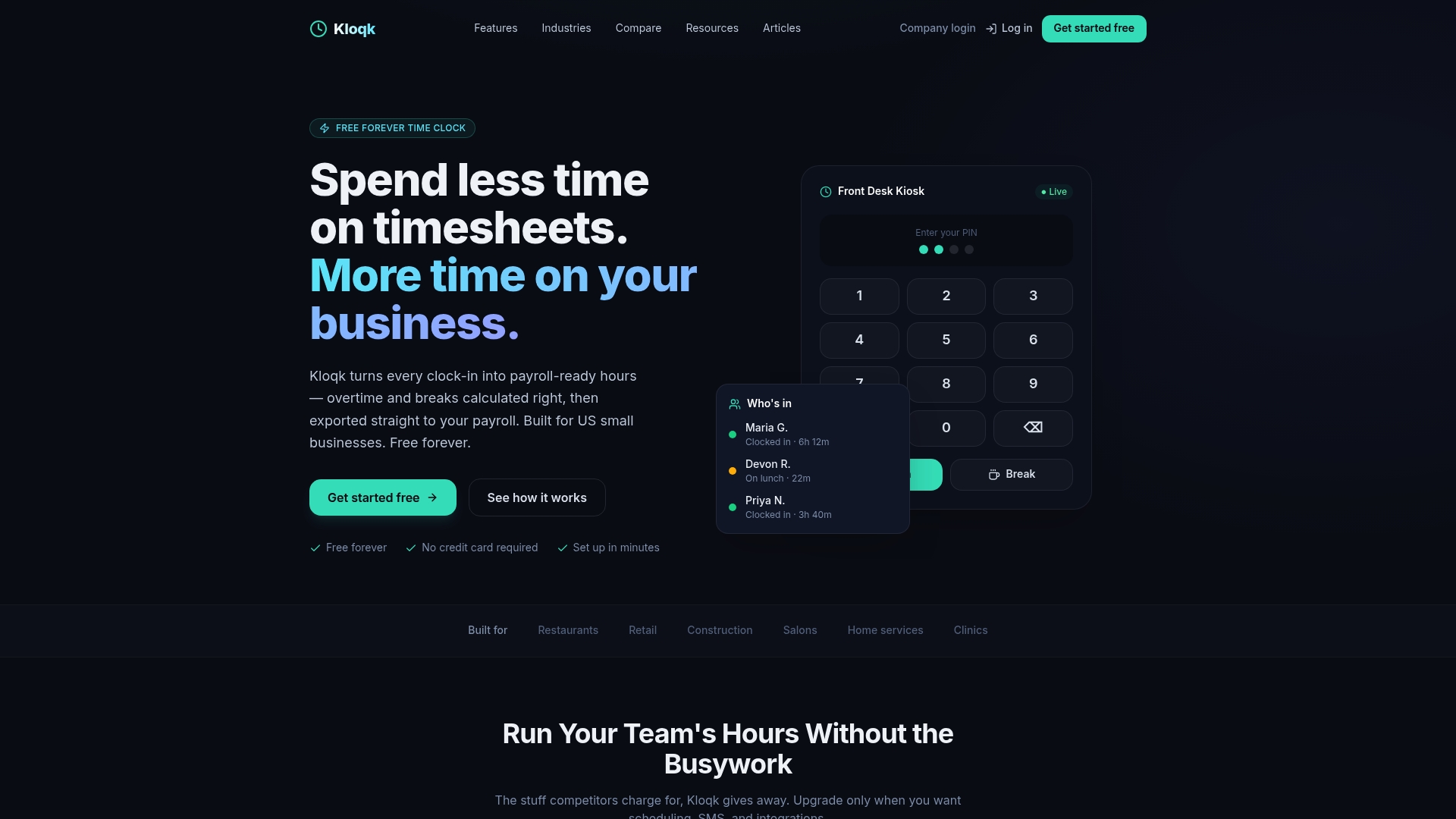
That’s why we built break tracking into the free core of our time clock. Employees punch out and in for meals, overtime is calculated from real punches, and the hours export payroll-ready. Photo verification and geofencing help show that a punch happened where and when it should have. For a restaurant or a construction crew, that is the difference between guessing and knowing.
We think a small business shouldn’t have to pay to get accurate breaks and overtime. So the basics are free, and upgrades are there only if you need them.
Saad
Tracking Texas breaks with Kloqk
Kloqk’s free plan includes payroll-ready timesheets, overtime and break calculations, photo verification for clock-ins, mobile and kiosk punching, and payroll exports, with unlimited employees. If you need scheduling, PTO or GPS geofencing, the Pro plan is $29 per month per location and Premium is $59 per month per location, as shown on the pricing page.
Start with our free time clock software for small business, or look at the GPS time clock with geofencing for crews working across job sites.
FAQ
Do employers have to give a lunch break in Texas?
No. Neither Texas nor federal law requires employers to provide meal breaks to adult employees. If you do give one of 30 minutes or more and the employee is fully relieved of duty, it can be unpaid.
Are 15-minute breaks required in Texas?
No law requires them. If your business offers short breaks of roughly 5 to 20 minutes, they must be paid and counted as hours worked.
Can an employer make me work through lunch without pay?
No. If you perform work during a meal period, the time is compensable even if company policy says you shouldn’t work. Report it to your manager or payroll, and keep a record of when it happened.
Is there a limit to how many hours I can work straight in Texas?
For most adults, the Texas Workforce Commission says there is no daily maximum. Overtime pay still applies after 40 hours in a workweek for most nonexempt employees.
Do minors have different break rules in Texas?
The research used here covers adults and 16- and 17-year-olds, who have no daily hour cap in most cases. Younger teens face separate child labor limits, so check with the Texas Workforce Commission before scheduling anyone under 16.
Sources
- Texas Workforce Commission: D. Breaks
- U.S. Department of Labor: Breaks and Meal Periods
- U.S. Department of Labor: Questions and Answers About the FLSA
- U.S. Department of Labor: Fact Sheet #22, Hours Worked
- Texas Workforce Commission: Work Schedules
- Texas Workforce Commission: Hours Worked, General
- Texas Workforce Commission: Texas Business Today, December 2022
- TASB: Ask HR Services, Meal Breaks
Recommended
Sources
Every figure on this page traces to one of these. Primary law and government sources are listed first.
- 1. U.S. Department of Laborprimary
- 2. efte.twc.texas.gov
- 3. twc.texas.gov
- 4. tasb.org
Written by
Dana WhitfieldHR Compliance Lead
Dana writes about wage-and-hour law, FLSA overtime, and leave compliance for U.S. small businesses, translating dense regulations into plain steps owners can act on.
Keep Reading
Track Hours the Easy Way
Kloqk is a free time clock that handles punches, breaks, overtime, and payroll-ready reports.
Start free