Two Week Pilot to Prove GPS Crew Time Tracking Without Surveillance

GPS crew time tracking ties a timestamp to a location, so a clock-in stamped “7:02 AM” also carries proof the worker was standing at the job site, not still parked at the shop. That single pairing settles most payroll disputes before they start. If you’re evaluating a system for your crew, focus on three things first: geofence controls, photo verification, and clean payroll export. Everything else is secondary.
TL;DR:
- Effective GPS crew time tracking should prioritize geofence buffers, photo verification, and simple payroll export formats compatible with state rules.
- GPS accuracy issues indoors or under heavy cover require buffer zones of 50 to 150 feet to prevent false rejects of legitimate punches.
- Rolling out GPS tracking should start with small pilots, clear policies, and phased scaling to prevent worker resistance and data collection issues.
- Tracking should focus on clock-in/out events with verification rather than continuous location pings to protect privacy and ensure legal compliance.
- Employing a well-configured system that captures geofencing, photo proof, and exports payroll data properly ensures legal use and reduces payroll disputes.
Table of Contents
- How Does GPS Crew Time Tracking Work?
- What Features Actually Matter for Crew-Based Teams?
- Is GPS Time Tracking Legal, and What Do You Have to Do?
- How Do You Roll Out GPS Time Tracking Without Chaos?
- What Goes Wrong With GPS Time Tracking, and How Do You Fix It?
- Verification Beats Surveillance
- Get Payroll-Ready GPS Tracking Without a Software Bill
- Sources
- FAQ
How Does GPS Crew Time Tracking Work?
The mechanics are simpler than most vendors make them sound. A worker opens an app or taps a kiosk, the device grabs a GPS coordinate along with the timestamp, and that pair gets logged as the clock event. From there, the system either accepts the punch, flags it, or blocks it depending on where the coordinate falls relative to a job site.
Most platforms build this around four moving parts:
- Clock-in/out capture: the app records latitude, longitude, and time at the moment of the punch, not a continuous trail.
- Geofencing: a virtual boundary around a job site that either restricts punches to inside the zone or flags punches made outside it.
- Breadcrumbs or periodic pings: some systems log a location point every so often during a shift to confirm the crew stayed on site, though this is optional and raises privacy questions covered later.
- Photo metadata: a selfie or job-site photo taken at clock-in, often stamped with the same coordinates, adds a second layer of proof.
Once captured, that data moves through a fairly standard path: the mobile app sends the punch to a cloud server, the server converts raw punches into a timesheet with regular and overtime hours split out, and the timesheet exports to payroll, either as a report you download or a direct feed into your payroll processor. The best systems compress that whole chain into something a foreman can operate without a manual. The worst ones require a supervisor to manually reconcile GPS pins against a spreadsheet every Friday, which defeats the purpose entirely.
One detail that trips up a lot of first-time buyers: GPS accuracy indoors or under heavy tree cover can drift by 50 feet or more, so a tight geofence around a small job site sometimes rejects legitimate punches. That’s not a bug in the software. It’s a limitation of GPS itself, and it’s why buffer zones matter more than most sales reps will tell you.
What Features Actually Matter for Crew-Based Teams?
A lot of GPS time tracking software looks identical on a features page. The differences show up once your crews are actually using it in the field, especially in the six areas below.
-
Geofence behavior and buffers: look for adjustable radius settings and a grace buffer (commonly 50 to 150 feet) so a punch made near the edge of a site doesn’t bounce for no reason.
-
Enforcement mode: some systems only flag out-of-zone punches for manager review; others block the punch outright. Field crews with legitimate reasons to clock in from a truck or trailer need the flexible option.
-
Photo verification tied to location: a timestamped photo with embedded coordinates makes buddy punching (one worker clocking in for another) far harder to pull off, and it gives you a visual record if a dispute ever reaches a labor board.
-
Offline capture: rural job sites, basements, and parking structures kill signal constantly. A system that queues the punch locally and syncs once connectivity returns is not optional for construction or utility crews.
-
Payroll export formats: check that the export handles overtime rules and rounding correctly for your state, not just a generic CSV dump you have to reformat by hand.
-
Sampling strategy: event-based tracking (clock-in, clock-out, maybe a lunch break) uses far less battery and raises fewer privacy flags than continuous tracking that pings every few minutes.
Integration matters too. If your GPS time tracker doesn’t talk to your payroll processor or accounting software, you’re just trading a paper timesheet problem for a digital one. Look for direct payroll exports rather than a system that forces you to re-key hours.
Pro Tip: Test the geofence buffer on your worst-signal job site before rolling out to the whole crew. If punches fail there, they’ll fail everywhere similar, and you’ll spend your first month fielding complaints instead of collecting clean payroll data.

Practitioner guidance on geofencing for time tracking consistently points to automated clock-in/out as the feature that cuts buddy punching and ties labor costs to the correct job site, more than any other single feature on the list.
Is GPS Time Tracking Legal, and What Do You Have to Do?
Yes, GPS time tracking is legal for employers to use on work devices during work hours, but legality doesn’t mean you’re free of obligations. Two federal frameworks govern how you use it: the Fair Labor Standards Act (FLSA), enforced by the Department of Labor, and workplace privacy guidance from the Equal Employment Opportunity Commission (EEOC).
On the recordkeeping side, the Department of Labor requires employers to preserve payroll records for at least three years, and records used to compute wages, like time cards, for two years. GPS logs can serve as part of that record, but they don’t replace your underlying duty to pay for all hours actually worked. The FLSA Hours Worked Advisor makes clear that employers must exercise reasonable diligence in tracking hours, including unscheduled work a GPS punch might miss entirely, like a crew member who stays late to finish a task but forgets to clock the extra time.
That last point matters more than most employers realize: a Department of Labor field bulletin on remote and teleworking hours states that employers can’t ignore hours they had reason to know about, even if the employee never submitted a formal punch. Pairing your GPS system with a short exception-reporting process, where crews flag unscheduled work and a supervisor confirms it before payroll runs, closes that gap.
Privacy is the other half of the equation. The EEOC’s guidance on wearables and location-tracking devices warns that these tools can raise discrimination concerns, particularly if they capture health or genetic data alongside location. Employers should limit collection strictly to what’s needed for timekeeping and keep any incidental health data confidential and separate from location logs.
Four things belong on your compliance checklist before you flip the switch:
- A written GPS tracking policy explaining when tracking occurs, what data is captured, and how long it’s retained.
- Written notice to every employee, ideally with a signature acknowledging they’ve read it.
- A retention schedule matching or exceeding the DOL’s three-year payroll and two-year wage-computation minimums.
- A defined process for exception reporting, so unscheduled or off-site work still gets paid correctly.
Records retention floor: payroll records, 3 years. Wage-computation records (time cards, wage tables), 2 years. Build your data retention settings around those minimums, not around what feels convenient.
How Do You Roll Out GPS Time Tracking Without Chaos?
Rolling this out cold, to every crew, on every site, in week one is how you end up with a mutiny by week two. A staged approach gets you clean data and buy-in at the same time.
- Run a small pilot first. Pick one or two crews and one or two job sites. Set a baseline: how many payroll disputes did you handle last month, how long did processing take, how often did buddy punching or forgotten punches come up.
- Draft a narrow tracking policy. Spell out exactly when location is captured (clock-in and clock-out, not all day), how long records are kept, and who can access the data. Share it before the pilot starts, not after.
- Train crews and supervisors separately. Crews need to know how to punch correctly and what to do if a geofence rejects them. Supervisors need to know how to review exceptions without treating every flagged punch as a red flag on the worker.
- Configure your technical safeguards before go-live. Set accuracy thresholds so weak GPS signals don’t trigger false rejections, apply debounce logic so a jittery signal doesn’t fire multiple alerts for one event, and confirm offline sync actually works by testing it in a dead zone on purpose.
- Measure and adjust after two to four weeks. Compare disputed hours against your baseline, track how much time your payroll process saves, and check adoption. If a crew is still filling out paper timesheets on the side, something in the rollout didn’t land.
- Scale once the pilot numbers hold up. Expand site by site rather than company-wide, and keep tuning geofence radii as you add locations with different signal conditions.
Pro Tip: Ask your pilot crew directly what confused them in week one. Foremen will tell you more about a clunky geofence buffer in five minutes than any analytics dashboard will show you in a month.
Combining GPS verification with a lightweight exception-reporting channel, where crews submit brief notes on unscheduled work for supervisor sign-off, satisfies the Department of Labor’s reasonable-diligence standard while keeping your data clean for job costing.
What Goes Wrong With GPS Time Tracking, and How Do You Fix It?
Most GPS time tracking failures aren’t software bugs. They’re configuration choices that seemed reasonable on paper and fell apart in the field.
- Continuous tracking instead of event-based capture creates a mountain of location data you don’t need and a privacy problem you didn’t ask for. Stick to clock-in, clock-out, and maybe a lunch break punch unless you have a specific operational reason for more.
- Raw GPS jitter triggering false alerts. Consumer GPS chips drift, especially near tall buildings or under dense cover, so a stationary worker’s coordinate can wander enough to look like movement. Systems that apply accuracy filtering and a debounce delay, waiting for a sustained change before firing an alert, cut this noise dramatically.
- Geofences sized too tight. A 50-foot radius around a small commercial site sounds precise, but it rejects legitimate punches from anyone parked at the curb. Widen the buffer and test it against your worst-signal location before rollout.
- Alert fatigue for managers. If every out-of-zone punch pings a supervisor’s phone, they’ll start ignoring the notifications within a week. Aggregate exceptions into a daily or shift-end summary so managers only see what’s actually payroll-relevant.
None of these problems require ripping out the system and starting over. They require adjusting thresholds, buffers, and notification rules until the tool matches how your crews actually move through a workday.
Verification Beats Surveillance
The instinct with any new tracking tool is to capture everything, all the time, just in case. That instinct is wrong for crew time tracking, and it’s wrong for a reason most software vendors won’t say out loud: more data doesn’t mean more accurate payroll. It means more noise, more privacy exposure, and more chances for an employee to feel watched rather than trusted.

Event-based verification, a clock-in stamp, a clock-out stamp, maybe a photo, does the job a continuous breadcrumb trail claims to do, without the legal and morale baggage. It answers the only question payroll actually needs answered: was this person at the job site when they said they were? Constant location pings answer a different question, one about surveillance, and most small businesses have no legitimate need to ask it.
The businesses that get this right treat the rollout as a communication project first and a technology project second. A policy that’s written down, shared before launch, and explained by a supervisor who can answer questions beats any feature list. An effective approach builds geofencing and photo verification around clock-in/out events rather than continuous tracking, reflecting the instinct to verify the moment that matters and leave the rest alone.
Saad
Get Payroll-Ready GPS Tracking Without a Software Bill
Kloqk gives you the core of GPS crew time tracking, geofencing, photo verification at clock-in, and payroll-ready exports, as permanently free features, not the trial-then-paywall model most competitors run. Unlimited employees, overtime and break calculations, and compliance-minded defaults come standard, with no card required to start.
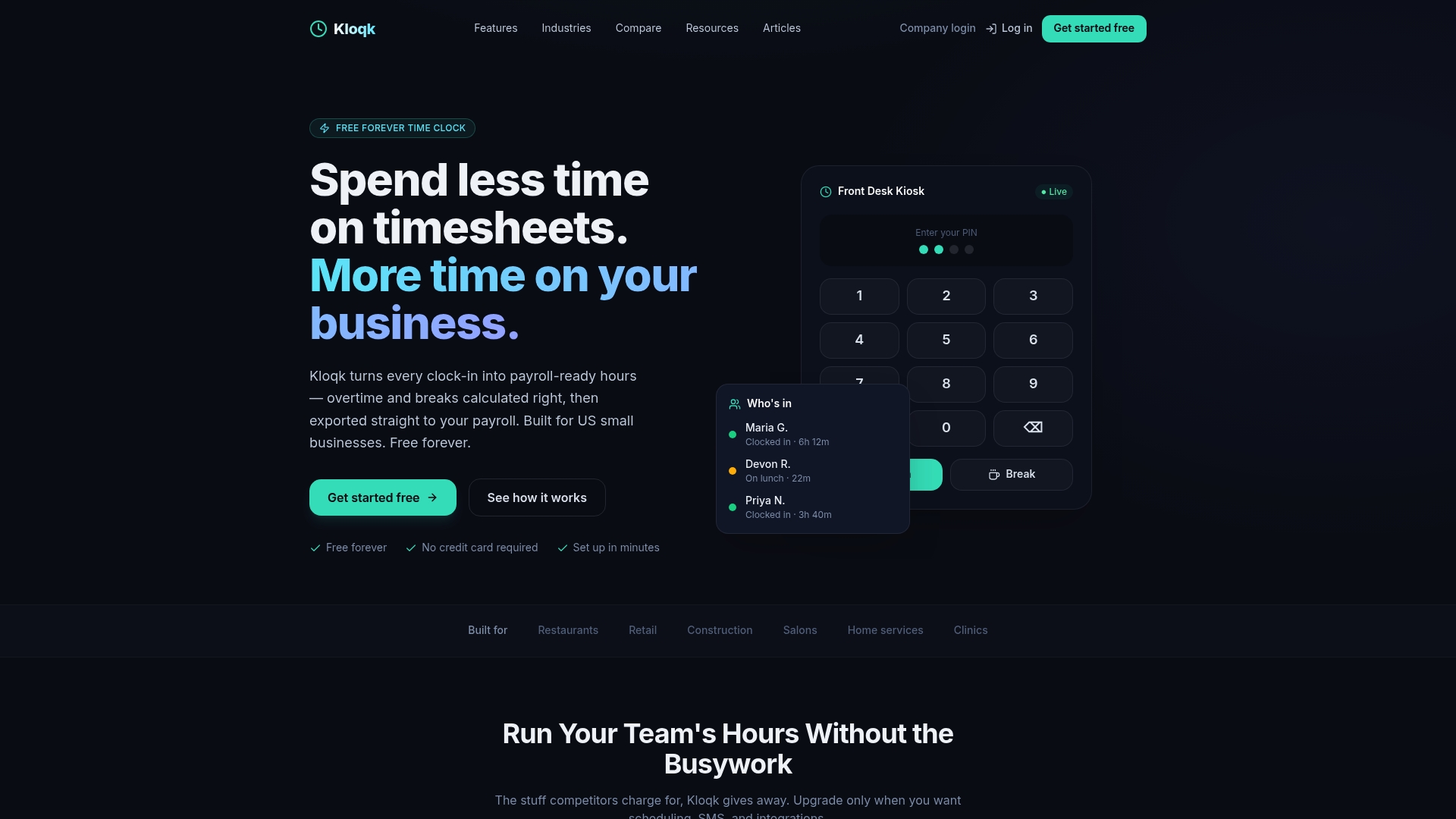
If your crews need more than the free core, scheduling, PTO tracking, or deeper integrations, Kloqk’s Pro plan runs $29 per month per location and Premium runs $59 per month per location, and both are optional upgrades, not gates on the features that already solve payroll accuracy and time theft. The GPS time clock with geofencing is built for exactly the pilot rollout described above: start small, test the geofence buffers on your toughest site, and scale once the numbers hold. Set up your first job site geofence today and run your own two-week pilot before your next payroll cycle closes.
Sources
For the recordkeeping rules referenced throughout this guide, the Department of Labor’s Fact Sheet #21 on FLSA recordkeeping requirements and the FLSA Hours Worked Advisor lay out what employers must track and preserve. The Department’s Field Assistance Bulletin No. 2020-5 covers the reasonable-diligence standard for remote and unscheduled hours. On privacy, the EEOC’s wearables and location-tracking fact sheet outlines discrimination and confidentiality safeguards. For deployment mechanics, MyShyft’s geofencing guidance and Kloqk’s geofencing explainer both cover practical setup.
- Fact Sheet #21: Recordkeeping Requirements under the Fair Labor Standards Act (FLSA) | U.S. Department of Labor
- FLSA Hours Worked Advisor | elaws
- Geofencing for time tracking | MyShyft blog
FAQ
What Is the Best Employee Time Tracking App With GPS?
The best option for most small crews is one that ties GPS to clock-in and clock-out events rather than continuous tracking, paired with geofencing and photo verification. Kloqk offers these as free core features, including payroll-ready exports, which makes it a strong starting point for crews that don’t want to pay for basics.
How Do You Keep Track of Staff Hours in the Field?
Most field crews rely on a mobile time clock app that captures GPS coordinates at each punch, often paired with a geofence around the job site to confirm the worker was actually there. Photo verification at clock-in adds a second layer of proof and helps prevent one worker punching in for another.
Can GPS Track Time?
GPS itself only records location and a timestamp; time tracking software combines that coordinate with the clock event to build a verified timesheet entry. The system then converts those verified punches into payroll-ready hours, splitting regular time from overtime automatically.
Is It Legal for Employers to Track Employees With GPS?
Yes, GPS tracking of employees during work hours on work devices is legal, but employers still have to follow FLSA recordkeeping rules and EEOC privacy guidance. That means a written policy, employee notice, limits on what data gets collected, and keeping payroll records for at least three years as the Department of Labor requires.
Recommended
Sources
Every figure on this page traces to one of these. Primary law and government sources are listed first.
- 1. U.S. Department of Laborprimary
- 2. U.S. Department of Laborprimary
- 3. myshyft.com
Written by
Marcus ReyesPayroll & Timekeeping Specialist
Marcus covers payroll accuracy, timesheets, and time tracking, the unglamorous mechanics that keep paychecks correct and audits painless.
Keep Reading
Track Hours the Easy Way
Kloqk is a free time clock that handles punches, breaks, overtime, and payroll-ready reports.
Start free