The Role of Location-Based Timekeeping in Field Work

Location-based timekeeping captures GPS coordinates at the exact moment an employee clocks in or out, creating a verified, time-stamped record of where work actually happened. For managers running mobile crews, field technicians, or multi-site teams, this is the difference between trusting a handwritten timesheet and knowing, with a digital audit trail, that your crew was on site when they said they were.
The shift from paper timesheets to GPS-verified clock-ins addresses several problems at once:
- Time theft and buddy punching are blocked when a clock-in requires physical presence at a verified location.
- Payroll errors from memory-based entries drop sharply when the system records hours automatically.
- Compliance with federal and state labor laws becomes easier to demonstrate when every clock-in carries a tamper-evident timestamp.
- Dispute resolution speeds up because both employer and employee can reference the same objective record.
- Job costing gets sharper when hours are tied to specific sites rather than lumped into a weekly total.
The technology works best for workforces that move. Construction crews, field service technicians, cleaning teams, and delivery drivers all operate in environments where traditional punch clocks are impractical. For a fixed office where everyone sits at the same desk every day, GPS adds little. But for anyone managing people across locations, the role of location-based timekeeping is straightforward: it replaces guesswork with a verifiable record.
How location-based timekeeping technology actually works
GPS timekeeping relies on the same satellite network your phone uses for navigation, but the application is narrower and more purposeful. When an employee taps “clock in” on a mobile app, the device queries GPS satellites to determine its coordinates. That location is captured at clock-in, time-stamped, and stored alongside the employee’s record. No continuous tracking. No live map of where your crew is walking. Just a single coordinate snapshot tied to a specific moment.
There are three distinct approaches, and choosing the right one matters:
- Point geolocation: Records location only at clock-in and clock-out. The least invasive option and sufficient for most field businesses.
- Geofencing: Defines a virtual boundary around a job site. When an employee clocks in, the system notes whether they were inside or outside that zone and logs it accordingly.
- Continuous tracking: Monitors location throughout the shift. Legally and ethically appropriate only for roles where travel is the core job function, such as delivery or logistics.
Geofencing works best as an informational tool, not a gate. The system records whether a clock-in happened inside or outside the defined zone, and the manager reviews any patterns that look off. Blocking a clock-in entirely because an employee is outside the zone creates compliance risk and erodes trust without adding meaningful accuracy.
Data flows from the employee’s device to a secure server, where it is encrypted and stored with a tamper-evident timestamp. Geofencing can reduce forgotten hours and provide automatic clock-in triggers, but it requires careful setup to avoid GPS drift causing false readings. Privacy by design means the system collects only what it needs: a location at clocking, not a continuous trail.
What are the real benefits of GPS time tracking for your business?

The most immediate gain is accuracy. Manual timesheets depend on memory, and memory is unreliable, especially at the end of a long week on a busy job site. GPS-verified clock-ins provide tamper-evident audit trails that manual records simply cannot match, and that difference shows up directly in payroll.
The location-based time tracking advantages extend well beyond accuracy:
- Buddy punching prevention: A clock-in tied to GPS coordinates (and optionally a photo) cannot be faked by a coworker clocking in on someone else’s behalf.
- Faster payroll processing: Hours flow from the app to your payroll system with the location data already attached, cutting the reconciliation step that eats up hours every pay period.
- Better job costing: When hours are tagged to a specific site, project managers can see exactly how much labor each job consumed, which tightens estimates on future bids.
- Reduced disputes: Employees and managers share the same objective record. When a disagreement arises, the digital trail resolves it without the back-and-forth of competing memories.
- Stronger compliance posture: The Fair Labor Standards Act requires employers to maintain accurate records of hours worked. A GPS-verified system makes that requirement easier to satisfy and easier to prove during an audit.
- Fairer treatment across the team: The same rules apply to everyone. No one gets credited for hours they did not work, and no one loses pay because a paper slip was lost.
Pro Tip: Tie your GPS timekeeping data directly to your job cost codes from day one. Retrofitting that connection later is painful, and the project-level visibility is where field businesses see the clearest return.
Field businesses achieve fast ROI with GPS timekeeping by cutting administrative overhead and improving mileage tracking accuracy. The savings are mostly indirect: less time spent correcting records, fewer missed billable hours, and faster invoice preparation.
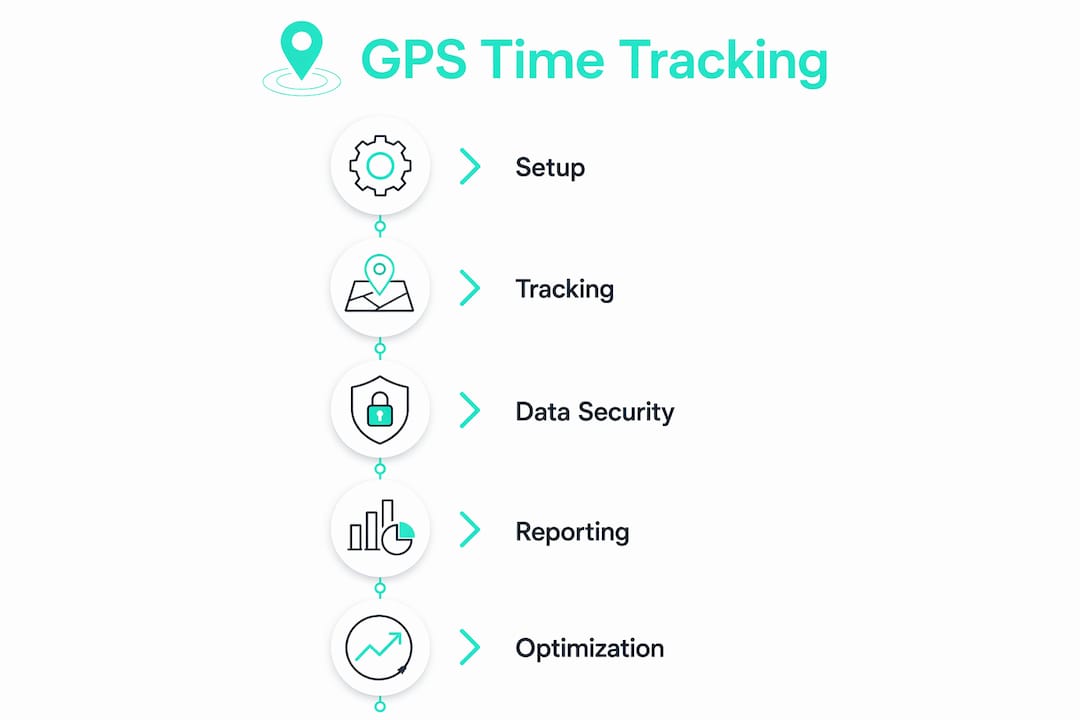
Best practices for rolling out location-based timekeeping in your organization
The technology works. What determines whether your team actually uses it correctly is how you introduce it. Designing GPS timekeeping to reduce administrative complexity rather than enforce control is the single biggest factor in whether employees accept the system or quietly work around it.
Start here:
- Assess your actual mobility patterns first. If half your crew works from a fixed yard and half travels to job sites, you may only need GPS for the mobile group. Don’t apply tracking where it adds no value.
- Communicate the purpose clearly before launch. Tell your team what data is collected, who can see it, and what it will be used for. Ambiguity breeds suspicion.
- Use point geolocation or geofencing for most roles. Continuous tracking is disproportionate for anyone who is not driving or traveling as the core of their job.
- Keep the clock-in process simple. One tap, one confirmation. If the process takes more than 15 seconds, adoption drops.
- Train everyone, including managers. Supervisors need to know how to read the data and how to handle exceptions, not just employees.
- Set a clear correction process. GPS occasionally misfires. Define who can correct a record, under what circumstances, and with what documentation.
- Limit data retention to what the law requires. The FLSA requires employers to retain payroll records for at least three years. Keep location data for the period required and delete it afterward.
- Put your policy in writing. A one-page document covering what is tracked, when, who sees it, and how long it is stored protects both the business and the employee.
Providing employees flexibility to clock in from any location, while using geofences informationally, strikes the right balance between operational visibility and employee autonomy. The goal is a system people trust, not one they resent.
Compliance considerations for location-based timekeeping in the United States

US employers operate under a layered compliance framework when they collect employee location data. Getting this wrong creates legal exposure on two fronts: labor law and privacy law.
On the labor law side, the FLSA mandates accurate time and attendance records for all non-exempt employees. GPS timekeeping helps satisfy that requirement, but only if the system records all hours worked, including any time an employee spends traveling between job sites during a shift.
On the privacy side, the rules are less uniform. No single federal law governs employee location tracking, but several state laws impose consent and notice requirements. California, Illinois, and New York have the most active regulatory environments. The practical baseline for any US employer:
- Obtain written consent from employees before activating location tracking on their devices.
- Limit tracking to working hours only. Collecting location data outside work hours is a serious violation in most jurisdictions.
- Collect only what you need. Point geolocation at clock-in is sufficient for most compliance purposes. Continuous tracking requires a stronger justification.
- Maintain tamper-evident audit trails. If you face a wage dispute or a Department of Labor audit, your records need to show that they have not been altered.
- Do not use geofencing to block clock-ins. Preventing an employee from recording their hours because they are outside a defined zone creates wage theft risk. The geofence should flag the location, not block the record.
- Store data securely and delete it on schedule. Encryption, access controls, and a defined retention period are not optional.
Regulatory trends in 2026 are moving toward informational geofencing as the accepted standard. The direction of travel in labor regulation, reflected in recent compliance guidance on geolocation timekeeping, favors systems that record where a clock-in happened rather than systems that restrict when or whether it can happen at all.
Which industries get the most value from location-based time tracking?
Not every business needs GPS timekeeping. A 10-person accounting firm where everyone works from the same office gets nothing from it. But for businesses where employees move, the value is immediate and concrete.
- Construction: Crews travel to different sites daily. GPS clock-ins confirm which site each worker was at, which feeds directly into job costing and subcontractor billing. Job site time tracking eliminates the paper slip problem that plagues project-based billing.
- Field services and maintenance: HVAC technicians, plumbers, and electricians moving between client locations need a record that ties hours to each address. GPS does that automatically.
- Restaurants and retail with multiple locations: Employees who float between stores need a clock-in system that works at any location and records which one they were at.
- Sales teams: Field reps visiting clients all day have no supervisor watching them. A GPS-verified clock-in creates a record of client visits without requiring a manager to be present.
- Cleaning and janitorial services: Teams rotating through multiple client buildings need confirmation that the right person was at the right building at the right time.
- Professional services with hybrid work: Consultants and project managers splitting time between client sites and home offices benefit from location-verified clock-ins that clarify where billable hours were logged.
- Delivery and logistics: The one sector where continuous tracking is genuinely appropriate, because travel is the job itself.
Fixed-office employees are the clear exception. If your whole team works from one location, a simple web-based or kiosk clock-in is sufficient. Adding GPS tracking where it provides no operational value creates unnecessary friction and privacy concerns without any corresponding benefit.
How location-based timekeeping supports evolving US operational needs in 2026
The most important shift happening right now is conceptual. GPS timekeeping is moving from a disciplinary tool to a structural efficiency fix. Businesses that frame it as “we need to catch people lying” get resistance and low adoption. Businesses that frame it as “we need accurate data to run the operation” get buy-in.
The operational case is strong. GPS timekeeping shifts the burden from fallible human memory to objective digital event trails, simplifying payroll and reducing disputes. That is not a minor administrative convenience. For a construction company running 20 workers across four job sites, the time spent reconciling paper timesheets every week can easily consume several hours of management time. GPS eliminates most of that.
Privacy-respecting design is also becoming a competitive differentiator in hiring. Workers are more aware of their data rights than they were five years ago. A system that collects location only at clock-in, never outside working hours, and gives employees access to their own records is easier to recruit around than one that feels like surveillance.
Accurate location-based clock-ins eliminate uncertainty in multi-site workforce management, and the audit trail they create supports both labor law compliance and internal accountability. Tamper-evident digital records are increasingly what regulators expect to see when they review time and attendance practices. Businesses that still rely on paper or unverified digital entries are carrying a compliance risk that GPS timekeeping removes directly.
The ROI calculation is cleaner than most managers expect. Fewer payroll errors, faster invoice preparation, sharper project cost data, and less management time spent chasing down missing records all contribute. Field businesses see these gains often within the first few weeks of consistent use.
What GPS limitations should you plan around?
GPS is accurate under open sky. It gets unreliable in environments with physical obstructions, and construction sites are full of them. Steel-framed buildings, underground work areas, dense urban canyons, and basements all degrade GPS signal quality. The result can be coordinates that are off by dozens of meters, which triggers false geofence alerts or missed automatic clock-ins.
A few practical realities to build your setup around:
- Geofence radius matters. A 50-meter boundary around a job site will generate false negatives in areas with poor signal. A 200-meter radius is more forgiving and still operationally useful.
- Device quality varies. Older smartphones have less accurate GPS chips. If your crew uses company-issued devices, standardizing on models with reliable GPS hardware reduces variance.
- Battery and connectivity affect reliability. A dead phone cannot clock in. Low-battery mode often disables GPS to conserve power. Policies around device charging are part of a working GPS timekeeping setup.
- Manual correction must be possible. No GPS system is perfect. When a clock-in fails or records an obviously wrong location, your manager needs a simple, documented way to correct the record without creating a compliance gap.
- Hybrid approaches often work best. For teams with mixed mobility, combining GPS clock-ins for field workers with web-based clock-ins for office staff gives each group the right tool without forcing a one-size-fits-all solution.
The goal is not perfect GPS data. It is accurate enough data, with a clear correction process for the exceptions.
How should you protect employee location and time data?
Location data is sensitive. A record of where your employees were at specific times, even just at clock-in and clock-out, carries real privacy implications if it is mishandled. The security framework around that data needs to be deliberate.
The baseline requirements for any US employer collecting location data:
- Encryption in transit and at rest. Location records should be encrypted from the moment they leave the employee’s device to the moment they are stored on your server.
- Role-based access controls. Not every manager needs to see every employee’s location history. Limit access to the people who have a legitimate operational reason to view it.
- Audit logging for the system itself. Your timekeeping platform should log who accessed what records and when. If a record is altered, the system should capture that event.
- Defined retention and deletion schedules. Keep location data for the period required by law, then delete it. Holding data indefinitely creates unnecessary exposure.
- Vendor due diligence. If you use a third-party timekeeping platform, review its security certifications, data processing agreements, and breach notification policies before you go live.
- Employee access to their own records. Giving workers the ability to view their own clock-in history builds trust and catches errors before they become disputes.
The security posture of your timekeeping system is also a compliance question. A breach that exposes employee location data can trigger notification requirements under state privacy laws, and the reputational damage from that kind of incident is disproportionate to the cost of getting the security right from the start.
Kloqk gives small businesses a free GPS time clock with geofencing built in, designed specifically for the field and mobile work environments described throughout this article. Photo verification at clock-in prevents buddy punching. Geofencing records where each clock-in happened without blocking employees from recording their hours. Overtime calculations, break tracking, and payroll exports are included at no cost, so the system handles compliance and accuracy without adding administrative overhead.
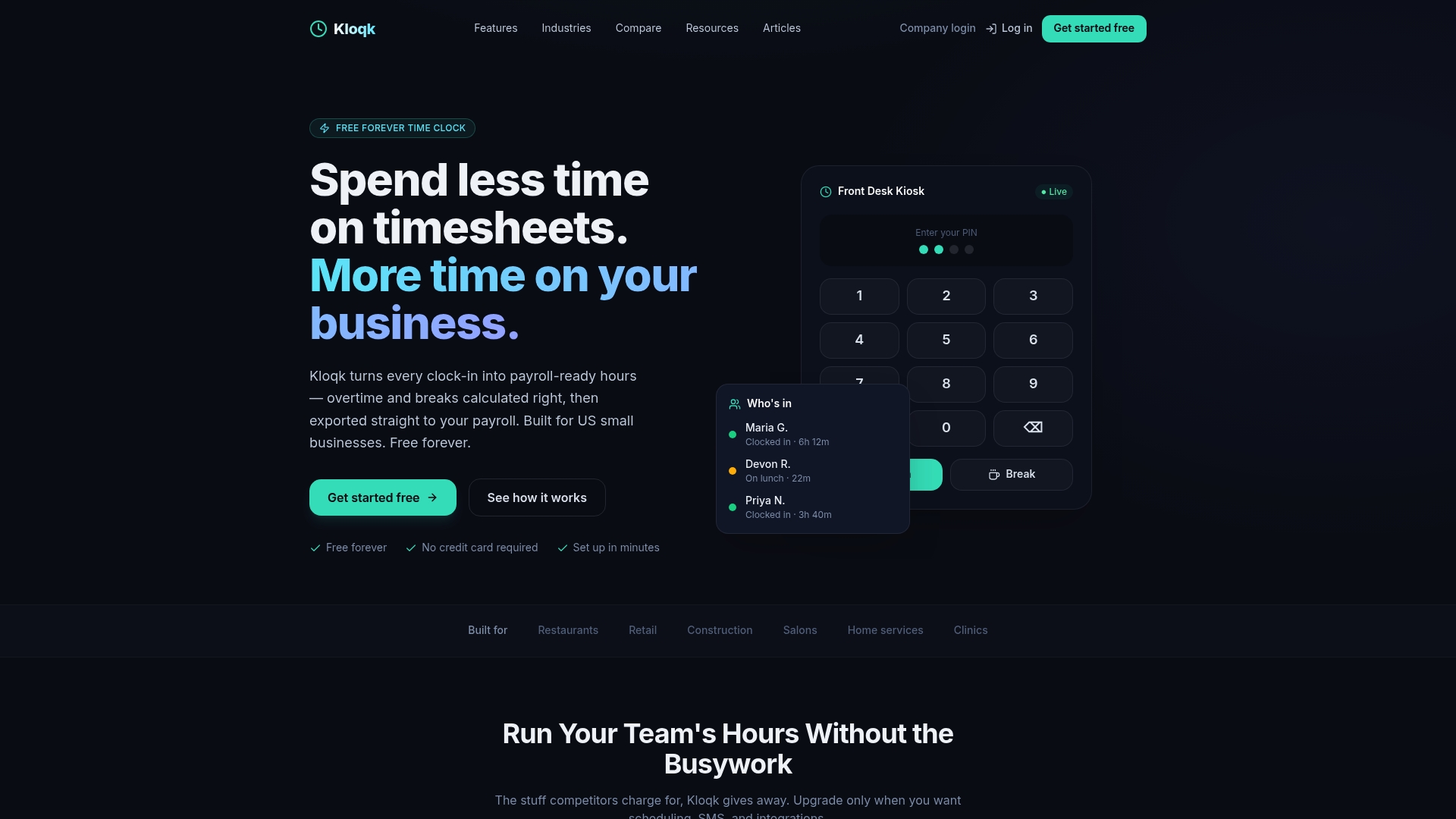
If your crew works across job sites, multiple locations, or anywhere a paper timesheet creates problems, Kloqk’s GPS time clock is built for exactly that environment. Free to start, no credit card required.
Key Takeaways
Location-based timekeeping replaces memory-dependent timesheets with GPS-verified, tamper-evident records that improve payroll accuracy, support labor law compliance, and give field businesses clear visibility into where hours are actually being worked.
| Point | Details |
|---|---|
| GPS captures location at clock-in only | Point geolocation records a single coordinate at clock-in, not a continuous trail, making it the least invasive and most widely appropriate option. |
| Geofences should inform, not block | Using geofences to flag off-site clock-ins is legally sound; using them to prevent clock-ins creates wage theft risk. |
| Compliance requires written consent | US employers must obtain employee consent before activating location tracking and must limit collection to working hours only. |
| Field businesses see fast operational ROI | Reduced admin time, fewer payroll disputes, and sharper job costing are the primary gains, often visible within the first project cycle. |
| Security and retention policies are mandatory | Encrypt location data, restrict access by role, and delete records on a defined schedule aligned with FLSA retention requirements. |
Recommended
Sources
Every figure on this page traces to one of these. Primary law and government sources are listed first.
- 1. U.S. Department of Laborprimary
- 2. mifichajelegal.com
Written by
Marcus ReyesPayroll & Timekeeping Specialist
Marcus covers payroll accuracy, timesheets, and time tracking, the unglamorous mechanics that keep paychecks correct and audits painless.
Keep Reading
Track Hours the Easy Way
Kloqk is a free time clock that handles punches, breaks, overtime, and payroll-ready reports.
Start free