HR Time Management Tools for Small Clinics: 2026 Guide

HR time management tools for small clinics are workforce management systems that automate staff scheduling, time tracking, and payroll exports within healthcare-specific labor rules. Small clinics face scheduling complexity that generic business software ignores: broken shifts, on-call periods, travel time between sites, and state labor compliance requirements all create payroll errors when managed manually. The right clinic staff management software eliminates those errors at the source. Switching from manual spreadsheets to automated scheduling cuts schedule build time from 5, 10 hours per month down to about 30 seconds. That time savings alone justifies the investment for most HR managers running a lean practice.
1. What are the key features of HR time management tools for small clinics?
The most effective HR management tools for healthcare handle scheduling complexity that generic apps cannot. A standard business time tracker records clock-in and clock-out. A healthcare-specific tool also captures broken shifts, on-call hours, sleepover allowances, and travel time between patient sites. Healthcare-specific software automates these conditions and feeds accurate data directly into payroll, cutting the manual reconciliation that burns HR hours every pay cycle.
Core features to prioritize:
- Automated shift scheduling that generates fair staff rotations without manual input
- Mobile clock-in and clock-out from phones or shared kiosks, with real-time attendance visibility
- GPS geofencing to confirm staff are clocking in from the correct location
- Healthcare labor rule support covering broken shifts, on-call pay, and overtime thresholds
- Payroll integration that exports timesheet data directly to accounting platforms
- Audit trails that document every schedule change for compliance reviews
- Low IT dependency with browser-based or app-based setup requiring no dedicated technical staff
Pro Tip: Before evaluating any tool, list every pay condition your clinic uses: broken shifts, on-call rates, travel allowances. Any tool that cannot automate those conditions will still require manual corrections every pay cycle.
Real-time visibility is a feature HR managers often undervalue until they need it. Coordinators who can see who is clocked in, where, and on which shift in real time can respond to no-shows immediately rather than discovering gaps after the fact.

2. Automated scheduling software
Automated scheduling software generates staff rotations based on availability, certifications, and shift rules without manual input. For a small clinic running rotating shifts across two or three providers, this removes the weekly scheduling task entirely. The software applies fairness rules automatically, distributing weekend and evening shifts evenly across the team.
The setup speed for purpose-built clinic tools is a genuine differentiator. Most clinics run fully configured schedules within 30 minutes of setup, compared to months-long implementations for hospital-grade enterprise systems. That speed matters when your HR team has no IT support and needs results this week, not next quarter.
3. Mobile-enabled time tracking
Mobile time tracking lets clinic staff clock in from a phone app or a shared tablet kiosk at the front desk. This works for single-location clinics and for practices with staff who travel between sites. The key requirement is real-time data sync so the HR manager sees attendance as it happens, not at the end of the day.
GPS geofencing adds a layer of accuracy that matters in healthcare. The system only accepts a clock-in when the staff member is physically within the defined boundary of the clinic or patient site. Kloqk includes GPS geofencing at no cost, which prevents time theft without requiring manual verification by the HR manager. Photo verification at clock-in adds a second layer, confirming identity without a supervisor present.
4. Timesheet software with healthcare award rules
Standard timesheet software records hours. Healthcare timesheet software records hours and applies the correct pay rates for each condition automatically. Broken shifts, where a staff member works a split day with an unpaid gap in the middle, carry a different pay rate in most state labor codes. On-call periods that convert to active duty mid-shift trigger overtime calculations. Manual timesheet systems miss these conditions regularly.
“Prioritize healthcare-specific automation of broken shifts and travel time to reduce payroll burnout and late pay cycles.”
The practical result of automating these rules is fewer payroll corrections. Payroll corrections are expensive in two ways: they cost HR time to fix, and they damage staff trust when pay arrives late or wrong. A tool that handles award interpretation automatically removes both costs.
5. Integrated payroll export functionality
Integration with payroll and accounting platforms eliminates double data entry. The timesheet data flows directly into the payroll run without manual re-entry. This reduces transcription errors and cuts the time HR spends reconciling hours before each pay cycle.
For small clinics using platforms like QuickBooks or Xero, direct integration means the payroll manager does not touch the timesheet data at all. The hours arrive formatted and ready. Kloqk offers payroll export functionality as part of its free tier, which is a meaningful cost advantage for clinics watching their software budget. You can learn more about digital timesheets in clinic HR to understand how this workflow change affects the full HR cycle.
6. Compliance-focused tools with audit trails
Labor compliance in healthcare is not optional. Federal overtime rules under the Fair Labor Standards Act (FLSA) apply to all clinic staff. State-level rules add additional requirements around break periods, shift lengths, and on-call pay. A compliance-focused time tracking tool logs every clock-in, clock-out, schedule change, and approval with a timestamp and user record.
That audit trail protects the clinic in a wage dispute or a Department of Labor audit. Manual records, whether paper or spreadsheet, rarely survive scrutiny because they lack the timestamp integrity that digital systems provide automatically. The benefits of automated clock-in systems extend well beyond convenience: they create a defensible compliance record.
7. Affordable tools built for small clinic teams
Small clinic scheduling tools start at around $49 per month for teams of 1, 5 providers and staff. Enterprise systems run $500$1,000 or more per month and require dedicated IT staff to maintain. Experts recommend that independent clinics avoid hospital-grade systems entirely because the complexity and IT overhead outweigh any feature advantage.
Kloqk takes a different approach: its core time tracking features, including overtime calculations, break tracking, and payroll exports, are free with no per-seat fees. For a clinic with five staff members, that is a direct cost saving compared to any per-seat pricing model. The free time clock app covers the core use case without requiring a budget conversation.
8. How to evaluate tool types: a feature comparison
The table below compares generic tool categories across the criteria that matter most to small clinic HR managers.
| Feature category | Basic time trackers | Healthcare-specific tools | Enterprise platforms |
|---|---|---|---|
| Broken shift automation | No | Yes | Yes |
| On-call pay rules | No | Yes | Yes |
| Mobile clock-in | Yes | Yes | Yes |
| GPS geofencing | Sometimes | Yes | Yes |
| Payroll integration | Limited | Yes | Yes |
| Setup time | Under 1 hour | Under 30 minutes | Weeks to months |
| IT staff required | No | No | Often yes |
| Starting price | Free to low | ~$49/month | $500+/month |
| Audit trail | Basic | Full | Full |
Basic time trackers work for clinics with simple, fixed schedules and no complex pay conditions. Healthcare-specific tools cover the full range of clinic scheduling needs without the cost or complexity of enterprise platforms. Enterprise platforms serve multi-site health systems, not independent practices.
9. Situational recommendations by clinic type
The right tool depends on your clinic’s size, schedule complexity, and budget. These recommendations match common small clinic scenarios to the tool category that fits best.
Small clinics with 1, 5 staff and simple schedules: Use a free or low-cost tool with mobile clock-in, basic overtime tracking, and payroll export. Kloqk’s free tier covers this scenario completely. The time and attendance overview explains what to expect from entry-level systems.
Clinics with rotating shifts and complex pay rules: Choose a healthcare-specific tool that automates broken shifts, on-call periods, and travel time. The cost of manual errors in this scenario exceeds the $49/month entry price of purpose-built software.
Multi-location clinics: GPS geofencing and real-time attendance visibility become non-negotiable. A multi-location time clock lets the HR manager monitor all sites from one dashboard without calling each location.
Low-IT clinics with no technical staff: Prioritize tools that deploy in under 30 minutes with browser-based or app-based access. Avoid any platform that requires server installation or IT configuration.
Budget-constrained clinics: Start with a free tool that covers core tracking and payroll export. Add features as the practice grows. Paying for features you do not use yet is a common mistake in small clinic software purchasing.
Pro Tip: Run a two-week trial with your actual shift schedule before committing. A tool that handles your specific pay conditions in the trial will handle them in production. One that requires workarounds in the trial will require them forever.
Key takeaways
The most effective HR time management tools for small clinics automate healthcare-specific pay rules, integrate with payroll platforms, and deploy in under 30 minutes without IT support.
| Point | Details |
|---|---|
| Automate healthcare pay rules | Choose tools that handle broken shifts, on-call hours, and travel time automatically. |
| Integrate with payroll | Direct payroll export eliminates manual re-entry and reduces errors each pay cycle. |
| Prioritize fast setup | Purpose-built clinic tools deploy in under 30 minutes; enterprise systems take months. |
| Match tool to clinic size | Free tools cover simple schedules; healthcare-specific tools start at $49/month for complex needs. |
| Build a compliance record | Audit trails with timestamps protect the clinic in wage disputes and labor audits. |
Why I stopped recommending generic time trackers to clinic HR teams
The most common mistake I see small clinic HR managers make is buying a general small business time tracker because it is cheap and familiar. The tool works fine for the first two weeks, until the first broken shift appears in the timesheet and the HR manager realizes the software has no idea what a broken shift is. Then the manual corrections start, and the time savings disappear.
Healthcare scheduling is genuinely different from retail or restaurant scheduling. The pay conditions are more complex, the compliance stakes are higher, and the staff are harder to replace if they feel underpaid due to payroll errors. A nurse who receives incorrect pay twice in a row starts looking for another position. That turnover cost dwarfs the price difference between a generic tracker and a healthcare-specific tool.
My practical advice: start with a purpose-built tool even if your schedule seems simple today. Clinics grow, shift patterns change, and adding a second location suddenly makes GPS geofencing and multi-site visibility non-negotiable. A tool that scales with you costs less than switching platforms mid-growth.
The implementation fear is also overblown. The idea that setting up new HR software requires weeks of IT work is a hospital-era assumption. Purpose-built clinic tools deploy in under 30 minutes. Involve your staff in the selection process, run a real trial with your actual schedule, and you will have buy-in before the first live pay cycle.
Saad
Kloqk offers free time tracking built for small clinic teams
Small clinic HR managers who want accurate time tracking without a per-seat fee have a direct option in Kloqk. The platform covers overtime calculations, break tracking, GPS geofencing, photo verification, and payroll export at no cost.
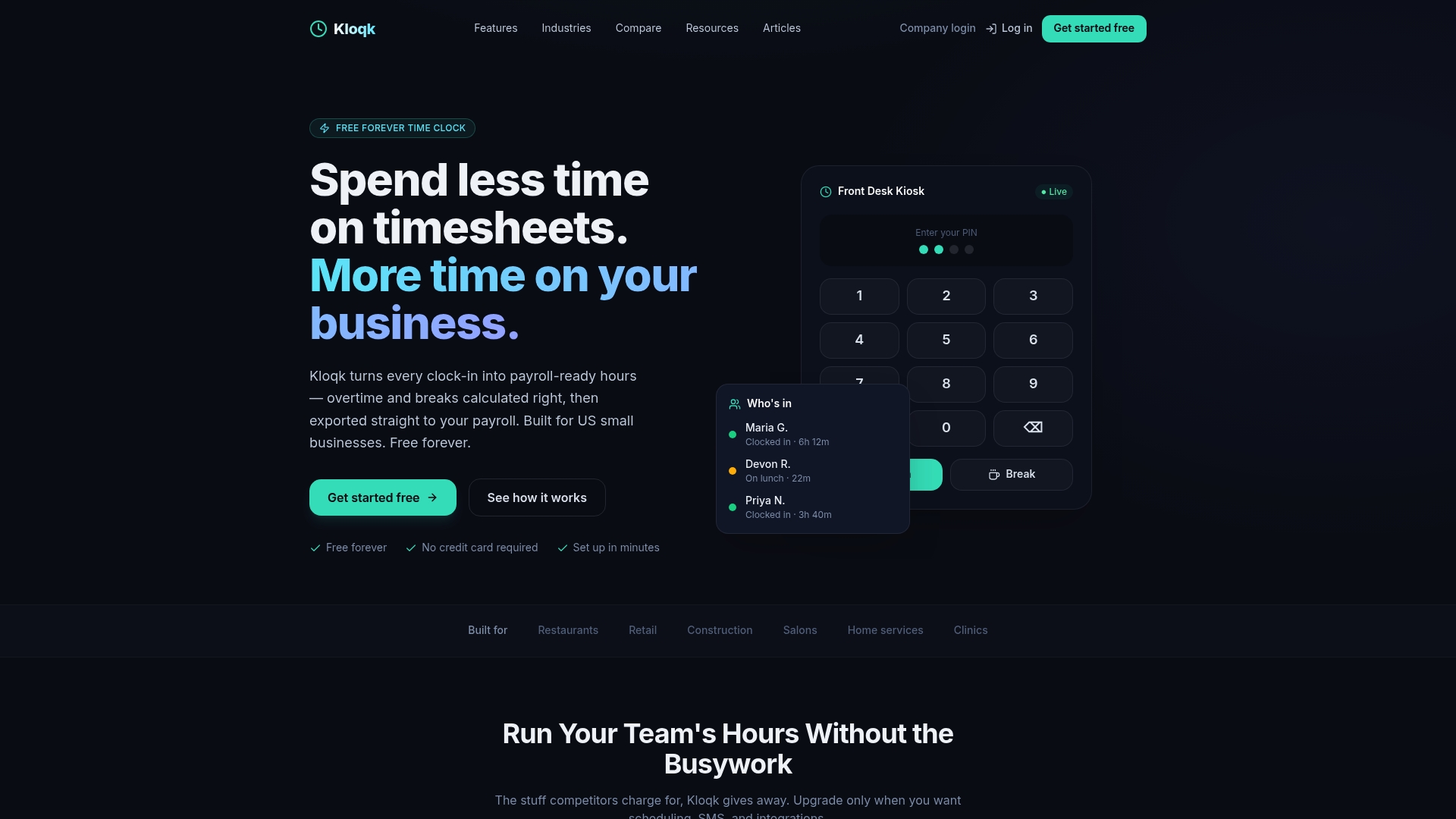
Kloqk’s employee time tracking is free for small clinic teams, with no seat limits and no hidden fees for core features. For clinics with staff who travel between sites or work from multiple locations, the GPS time clock with geofencing confirms location at every clock-in automatically. Setup takes minutes, not weeks, and the payroll export works with the accounting platforms most small practices already use.
FAQ
What are HR time management tools for small clinics?
HR time management tools for small clinics are software systems that automate staff scheduling, time tracking, and payroll exports while handling healthcare-specific pay rules like broken shifts and on-call hours. They replace manual spreadsheets and reduce payroll errors.
How long does it take to set up clinic time tracking software?
Purpose-built clinic scheduling tools typically deploy in under 30 minutes. Enterprise hospital systems take weeks to months and require dedicated IT staff, making them a poor fit for independent practices.
Do small clinics need healthcare-specific time tracking software?
Yes. Generic time trackers do not handle broken shifts, on-call pay, or travel time between sites. Healthcare-specific tools automate these conditions automatically, which prevents payroll errors and compliance gaps.
What does clinic time tracking software cost?
Small clinic scheduling and time tracking tools start at around $49 per month for teams of 1, 5 staff. Free options like Kloqk cover core tracking, overtime, and payroll export with no per-seat fees.
How does GPS geofencing help small clinic HR managers?
GPS geofencing confirms that staff clock in from the correct physical location, preventing time theft without requiring manual supervisor verification. It is especially useful for clinics with multiple sites or mobile staff.
Recommended
Sources
Every figure on this page traces to one of these. Primary law and government sources are listed first.
- 1. shiftmd.co
- 2. wojohq.com
Written by
Sam TolbertWorkforce Operations Editor
Sam writes about scheduling, shift work, and the software that runs an hourly workforce, what actually saves time on the floor versus what just adds clicks.
Keep Reading
Track Hours the Easy Way
Kloqk is a free time clock that handles punches, breaks, overtime, and payroll-ready reports.
Start free