Minor Break Laws by State: What Employers Must Know

Federal law does not require meal or rest breaks for workers under 18. Minor break rules come from the states, and they differ a lot: some require a 30-minute meal period after a set number of hours, some cover only the youngest workers, and some require nothing at all. If you employ teenagers, the rule that applies to you is the one in your state, and when two rules overlap you follow the stricter one.
This guide explains where federal law stops, how state rules for under-18 workers are built, what the rules look like in several states, and how to record breaks so your timesheets hold up.
TL;DR
- The Fair Labor Standards Act (FLSA) does not require meal or rest periods, for adults or minors. Break duties for minors are set by state law.
- The U.S. Department of Labor lists 35 jurisdictions with separate meal-period provisions for minors. Check yours before you schedule a teenager.
- Typical state rules trigger a 30-minute meal period after 4 or 5 consecutive hours. Some states also add paid 10-minute rest breaks.
- When both an adult rule and a minor rule apply, the employer must observe the higher standard.
- Document every break. Start and end times for meal periods are your proof of compliance.
Table of Contents
- What federal law says about breaks for minors
- How state minor break rules are built
- State examples
- Paid or unpaid: how to treat minor breaks
- A scheduling checklist for teen employees
- Perspective
- Track minor breaks without extra paperwork
- Common mistakes with minor breaks
- FAQ
- Sources
What federal law says about breaks for minors
The FLSA is the main federal wage and hour law, and it is silent on breaks. The Department of Labor’s Breaks and Meal Periods page says federal law does not require lunch or coffee breaks. The DOL’s FLSA Advisor adds that some states have their own requirements, and that where a state has none, breaks are a matter of agreement between employer and employee.
Age does not change this. The North Carolina Department of Labor notes that the FLSA does not mandate rest or meal breaks regardless of an employee’s age.
Federal law does matter for minors in two other ways:
- Pay for breaks you do offer. Under the DOL’s guidance, short breaks of about 5 to 20 minutes are compensable work time. Meal periods, typically 30 minutes or more, are not work time when the employee is relieved of duty.
- Hours limits for 14- and 15-year-olds. The Handy Reference Guide says they may work outside school hours only, up to 3 hours on a school day, 18 hours in a school week, 8 hours on a non-school day and 40 hours in a non-school week. Minors 16 and 17 may do any nonhazardous job for unlimited hours under federal law.
Those hour limits are not break rules, but they shape the shifts where break rules kick in. A 3-hour school-day shift for a 15-year-old rarely reaches a state meal-break trigger. A summer shift of 8 hours often does.
How state minor break rules are built
Most states that regulate minor breaks do it through their child labor statute, separately from the adult meal-break rule. The Department of Labor’s state meal period chart lists the jurisdictions with minor-specific provisions: Alabama, Alaska, California, Colorado, Delaware, Florida, Hawaii, Illinois, Indiana, Iowa, Kentucky, Louisiana, Maryland, Massachusetts, Michigan, Minnesota, Nebraska, Nevada, New Hampshire, New Jersey, New York, North Carolina, North Dakota, Ohio, Oklahoma, Oregon, Pennsylvania, Rhode Island, Utah, Virginia, Washington, West Virginia, Wisconsin, Guam and Puerto Rico.
Four variables decide what you owe:
- Age band. Many states split rules at 16. Under-16 workers often get the strictest treatment.
- Trigger. The number of consecutive hours before a break is due, usually 4 or 5.
- Length. Most meal periods are 30 minutes.
- Paid or unpaid. A meal period is typically unpaid if the employee is fully relieved of duty. Shorter rest breaks are paid.
Which rule wins when two apply
Two layers of law can touch the same teenager. On hours, the DOL’s state child labor page says that where state law is less restrictive than federal law, federal law applies, and where state law is more restrictive, state law applies. On breaks, the DOL notes that when a minor is covered by both an adult provision and a minor provision, the employer must observe the higher standard.
In practice: find the federal rule, the state adult rule and the state minor rule, then schedule to whichever is most protective.
State examples
The rules below come from state agencies and statutes. They are examples of how different the rules are, not a full 50-state chart. Always confirm with your state labor department, because rules get amended.
| State | Who is covered | Break rule |
|---|---|---|
| Washington | 16 and 17 | 10-minute paid rest break on shifts longer than 4 hours, and a 30-minute meal break after 5 consecutive hours |
| Washington | Under 16 | 30-minute meal break after 4 consecutive hours |
| Michigan | Under 18 | No more than 5 hours continuously without a 30-minute interval for a meal and rest |
| New Jersey | Under 18 | 30-minute meal period after 5 hours in a row |
| North Carolina | Under 16 | At least 30 minutes after 5 hours |
| North Carolina | 16 and older | No mandatory rest or meal breaks |
| Hawaii | 14 and 15 | 30-minute rest or meal period after 5 consecutive hours |
| Texas | All minors | No state break requirement |
Washington
Washington has some of the most detailed minor rules. The state Department of Labor and Industries requires 16- and 17-year-olds to get a paid rest break of at least 10 minutes on shifts longer than 4 hours, and they must not work more than 3 hours without a rest break. The meal break of 30 minutes after 5 consecutive hours must be uninterrupted. Minors under 16 must get their 30-minute meal break after 4 consecutive hours.

Paid rest breaks count as hours worked when calculating wages, paid sick leave and overtime. For the adult side of the same state, see our guide to Washington State break laws.
Michigan
Michigan’s Compiled Laws Section 409.112 says a minor shall not be employed more than 5 hours continuously without an interval of at least 30 minutes for a meal and rest, and an interval shorter than 30 minutes does not break up the continuous period. The state’s Department of Labor and Economic Opportunity adds a record-keeping point: the break should be documented, and daily time records should show shift start and end plus the 30-minute uninterrupted break.
That last point is the practical one. A 20-minute break does not satisfy the rule, and without a record you cannot show the break happened.
New Jersey
The New Jersey Department of Labor says workers under 18 must receive a 30-minute meal period after five hours in a row. Age 17 is covered, so the break applies to the whole under-18 group.
North Carolina and Hawaii
The North Carolina Department of Labor says the state wage and hour law does not require breaks for employees 16 or older, and requires them only for youths under 16, who must get at least 30 minutes after 5 hours. That means a 15-year-old and a 16-year-old on the same crew can have different break rules.
In Hawaii, the Wage Standards Division says the only break requirement in the state is in the child labor law: a 30-minute rest or meal period for 14- and 15-year-olds after five consecutive hours. It also explains that a meal period of 30 minutes or more is not compensable if the employee is completely relieved of duty, while rest breaks of five to twenty minutes count as hours worked.

Texas and the 17-year-old question
Texas is a common search because the rules are lighter. The Texas Workforce Commission says child labor laws cover everyone under 18, and that a 16- or 17-year-old has no state limits on hours or times of day. On breaks, the TWC’s guidance for employers says that with one exception, neither the FLSA nor Texas law requires breaks during the workday, but if breaks are given, federal pay rules apply. See our Texas break laws guide for details on that.
For other states with their own minor rules, such as Florida, see our guide to Florida labor laws for minors. For California, our California lunch break law guide covers the adult side of the rule.
Paid or unpaid: how to treat minor breaks
The pay question follows the length and the freedom of the break, not the age of the worker.
- Meal periods. The DOL says meal periods, typically at least 30 minutes, serve a different purpose than coffee or snack breaks and are not compensable under federal law when the employee is relieved of duty. For the full picture, read are lunch breaks paid.
- Short rest breaks. Breaks of about 5 to 20 minutes are paid work time under federal rules. In Washington, a minor’s rest break is paid by the state’s own rule.
- Interrupted meals. If a minor is called back to the counter during a meal period, that time is not a true off-duty meal. Michigan and Washington both frame the minor meal period as uninterrupted, so treat an interrupted break as one that needs to be fixed, not just noted.
The risk to watch is the automatic deduction. Many payroll setups subtract 30 minutes every shift whether or not the break was taken. With minors, that creates two problems at once: unpaid time if the break did not happen, and a missing record of compliance. Our piece on preventing back pay from 30-minute meal break deductions walks through how to avoid it.
A scheduling checklist for teen employees
Use this routine for each new minor hire.
- Confirm the age band. Record the birth date. Many rules change at 16 or at 18.
- Look up your state’s minor rule. Start with the DOL state meal period chart, then open your state labor department page for the current text.
- Compare it with the adult rule. If both apply, schedule to the higher standard.
- Map your longest shifts. Find any shift that crosses the state trigger, such as 4 or 5 consecutive hours, and put the break in the schedule before it happens.
- Protect the break. Give the minor a clear start and end, and keep them off the floor for the full period.
- Check hours limits too. For 14- and 15-year-olds, keep school-day, school-week and non-school-day totals inside the federal caps, or your state’s tighter ones.
- Keep the records. Store the time record for each shift, with break start and end.
Mistakes in break and hour records do not stay in the schedule. They can show up later as back wages, penalties and payroll corrections, which is why it helps to understand payroll tax compliance alongside your wage and hour duties.
A worked example
Say you run a retail store in Michigan and a 17-year-old closes on Saturdays from 10:00 a.m. to 6:00 p.m. That is 8 hours. Under the state rule, the minor cannot work more than 5 hours continuously without a 30-minute interval. So the break has to start no later than 3:00 p.m. A 15-minute pause at 1:00 p.m. does not reset the clock, because an interval under 30 minutes does not interrupt the continuous period. Your time record should show the shift start, the break start and end, and the shift end.
Now take the same teen in Texas. State law sets no break for the shift, so the break is up to you. If you give a 15-minute rest break, federal rules treat it as paid time.
Perspective
We built Kloqk for small business owners who do not have an HR department, and minor break rules are exactly where that gap hurts. The rule is rarely hard to read. What goes wrong is the daily follow-through: someone forgets to send a 16-year-old on break, a punch is missed, and there is no record to show what happened.
That is why we think break tracking and state-aware overtime and break calculations belong in the free core of a time clock, not behind a paywall. Our approach is to turn clock-ins into payroll-ready hours with break tracking included, so the record exists by default. A small team can run full payroll-ready time tracking without paying or committing, and upgrade later only if scheduling, PTO or other tools become useful.
If you employ minors, our advice is simple: pick your state’s rule, put the break in the schedule, and let the time record prove it.
Saad
Track minor breaks without extra paperwork
A paper log works until a busy Saturday. A digital time clock records start and end times at the moment they happen, which is what state agencies such as Michigan’s point to when they say daily records should show the meal break.
Kloqk is a time clock for small businesses with a free plan that includes payroll-ready timesheets, overtime and break calculations, mobile and kiosk punching and payroll exports. Our overtime tracking software with break rules by state page explains how break rules are applied, and our free time clock software page shows what the free plan covers. Paid tiers add scheduling, PTO and other tools: Pro is $29 per month per location and Premium is $59 per month per location, and the full list is on our pricing page.
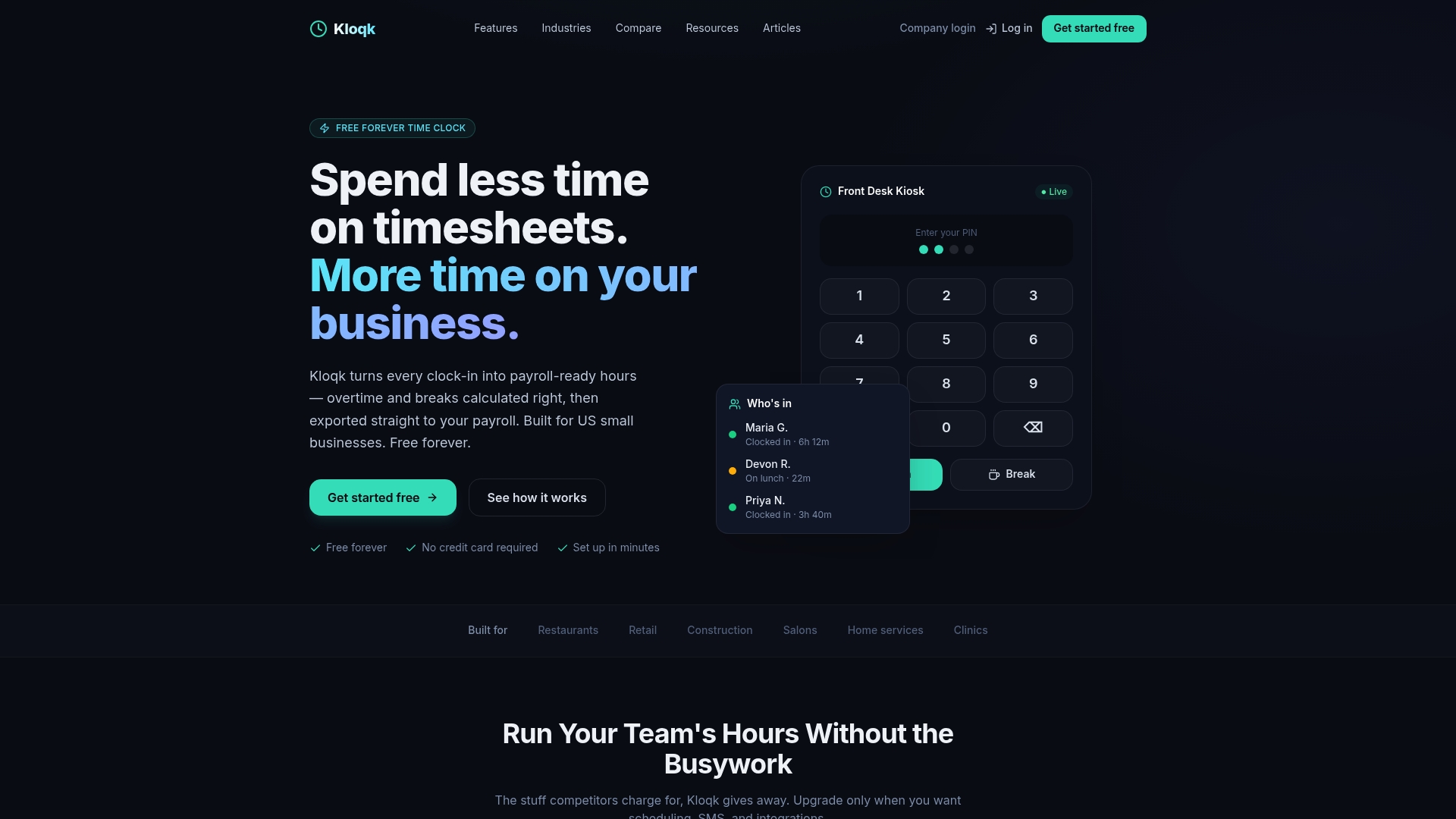
If you want to start with the basics, set up the free time clock and have your teen staff punch in and out from their first shift.
Common mistakes with minor breaks
- Assuming federal law covers it. It does not. If you rely only on the FLSA, you will miss every state minor rule.
- Using the adult rule for everyone. Several states have a separate, stricter minor rule. The employer must meet the higher standard.
- Treating 16 and 17 like younger teens, or the reverse. North Carolina, Washington and Hawaii all treat age bands differently.
- Auto-deducting meal periods. A deducted break that never happened is unpaid time and a weak record.
- Letting a break be cut short. In states that call for a 30-minute uninterrupted period, a shorter pause may not count.
- Forgetting that rules change. Review your state’s page each year, and when you hire your first minor in a new location.
FAQ
Does federal law require breaks for workers under 18?
No. The Department of Labor says the FLSA does not require meal or rest periods, and that applies to minors as well as adults. Breaks for minors come from state law. If you do give short breaks of about 5 to 20 minutes, federal law treats them as paid work time.
Which states require a 30-minute meal break for minors?
The DOL lists 35 jurisdictions with minor-specific meal period provisions, and many of them use a 30-minute period. Washington, Michigan and New Jersey are examples. Triggers vary, so confirm the number of hours and the age band with your state labor department.
Does a 17-year-old in Texas get breaks?
Not under state law. The Texas Workforce Commission says 16- and 17-year-olds have no limits on hours or times of day, and Texas does not require breaks. If you choose to give a short break, federal rules say it is paid time.
Does the break have to be uninterrupted?
In some states, yes. Washington requires the 30-minute meal break for 16- and 17-year-olds to be uninterrupted, and Michigan’s guidance calls for a documented uninterrupted 30 minutes. Plan coverage so a minor is not pulled back to work mid-break.
What if state and federal rules conflict?
For hours, the stricter rule applies: federal law governs when the state rule is less restrictive, and state law governs when it is more restrictive. For meal breaks, the DOL says an employer covered by both adult and minor provisions must observe the higher standard.
Sources
- Handy Reference Guide to the Fair Labor Standards Act, U.S. Department of Labor
- Breaks and Meal Periods, U.S. Department of Labor
- FLSA Advisor, U.S. Department of Labor
- Minimum Length of Meal Period Required under State Law for Minors, U.S. Department of Labor
- Selected State Child Labor Standards, U.S. Department of Labor
- Wages, Rest Breaks and Meal Periods, Washington Labor and Industries
- MCL Section 409.112, Michigan Legislature
- Breaks, Meal and Rest Periods, Michigan LEO
- Meal period requirement, New Jersey Department of Labor
- What to Know About Breaks, North Carolina Department of Labor
- Breaks: Meal and Rest, Hawaii Wage Standards Division
- Texas Child Labor Law, Texas Workforce Commission
- Breaks, Texas Workforce Commission
- Payroll tax compliance
Recommended
Sources
Every figure on this page traces to one of these. Primary law and government sources are listed first.
- 1. U.S. Department of Laborprimary
- 2. U.S. Department of Laborprimary
- 3. Washington State Legislatureprimary
- 4. labor.nc.gov
- 5. legislature.mi.gov
- 6. michigan.gov
- 7. nj.gov
- 8. labor.hawaii.gov
- 9. twc.texas.gov
- 10. efte.twc.texas.gov
- 11. taxproblem.org
Written by
Dana WhitfieldHR Compliance Lead
Dana writes about wage-and-hour law, FLSA overtime, and leave compliance for U.S. small businesses, translating dense regulations into plain steps owners can act on.
Keep Reading
Track Hours the Easy Way
Kloqk is a free time clock that handles punches, breaks, overtime, and payroll-ready reports.
Start free