Audit Ready Timesheets: 3 Records Small Businesses Need

Audit-ready timesheets are daily, timestamped records with an immutable change log and exportable reports. Get those three things right and you’ll satisfy most audits. This guide breaks each requirement into concrete steps: how to capture reliable timestamps, lock records after approval, maintain a tamper-evident audit trail, and export the reports regulators and auditors expect.
TL;DR:
- Send a reminder when employees clock out, follow up by text or email within two hours, and alert supervisors before the shift ends.
- After supervisor approval, lock each record; require every later correction to preserve the original entry and include its reason, timestamp, and approver identity.
- Keep time cards and related wage records for at least two years, payroll records for three, and employment tax records for four years.
- Keep timecards, payroll registers, change logs, and exception reports ready; use PDF for signed summaries and CSV or XLS for sortable data.
- Configure break and overtime rules by state, because federal compliance alone may not meet local requirements for meal periods, daily overtime, or scheduling.
Table of Contents
- 1. Compliant Daily Time Entry and Timestamping
- 2. Reminders, Missed-Entry Alerts, and Enforcing Timely Logging
- 3. Supervisor Approval Workflows and Locking Records
- 4. Transparent Audit Trail and Change History
- 5. Timesheet Validation Rules and Exception Handling
- 6. Role-Based Permissions and Approvals
- 7. Reporting, Export Formats, and Retention Policies for Audits
- 8. Security, Storage, and Making Records Tamper-Evident
- 9. Practical Checklist: Getting Audit-Ready Step by Step
- 10. Photo Verification for Clock-Ins to Prevent Fraud
- 11. GPS Geofencing to Verify Location Compliance During Clock-In/Out
- 12. Compliance With Federal and State Labor Laws Related to Timesheets
- 13. Integration of Overtime Calculations and Break Tracking Within Timesheets
- Author Perspective: Balancing Compliance and Small-Team Practicality
- How Kloqk Helps Keep Audit-Ready Timesheets
- FAQ
- Sources
1. Compliant Daily Time Entry and Timestamping
Auditors flag timesheets that look reconstructed after the fact. A weekly or biweekly entry habit, where employees fill in hours from memory on Friday afternoon, is one of the fastest ways to raise suspicion during a review. Daily timestamps create a contemporaneous record that holds up because the data was captured as the work happened, not recalled later.
The capture method matters less than consistency. The DOL’s Fact Sheet #21 confirms there’s no required technology for timekeeping, only a standard of accuracy and completeness.
Reliable capture methods include:
- Automatic timers that start and stop with a single tap, reducing manual entry errors.
- Kiosk or mobile clock-ins for shift-based teams who punch in at a fixed location.
- Fixed-schedule exceptions for salaried staff where only deviations need logging.
Add task or project tags and location data when they clarify billing or compliance, but skip fields that slow workers down without adding audit value, especially when choosing a Stress Free CRM for service businesses that integrates smoothly with your time tracking.
2. Reminders, Missed-Entry Alerts, and Enforcing Timely Logging
Daily logging only works if missed entries get caught the same day, not during a payroll run two weeks later. A reminder and escalation system closes that gap before it becomes a pattern.
A workable cadence looks like this:
- Push notification at the scheduled clock-out time if no entry exists.
- SMS or email follow-up within two hours if the push is ignored.
- Supervisor alert by end of shift, routing the gap into an exception queue for same-day review.
Hourly teams in restaurants and construction benefit most from this structure because shift turnover makes next-day memory unreliable. Supervisors who clear the exception queue daily, rather than weekly, keep the audit trail clean and avoid a backlog of unexplained gaps.
Pro Tip: Set the first reminder to fire automatically at shift end, not at midnight. The closer the nudge is to the actual work, the more accurate the eventual entry.
3. Supervisor Approval Workflows and Locking Records
Approval is the checkpoint where errors get caught before they become payroll problems or audit findings. Once a supervisor or payroll admin signs off, the record should lock.
- Shift leads approve daily or per-shift entries for hourly staff; payroll admins approve the final pay-period summary before processing.
- Locking prevents silent edits after approval, so if someone needs to change a locked entry, the system requires a new, logged correction rather than a quiet overwrite.
- Every correction needs a documented reason and the approver’s identity attached, stored alongside the original entry rather than replacing it.
This sequence matters because back-dating is one of the first things auditors test for. A locked record with a visible correction trail answers that question before it’s asked.
4. Transparent Audit Trail and Change History
An audit trail is only useful if it answers who changed what, when, and why, without requiring a separate investigation. The essential fields are the original timestamp, the edit timestamp, the user ID of whoever made the change, and a reason or note explaining it.
- Original timestamp: the exact moment of the initial clock-in or clock-out.
- Edit timestamp: when any later change was made.
- User ID: who made the edit, distinct from who it affects.
- Reason or note: a short, mandatory explanation tied to the correction.
When an auditor requests this history, exporting a single report that shows the original entry next to every subsequent edit, in order, is far more convincing than reconstructing it manually. Weak correction logs, where supervisors can edit employee time without documenting a reason, are among the most common sources of small-business audit findings. Immutable logging, where past entries can’t be overwritten, only appended to, is the strongest evidence that records weren’t altered to hide noncompliance.
5. Timesheet Validation Rules and Exception Handling
Automated validation catches problems before they reach payroll, which is cheaper than catching them during an audit. The common checks are overlapping shifts, missing breaks, and hours crossing overtime thresholds.
- Flag the exception automatically the moment it’s detected, not at pay-period close.
- Route it to the relevant supervisor with the specific rule that triggered it.
- Require documentation and approval before the entry can be finalized for payroll.
Every resolved exception should stay searchable by date, employee, and rule type. That searchable record is what turns a vague “we handle overtime carefully” claim into something an auditor can verify in minutes.
6. Role-Based Permissions and Approvals
Who can edit, approve, or export time data should be limited to what each role actually needs, a principle often called least privilege. Giving every manager full edit access creates unnecessary risk and more questions during an audit.
- Employees can submit and view their own entries but not alter approved records.
- Shift leads approve entries for their team but can’t export company-wide payroll data.
- Payroll admins export and process final reports but shouldn’t be the same person approving the hours they’re paying out.
That separation, keeping approval and payroll processing in different hands, is a basic segregation of duties that reduces fraud risk. Permission logs showing who had access to what, and when, let you answer an auditor’s access-control questions without guesswork.
7. Reporting, Export Formats, and Retention Policies for Audits
Auditors typically ask for four documents: timecards, payroll registers, change logs, and exception reports. Having these ready as pre-built exports, rather than assembled on request, shortens every audit interaction.
- PDF works best for signed summaries meant for final records or employee sign-off.
- CSV or XLS suits raw data review, since auditors often need to sort, filter, or cross-check figures.
- Change logs should export in the same format as the timecards they document, so the two can be compared side by side.
Retention timelines vary by authority. The Department of Labor requires employers to keep time cards and related wage records for at least two years, and payroll records for at least three years. The IRS requires employment tax records for at least four years after the tax is due or paid, with some credit-related records held for six years. A practical archive policy keeps the longer window as the default rather than tracking multiple expiration dates separately.
8. Security, Storage, and Making Records Tamper-Evident
Storage policy is where audit-readiness either holds up or falls apart under scrutiny. Records need to be both protected from unauthorized access and provably unaltered.
- Encryption at rest and in transit protects timesheet data from exposure during storage and export.
- Access logging records every view, download, or export, not just edits, so there’s a full trail of who touched the data.
- Secure, redundant backups prevent a single point of failure from wiping out records an auditor later requests.
Government contractors face additional rules: FAR 52.222-8 requires payrolls and basic records to be maintained during the work and preserved for three years after completion, with clock cards retained for two years and payroll registers for four years. Where electronic imaging replaces paper originals, the imaging process needs to produce reliable, retrievable copies, with the originals kept for a minimum period afterward for validation. Proving authenticity to an auditor comes down to showing the access log and the unbroken chain between the original entry and any later edit.
9. Practical Checklist: Getting Audit-Ready Step by Step
Here’s a condensed sequence for small teams tackling this for the first time:
- Turn on daily timestamping and verify entries are logged the same day, not reconstructed later.
- Set up missed-entry alerts and confirm supervisors clear exception queues daily.
- Require supervisor approval before any record locks for payroll.
- Check that your change log captures user ID, timestamp, and a reason for every edit.
- Assign role-based permissions so approval and payroll export aren’t handled by the same person.
- Export a sample report in PDF and CSV to confirm both formats are ready on demand.
- Confirm your retention settings meet the longer of the DOL, IRS, or FAR windows that apply to your business.
Pro Tip: Run through this checklist quarterly, not just before an audit. Catching a gap in March is far less stressful than catching it during a Department of Labor inquiry.
Our feature set for daily logging, approvals, and exports was built around this exact sequence, and our guide on accurate timesheets reducing workplace disputes covers the downstream payroll benefits in more detail.
10. Photo Verification for Clock-Ins to Prevent Fraud
Buddy punching, where one employee clocks in for another, is a quiet but persistent source of payroll loss for shift-based businesses. Photo verification closes that gap by capturing an image at the moment of clock-in or clock-out, tied directly to that timestamp.
The process is simple in practice: when an employee punches in on a mobile device or kiosk, the system captures a photo alongside the timestamp and stores both together as part of the same record. A supervisor reviewing the day’s entries can confirm, at a glance, that the person who clocked in is the person who worked the shift. This matters most in environments with high turnover or multiple entry points, like restaurant kitchens or construction sites with rotating crews.

For audit purposes, photo verification adds a layer of evidence that a plain timestamp can’t provide on its own. If a wage dispute or an internal investigation ever questions whether a specific employee worked a specific shift, having a photo attached to that exact punch resolves the question quickly rather than relying on supervisor recollection.
It also acts as a quiet deterrent. Employees who know their clock-in is photographed are far less likely to ask a coworker to punch in on their behalf, which reduces the kind of time theft that’s difficult to catch after the fact. The feature works best when it’s a standard part of every punch, not an occasional spot check, since consistency is what makes the resulting record credible during a review.
11. GPS Geofencing to Verify Location Compliance During Clock-In/Out
Location verification solves a different problem than photo verification: confirming that an employee was actually at the job site when they clocked in, not at home or in transit. GPS geofencing draws a virtual boundary around an approved work location and only allows a clock-in or clock-out to register when the device is inside that boundary.
For construction crews moving between job sites, or retail and restaurant staff with multiple locations, this prevents early clock-ins from a parking lot or late clock-outs logged after someone has already left. It also protects against remote punching, where an employee asks a coworker to submit a clock-in on their behalf from a different location, since the geofence check happens at the device level in real time.
The data this generates is useful beyond fraud prevention. A timesheet that shows not just when someone worked but where strengthens the record during a wage-and-hour audit, particularly for businesses that bill by location or need to prove compliance with site-specific labor rules. It also helps resolve disputes about travel time or multi-site shifts, since the geofence log shows exactly when an employee entered and left each boundary.
Setup is straightforward: a manager defines the geofence radius around each work site once, and the system applies the rule automatically to every future punch at that location. For teams managing multiple sites, this scales without adding manual oversight, since the check runs the same way whether there’s one location or a dozen.
12. Compliance With Federal and State Labor Laws Related to Timesheets
Federal law sets the floor for timesheet recordkeeping, but state rules can add requirements on top of it. The Fair Labor Standards Act generally requires employers to capture all hours worked, with only very limited allowances for small, unavoidable rounding differences. Frequent small increments of unrecorded time, even a few minutes here and there, should not be treated as negligible.
Several states layer additional requirements on top of the federal baseline, covering areas like meal and rest break documentation, daily overtime thresholds, or predictive scheduling notices. Because these rules vary by state and change periodically, the safest practice is to build your timesheet system around the strictest applicable rule rather than assuming federal compliance automatically satisfies state law.
For businesses with employees in multiple states, this means configuring break and overtime rules per location rather than applying a single company-wide policy. A system that lets you set state-specific break thresholds and overtime triggers reduces the risk of a technically correct federal record that still falls short of a state requirement.
The practical compliance test an auditor applies isn’t whether you used particular software or forms. It’s whether your records are accurate, complete, and available for inspection on request, which is the standard the DOL applies regardless of the method used to generate them. Meeting that standard consistently, across every applicable state and federal rule, is what keeps a labor audit from turning into a liability.

13. Integration of Overtime Calculations and Break Tracking Within Timesheets
Overtime and break compliance are two of the most common sources of wage-and-hour disputes, and both depend on accurate underlying time data. When overtime calculations and break tracking are built directly into the timesheet rather than handled in a separate spreadsheet, the risk of a mismatch between hours worked and hours paid drops significantly.
Automatic overtime calculation means the system applies the correct threshold, typically hours worked beyond a standard workweek, without requiring a payroll admin to manually flag and recalculate each case. This matters most for hourly teams with variable schedules, where a few employees crossing into overtime each week is easy to miss by hand but straightforward for a system tracking hours in real time.
Break tracking works the same way: the system logs when an employee clocks out for a meal or rest break and when they return, flagging any break that falls short of the required duration or doesn’t happen at all. That flag becomes part of the exception queue covered earlier, so a missed break gets caught and resolved the same day rather than surfacing as a pattern during an audit months later.
Keeping these calculations inside the timesheet, rather than reconciled afterward in payroll software, also means the audit trail stays unified. An auditor reviewing overtime pay can see the exact hours that triggered it, the break records for that same shift, and any corrections, all in one export instead of three separate systems that have to be cross-referenced manually.
Author Perspective: Balancing Compliance and Small-Team Practicality
Strict controls make sense where the stakes are highest: locking records after approval, documenting every correction, enforcing daily entry. Beyond that, simplicity wins. A ten-person restaurant doesn’t need the same permission tiers as a two-hundred-person contractor.
Restaurants get the fastest win from photo verification, since buddy punching is their most common leak. Construction crews benefit most from geofencing, since job-site accuracy drives both payroll and billing. Start with whichever problem costs you the most right now.
Saad
How Kloqk Helps Keep Audit-Ready Timesheets
Every requirement covered above, daily timestamps, locked approvals, a visible change log, exportable reports, and multi-year retention, maps directly to what we built into our free time tracking features. Daily clock-ins happen through mobile or kiosk punching, supervisors approve and lock shifts before payroll runs, and every edit logs who made it and why.
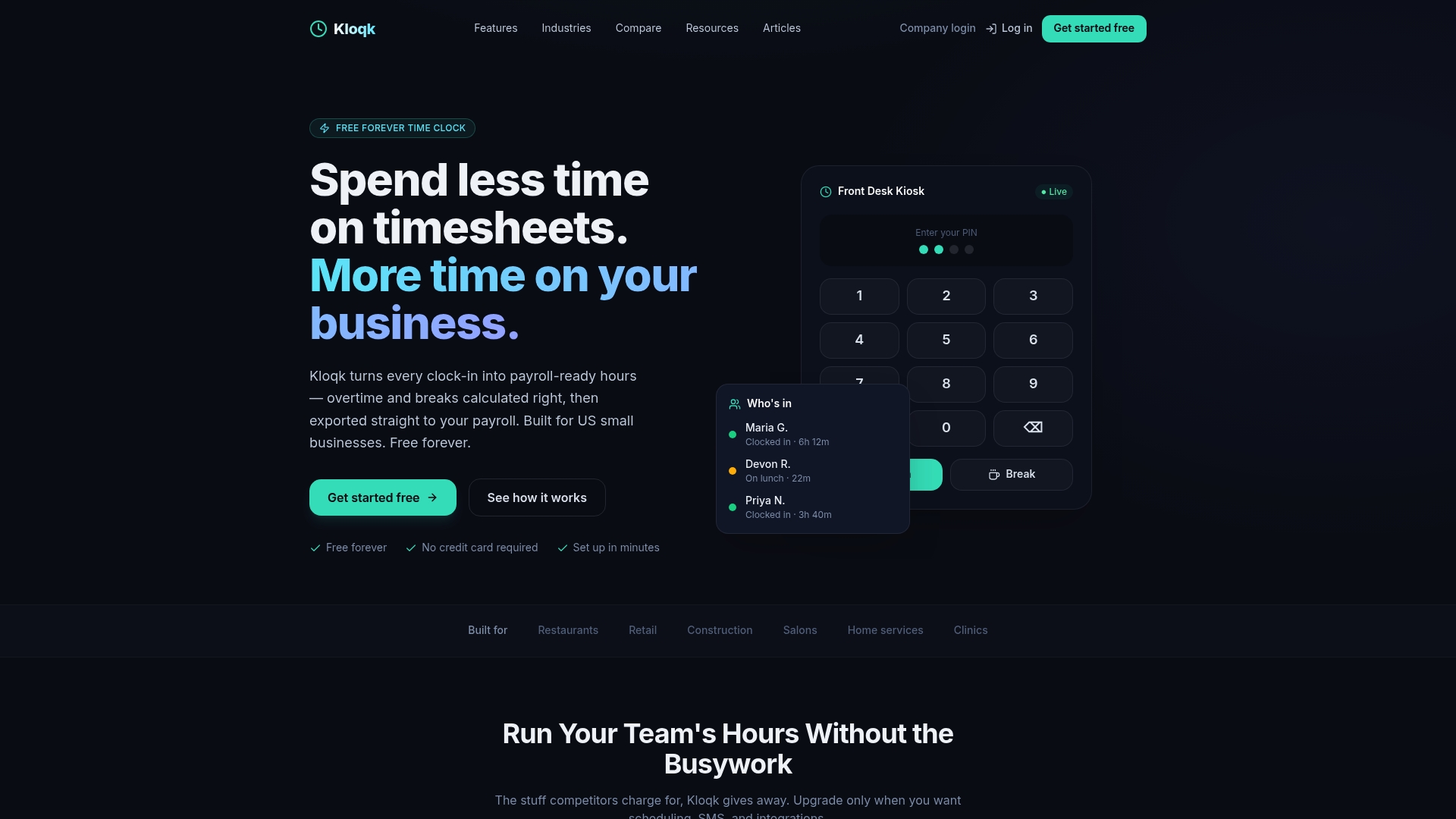
Photo verification and GPS geofencing come standard, not as paid add-ons, which is where many alternatives charge extra for the exact features that make a timesheet defensible. Overtime and break calculations run automatically inside the same record, so your audit trail never has to be reassembled from separate payroll tools.
Our core time clock, payroll exports, and compliance features stay free on the Free plan with no published price, while Pro runs $29 per month per location and Premium runs $59 per month per location for teams that want scheduling, PTO, and hiring tools layered on top. Check current plans and features to see which tier fits your team.
FAQ
What Does Audit Ready Mean for Timesheets?
Audit-ready means your timesheet records are accurate, complete, and available for inspection at any point, with a clear trail showing when entries were made and whether they were later changed. It doesn’t require specific software, only that records meet the accuracy and availability standard the Department of Labor applies to wage and hour recordkeeping.
What Is a Timesheet Audit?
A timesheet audit is a review, internal or external, that checks whether recorded hours match actual hours worked and whether those records were kept and retained correctly. Reviewers typically check for daily consistency, proper approvals, and a documented reason behind any corrections.
What Are the Stages of the Audit Process?
A typical timesheet audit moves through planning, where the scope and records needed are defined, followed by data collection, where timecards and logs are pulled for the period in question. From there, reviewers verify accuracy against payroll and attendance records, document any exceptions or discrepancies found, and close with a report summarizing findings and any required corrections.
What Is Audit-Ready Documentation?
Audit-ready documentation refers to the specific reports and records an auditor expects to see without delay: timecards, payroll registers, change logs, and exception reports, typically available in both a signed summary format like PDF and a raw data format like CSV. Retention periods vary by authority, with the IRS requiring employment tax records for at least four years after the tax is due or paid.
Sources
- Recordkeeping | U.S. Department of Labor
- Employment tax recordkeeping | Internal Revenue Service
- Acquisition
Recommended
Sources
Every figure on this page traces to one of these. Primary law and government sources are listed first.
- 1. U.S. Department of Laborprimary
- 2. U.S. Department of Laborprimary
- 3. Internal Revenue Serviceprimary
- 4. U.S. Department of Laborprimary
- 5. acquisition.gov
Written by
Marcus ReyesPayroll & Timekeeping Specialist
Marcus covers payroll accuracy, timesheets, and time tracking, the unglamorous mechanics that keep paychecks correct and audits painless.
Keep Reading
Track Hours the Easy Way
Kloqk is a free time clock that handles punches, breaks, overtime, and payroll-ready reports.
Start free