FLSA Compliant Timesheet Audit Trail: 2-3 Year Retention Steps for HR

A timesheet audit trail is a chronological, event-level record of every action taken on an employee’s timesheet, from the original punch to any later edit. It matters for two reasons: it satisfies FLSA recordkeeping requirements, and it gives you evidence to resolve overtime or pay disputes before they turn into claims. Tools like Kloqk build this logging into the clock-in process itself.
TL;DR:
- An audit trail records every original punch, edit, approval, and exception with clear timestamps and responsible parties, ensuring a complete chronicle of timesheet changes.
- Digital logs must be append-only, linking corrections to initial entries without overwriting, which strengthens defenses during audits or disputes.
- Maintaining records for at least two to three years, with regularly tested export capabilities, is crucial for compliance and defending wage claims.
- Collecting only necessary data like GPS or photo verification minimizes privacy concerns and reduces noise from false flags or erroneous edits.
- Implementing clear policies, role-based permissions, and routine audits helps small teams stay audit-ready without excessive administrative effort.
Table of Contents
- What counts as a timesheet audit trail
- Why audit trails matter for compliance and payroll
- Examples: what an audit-trail entry looks like
- How a timesheet audit trail works day to day
- Weighing the benefits against the risks
- Building a compliant timesheet process
- Audit readiness checklist and review cadence
- Keeping small teams audit-ready without extra admin work
- A practical note on priorities
- Getting audit-ready time tracking without the paperwork
- FAQ
- Sources
What counts as a timesheet audit trail
An audit trail is not the same as a summary timesheet. A summary shows total hours for a pay period; an audit trail shows every event that produced that total, in order, with no gaps. If your system only stores the final number, you do not have an audit trail, you have a report.
A usable audit trail captures:
- Every clock-in and clock-out, including the method used (kiosk, mobile, desktop, GPS-tagged punch)
- Every edit made after the original entry, with who made it and when
- Manager approvals and rejections at each stage of review
- Payroll export events, including the date and batch they belong to
- Geofence or photo verification exceptions flagged at the point of punch
The records that hold up best are append-only: the original entry stays untouched, and any correction is logged as a new, linked event rather than an overwrite. That distinction is what makes a log defensible later.
Why audit trails matter for compliance and payroll
The Department of Labor’s recordkeeping fact sheet requires employers to preserve time cards and the records used to compute pay for at least two years, and broader payroll records for at least three years. An inspector reviewing your records during a wage claim or audit is not just checking totals. They are checking whether the record is complete, accessible on request, and shows a clear chain of changes from first punch to final paycheck.
A documented chain of custody for every edited punch is one of the strongest defenses against a wage-and-hour claim, according to the Department of Labor’s recordkeeping standards, because it shows the employer corrected errors transparently rather than altering pay after the fact.
Overtime disputes are where this matters most. If an employee claims they worked unpaid hours, your defense is the log, not your memory. The same records that satisfy DOL requirements also support IRS employment tax reviews, which is why most HR teams keep one retention policy that covers both rather than two separate systems.

Examples: what an audit-trail entry looks like
A real entry pairs the original event with any correction, not just the final state. For a manager override:
- Original punch: 8:58 AM clock-in, mobile app, GPS-confirmed
- Edit: Changed to 8:30 AM by manager J. Rivera, 6:40 PM same day, reason: “forgot to clock in, confirmed on schedule”
- Geofence exception: Clock-in flagged outside 200-foot radius, approved by supervisor with note
- Photo verification record: Clock-in photo captured and matched to employee profile at 7:02 AM
The fields that carry forensic weight are consistent across all of these: who made the change, when, the original value, the new value, and the stated reason. Drop any one of those and the entry becomes harder to defend in a dispute.
How a timesheet audit trail works day to day
The mechanics split into three layers: capture, storage, and access control.
- Capture: punches come from a kiosk, mobile app, GPS-enabled check-in, desktop login, or an integration with scheduling software; each method should timestamp and tag its source automatically.
- Storage: every event writes to an append-only log; corrections create a new linked record instead of replacing the original, and the whole log exports in a format auditors can read without special software.
- Access control: edit permissions are limited to managers or admins, every edit is logged against a named account, and payroll exports are signed or timestamped so you can prove what was sent and when.
The DOL’s Field Operations Handbook confirms that machine-processed records satisfy recordkeeping requirements as long as they can be reproduced in a readable form for inspection, so a digital log is acceptable as long as you can export it cleanly.
Pro Tip: Test your export function quarterly, not just when an audit is announced. A log that cannot be printed or read is treated the same as no log at all.
Weighing the benefits against the risks
A solid audit trail pays off in ways that go beyond compliance paperwork.
- Dispute defense: a documented edit history settles pay disagreements with evidence instead of guesswork.
- Time theft detection: patterns like repeated early clock-ins or buddy punching surface faster when every event is logged.
- Pay accuracy: fewer manual corrections slip through unnoticed when edits require a reason.
- Billing clarity: client-billed hours tie back to a verifiable record, not a manager’s estimate.
The trade-offs are real too. Logging GPS and photo data raises privacy questions, and collecting more than you need invites scrutiny of its own. Erroneous edits and false flags (a phone with a weak signal reading as outside the geofence) create noise that managers have to sort through. The fix is collecting only what the job requires, setting a clear retention policy, and having a manager review flagged exceptions on a set schedule rather than ad hoc.
Building a compliant timesheet process
Most audit-trail failures are process failures, not technology failures. Start with the policy, then layer on the tools.
- Write the rules first. Define who can edit a timesheet, what counts as an acceptable edit reason, and how corrections get approved. Publish this to staff so nobody is guessing.
- Choose your capture points. Decide where GPS geofencing or photo verification makes sense, typically for remote or multi-site teams, and apply it consistently rather than selectively.
- Set an approval workflow. A four-stage approval process gives employees, managers, payroll, and an admin layer each a checkpoint before hours become pay.
- Train managers on the edit log, not just on approving hours. An edit without a logged reason is the single most common gap auditors flag.
- Set retention and export rules that match the longest applicable timeline. FLSA requires two to three years depending on the record type, so align your system defaults to that window rather than shorter defaults some software ships with.
Pro Tip: Run a short weekly scan for unresolved edits before they pile up into a monthly cleanup that nobody has time for.
Audit readiness checklist and review cadence
Preparing for an audit is mostly about not being surprised by your own records. Keep a running checklist:
- Retention windows match FLSA minimums for time cards and payroll records
- No outstanding edits sit unapproved past the current pay period
- Manager approvals are complete for every logged period
- Timekeeping and edit policies are signed and dated by staff
- Recent payroll exports are saved and retrievable on demand
Industry guidance on time-tracking reviews recommends weekly or biweekly checks to catch errors before they compound, paired with a deeper monthly audit of approvals and exports.
| Review type | Frequency | Who owns it |
|---|---|---|
| Spot check for unresolved edits | Weekly | Shift or department manager |
| Full approval and export audit | Monthly | HR or payroll admin |
| Retention policy review | Annually | HR lead |
When an inspection request comes in, the packet you hand over should include the exported log, a short written explanation of any flagged exceptions, and your signed timekeeping policy. Our guide on timesheet retention requirements walks through building that packet in advance.
Keeping small teams audit-ready without extra admin work
Small teams rarely have a dedicated compliance staffer, so the audit trail has to come from the tool you already use for punches. Features that map directly to the checklist above include:
- Photo verification at clock-in, which answers the “who punched this” question automatically
- GPS geofencing that flags out-of-range punches as exceptions rather than silent entries
- Overtime and break calculations that log the rule applied, not just the final total
- Payroll exports that timestamp the batch sent, closing the loop between hours worked and hours paid
We built these features into our free tier because audit-ready logging should not depend on which plan a small restaurant or construction crew can afford.
A practical note on priorities
Keep your process simple enough that managers actually follow it. Document every exception with a reason, review logs weekly rather than quarterly, and coach employees on repeat edit patterns instead of jumping straight to discipline. For a next step, see our HR time management audit guide.
Saad
Getting audit-ready time tracking without the paperwork
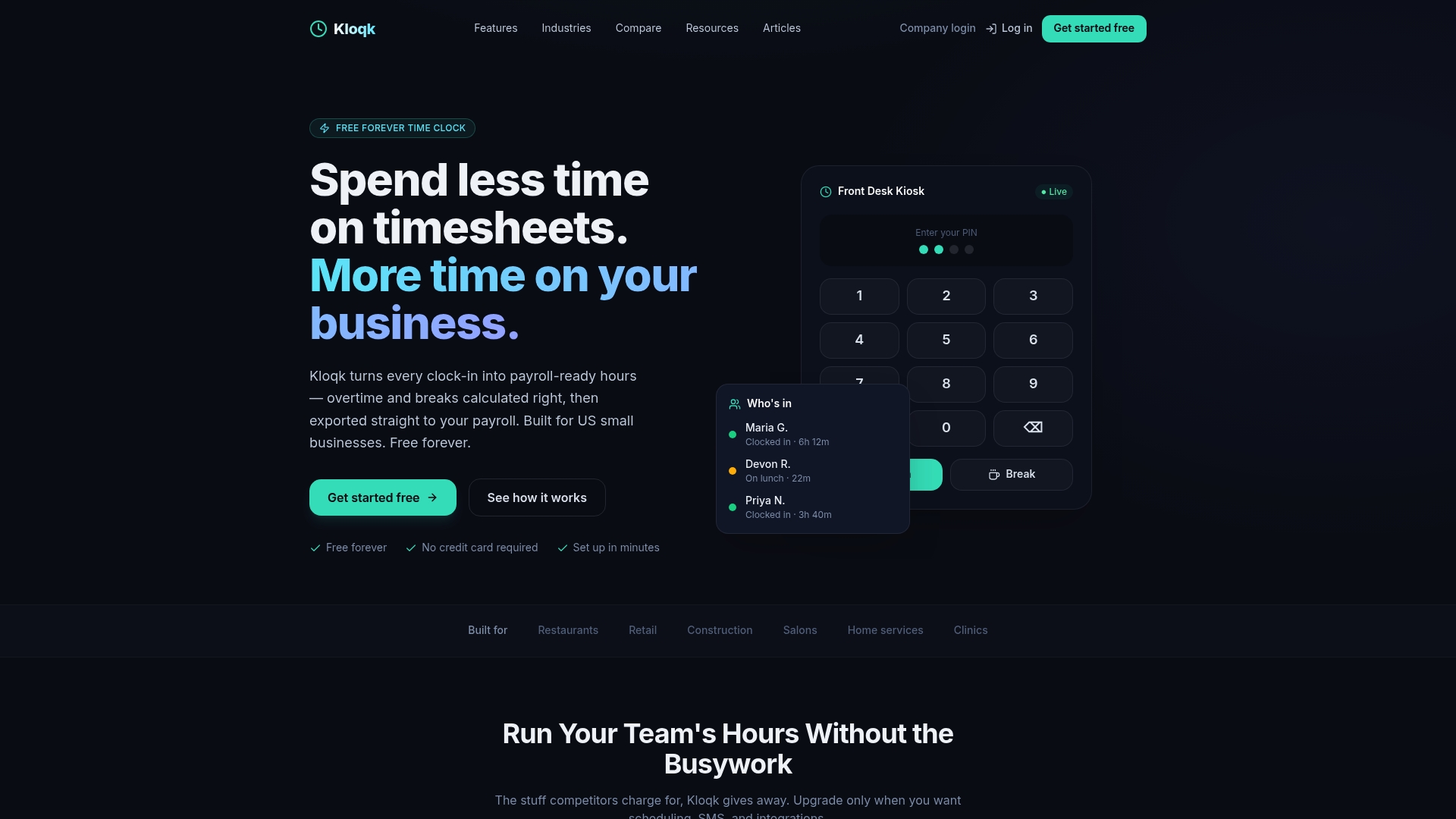
We built Kloqk so small teams get audit-ready logging without paying for it first. Our free plan includes overtime calculations, break tracking, payroll exports, and photo verification at no cost, where many competitors charge for these as add-ons. GPS geofencing flags out-of-range punches automatically, so exceptions show up as logged events instead of disappearing into a manual spreadsheet.
- Export a sample audit log from your own data to see how clean the format is before you commit to anything
- Upgrade to paid plans later if you need scheduling, PTO, or hiring tools; current prices are listed on our pricing page.
- Use a recruitment ROI calculator if you are also weighing the cost of administrative hours against new hires
If you manage hourly staff and want payroll-ready hours without the manual cleanup, check our pricing and start with the free tier.
FAQ
What is a timesheet audit?
A timesheet audit is a review of timekeeping records, including original punches, edits, and approvals, to confirm hours were recorded and paid correctly. It checks for completeness, proper approvals, and whether edits have documented reasons, typically against FLSA recordkeeping standards.
Can you give an example of an audit trail?
A simple example is a punch logged at 8:58 AM, later corrected to 8:30 AM by a named manager with a stated reason and a timestamp showing when the edit happened. The original entry stays visible alongside the correction rather than being overwritten.
How do I keep track of employees’ hours?
Most small teams use a time clock app or kiosk that logs punches automatically, then layers in manager approval before hours go to payroll. Features like GPS geofencing and photo verification add a layer of confirmation at the point of punch rather than relying on manual entry.
Is an audit trail mandatory?
The FLSA does not require a specific audit-trail format, but it does require employers to preserve time cards and payroll records for set retention periods: two years for time-related records and three years for payroll records. A detailed audit trail is the practical way most employers meet that requirement and defend against disputes.
Sources
- Fact Sheet #21: Recordkeeping Requirements under the Fair Labor Standards Act (FLSA) | U.S. Department of Labor
- Time tracking best practices | Atlassian
Recommended
Sources
Every figure on this page traces to one of these. Primary law and government sources are listed first.
- 1. U.S. Department of Laborprimary
- 2. atlassian.com
Written by
Marcus ReyesPayroll & Timekeeping Specialist
Marcus covers payroll accuracy, timesheets, and time tracking, the unglamorous mechanics that keep paychecks correct and audits painless.
Keep Reading
Track Hours the Easy Way
Kloqk is a free time clock that handles punches, breaks, overtime, and payroll-ready reports.
Start free