Photo Clock-In Policy: U.S. Employers Need Privacy Rules Before Launch

Photo clock-ins are generally lawful in the United States when they serve a real timekeeping purpose and the employer limits what it collects, how long it keeps images, and who can see them. The main limits come from nondiscrimination law, not a photo-specific ban, plus state privacy rules that vary by location. If you run a team, the next step is a written policy that spells out purpose, retention, access, and accommodations before you turn the feature on.
TL;DR:
- Federal law requires accurate time records, not photos; facial matching may trigger state biometric rules, unlike a supervisor’s visual review of an image.
- Federal rules require employers to keep time cards for two years and payroll records for three; delete photos when applicable retention periods end.
- Document alternatives such as PIN entry or supervisor verification when disability, religious practice, or medical needs prevent photo capture, and log approved exceptions.
- Restrict photo access to managers or payroll staff who need it, encrypt stored and exported files, log access, and prohibit unrelated use or sharing.
- For crews across multiple job sites, pair photos with GPS or geofencing and use a validated time source rather than a device clock employees can change.
Table of Contents
- What federal law actually says about photo clock-ins
- Treat clock-in photos as sensitive data, not just a punch record
- Building a photo clock-in policy that holds up operationally
- Sample policy language and a launch checklist
- Where this policy debate usually goes wrong
- Run photo clock-ins without building the policy from scratch
- FAQ
- Sources
What federal law actually says about photo clock-ins
No federal statute names “photo clock-ins” directly, so the legal question really splits into two parts: recordkeeping law and nondiscrimination law.
On recordkeeping, the Fair Labor Standards Act requires employers to keep accurate records of hours worked for non-exempt employees, including time cards for a minimum period consistent with federal retention rules and payroll records for a minimum retention period as required by law. The FLSA does not require any particular method of tracking time. A punch clock, a handwritten log, and a photo-based mobile app satisfy the law equally well as long as the resulting records are complete and accurate. That means a photo requirement is not a special legal category: it stands or falls on whether it produces reliable hours-worked data, the same test applied to any other timekeeping tool.
The nondiscrimination side is where employers need more care. The Equal Employment Opportunity Commission has issued guidance addressing wellness programs and, more recently, wearable and device-based data collection. In its guidance on wearables, the EEOC warns that collecting biometric or health-related information through workplace devices can trigger Americans with Disabilities Act obligations, including rules against disability-related inquiries and medical examinations. A photo clock-in itself is not a medical exam, but a program that captures or infers health information, visible symptoms, pregnancy, or a disability accommodation device could cross into ADA territory if that data gets used in employment decisions. The EEOC’s wellness program rules add a related principle: when a program touches health data, it needs to be reasonably designed, voluntary where applicable, and backed by confidentiality protections and clear notice about what gets collected and how it stays confidential.
Three practical takeaways follow from that framework:
- Photo clock-ins must exist to verify identity and hours worked, not to monitor health, appearance, or protected characteristics.
- Any program that captures more than a basic identity photo (health status, visible disabilities, religious dress) needs a documented business reason and accommodation pathway.
- Notice and confidentiality protections should exist in writing before the first photo is ever taken.
State and local law is the piece most employers underestimate. A growing number of states regulate biometric data collection, and some photo-based verification systems use facial geometry or matching algorithms that can fall under those statutes depending on how the technology works. Other states have broader employee privacy or data breach notification laws that apply once you’re storing photos tied to an identifiable worker. None of this means photo clock-ins are banned; it means the compliance bar depends heavily on where your employees are located and what the underlying technology actually does with the image. A straightforward photo capture used only for a supervisor’s visual confirmation sits in a different risk category than a system running facial recognition matching in the background. Before rolling out photo verification across multiple states, it’s worth confirming with a qualified employment attorney whether any state-specific biometric or privacy statute applies to your setup.
Treat clock-in photos as sensitive data, not just a punch record
Once associated with an employee’s name and timestamp, a photo constitutes personally identifiable information requiring strong data protection measures akin to those used for sensitive identifiers.
Three practices form the baseline for safe handling:
- Store photos with encryption at rest and in transit, and restrict viewing access to the managers or payroll staff who actually need it for their jobs.
- Log who accesses clock-in photos and when, so you have an audit trail if a dispute or investigation ever arises.
- Prohibit any secondary use, meaning photos collected for timekeeping never get repurposed for marketing, social media, or performance evaluation unrelated to attendance.
Retention practices should align with FLSA recordkeeping schedules, retaining time card data and associated photos for the legally required periods, rather than using indefinite retention which increases privacy risk. Once those windows close, delete the images rather than letting them accumulate indefinitely in a dashboard or cloud folder. Indefinite retention does not make you more compliant; it just expands the amount of sensitive data sitting around if a breach ever happens.
When photos or related data extracts leave your primary system, such as during a payroll audit, an attorney request, or a software migration, the handling matters as much as the storage. The EEOC’s own internal policy on personally identifiable data extracts offers a useful model even outside the agency context: it calls for logging every extract of sensitive data, encrypting PII on any portable device, and password-protecting files before transmission. Employers exporting clock-in photos for a payroll vendor or legal review can mirror those same three steps: log it, encrypt it, protect it in transit.
Pro Tip: Before you export any batch of clock-in photos for an audit or legal hold, write down who requested it, why, and when it will be deleted, so the exception doesn’t quietly become a permanent copy.
Finally, put the prohibition on sale or sharing directly into your written policy. Employees are far more likely to accept a photo requirement when the policy explicitly states that images are used only for timekeeping verification and are never sold, shared with third parties for unrelated purposes, or used in disciplinary matters outside attendance disputes.
Building a photo clock-in policy that holds up operationally
A policy that only addresses legality but skips day-to-day mechanics tends to fall apart within a few months, usually around the first disputed punch or the first employee who asks for an exception. The following framework covers both.
- Define purpose and scope first. State plainly that photo capture exists to verify identity and confirm hours worked, and specify which roles or locations are covered, since not every policy needs to apply company-wide.
- Set the capture moment and method. Decide whether photos are taken at a shared kiosk, through a mobile selfie, or both, and specify that the photo is captured automatically at the moment of clock-in rather than at random intervals.
- Pair photos with timestamp accuracy. Photo verification only solves half the problem if the underlying clock is unreliable, so timestamping should rely on a validated time source rather than a device’s local clock that an employee could manually adjust.
- Build in accommodation pathways before launch, not after a complaint. Employees with disabilities that make photo capture difficult, religious objections to being photographed, or pregnancy-related concerns should have a documented alternative, such as a PIN-based clock-in or supervisor verification, and HR should log each exception granted.
- Decide how disputes get resolved. Specify who reviews a disputed punch, what evidence (photo plus GPS or geofence data) gets considered, and how quickly an employee can expect a correction.
- Communicate and train before go-live. Hold a short training session for supervisors so they understand the purpose, the retention rules, and how to handle an accommodation request, and distribute the written policy to all covered employees for signed acknowledgment.
- Audit periodically. Review who has access to stored photos, confirm old images are being purged on schedule, and refresh supervisor training at least annually.
Operationally, many small employers pair photo capture with GPS or geofencing so a punch is verified both by who clocked in and where. That combination is particularly useful for construction crews and field teams working across multiple job sites, where a supervisor can’t physically confirm every clock-in. One approach worth reviewing is how job-site clock-ins with photo capture reduce disputes for distributed crews, since the same principle extends to any employer managing workers who aren’t at a single fixed location.
The disciplinary side of the policy matters too. Spell out what happens if an employee attempts to clock in for someone else (a practice often called buddy punching), what happens if someone repeatedly refuses the photo step without an approved accommodation, and how those situations differ from a simple missed punch that just needs correction. Clear, written rules here protect both the business and the employee, since ambiguity is usually what turns a minor timekeeping disagreement into a formal grievance.
Sample policy language and a launch checklist
A short, direct policy reads better than a dense legal document, and employees are more likely to actually follow it.
- Purpose: “Photo capture at clock-in verifies employee identity and confirms accurate hours worked for payroll purposes.”
- Scope: “This policy applies to all non-exempt employees using the mobile or kiosk time clock at [location/role].”
- Retention: “Clock-in photos are retained for the same period as associated time card records and deleted on a rolling schedule thereafter.”
- Access: “Only payroll administrators and direct supervisors may view stored clock-in photos.”
- Accommodations: “Employees who cannot use photo clock-in due to disability, religious practice, or medical need may request an alternative verification method through HR.”
| Phase | Key actions |
|---|---|
| Before launch | Draft written policy, identify accommodation process, set retention schedule, configure access controls |
| Launch day | Distribute policy for signed acknowledgment, train supervisors, test photo and timestamp accuracy |
| Ongoing audits | Review access logs, purge expired photos, confirm disputed punches were resolved and documented |
Keep every signed acknowledgment, accommodation record, and audit log alongside your standard payroll files. If a wage dispute or an EEOC inquiry ever arises, those records show the policy was applied consistently rather than improvised on a case-by-case basis.
Where this policy debate usually goes wrong

Most employers either overbuild or underbuild their photo clock-in policy, and both mistakes come from treating it as a technology decision rather than a records decision. The overbuilders add facial recognition, indefinite storage, and vague “for security purposes” language that invites exactly the state biometric and privacy scrutiny they were trying to avoid. The underbuilders flip on a photo feature in their time tracking app, skip the written policy entirely, and discover only after a disability accommodation request or a data request from a departing employee that they have no documented process to point to.
The more durable approach treats a clock-in photo the way payroll already treats a timesheet: a record with a defined purpose, a defined lifespan, and defined custody. Employers who think in those terms rarely run into trouble, because the FLSA’s two-year and three-year retention windows and the EEOC’s confidentiality principles already supply most of the structure needed. The gap isn’t usually the law; it’s that nobody wrote the policy down before the feature went live.
Saad
Run photo clock-ins without building the policy from scratch
Our time clock with photo capture helps small employers verify identity at every punch without extra charges that some platforms impose for photo verification. Our employee time tracking plan offers photo capture, GPS geofencing, overtime and break calculations, and payroll-ready exports, with retention and access managed within the platform.
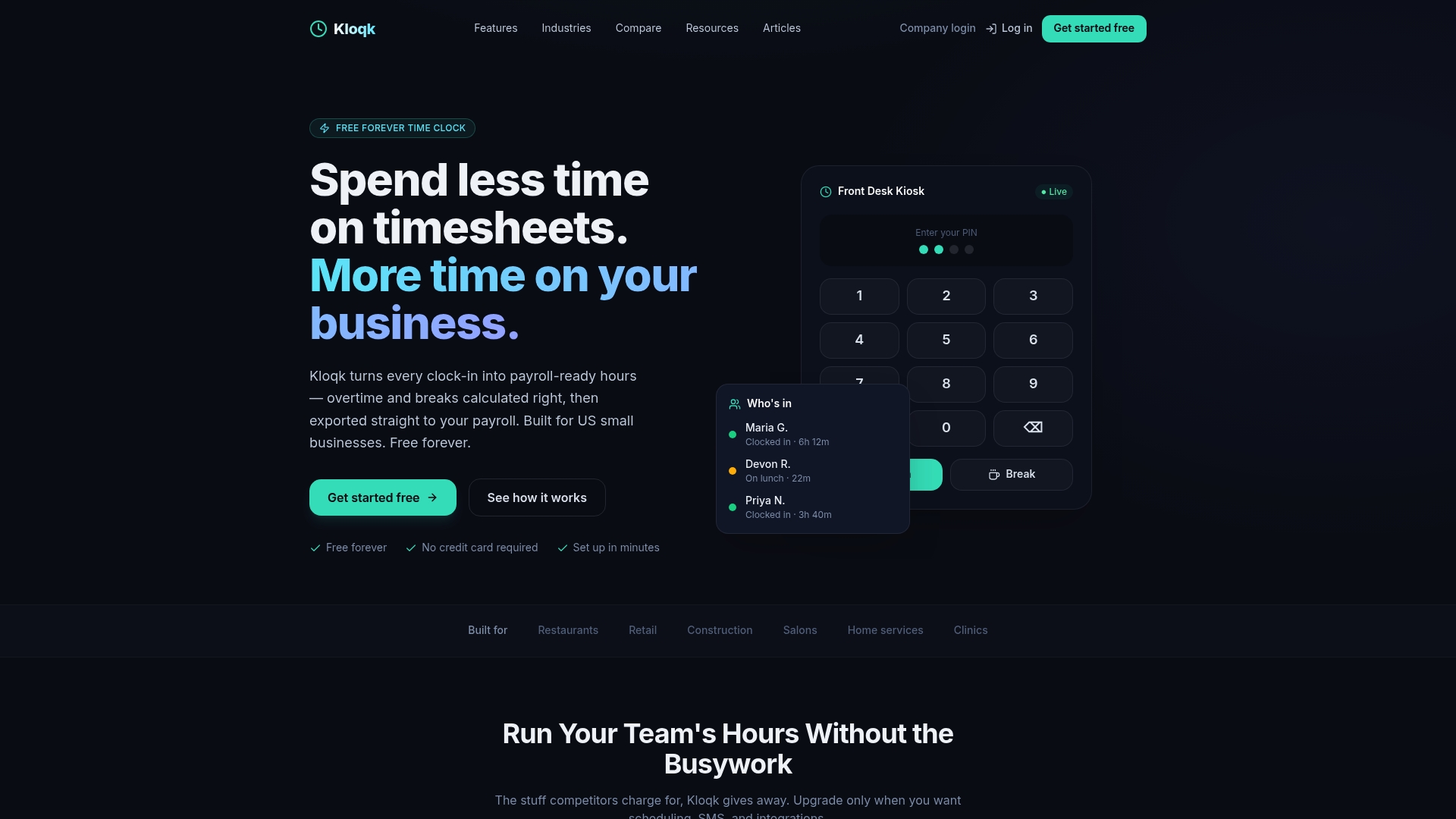
- Photo verification at clock-in, paired with GPS geofencing to confirm location.
- Payroll-ready exports that cut down on manual timesheet entry.
- Upgrade paths for additional features such as scheduling, PTO, or hiring tools are available.
If you’re ready to put a documented, audit-ready photo clock-in process in place, check our pricing page and start with the free plan built for exactly this job.
This article is general information, not a substitute for advice from a qualified lawyer. Consult a qualified legal professional about your own circumstances before acting on anything here.
FAQ
Can your boss change your clock in time?
An employer can correct a clock-in time to fix a genuine error, such as a missed punch or a system glitch, but altered records still need to reflect hours actually worked under the FLSA’s recordkeeping rules. Employees should be able to see and dispute any edits, and a clear correction process in the written policy helps prevent disagreements from turning into formal complaints.
What does “clocking out” mean?
Clocking out means recording the exact time an employee stops working for the day or for a break, which closes out that work period for payroll purposes. Accurate clock-out times matter because the FLSA requires employers to keep precise records of total hours worked, and a missed or inaccurate clock-out can lead to underpayment or overpayment disputes.
What should I check before choosing a workplace’s photo-based time clock system?
Before relying on any photo-based time clock, check that the policy states a clear purpose for the photos, a defined retention period tied to payroll recordkeeping, and an accommodation process for employees who can’t use photo verification for disability, religious, or medical reasons. You should also confirm who has access to stored images and whether the employer has addressed any state-specific biometric privacy requirements that might apply.
Can I refuse to use a biometric fingerprint time clock?
Whether you can refuse depends on your employer’s accommodation policy and any applicable state biometric privacy law, since some states require consent before collecting fingerprint or facial geometry data. If a fingerprint clock would conflict with a disability, religious belief, or documented medical concern, the EEOC’s guidance on device-based data collection supports requesting a reasonable alternative, such as a PIN or photo-based clock-in instead.
Sources
Recommended
Sources
Every figure on this page traces to one of these. Primary law and government sources are listed first.
- 1. U.S. Department of Laborprimary
Written by
Marcus ReyesPayroll & Timekeeping Specialist
Marcus covers payroll accuracy, timesheets, and time tracking, the unglamorous mechanics that keep paychecks correct and audits painless.
Keep Reading
Track Hours the Easy Way
Kloqk is a free time clock that handles punches, breaks, overtime, and payroll-ready reports.
Start free