Audit Ready Geofenced Clock In in Two Weeks for HR

Geofenced clock-in is a sound choice for most hourly workforces because it verifies location at the moment of the punch, cuts down on buddy punching, and creates a defensible time record. The trade-offs are real: GPS accuracy has limits, employees expect clear consent and privacy protections, and every rollout needs an exception process for denied permissions or dead zones. Standards from the Fair Labor Standards Act and the NIST Privacy Framework, plus vendors like Kloqk, give you a workable model to follow.
TL;DR:
- GPS accuracy issues can cause false rejections, especially indoors or near tall structures, making enforcement mode suitable only for fixed-site roles.
- Proper permission settings, a site-specific radius, and a small pilot are essential to prevent configuration errors and system rejection during initial rollout.
- Location data should be captured only at punch time and with clear employee consent to comply with privacy frameworks and avoid legal risks.
- Differentiating enforcement mode for fixed sites and verification mode for mobile crews helps reduce disputes and improves punch reliability.
- Starting with a wider geofence radius and tightening it after real-world testing prevents unnecessary punch denials and enhances accuracy.
Table of Contents
- How geofenced clock-ins work: zones, device behavior, and data captured
- Key benefits and practical limitations
- Planning and technical requirements before enabling geofenced clock-in
- Privacy, consent, and compliance: data-minimizing best practices
- Step-by-step rollout and exception handling guide
- Payroll integration and recordkeeping in practice
- Publisher example: how Kloqk applies geofenced clock-ins for small employers
- Saad’s short take: three priority actions for HR teams
- Evaluate Kloqk: quick links to try a free pilot or see pricing
- Sources
- FAQ
How geofenced clock-ins work: zones, device behavior, and data captured
A geofence is a virtual boundary drawn around a job site, usually a circle with a set radius, though some systems support custom shapes for irregular lots or multi-building campuses. The employee’s phone or tablet uses GPS, Wi-Fi positioning, and cell tower data together to estimate location, then checks that estimate against the zone boundary before allowing or logging a punch, within typical GPS accuracy limits.
There are two common patterns. Automatic entry and exit triggers fire a punch the moment a device crosses the boundary, useful for delivery drivers or field technicians who move between sites all day. Location-validated manual punches work differently: the employee still taps “clock in,” but the app blocks the action or flags it if the device sits outside the approved radius. Most small business deployments favor the manual model because it keeps the employee in control of the action while still enforcing the location rule.

Every punch event should capture a consistent set of metadata: a timestamp, GPS coordinates (or a truncated version of them), a device identifier, and, where the employer requires it, a photo. Each field serves a purpose. The timestamp anchors the record to a specific pay period. Coordinates confirm the employee was where the schedule says they should be. The device identifier helps catch someone punching in on a coworker’s phone. A photo adds a second layer of verification that coordinates alone cannot provide, since GPS can be spoofed or simply inaccurate near tall buildings.
None of this needs to run continuously. A geofence check that fires only during the brief windows around a scheduled clock-in or clock-out gives you the accuracy benefit without turning the app into a tracking device that follows employees through their day. That distinction matters both operationally and legally, and it shapes almost every design decision that follows.
Key benefits and practical limitations
Geofenced clock-in earns its place in a time tracking stack when the benefits outweigh the setup effort, and for most hourly teams they do.
- Accuracy: punches tie directly to a verified location instead of a self-reported entry.
- Time theft prevention: buddy punching becomes far harder when a coworker’s phone cannot fake presence at the job site.
- Audit trails: timestamped, geotagged records hold up better in a wage dispute or Department of Labor inquiry than a paper timesheet.
- Correct job allocation: multi-site businesses can confirm which crew worked which location, which matters for job costing as much as payroll.
The limitations are just as concrete. GPS drift can place a device tens of feet off its true position, which causes false rejections near a geofence edge. Indoor and multi-floor buildings confuse GPS entirely, since satellite signals do not penetrate concrete and steel well, so a warehouse worker on the third floor might read as “outside the zone.” Employees sometimes deny location permission, whether by accident or on purpose, and that blocks the punch outright. Battery optimization settings on some phones quietly suspend background location services, and poor cellular or Wi-Fi coverage on rural or industrial sites can delay a punch from registering at all.
The practical fix is choosing between enforcement and verification modes based on the job. Enforcement, where a punch outside the geofence is blocked, suits fixed-site roles like a restaurant or retail store where an employee should never be clocking in from home. Verification, where an out-of-zone punch is logged with a flag for supervisor review rather than blocked outright, suits field service or construction crews whose site boundaries are less exact and whose punches often happen from a truck in the parking lot.
Planning and technical requirements before enabling geofenced clock-in
A rollout that skips the planning stage usually stalls on permission errors and radius disputes within the first week. Handle these items before you flip the switch.
- Confirm device and OS permission settings across the phones and tablets your team actually uses, since Android and iOS handle location permissions differently.
- Set the permission model to “only while using the app” rather than “always,” which satisfies most punch-accuracy needs without collecting location in the background.
- Run a short site survey at each location to see how GPS behaves near entrances, parking areas, and any structural interference before locking in a radius.
- Choose a starting radius, typically 100 to 300 feet depending on the site’s shape and surrounding buildings, then adjust based on pilot data rather than guessing once and moving on.
- Define offline behavior: punches made without a signal should queue on the device and sync once connectivity returns, with the original timestamp preserved.
- Build a fallback path for when location is denied or unavailable, such as a manual punch with a note field that routes to a supervisor for approval.
- Restrict zone creation and editing to a small admin group, and keep a change log so any radius or boundary edit is timestamped and attributed.
Pro Tip: Start every new site with a radius wider than you think you need, then tighten it after a week of real punch data instead of narrowing it on day one and generating false rejections.
Privacy, consent, and compliance: data-minimizing best practices
The FLSA does not require any particular timekeeping method. Employers can use geofencing, paper timesheets, or a punch clock, as long as the resulting records are accurate and complete. Geofencing supports that requirement; it does not replace the underlying duty to keep defensible hours records.
Location data carries higher stakes than a typical timestamp. The FTC’s guidance on privacy and security treats location as sensitive information and calls for clear consent, transparency about what is collected, defined retention limits, and oversight of any vendor that touches that data. The agency has backed that guidance with enforcement: its 2026 settlement with a Kochava subsidiary over selling sensitive location data now requires affirmative express consent and strict retention and vendor controls before that kind of data can be shared at all. Small employers are not the target of that action, but the underlying principle applies directly: treat precise location as data you protect, not data you casually pass along to a third party.
Continuous background tracking of employee location is one of the fastest ways to trigger an FTC-style enforcement risk and an employee-relations problem at the same time, which is why the NIST Privacy Framework recommends minimizing collection to only what a task requires.
Publish a short policy covering these points before launch:
- A plain-language purpose statement explaining that location is captured only to verify punch times, not to track movement during the day.
- A retention schedule stating how long punch-level location data is kept and when it is purged.
- A limited-use clause confirming the data is never sold or shared beyond payroll and compliance purposes.
- A vendor contract clause requiring your time tracking provider to meet the same retention and security standards you commit to.
Apply the same data-minimization logic to the system itself: capture coordinates only at the moment of the punch rather than as a continuous trail, store truncated or hashed location values where full precision is not required for the audit, and give employees a documented path to ask questions about the data or request its deletion once it is no longer needed.
Step-by-step rollout and exception handling guide
A staged rollout catches configuration problems while the stakes are still low.
- Pick one pilot site and a small crew, ideally five to fifteen employees, representative of the roles you plan to cover eventually.
- Set success metrics before you start: punch success rate, denied-location rate, and how often a supervisor has to override a flagged punch.
- Send a short employee notice covering why geofencing is being added, exactly what data is captured, and how long it is retained. Answer the “does this track me all day” question directly, because it is the one employees ask first.
- Train supervisors on the override workflow so they know when to approve a flagged punch versus when to send it back for a manual note.
- Run the pilot for one to two weeks, reviewing punch logs daily for the first few days and weekly after that.
- Document every exception: a denied punch, an offline sync, or a supervisor override, along with the reason, so the pattern is visible before scaling.
- Tune the geofence radius and tolerance based on real data, then repeat the pilot cycle at a second site before rolling out company-wide.
Exceptions need a fixed path, not ad hoc judgment calls. When a device is offline, the app should queue the punch locally and sync it once a connection returns, timestamped to the original moment rather than the sync time. When location is denied, the employee should be able to submit a manual punch with a short note, which routes to a supervisor for same-day approval. Disputes over a flagged or rejected punch should have a clear resolution window, ideally within one pay cycle, so payroll never runs on an unresolved record.
Pro Tip: Review pilot data weekly for the first month; after full rollout, a monthly tuning pass is usually enough to catch drift in punch patterns or site conditions.
Most early failures trace back to permission settings rather than the geofence itself, so a short, specific training session on granting “while using the app” access solves the bulk of week-one tickets.
Payroll integration and recordkeeping in practice
Geofenced punches only pay off once they map cleanly into payroll rules. Rounding policies, grace windows around scheduled shift times, overtime triggers, and break deductions all need to apply consistently to geofenced data the same way they would to any other punch method, per DOL guidance on hours worked and rounding practices.
- Export audit-ready files in a format your payroll vendor accepts, with location and photo metadata attached to each punch record rather than stripped out before export.
- Handle multi-site and split shifts explicitly, since an employee who works two locations in one day needs punches attributed to the correct site for job costing as well as pay.
- Account for travel time between sites according to your existing policy, geofencing only confirms arrival and departure, it does not decide whether that travel is compensable.
- Retain full records long enough to satisfy an audit or a client billing dispute, and make sure the export format still makes sense to someone reviewing it a year later.
Payroll date scheduling is its own puzzle once time data is clean; a guide to payroll date management covers how small businesses structure pay periods around varying cutoffs.
Publisher example: how Kloqk applies geofenced clock-ins for small employers
Kloqk builds its GPS time clock around the free-first model described on its own geofencing overview: geofencing, photo verification at clock-in, and payroll exports are included in the core product rather than gated behind a paid tier. Photo verification pairs with the location check so a flagged punch has two independent signals instead of one.
Its approach to privacy aligns with data-minimization practices: location is captured only at the moment of punch rather than continuously tracked, and zone creation or editing is restricted to certain admin roles. A small employer piloting the system would typically draw zones for one or two sites, run a one-week test with a small crew, export that first payroll batch, and track how many punches got flagged or disputed before deciding whether to widen the rollout.

Saad’s short take: three priority actions for HR teams
Start small. Run a real pilot before touching every site, write your data policy down before employees ask about it, and tune your geofence radius from actual punch data rather than a guess. Use enforcement mode for fixed sites and verification mode for field crews, since forcing a rigid rule onto a mobile job just generates disputes. The single biggest privacy pitfall is tracking location outside the punch window: turn that off before it becomes a policy you have to explain after the fact.
Saad
Evaluate Kloqk: quick links to try a free pilot or see pricing
Many geofencing add-ons charge extra for key features like photo verification, payroll exports, and unlimited employee seats; however, some providers include these features in their free plans, making it affordable to test before budget discussions. Start with the GPS time clock feature page to see how zones and verification work together, or check the pricing page to compare Free, Pro at $29 per month per location, and Premium at $59 per month per location for the scheduling and PTO tools that sit on top of the core time clock.
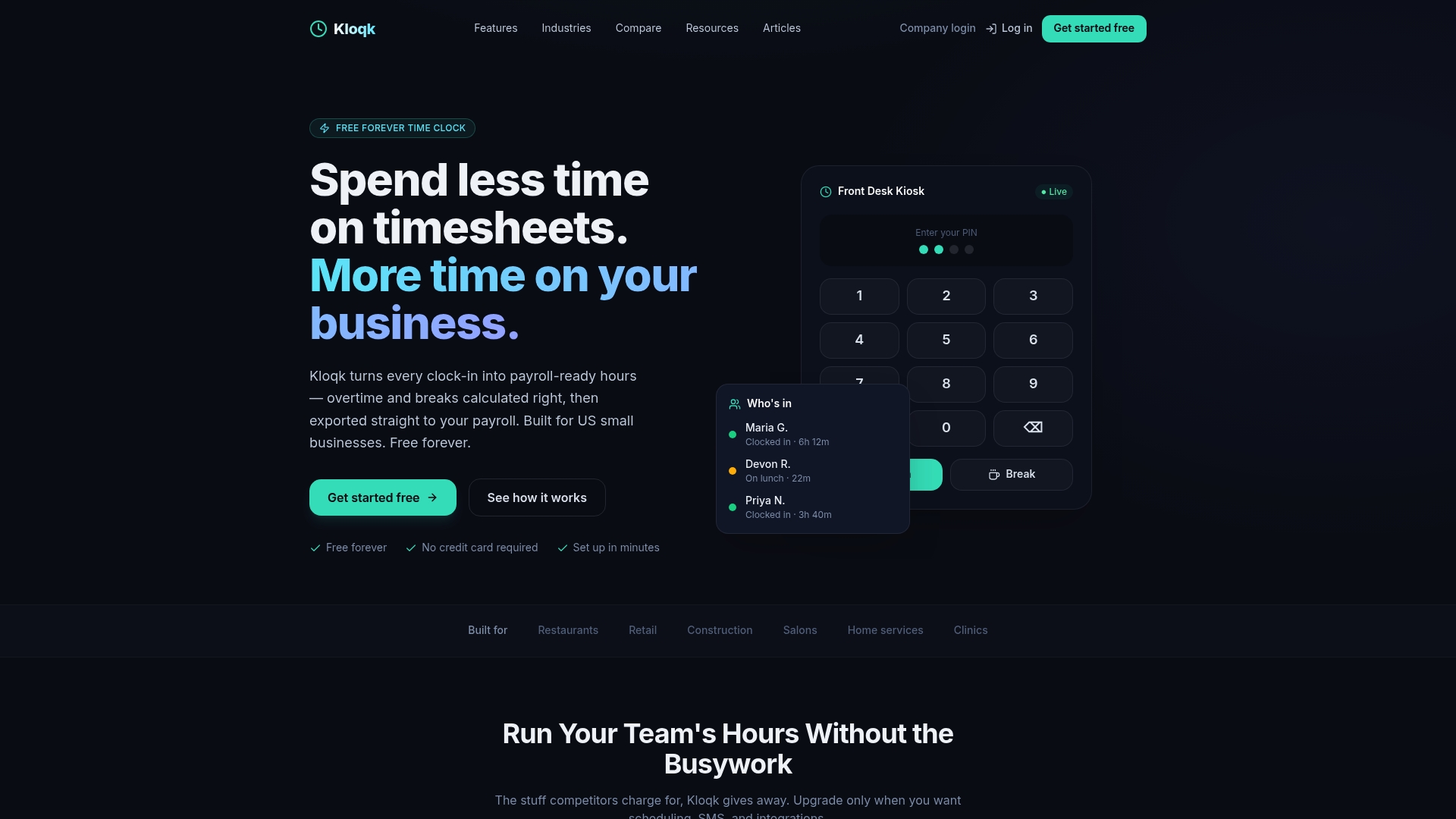
A sensible two-week pilot looks like the rollout above: one site, a small crew, daily review of punch logs for the first few days, then an export of the first payroll run to confirm the numbers match what supervisors expect. If the free tier covers what your team needs, there is nothing to upgrade until you want scheduling or PTO tracking added.
Sources
The FLSA recordkeeping fact sheet and DOL’s FLSA reference guide cover what records you must keep. FTC privacy guidance and the NIST Privacy Framework explain consent and data-minimization expectations for location data.
- Fact Sheet #21: Recordkeeping Requirements under the Fair Labor Standards Act (FLSA) | U.S. Department of Labor
- FTC guidance on privacy and security
- NIST Privacy Framework
FAQ
What is geofencing for clocking in?
Geofencing for clocking in uses a virtual boundary around a job site, checked against a device’s GPS location, to confirm an employee is physically present before their punch is accepted. It is commonly paired with photo verification for a second layer of confirmation, as described in Kloqk’s geofencing overview.
What are the disadvantages of geofencing?
GPS accuracy can drift near tall buildings or indoors, which causes false rejections at a zone’s edge, and devices with location permission denied or battery-saving modes enabled can miss a punch entirely. It also raises privacy questions if tracking runs continuously instead of only at the moment of the punch, which is why the NIST Privacy Framework recommends limiting collection to what the task needs.
What is the 7 minute rule for clocking in and out?
This refers to a common rounding practice where punches within roughly seven minutes of a scheduled shift boundary round to that scheduled time, so an employee clocking in a few minutes early or late is paid to the nearest quarter hour. The Department of Labor’s guidance on hours worked allows rounding practices as long as they do not systematically shortchange employees over time.
Can I do geofencing myself?
Yes, most modern time clock apps, including Kloqk’s GPS time clock, let a manager draw a zone and set a radius directly in the app without any developer help. The harder part is not the setup itself but choosing the right radius and permission settings, which a short pilot at one site will reveal quickly.
Recommended
Sources
Every figure on this page traces to one of these. Primary law and government sources are listed first.
- 1. U.S. Department of Laborprimary
- 2. U.S. Department of Laborprimary
- 3. nist.gov
- 4. ftc.gov
- 5. glendalepayroll.com
Written by
Marcus ReyesPayroll & Timekeeping Specialist
Marcus covers payroll accuracy, timesheets, and time tracking, the unglamorous mechanics that keep paychecks correct and audits painless.
Keep Reading
Track Hours the Easy Way
Kloqk is a free time clock that handles punches, breaks, overtime, and payroll-ready reports.
Start free