Tip Pooling vs. Tip Sharing: Rules, Differences, and Payroll

Tip pooling collects tips from a group of employees into one pot and splits that pot by a set formula. Tip sharing (also called tipping out) has each tipped employee keep their own tips and hand a set percentage to colleagues such as bussers, bartenders, or kitchen staff. Federal law has no separate definition for “tip sharing,” so both fall under the same Fair Labor Standards Act (FLSA) rules about who may take part, who may not, and what you must record.
The label matters less than three questions: Do you take a tip credit? Who receives a share? And can you show how every dollar was divided? This guide answers each one for U.S. employers and explains where service charges fit in.
TL;DR
- Pooling vs. sharing: a pool is combined and split by a formula (often hours or points). Sharing is a percentage each person pays out of their own tips. Legally, both are treated as tip pools.
- With a tip credit, a mandatory pool may include only employees who customarily and regularly receive tips. Without one, cooks and dishwashers can be included.
- Managers, supervisors, and owners may never take from a pool, though they can keep tips a customer gives them directly for service they personally provide.
- A service charge is not a tip. It is mandatory, belongs to the business, and can be handled very differently from tips.
- Records win disputes. Track hours by role and keep a written policy so each person’s share can be reproduced.
Table of Contents
- What is the difference between tip pooling and tip sharing?
- The federal rules that govern both
- How pooled tips are commonly divided
- Service charges are not tips
- State rules can be stricter than federal rules
- What happens when a pool is invalid
- Notices, records, and payroll
- Pooling or sharing: which fits your business?
- Our perspective on tip pools and time data
- Get the hours behind your tip split right
- FAQ
- Sources
What is the difference between tip pooling and tip sharing?
In everyday restaurant talk the two terms overlap, and people often use them interchangeably. One industry explainer notes that there is no real legal definition for tip sharing and that “tip pooling” is the broad legal category for contributing tips and redistributing them. The practical distinction managers draw looks like this:
| Tip pooling | Tip sharing (tipping out) | |
|---|---|---|
| Who holds the money first | Everyone’s tips go into a common pot | Each server keeps their own tips |
| How the split works | Pot divided by hours, points, or equal shares | Server pays a set percentage (of tips or sales) to support staff |
| Typical setup | Bar teams, counter service, banquets | Full-service dining rooms |
| Where the income varies | Less variation between people on the same shift | Servers still earn more on busy tables |
| Main admin task | Calculate each person’s share of the pot | Calculate and collect each person’s payout |
A server who keeps 60% of the night’s tips and passes 40% to bussers, bartenders, and hosts is tip sharing in the everyday sense. A team of baristas who drop everything into a jar and split it by hours worked is pooling. To the Department of Labor (DOL), both are arrangements where employees contribute tips to be shared with other employees.
The federal rules that govern both
The FLSA allows employers to require employees to share or pool tips with eligible employees. Several rules apply however you describe the arrangement:
- The tips belong to employees. Federal law prohibits employers from keeping employees’ tips, whether or not a tip credit is taken.
- Eligibility depends on the tip credit (more below).
- Managers and supervisors are out. They may not receive tips from a pool, but may keep tips customers give them directly for services they directly and solely provide.
- Timing matters. Pooled tips must be distributed by the regular payday for the workweek, or as soon as practicable if the amount or distribution cannot be determined before payroll is processed.
Who can be in the pool when you take a tip credit
If you pay a reduced cash wage and count tips toward the minimum wage, you may require contributions only to a pool limited to employees who customarily and regularly receive tips, such as waiters, counter personnel who serve customers, bussers, and service bartenders. Cooks and dishwashers are not eligible in that setup.
The tip credit has its own rules on notice, wages, and rounding. We cover them in our guide to tip credit rules for U.S. employers.
Who can be in the pool when you do not
When you pay every employee a direct cash wage of at least the federal minimum wage, you may require a nontraditional tip pool that includes non-tipped employees such as cooks and dishwashers. The owner and managers remain excluded.
Before you add back-of-house staff, confirm they are nonexempt and paid properly. Our partner-style reference on exempt versus nonexempt pay is a good way to check how the classification works. Salaried exempt managers cannot join the pool in any case. Hourly cooks who share in tips still earn overtime, and their tips do not replace it. See our FLSA overtime guide for how to calculate it.
How pooled tips are commonly divided
The law does not prescribe one formula. It asks that a pool be fair and reasonable. Distributions should generally correlate to how much each employee contributes to the service the customer receives, based on industry practice. California’s labor agency takes the same view, saying pools need a reasonable relationship between each person’s contribution and share.
Three formulas cover most small businesses:
- Hours-based. Each person’s share is their hours divided by total pool hours. This is the easiest to defend, because time records back it up.
- Points-based. A server might count as 1.0 point, a busser as 0.5, a bartender as 0.75, per hour worked. Shares are points multiplied by hours.
- Percentage-based (tip sharing). Servers pay 2% to 4% of sales or a percentage of tips to each support role. This is simple on the floor but harder to audit if cash is handed over informally.
A worked example
A coffee counter pools $420 in tips for a shift. Three baristas worked 6, 6, and 4 hours, 16 hours total. The pool is $26.25 per hour. The first two baristas receive $157.50 each, and the third receives $105.00. If one barista had stayed the full eight hours, the numbers shift automatically, which is why accurate clock-in data matters. Without it, you are guessing.

Service charges are not tips
Searchers often confuse tips and service charges, and the confusion costs employers money. A tip is a voluntary sum given by a customer. A service charge is a mandatory fee the business adds. Washington’s labor department puts it this way: tips are voluntary sums customers give employees, while service charges are mandatory fees an employer may charge.
The DOL’s fact sheet says a compulsory charge, such as a set percentage of the bill, is not a tip and counts as the employer’s gross receipts. Money you pay staff from a service charge is wages, so it cannot be counted as tips received. It can count toward your minimum wage and overtime obligations.
Two practical consequences:
- Disclose it. In Washington, businesses must say on receipts and menus how much of a service charge, if any, goes to employees. If disclosure is absent or unclear, the entire charge must go to the employee who provided the service.
- Keep it out of the tip pool unless your policy and state law say otherwise. Mixing service-charge income with voluntary tips makes your records hard to defend.
Banquets, large parties, and automatic gratuities on big tables are the usual trouble spots. If a customer sees a line called “gratuity” that is mandatory, check your state’s rules on whether it is treated as a tip or a service charge before you decide who receives it.
State rules can be stricter than federal rules
The FLSA sets a floor. Your state may go further, and the stricter rule applies. Two examples show how much the details differ:
- Washington allows tip pools to include employees who do not directly serve customers, but excludes salaried exempt managers and business owners. Washington cities such as Seattle also set their own wage floors. See Seattle minimum wage.
- California says an employer-mandated pool may include employees who provide direct table service, but not owners, managers, or supervisors. California also has no tip credit, so the full state minimum applies. Check California’s current minimum wage before setting your pool.
If you operate in more than one state, write a separate policy for each. Your state labor department’s page on tips is the starting point, and an employment attorney should review a pool that includes back-of-house staff.
What happens when a pool is invalid
The cost of getting this wrong is real. The DOL recovered $200,137 in back wages and assessed $15,256 in penalties after finding an Oregon restaurant ran an invalid tip pool and also violated overtime rules. The two problems tend to travel together: a business that does not track tips carefully often does not track hours carefully either.
Common causes of invalid pools:
- A shift lead or assistant manager receiving a cut
- Back-of-house staff in a pool while the employer takes a tip credit
- Tips withheld to cover credit card fees beyond what the law permits, or kept to pay breakage or walkouts
- No written policy and no record of how shares were calculated
Notices, records, and payroll
A clean process has four parts.
- Write the policy. State who is in the pool, the formula, how often it pays out, and whether you take a tip credit. Give employees a copy and have them acknowledge it.
- Record contributions and payouts. Employers that collect tips for mandatory pools without taking a tip credit must keep records of each employee receiving tips and the weekly or monthly amount reported. Collected tips generally must be redistributed within the pay period.
- Tie shares to hours. Hours-based and points-based pools both depend on accurate time by role. Our guide to tipped employee time tracking shows what to record and why.
- Pay on payday. Put tip payouts on the paycheck rather than handing out envelopes. Cash tip-outs are legal but leave a thin paper trail.
Technology can cut the paperwork. Firebirds said that replacing a tip-share process that required managers to stuff cash into envelopes with a digital tool cut change-order deliveries from three times a week to once, saving on bank charges, and that employees could see their earnings in an app.
Pooling or sharing: which fits your business?
Neither is better in every case. Choose by how your floor works.
Pooling usually fits when:
- The team works as a unit (counter service, bars, banquets)
- You want less friction between high-volume and low-volume stations
- Hours data is reliable, so an hours-based split is easy to prove
Sharing usually fits when:
- Servers own their sections and expect to keep most of what they earn
- Support roles vary a lot from table to table
- You want contributions tied to sales rather than to tips
If you are unsure, test with a small, written trial period and ask staff for feedback before you make it permanent. Whatever you choose, apply it the same way to everyone in the covered roles.
Our perspective on tip pools and time data
Most tip disputes we hear about are not really about tips. They are about hours. A pool split by hours is only as fair as the clock behind it, and a missed break punch, a rounded shift, or a buddy punch quietly moves money from one person to another.

So we suggest getting the time data right first. Pay the right wage per role, capture real clock-in and clock-out times, and keep meal and break records. Then the tip split becomes arithmetic. Rounding rules matter too: review FLSA time rounding rules and meal break deductions before you rely on shift totals. If you run restaurants, our notes on restaurant overtime rules cover the other half of the same audit.
We built Kloqk so a small business does not have to pay for the basics of that data. The tip policy itself still needs your judgment and, for complex setups, your attorney’s.
Saad
Get the hours behind your tip split right
Kloqk’s free plan gives small teams payroll-ready timesheets, overtime and break calculations, photo verification at clock-in, and payroll exports, so your hours-based tip shares rest on records you can show an auditor. Staff can punch in from a phone or a shared kiosk. Optional upgrades add things like scheduling and PTO: Pro is $29 per month per location and Premium is $59 per month per location. See Kloqk’s plans or start with free employee time tracking.
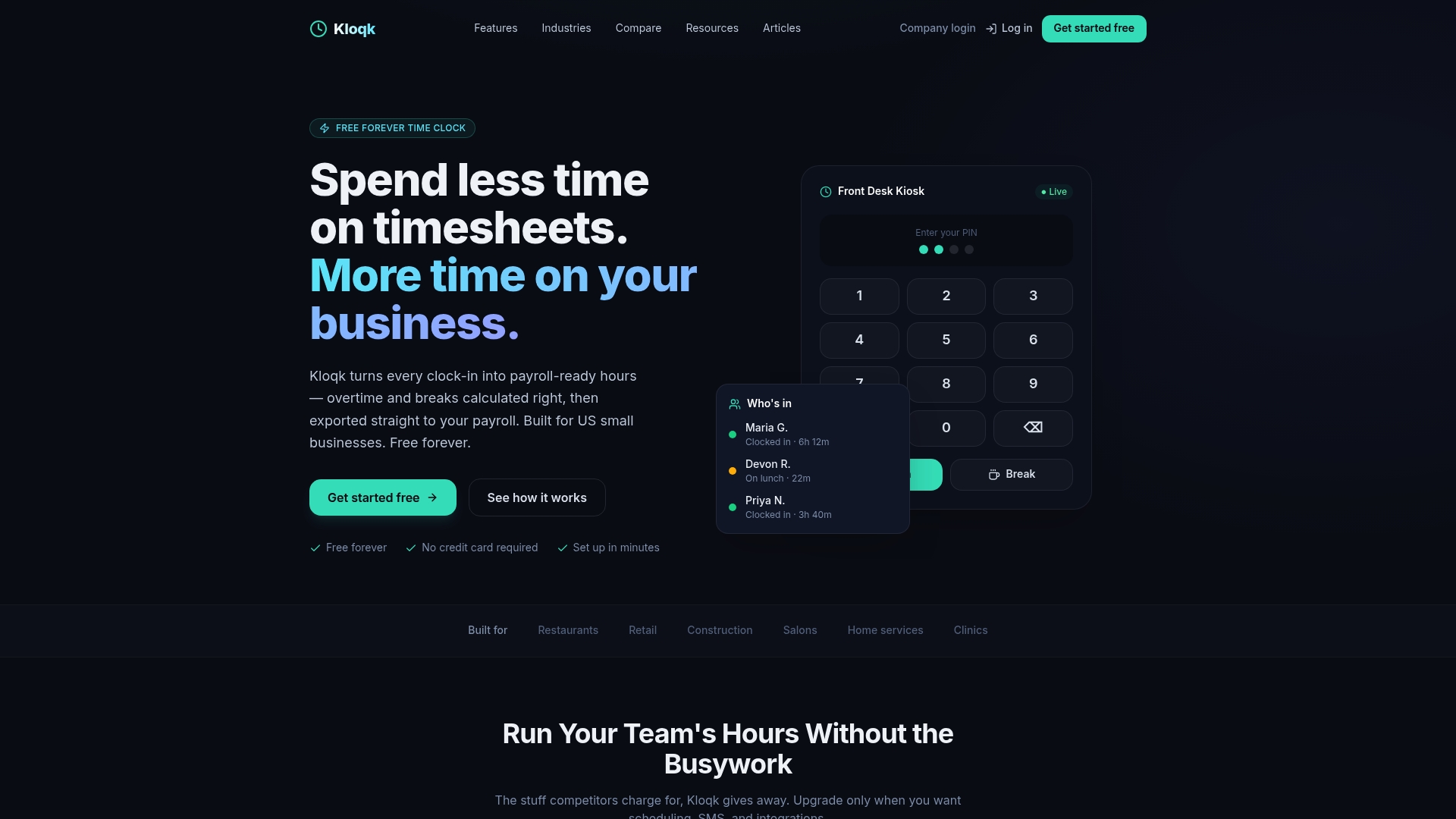
If buddy punching could skew who gets what from the pool, our page on preventing buddy punching explains how photo and GPS verification help.
FAQ
Is tip sharing legal?
Yes. Federal law allows employers to require employees to share or pool tips with eligible employees. The rules about who may receive tips and who may not apply to sharing just as they do to pooling. Check your state, because some set tighter limits.
Can managers take part in a tip pool?
No. Managers and supervisors may not receive tips from a pool. They may keep tips that customers give them directly for services they personally and solely provide, such as a manager who serves a table on their own.
Can cooks and dishwashers share in tips?
Only if you do not take a tip credit and pay them at least the federal minimum wage in direct cash wages. If you do take a tip credit, the mandatory pool is limited to employees who customarily and regularly receive tips. Some states add their own conditions.
Is a service charge the same as a tip?
No. A tip is voluntary and belongs to the employee. A service charge is mandatory and is part of the business’s revenue. How you distribute it depends on your policy and your state’s disclosure rules, and money paid to staff from it counts as wages.
How often must pooled tips be paid out?
By the regular payday for the workweek in which they were earned, or as soon as practicable if the amount cannot be determined before payroll runs. Put the schedule in your written policy so staff know what to expect.
Sources
- DOL Fact Sheet #15: Tipped Employees Under the FLSA
- DOL: Tip Regulations under the FLSA
- DOL WHD Opinion Letter FLSA2026-13
- DOL Field Operations Handbook, Chapter 30
- DOL news release: Oregon restaurant back wages
- Washington L&I: Tips and Service Charges
- California DLSE opinion letter on tip pooling
- Hospitality Technology: Firebirds tipping tech
- Kickfin: Tip pooling, tip sharing, and tipping out
- Salary Atlas: Exempt vs. nonexempt salary
Recommended
Sources
Every figure on this page traces to one of these. Primary law and government sources are listed first.
- 1. U.S. Department of Laborprimary
- 2. California Department of Industrial Relationsprimary
- 3. Washington State Legislatureprimary
- 4. kickfin.com
- 5. salary-atlas.com
- 6. hospitalitytech.com
Written by
Marcus ReyesPayroll & Timekeeping Specialist
Marcus covers payroll accuracy, timesheets, and time tracking, the unglamorous mechanics that keep paychecks correct and audits painless.
Keep Reading
Track Hours the Easy Way
Kloqk is a free time clock that handles punches, breaks, overtime, and payroll-ready reports.
Start free