Employee Scheduling vs. Labor Laws: What U.S. Employers Must Follow

Federal law says almost nothing about when you schedule people, but it says a lot about what you owe for the hours they actually work. The Fair Labor Standards Act (FLSA) has no scheduling provisions apart from child labor rules, so there is no federal advance-notice rule and no federal minimum gap between shifts. The real risk sits in three places: city and state fair-workweek laws, overtime and break rules, and anti-discrimination and retaliation law. All three are decided by what your records show, which is why accurate time records matter more than the schedule itself.
TL;DR
- No federal law requires advance notice of schedules or rest time between shifts. Some states and cities do, so check your location before you publish a schedule.
- Fair-workweek laws (Chicago, Los Angeles, Oregon, Maine, New York City and others) typically require 14 days’ notice and extra pay when you change shifts late.
- Every employer covered by the FLSA must pay overtime after 40 hours in a workweek and keep daily hour records. A schedule that stacks hours creates overtime whether or not you planned it.
- A schedule change can still be illegal if it is discrimination or retaliation, even where no scheduling law applies.
- Compare scheduled hours with punched hours every pay period. That one habit catches most problems.
Table of Contents
- What federal law does and does not say about schedules
- Fair-workweek laws: where scheduling becomes regulated
- Breaks and rest: state law fills the federal gap
- Scheduling that is illegal even without a scheduling law
- A compliance routine for building and changing schedules
- Where a time clock fits in
- Try the free time clock
- Our perspective
- FAQ
- Sources
What federal law does and does not say about schedules
The U.S. Department of Labor (DOL) is direct on this: unless an agreement with the employee or their representative says otherwise, an employer may change work hours without prior notice or consent. A union contract or written employment agreement can add notice duties, so read yours.
What the FLSA does regulate is pay for the hours that result:
- Minimum wage. The federal rate is $7.25 an hour, and many states set a higher one.
- Overtime. Covered nonexempt employees get at least 1.5 times their regular rate after 40 hours in a workweek. The FLSA sets no cap on daily hours for workers 16 and older, and it does not require overtime just because the work falls on a weekend or holiday.
- Breaks. Short rest periods, usually 20 minutes or less, are paid and count as hours worked. Bona fide meal periods, typically 30 minutes or more, generally need not be paid if the employee is completely relieved of duty.
- Records. You must keep hours worked each day and each workweek, the regular rate, straight-time and overtime earnings, and total wages per pay period for each nonexempt worker.
If you want the overtime math in detail, our FLSA overtime rules guide walks through it, and how many hours a week before overtime kicks in covers the workweek definition that trips up many owners.
Where scheduling quietly creates overtime
A manager who swaps a closing shift for an opening shift on Thursday has not broken a scheduling law. But if that swap pushes a cook to 43 hours, you owe three hours at time and a half. Because the workweek, not the day, is the unit, schedules built shift by shift drift past 40 more easily than owners expect. Restaurants feel this most, and our restaurant overtime rules article lists the common errors.
Fair-workweek laws: where scheduling becomes regulated
Fair-workweek (also called predictive scheduling) laws are local and state rules that make employers give notice of schedules and pay extra when they change them late. They usually cover only certain industries, such as retail, hospitality and food service, and often only employers above a size threshold. Whether you are covered depends on your city, your industry and your headcount.
Littler’s 2026 analysis says these ordinances generally require schedules published at least 14 days in advance, consent before adding hours, premiums for changes, good-faith estimates of hours at hire, 9 to 11 hours of rest between shifts, and offering extra hours to existing staff first. Records generally must be kept three years.
| Jurisdiction | Key requirements | Source |
|---|---|---|
| Chicago | Schedules 14 days ahead; one hour of predictability pay for certain changes within 14 days; at least 50% pay for hours cancelled with under 24 hours’ notice; 1.25x base rate for a shift starting less than 10 hours after the last one | Chicago Fair Workweek FAQ |
| Los Angeles | Schedules 14 calendar days ahead; written notice of late changes; written consent when employees voluntarily accept certain changes; predictability pay | Wages LA |
| Oregon | Statewide law for retail, hospitality and food service employers with 500 or more employees worldwide; 14 days’ written notice; predictability pay; right to decline shifts within 10 hours of the previous one | Oregon summary |
| Maine | Employers with 10 or more employees pay for reduced or cancelled scheduled shifts, the lesser of two hours’ regular pay or the pay for the shift; effective September 24, 2025 | Seyfarth 2026 outlook |
| New York City | Amendment effective February 22, 2026 adds a right to request temporary schedule changes | Seyfarth 2026 outlook |
The same Seyfarth outlook notes that Los Angeles County’s ordinance took effect in 2025 and that Berkeley and Evanston enacted newer city frameworks in 2024. This area keeps moving, so treat any table, including this one, as a starting point and confirm the thresholds on your city’s labor standards page.
What a late change costs
Penalties are real money. Under Los Angeles rules, violations can bring restitution, penalties per employee, up to $50 per day that predictability pay is withheld, and a 50% higher maximum administrative fine for a repeat violation of the same provision within three years.
Here is a worked example using Chicago’s rules. A covered employer cancels a server’s five-hour shift at 6 p.m. the evening before. With less than 24 hours’ notice, the employer owes at least 50% of the pay for the cancelled hours. At $16 an hour, that is 5 hours x $16 x 50% = $40 for a shift nobody worked. Do that a few times a week across a team and it adds up fast.
One technical point for payroll: DOL says predictive-scheduling penalties paid above regular earnings, when not prearranged, can be excluded from the FLSA regular rate. That keeps those premiums from inflating your overtime rate, but only if you record them separately from wages.

A federal bill that has not passed
The proposed Schedules That Work Act would set national rules for employers with 15 or more employees, including advance notice and predictability pay in covered sectors. It is a proposal, not law. Build your process around the rules that apply to you now, and a stricter local standard will not catch you off guard.
Breaks and rest: state law fills the federal gap
The FLSA does not require meal or rest breaks at all. It only says when a break you give counts as paid time. States do require them. California requires a paid 10-minute rest period for each four hours worked or major fraction of it, and Colorado requires a paid 10-minute rest per four hours.

For scheduling, that means your shift template must leave room for breaks that the law counts as work time, and for meal periods in states that require them. Our meal and rest break laws by state page lists the rules, and the California lunch break guide goes deeper for the strictest state.
Scheduling that is illegal even without a scheduling law
Even where no notice rule exists, you cannot use the schedule as a weapon. Title VII makes it unlawful to discriminate in the terms, conditions or privileges of employment because of race, color, religion, sex or national origin, and scheduling is one of those terms. Age, disability, pregnancy, religious practice and family or medical leave are covered by other federal laws.
Retaliation is the other trap. Cutting someone’s hours or moving them to bad shifts soon after a complaint, a wage question or a leave request looks like punishment, and it does not have to reduce pay to count. In September 2026, a DOL opinion letter on USERRA, the federal law protecting service members’ jobs, reported by HR Dive, said schedule changes, transfers to less desirable positions and increased scrutiny can be prohibited retaliation if they would dissuade a reasonable worker from making or supporting a charge.
There is an unemployment angle too. The Texas Workforce Commission notes that neither Texas nor federal law requires advance notice of schedule changes, but sudden adverse changes can in some circumstances count as good cause to resign, which affects unemployment insurance eligibility.
The practical defense is documentation. Write down why each schedule decision was made, keep the schedule history, and keep punch records that show who worked what. If you run a contractor business and want a second view on keeping clean payroll documentation, this guide to construction payroll services covers what to track.
A compliance routine for building and changing schedules
You do not need a legal department. You need a repeatable routine.
- Find your rules. Check your state and city labor agency for fair-workweek, break and overtime rules. Note thresholds by industry and headcount.
- Publish early. Even where not required, a 14-day posting window matches the most common legal standard and lets you grow into stricter rules.
- Build in rest. Leave at least 10 hours between a closing shift and the next opening shift. Several ordinances attach premiums below that gap.
- Log every change. Record who changed what, when, and why, plus whether the employee agreed in writing.
- Compare scheduled to worked. At the end of each week, look at actual punches against the plan. Flag anyone near 40 hours before the week ends, not after.
- Pay the premiums separately. Record predictability pay as its own line so your overtime rate stays right.
- Keep records. The FLSA sets the minimum content. Some local laws require three years of retention.
Where a time clock fits in
A schedule is a plan. Labor law is enforced against what happened. When a wage claim or an agency audit comes, your punch records decide the outcome. That is the job of a time clock, and it is why steps 5 through 7 above are the ones owners most often skip: doing them by hand from paper or text messages is slow and error-prone.
Our time clock software for small business turns clock-ins into payroll-ready hours, with overtime and break calculations, payroll exports and compliance with federal and state labor laws built in. Photo verification at clock-in and GPS geofencing help keep the hours on your records real. Our guide on how to track employee hours shows the method step by step, and overtime tracking software with break rules by state shows how the break rules apply by location.
Rounding is another place scheduling and pay collide: shaving minutes to match the planned shift can create unpaid time. See our FLSA time rounding rules before you set a rounding policy.
Try the free time clock
Kloqk’s Free plan covers payroll-ready timesheets, overtime and break calculations, photo verification, mobile and kiosk punching and payroll exports, with up to 10 people. Optional paid upgrades add advanced scheduling, time-off rules and e-signature: Pro is $37 a month for your first 10 people, then $3.75 a person ($29 and $3 billed yearly) and Premium is $74 a month for your first 10 people, then $6.25 a person ($59 and $5 billed yearly), as listed on our pricing page. If you run a franchise location or a city department and want a shared kiosk, start with the free time clock app.
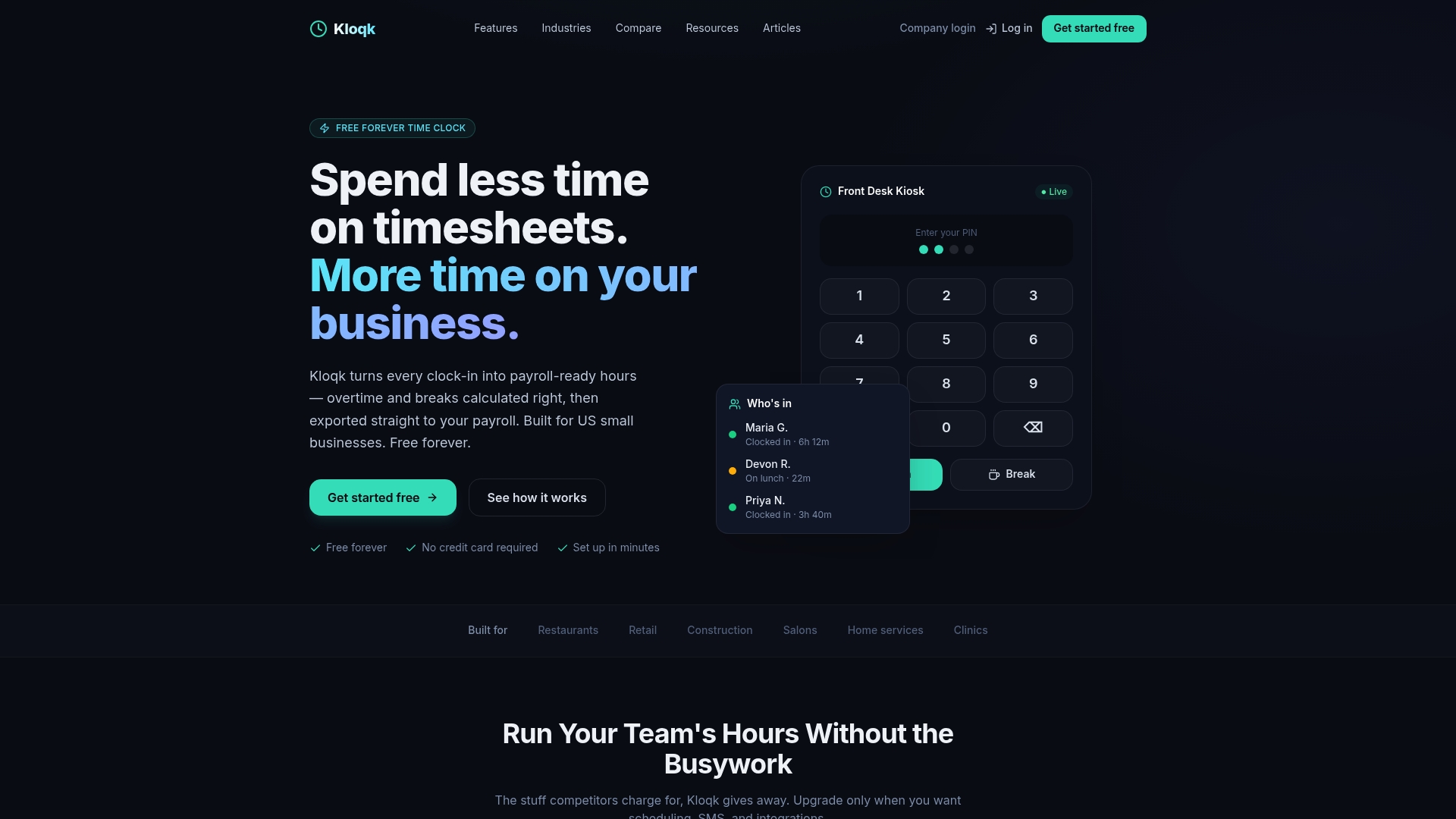
Business owners who want a record they can stand behind can set up the free plan first and add scheduling later, once their punch data is clean.
Our perspective
Most owners we talk to treat scheduling and labor law as two separate worries: one is a calendar problem, the other is a legal problem. They are the same problem. Every schedule you publish becomes overtime, break time and, in some cities, predictability pay the moment people start working it.
That is why we built the free core of Kloqk around the record of actual hours, not the plan. Overtime and break calculations, photo verification, GPS geofencing and payroll exports are there so a small business can have accurate, payroll-ready hours without paying for the basics. Upgrades for scheduling, PTO and hiring are optional, and you can add them when your team is ready.
Our advice: get the time record right first. A clean record protects you when a schedule change is questioned, and it protects your employees from being shorted. Everything else is easier from there.
Saad
FAQ
Is there a federal law on how much notice an employer must give for a schedule?
No. The FLSA has no provisions on employee scheduling other than certain child labor rules. Notice duties come from state or city laws, union contracts or written agreements with employees.
Is there a legal minimum time between shifts?
Not under federal law. Some fair-workweek laws set one: Chicago pays 1.25x the base rate for a shift starting less than 10 hours after the previous one, and Oregon gives employees a right to decline shifts within 10 hours. Check your local rules.
Can my employer cut my hours or change my shifts without telling me?
In most places federal law allows it, unless a contract or local law says otherwise. It becomes illegal when used for discrimination, retaliation or to deny a required accommodation. Employees in covered cities may be owed extra pay for late changes.
Do small businesses have to follow fair-workweek laws?
It depends on location, industry and size. Maine’s law applies at 10 or more employees, and Oregon’s statewide law applies to employers with 500 or more employees worldwide in retail, hospitality and food service. Confirm with your city or state labor agency.
What records should I keep to show I followed the law?
Keep daily and weekly hours worked, rates, overtime and total wages as the DOL requires, plus a log of schedule changes and employee consent. Some local laws require three years of retention.
Sources
- DOL: Questions and Answers About the FLSA
- DOL: Handy Reference Guide to the FLSA
- DOL Fact Sheet #23: Overtime Pay Requirements
- DOL Fact Sheet #22: Hours Worked
- DOL: Recordkeeping and Reporting
- Littler: State and Local Fair Workweek Laws
- Chicago Fair Workweek FAQ
- Wages LA: Fair Work Week Information
- Predictive Scheduling Laws summary
- Seyfarth: Employment Laws on the Horizon, 2026 edition
- DOL Fact Sheet #56B: Scheduling Law Penalties
- Schedules That Work Act summary
- DOL: Minimum Paid Rest Period Requirements by State
- EEOC CM-613: Terms, Conditions, and Privileges of Employment
- HR Dive: Schedule changes, transfers may be retaliation under USERRA
- Texas Workforce Commission: Work Schedules
- Construction Payroll Services: What to Look For and What to Track
Recommended
Sources
Every figure on this page traces to one of these. Primary law and government sources are listed first.
Written by
Kloqk teamKloqk
Written by the people who build Kloqk's time clock, timesheets and payroll exports. Prices and laws link to the source we checked, with the date we checked it.
Keep Reading
Track Hours the Easy Way
Kloqk is a free time clock that handles punches, breaks, overtime, and payroll-ready reports.
Start free