Free Time Tracking Tools for Small Businesses in 2026

Free time tracking software is defined as any digital system that records employee work hours automatically, without charging per seat or requiring a paid subscription for core features. Manual time tracking errors cost small businesses 1%8% of total payroll, and switching to automation delivers positive ROI within six months. For small business owners managing hourly staff, that gap between what you pay and what you actually owe is where profit disappears. The best free time tracking tools for small businesses close that gap by converting raw clock-in data into payroll-ready hours, with no spreadsheet required.
1. What are the essential features of free time tracking tools for small businesses?
The right features determine whether a free tool actually saves you time or just adds a new layer of admin work. Not every free plan is built equally, and the difference shows up fast once payroll week arrives.
Payroll integration is the single most important feature. Syncing directly with payroll systems eliminates manual re-entry errors, which are the leading cause of paycheck disputes. If your time tracking app does not connect to your payroll workflow, you are still doing the hard part by hand.

Unlimited users and projects matter more than most owners expect. Many free tiers cap users at five or ten, which forces an upgrade the moment your team grows. Look for plans that support your full headcount without per-seat fees.
Unrestricted data export is a feature many owners overlook until it is too late. Some free tools lock CSV and Excel exports behind paid tiers, trapping your hours inside the software and forcing a costly upgrade. Confirm export options before you commit.
Other features worth checking:
- Automated overtime calculations that apply federal and state rules without manual input
- Break tracking that logs paid and unpaid breaks separately for compliance
- Audit logs that show who clocked in, when, and from where
- Mobile app access so employees can clock in from any device
Pro Tip: Before signing up for any free plan, download a sample export file from the vendor’s demo or support docs. If the export is locked or the sample is not available, treat that as a red flag.
2. How to set up free time tracking software for payroll accuracy
Most free time tracking setups take under 10 minutes and require no credit card. That speed is a feature, not a coincidence. Vendors who offer genuinely free plans have no reason to bury setup behind a sales call.
Follow these four steps to get your system running correctly from day one:
- Configure company settings. Set your pay period (weekly, biweekly, or semimonthly), your overtime threshold, and your time zone. These settings drive every calculation downstream, so getting them right first prevents errors later.
- Build your project and client structure. If you bill clients by the hour or track time by job site, create those categories before inviting anyone. Retroactively reorganizing time entries is tedious and error-prone.
- Invite your team. Send invitations by email or share a QR code for kiosk setups. Assign roles carefully: managers should see team reports, while employees should see only their own hours.
- Connect your payroll integration. Link the tool to your payroll provider or set up a recurring CSV export schedule. Test the connection with one pay period before relying on it fully.
Pro Tip: Hold a five-minute team meeting before launch. Explain that the tool tracks hours for payroll accuracy, not to monitor productivity. Employee compliance fails most often when workers assume surveillance is the goal. Framing the purpose correctly from the start prevents resistance.
3. Which categories of free time tracking tools fit different small businesses?
Free time tracking apps fall into three distinct categories, and the right one depends entirely on your workforce type. Choosing the wrong category means paying for features you do not need or missing the ones you do.
| Category | Best for | Key strength | Watch out for |
|---|---|---|---|
| Project-based trackers | Desk and remote teams | Billable hour reporting | May lack punch clock features |
| Digital punch clocks | Hourly staff at fixed locations | Simple clock-in/out records | Limited project-level detail |
| GPS and photo-enabled clocks | Field workers, construction, delivery | Location verification, anti-fraud | Requires smartphone or tablet |
Project-based trackers work best for agencies, consultants, and remote teams who need to log hours against specific clients or deliverables. They typically include timer widgets, browser extensions, and detailed reporting by project.
Digital punch clocks serve restaurants, retail stores, and any business where employees share a single device at a fixed location. A tablet mounted at the entrance acts as a shared kiosk, and each employee clocks in with a PIN or badge scan.
GPS and photo-enabled clocks solve the hardest problem in field-based businesses: proving that an employee was actually at the job site when they clocked in. Kloqk’s GPS geofencing feature restricts clock-ins to a defined radius around each job site, and photo verification confirms the identity of the person clocking in. Both features address buddy punching directly.
4. Why “free forever” plans matter more than free trials
The phrase “free plan” covers two very different things. A free trial gives you full access for 14 or 30 days, then charges you. A permanent free tier has no expiration and no credit card requirement. The distinction matters because switching time tracking tools mid-year disrupts payroll records and requires retraining your team.
Free tiers that require a credit card at signup are a customer acquisition strategy, not a genuine free offering. The card on file makes it easy for the vendor to start charging when the trial ends, often without a prominent warning. Businesses that fall into this pattern face unexpected subscription costs at the worst possible time.
A genuine free forever plan gives you a stable foundation. You can grow your team, add locations, and integrate with payroll without worrying about hitting a usage cap that triggers an upgrade. Kloqk’s free time clock app operates on this model: unlimited employees, no per-seat fees, and no expiration date on core features.
5. How automated tracking reduces payroll errors and time theft
Free automated tracking reduces human error by up to 95% compared to manual methods. That figure reflects the difference between a system that records a timestamp automatically and one that relies on an employee writing down their own hours.
Time theft takes several forms in small businesses. Buddy punching, where one employee clocks in for another, is the most common. Early clock-outs, extended breaks, and rounded-up hours are subtler but equally costly. Automation catches all of these by creating a digital record that cannot be altered after the fact.
The financial impact is concrete. Automation can save 3, 5 hours per pay period in reconciliation work and prevent over $22,000 in annual losses from time theft. For a business with 10 hourly employees, that math justifies the switch immediately.
Photo verification adds a second layer of protection. When an employee clocks in, the system captures a photo and timestamps it. Managers can review flagged entries without confronting employees directly, which reduces workplace tension while maintaining accountability.
6. What to look for in a free time tracking tools comparison
Evaluating free tools requires a consistent framework. Feature lists from vendor websites are written to impress, not to inform. Apply these criteria to every option you consider.
Payroll export quality is the first filter. Download a real export file and open it in your payroll system. If the columns do not map cleanly, you will spend time reformatting every pay period.
User limit transparency is the second. Read the pricing page carefully and look for the exact user cap on the free tier. Some vendors advertise “free for small teams” but define small as three users.
Overtime and break rules should be automatic, not manual. If you have to calculate overtime yourself after exporting, the tool is not saving you work.
Support access on free plans varies widely. Some vendors restrict free users to community forums only. If you run payroll for a team and the system goes down on a Friday, that matters.
Kloqk includes overtime calculations and break tracking on its free plan, along with clean CSV exports and multi-location support. For small businesses in restaurants or construction, those features cover the most common payroll compliance requirements without an upgrade.
7. How to track part-time and hourly employee hours accurately
Part-time employees create specific tracking challenges. Their hours vary week to week, their schedules often change with little notice, and they are more likely to work at multiple locations. Manual tracking fails here faster than anywhere else.
The fix is a system that logs hours at the moment of clock-in, not at the end of the shift. Real-time tracking means the record is created before memory or incentive can distort it. For businesses with part-time worker payroll complexity, this distinction is the difference between accurate pay and constant disputes.
Kiosk-based clock-ins work particularly well for hourly staff. A shared tablet at the entrance records each clock-in and clock-out with a timestamp. Employees do not need their own devices, and managers get a complete attendance record without chasing anyone down.
Pro Tip: Set up automatic alerts for missed clock-outs. When an employee forgets to clock out, the system flags the open entry instead of recording an incorrect total. Managers can correct it before payroll runs, not after.
Key Takeaways
Free time tracking software that integrates directly with payroll eliminates manual re-entry errors, prevents time theft, and saves small business owners 3, 5 hours per pay period in reconciliation work.
| Point | Details |
|---|---|
| Automation cuts payroll errors | Automated tracking reduces human error by up to 95% compared to manual timesheets. |
| Verify export before committing | Confirm CSV and PDF exports are free before signing up to avoid data lock-in. |
| Choose the right tool category | Match your tool type (project-based, punch clock, GPS) to your workforce and location setup. |
| Free forever beats free trial | Permanent free plans protect your budget; trials with credit cards on file often convert to paid without warning. |
| Train employees on purpose | Explain that tracking protects pay accuracy, not productivity monitoring, to prevent compliance resistance. |
What I’ve learned from watching small businesses adopt free time tracking
The biggest mistake I see is owners choosing a tool based on the feature list rather than the export. A tool can have GPS, photo punch, project tracking, and a beautiful dashboard. If the export file does not map to your payroll system, you are still doing manual work every two weeks.
The second mistake is skipping the employee conversation. Training on the “why” rather than just the “how” is what separates a smooth rollout from two weeks of pushback. I have watched teams resist perfectly good tools because no one explained that the goal was accurate paychecks, not surveillance.
The third mistake is trusting the word “free” without reading the fine print. Confirm that the free tier is permanent and does not require a credit card. “Free” tiers are often customer acquisition strategies. The moment you hit a user cap or need a feature that is paywalled, you are locked in because switching costs time and disrupts records.
The tools that actually stick in small businesses are boring in the best way. They clock people in, calculate hours correctly, and export a clean file. That is the whole job. Owners who chase advanced analytics on a free plan almost always end up frustrated. Get the basics right first, then add complexity only when the business demands it.
Saad
Kloqk’s free time tracking for small business payroll
Small business owners who need accurate payroll without administrative overhead have a direct path forward with Kloqk.
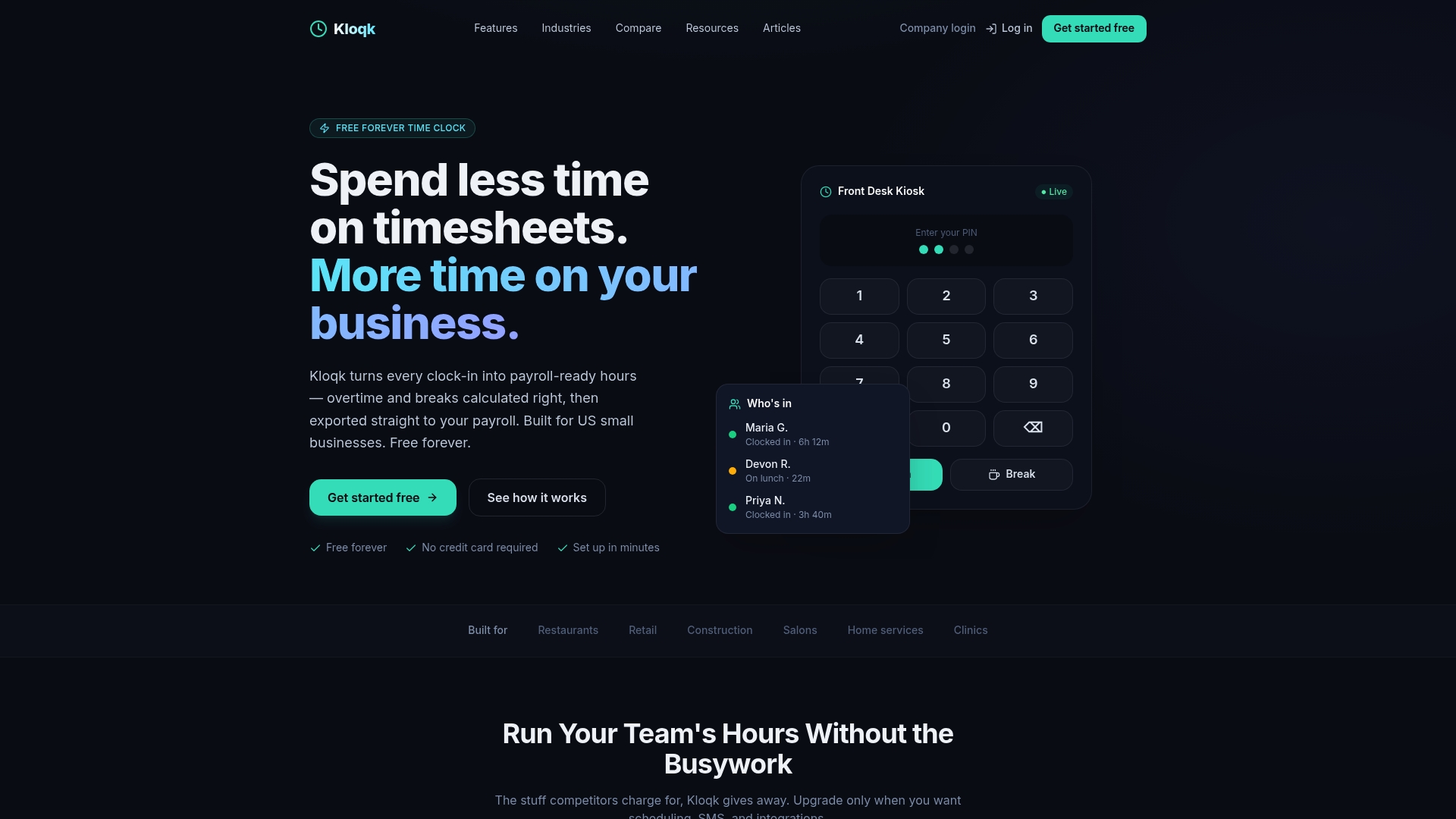
Kloqk’s free employee time tracking software supports unlimited employees with no per-seat fees and no expiration on core features. GPS geofencing restricts clock-ins to verified job sites, and photo verification stops buddy punching before it costs you money. Clean CSV exports map directly to payroll without reformatting. For businesses with multiple locations, Kloqk consolidates all employee time data in one place. Overtime calculations and break tracking are built in, covering federal and state compliance requirements at no extra cost. If you manage hourly staff in restaurants, construction, or retail, Kloqk is built for exactly that workflow.
FAQ
What is free time tracking software?
Free time tracking software is a digital tool that records employee work hours automatically without a subscription fee for core features. The best free plans include payroll export, overtime calculations, and unlimited users at no cost.
How do free time tracking tools prevent time theft?
GPS geofencing restricts clock-ins to approved locations, and photo verification confirms employee identity at clock-in. Together, these features eliminate buddy punching and unauthorized early clock-outs.
Are free time tracking plans really free forever?
Not always. Some free plans are time-limited trials or require a credit card that converts to a paid subscription. Look for plans explicitly labeled “free forever” with no credit card requirement at signup.
How long does it take to set up free time tracking software?
Most setups take under 10 minutes and cover company settings, project structures, team invitations, and payroll integration. No technical background is required for standard configurations.
Can free time tracking tools handle multiple locations?
Yes. Tools like Kloqk support multi-location time tracking on the free plan, consolidating employee hours across all sites into a single payroll-ready report.
Recommended
Sources
Every figure on this page traces to one of these. Primary law and government sources are listed first.
Written by
Priya NairPeople Operations Writer
Priya focuses on HR and hiring for small teams, onboarding, scheduling people fairly, and the day-to-day of managing hourly staff without an HR department.
Keep Reading
Track Hours the Easy Way
Kloqk is a free time clock that handles punches, breaks, overtime, and payroll-ready reports.
Start free